

U.S. Nonprofit Data APIs: A Developer’s Overview
A guide for developers on nonprofit APIs to verify EINs, track donations, and integrate reliable, real-time nonprofit data into apps.
 ·
·
Join the DZone community and get the full member experience.
Join For FreeTrust will be the most important factor in the future, whether online donation is successful. No one is satisfied to do no more than click "Donate" and hope for the best. They want guarantees, data validation, and proof that their money has not actually been dumped. In the background, this schema is mostly realized as APIs.
You can produce a fundraising platform, a donor portal, or a gift assessment dashboard. If you're making anything, the backend we are provided by technology becomes a soon-to-be irreplaceable asset for confidence and efficiency management.
Let’s consider the next generation of apps built for social impact technology, which will require understanding one of its basic APIs.
Why Nonprofit Data APIs Are Now More Important than Ever
In the old days, confirmation organizations meant sifting through stale PDFs, struggling with unwieldy Excel spreadsheets, and calling the IRS by hand. And nowadays, APIs enable faster, more scalable processes. If you need to confirm sanctions or tax-exempt status or check grant histories, the organized, verified data can be pulled and integrated into your software with a few lines of code, via an API.
There are several applications, including (but not limited to):
- Foundation and government agencies are automating part of their due diligence.
- Checking NGOS against the application and culling them from your database to prevent bad actors.
- Donor analytics and providing stakeholders with data visualizations of nonprofit compliance monitoring and reporting.
The focus is primarily on optimizing the highest quality of experience for all users and engagement through value-driven processes while minimizing the time spent on redundant tasks.
Common API Types Used in Nonprofit Data
It is logical to group APIs by function. Below are a few of the types you are likely to encounter:
| Type | Function |
|---|---|
|
What Verification APIs Do |
Validate IRS nonprofit status, tax-exempt status, and revocation status. |
|
Give APIs |
Study the flow of money: who gives, what the money is, and the direction in which it is flowing. |
|
Fraud and Sanction APIs |
Verify charity organizations against OFAC or other federal exclusion lists. |
|
Impact Metric APIs |
Review and report program SAVERS ratings, cost/net ratios, overhead ratios, and costs. |
|
Donation APIs |
Track and alert payer’s transaction/payment receipt/donation in-app behavior collection. |
Top US Nonprofit APIs in 2025
Below, I break down five key players in the nonprofit API space and what competitive moat each has built.
1. Pactman’s Nonprofit Check+ API
What they do: Nonprofit, EIN verification, compliance, and sanctions check.
Website: pactman.org
For anyone building a platform that needs real-time EIN validation and IRS compliance for nonprofits, Pactman’s Nonprofit Check+ API is one of the simplest for developers to set up. It checks:
- IRS Pub 78 Qualified.
- BSF Status Business Master File is one of the factors to be considered.
- Revocations
- OFAC SDN list
Why developers love it:
- Sub 500ms JSON response time
- Clear, spoken documentation of the endpoints
- Webhook and batch processing are available as an add-on.
Real-world example: The following API request using an EIN returns a JSON response that confirms EIN 996589560 is a nonprofit and in good standing, and does not appear in any federal lists.
2. Charity Navigator API
Focus: Financial sustainability and accountability measures
Website: charitynavigator.org
Data on nonprofits, including their program expense ratios and their governance transparency, can be retrieved through this API. Great for any donor-facing platform, where a charity wants to highlight all aspects of their impact and efficiency.
3. Candid (Guidestar) API
Special interest: Past IRS files, grantmaker information
Website: candid.org
Candid provides a wealth of information from IRS Form 990: grant history and executive compensation. They also offer a Grants API, which is used for analyzing the sponsorships and grants that a nonprofit has received.
Tip: Because of both the cost and depth of data offered, collections professionals and grant apps are the primary place I've found value in this API.
4. CharityAPI.org
Focus: IRS nonprofits data chunks in the form of APIs
Website: charityapi.org
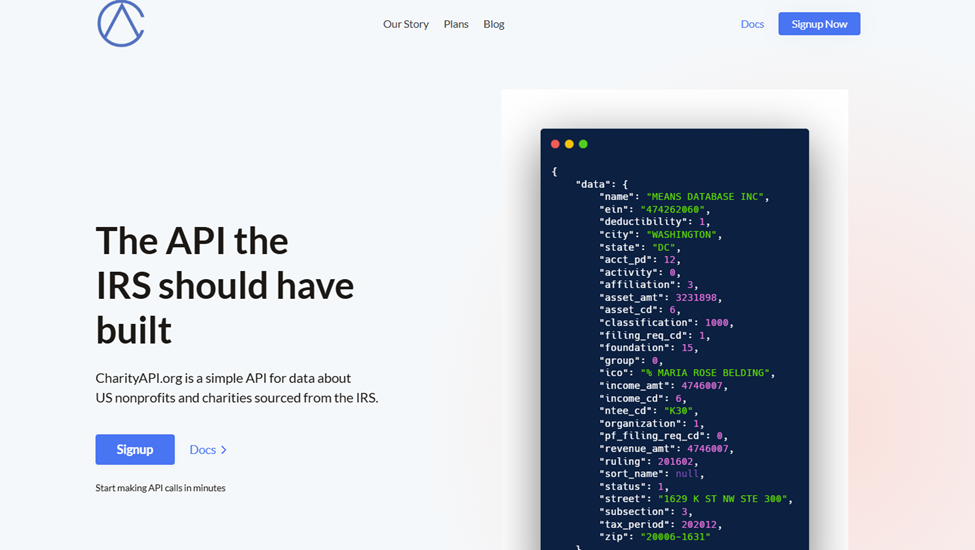
This is an open-source project to simplify IRS data for nonprofits. Anyone who needs an EIN verification system for nonprofits will benefit from this — and it’s free and easy to use for small teams too.
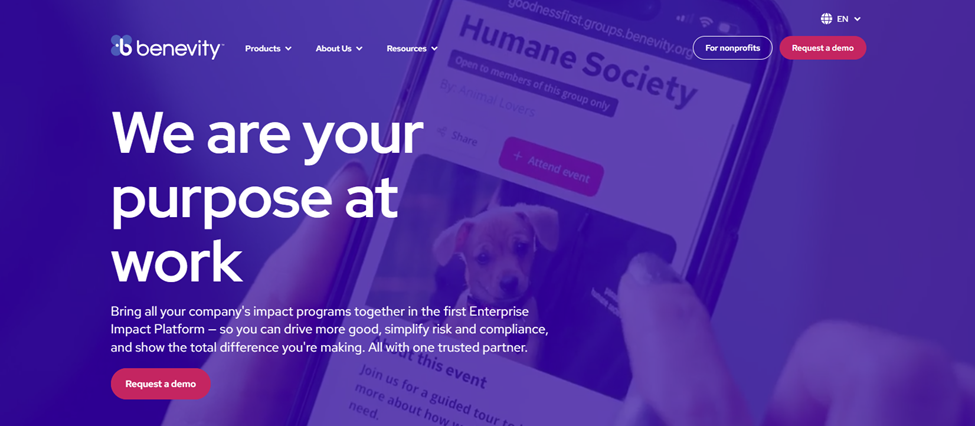
5. Benevity Causes API
Focus: Charity partners and nonprofit engagement
Website: benevity.com
Integrating with nonprofits from around the world, this API is a solution for any business looking to add Corporate Social Responsibility (CSR) to their operations. It is starting to be adopted in HR systems and is leveraged by employee giving platforms.
The Developer's Dilemma: Choosing the Best API
Your nonprofit API selection depends on your situation. The following is a simple flow of decisions:
| Objective | Most suitable API |
|---|---|
|
EINs + IRS Data Verifications |
Pactman Nonprofit Check + API |
|
Characterize ratings |
Charity Navigator |
|
Examine 990s or funding data: |
Candid (Guidestar) |
|
Integrate into CSR programs |
Benevity |
|
Streamlined EIN validation |
CharityAPI |
Additional Considerations
- Needs for batch validation: Is it applicable to you?
- How important is speed and uptime in terms of your workflow?
Conclusion: Smarter Giving and AP Freed Nonprofit Operations
As the fintech, healthtech, and e-commerce spaces continue to open up to APIs, the nonprofit sector is quick to follow suit. Things that used to require manual review can now be scripted, and everyone is happy about that.
API-based nonprofits are the soil for scalable, robust, and dependable systems, underpinning everything from big foundations that automate their due diligence to side projects taking the shape of single dev teams. If your tools are life-changing, the data behind every donation is monumental. Choose the right API, and embed trust into your code.
Do you wish to go deeper? APIs provided by nonprofits are accessible to developers via sandboxes or open datasets for testing and integration.
Opinions expressed by DZone contributors are their own.
Comments