

The Self-Healing Endpoint: Why Automation Alone No Longer Cuts It
Partial, script-based automation is hitting a ceiling — so organizations are moving toward autonomous endpoint management systems.
 CORE
·
CORE
·
Join the DZone community and get the full member experience.
Join For FreeMost organizations have poured heavy capital into endpoint automation. That investment has yielded partial results at best. IT teams frequently find themselves trapped maintaining the very scripts designed to save them time.
Recent data from the Automox 2026 State of Endpoint Management report reveals that only 6% of organizations consider themselves fully automated. Meanwhile, 57% operate as partially automated using custom workflows.
This setup still depends too heavily on people stepping in and undermines the whole point of automation in the first place. That’s why the industry is moving toward autonomous endpoint management systems that can enforce policies, catch configuration drift, and fix issues on their own without someone having to manually kick things off.
The Partial Automation Trap
Current automation efforts fall short of enterprise requirements. Traditional endpoint tools fail to match the pace of hybrid work and escalating compliance demands. When environments change, hardcoded scripts break. When key staff resign, organizations lose the undocumented knowledge required to maintain those workflows. Rigid systems cannot adapt to novel conditions.
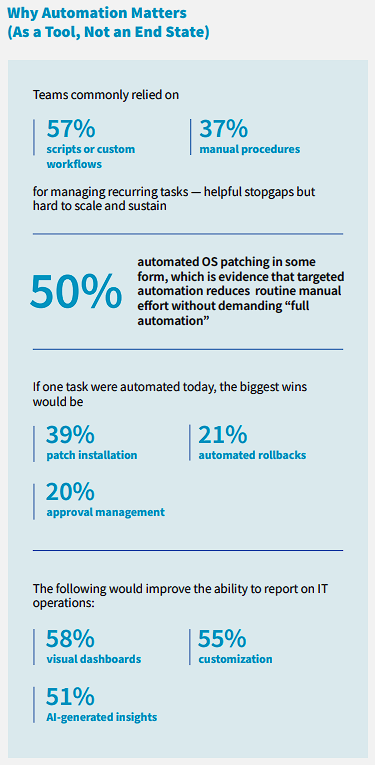
Data highlights this maturity plateau. While 50% of IT teams automate OS patching in some capacity, this targeted approach ignores visibility gaps across diverse platforms. The Automox report shows 57% of teams rely heavily on custom scripts for recurring tasks. These act as helpful stopgaps but struggle to scale. Another 37% execute manual procedures based on written documentation. Only 23% have fully automated their recurring software deployments, leaving the vast majority exposed.
Partial automation is merely a temporary plateau. It reduces manual entry but proves insufficient for closing exposure windows across distributed IT infrastructures.
The Trust Barrier to Scaling Automation
Even when organizations recognize the necessity of scaling their capabilities, deep-seated hesitation stalls progress. The barrier is not a failure to understand the value. The issue is risk amplification.
"It's one thing to be wrong. It's a whole other thing to be wrong at scale," notes Jason Kikta, Chief Technology Officer at Automox. "If I'm wrong on an individual computer, that's a problem. If I'm wrong on the entire network, I might get fired. If I'm wrong for a day on a backup, that's not good. If I'm wrong for three months, that might end the company. And so that's where people's fears take them."
This fear is entirely rational. Automation applied across thousands of assets amplifies both operational benefits and potential errors. The Automox report quantifies these concerns regarding autonomous adoption. Data privacy and security implications worry 46% of IT leaders. The risk of incorrect or unauthorized system changes holds back another 44%. Decision-makers also cite limited trust in AI-driven recommendations (36%). One of the biggest operational challenges, according to them, is not being able to clearly see what automated systems are doing in real time (36%). Another issue is seen in having to rely on algorithmic decisions that often feel like a black box (34%).
Organizations need to provide solutions to these issues. They must show their IT teams that automated changes will remain controlled, transparent, and not be allowed to run unchecked.
Guardrails Enable Scale
Organizations overcome adoption hesitation by implementing strict operational boundaries. Guardrails act as the primary enabler for scale — not an obstacle to speed.
Industry best practices from Datto emphasize testing patches before deployment. Datto also recommends using phased rollouts and maintaining rollback capabilities. With these mechanisms, organizations can expand automation confidently because they know they can intervene, verify, and recover immediately.
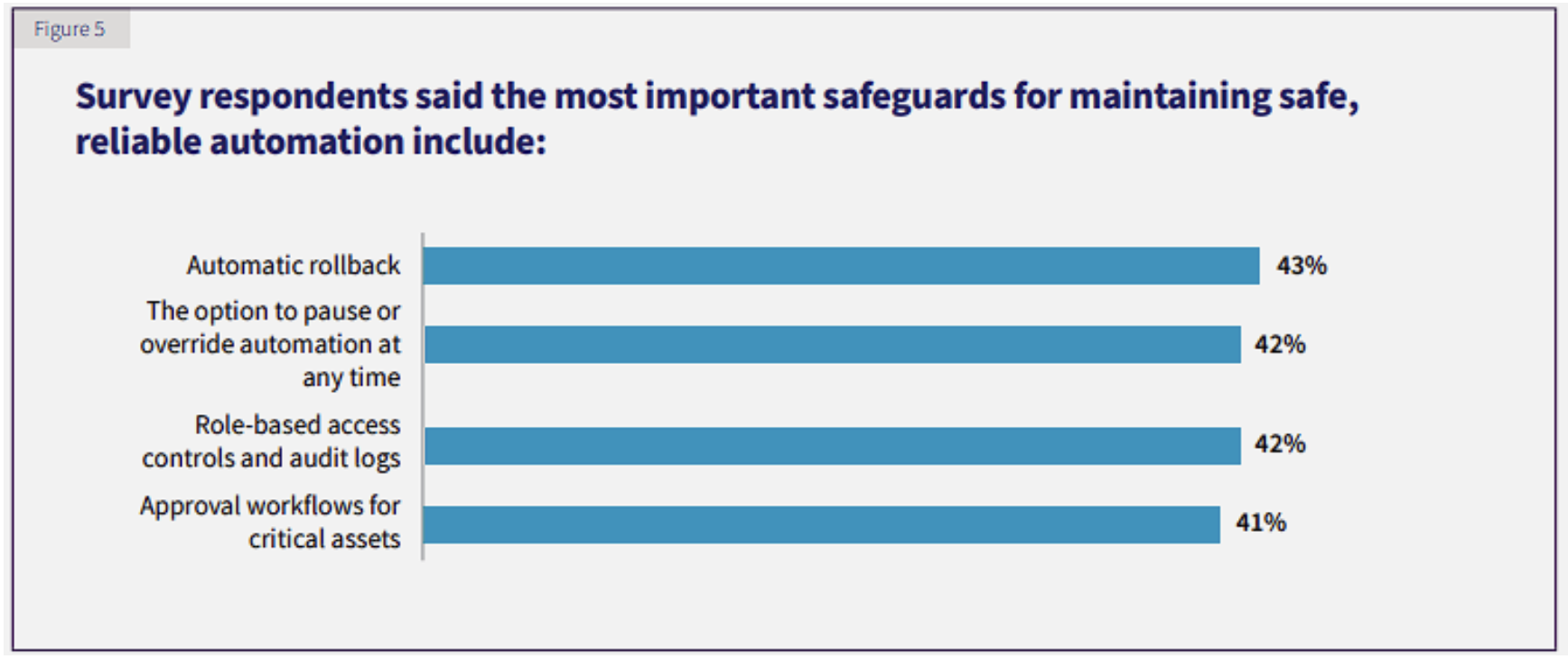
IT leaders demand these safeguards before ceding control. Automox’s data shows that requested protections include automatic rollback (43%), the ability to pause or override anytime (42%), role-based access controls and audit logs (42%), and approval workflows for critical assets (41%). Control over when agent updates apply is highly important to 74% of respondents. But another 46% expressed strong concern regarding unauthorized device actions.
The operating philosophy shifts to a pragmatic baseline: trust but verify. Even when automation works perfectly, you check in on it.
What Autonomous Endpoint Management Actually Delivers
Autonomous endpoint management (AEM) represents the convergence of visibility, policy enforcement, and adaptive response. Rather than replacing human judgment, it removes technicians from repetitive decision loops where raw speed dictates security outcomes.
AEM platforms deliver continuous monitoring, AI-assisted insight, and integrated operations workflows that translate telemetry into timely decisions. These systems monitor environments around the clock. A simple way to think about it is as a self-healing endpoint defense layer for your organization. The platform identifies vulnerabilities and pushes out the required fixes automatically so IT teams don’t have to manually trigger every response.
Policy-driven automation doesn't sideline human oversight; it actually gives IT personnel the speed to make decisive moves. Automox asked teams which single task they would automate today. Patch installation led the pack at 39%, followed by automating rollbacks (21%) and managing approvals (20%). AEM delivers these exact capabilities seamlessly.
The Automation Ceiling Is Real, Autonomy Breaks Through It
Partial automation serves as a temporary stopping point rather than a permanent end state. Organizations stuck at the script-and-schedule level face the same exposure risks as those with zero automation in place. They simply manage a higher degree of infrastructure complexity.
AEM represents the definitive next stage of maturity for IT operations. These policy-driven systems continuously maintain the desired security state across distributed assets without requiring constant human oversight, transforming reactive defense into sustainable operational resilience.
Opinions expressed by DZone contributors are their own.
Comments