

The New Senior Developer Job Description: Half Engineer, Half AI Systems Architect
Senior developers now own two roles: traditional engineering plus AI systems architecture. This split reshapes compensation, hiring, and what 'senior' actually means.
 CORE
·
CORE
·
Join the DZone community and get the full member experience.
Join For FreeShe had everything on the list. Eight years of experience. Strong systems design. Distributed architecture under her belt. The panel interview went well — one of the hiring managers later described it as the best technical conversation they'd had with a candidate all quarter. The team passed on her.
Two weeks later, during a casual conversation with that hiring manager, the reason came out. It wasn't her architectural skills or her communication. It was a question someone had slipped in near the end: "Walk us through how you'd set up an AI-assisted code review pipeline for a team that ships twelve microservices." She described doing it manually. The other finalist described standing up an orchestration layer with context-aware models, configuring fallback thresholds, and building observable feedback loops that trained the team's prompt library over time.
Same job title. Completely different mental model of what the job now involves.
That story isn't unique. It captures something that's been happening gradually over the past eighteen months and then very suddenly in the last six: the senior developer role has quietly split into two jobs. One of them is the job we all trained for. The other is the job that a meaningful portion of your working week now actually requires. And the gap between developers who've accepted that and developers who haven't is becoming very hard to explain away in performance conversations.
The Split That Happened Without a Memo
Let's be specific about what the "AI Systems Architect" half of the role actually means, because people either over-mystify it or undersell it. It doesn't mean you become a data scientist. It doesn't mean you're fine-tuning models or writing PyTorch. Those are real jobs — they're just different jobs. What it means is something more operational and less glamorous: you are now responsible for designing, maintaining, and improving the systems of AI assistance that your team works inside of, not just the code that the team produces.
That sounds abstract until you break it into daily decisions. Which tasks should be fully AI-generated versus AI-assisted versus AI-reviewed only? Where are your model's blind spots for your specific codebase, and how do you account for them in code review? When a junior developer on your team gets a plausible-but-wrong architectural suggestion from an AI assistant, what's the escalation path? How do you measure the quality of your team's prompting over time? These aren't rhetorical questions — they're operational ones that live teams are answering right now, often badly, because no one assigned anyone to own them.
Senior developers are getting assigned to own them. Not officially. Not with updated job descriptions. Just through the ordinary mechanism of "this problem needs solving, and you're the most experienced technical person in the room."
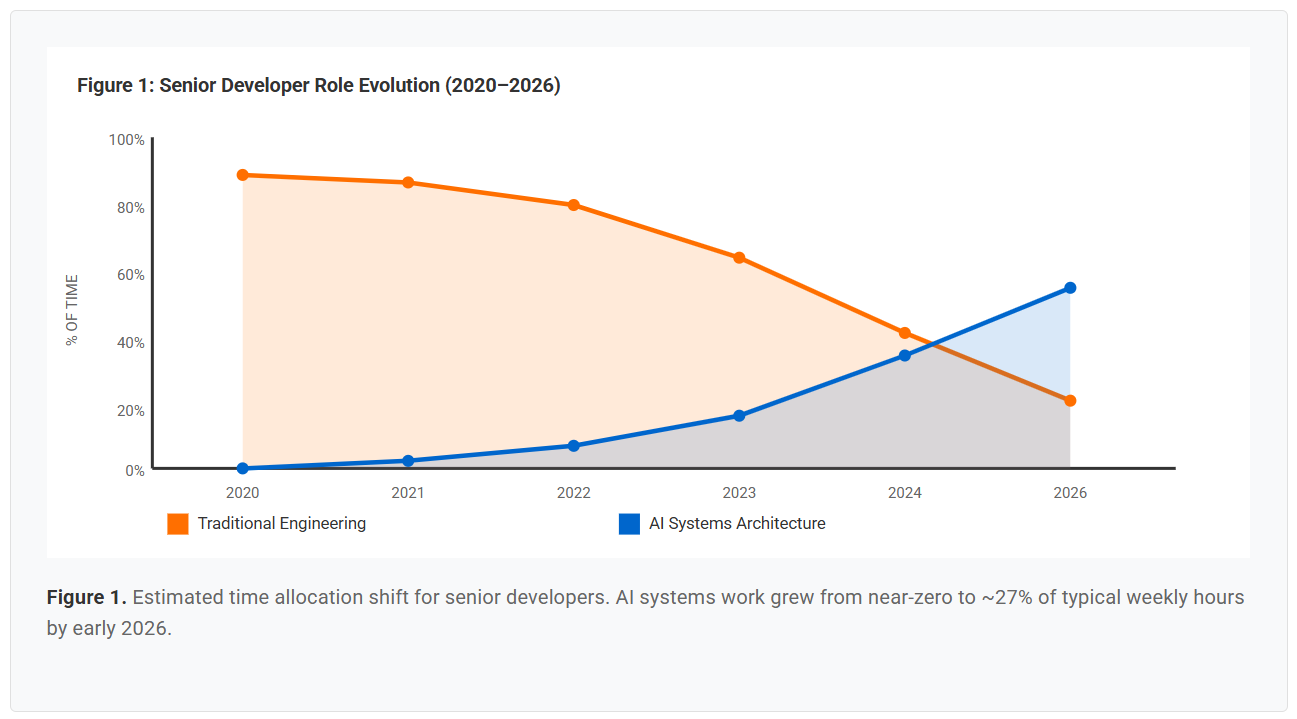
What "AI Systems Architect" Actually Means Day to Day
The phrase sounds bigger than the practice. What it actually breaks down to is four interconnected responsibilities that are now landing on senior developers, whether they want them or not.
First: workflow design. Someone has to decide which parts of the development cycle use AI assistance, at what level of autonomy, and with what human checkpoints. At most companies, this currently happens by accident — everyone develops their own habits, and nobody compares notes. The developers who are stepping into the architect half of the role are the ones making that deliberate, rather than emergent.
Second: model selection and configuration. Not fine-tuning, but product-level decisions: which models for which tasks, what context window strategy, how to handle codebases that exceed context limits, what fallback behavior looks like. These are practical engineering decisions that live in the space between "developer tool choice" and "infrastructure decision." They belong to senior engineers.
Third: quality governance. AI-generated code introduces a new failure mode: plausible-looking outputs that are subtly wrong. The patterns of wrongness are specific and learnable. Senior developers who have mapped the failure modes of their AI tooling — the kinds of edge cases it consistently misses, the naming convention assumptions it gets backward, the security patterns it handles confidently and incorrectly — are providing a form of institutional knowledge that is genuinely hard to replace.
Fourth: team prompting culture. This is the one nobody talks about at conferences yet, but engineering managers across the industry have been mentioning it consistently over the past six months: the quality variance in how different team members prompt their AI tools is enormous, and it compounds. Senior developers who build and maintain shared prompt libraries, who do prompt review the way they do code review, who can diagnose why a colleague got a bad output — those developers are operating as a force multiplier for the entire team, not just themselves.
The Job Description Before and After: A Concrete Comparison
This is worth making explicit. Analysis of actual senior engineer job postings — anonymized, from companies between 80 and 1,200 employees — shows a clear shift when comparing what the role requirements looked like in early 2023 versus what's being written now. The change is real and measurable.
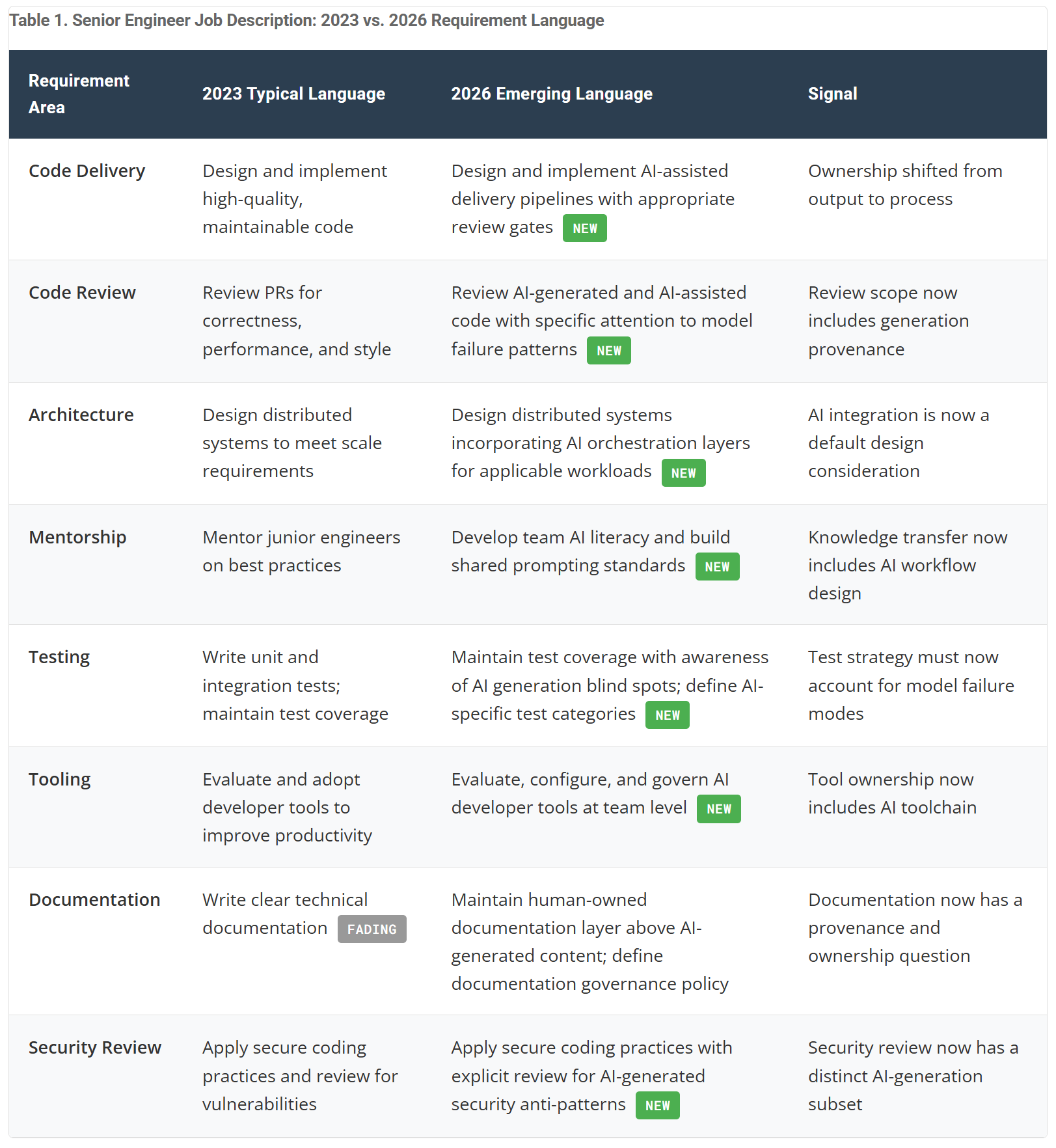
The pattern across all of it: the what of the role hasn't changed so much as the how and the governance around it. Senior developers are still responsible for the same categories of work. They're now also responsible for the design of the AI-assisted systems that help a team do that work, and for the failure modes those systems introduce.
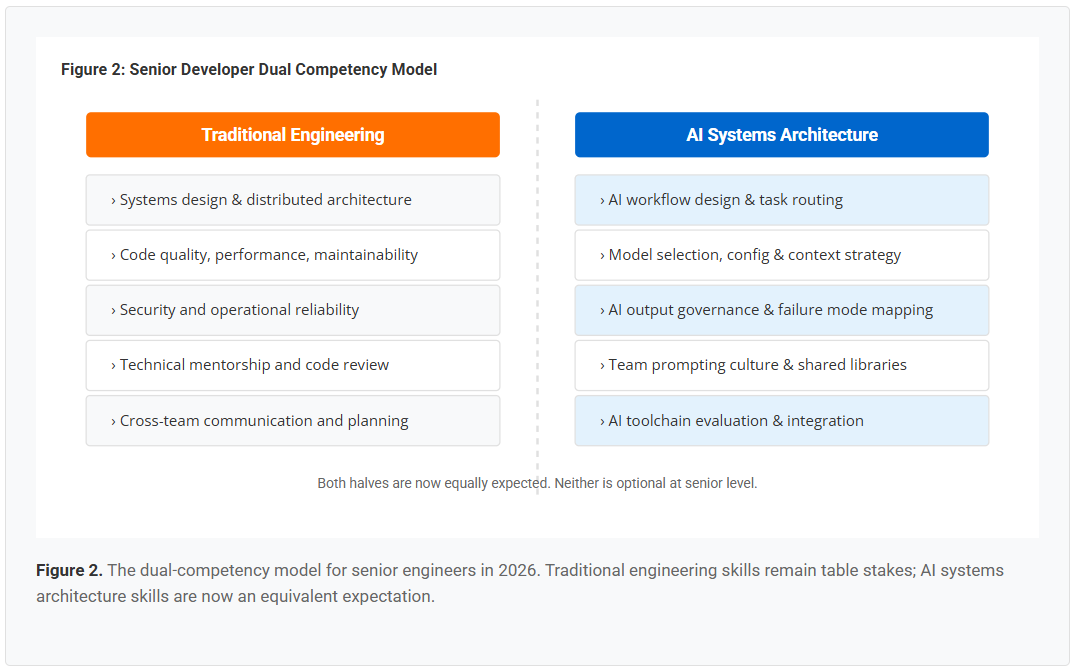
The New Core Competency Stack
Here's what the competency model looks like in practice when you lay it out. The traditional side should feel familiar. The AI architecture side probably contains a few items you haven't formally owned yet — but if you've been doing this job for more than two years and paying attention, you've been building these skills without realizing it.
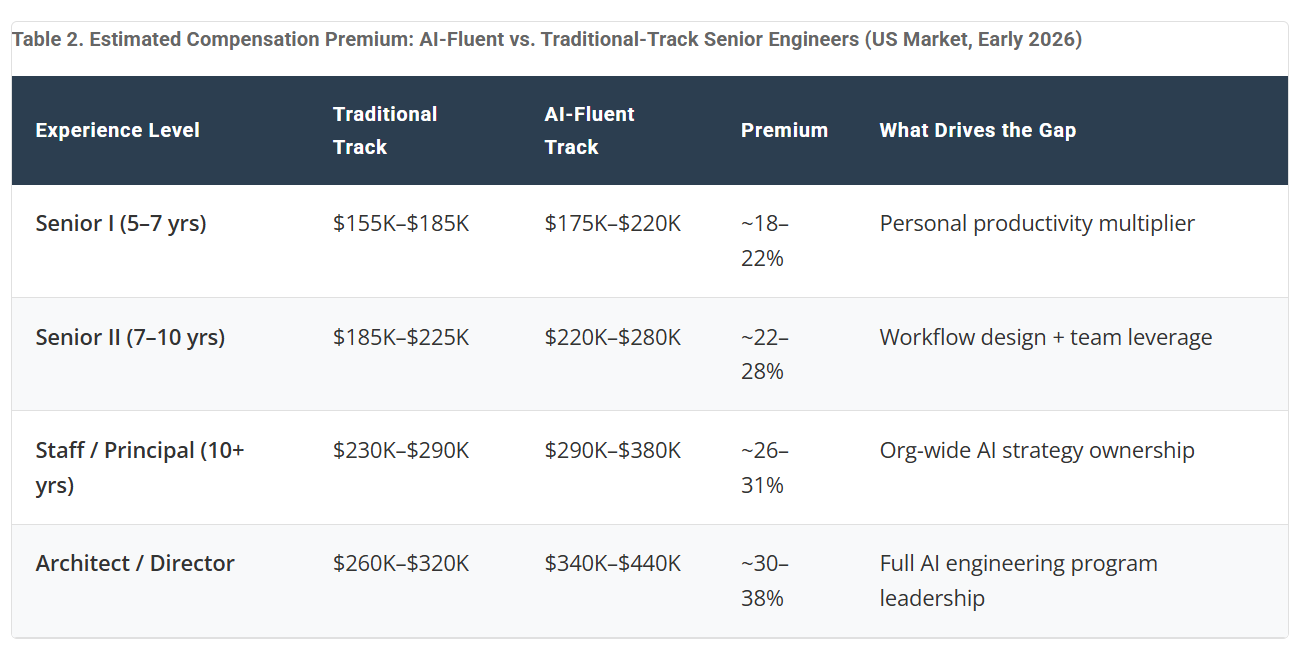
The Salary Premium Is Already Real
Compensation data lags reality by about eighteen months, so take specific numbers here with appropriate skepticism. What industry reporting suggests is that a clear pattern is emerging: developers who can demonstrably operate in both halves of the new role — not just use AI tools personally, but architect AI-assisted workflows for a team — are commanding a premium that's running somewhere between 18% and 31% above their single-track counterparts at the same years-of-experience mark.
That range is wide. The premium is highest in companies that have recently invested in AI transformation initiatives and learned, the hard way, that "everyone uses Copilot" is not the same as "we have a coherent AI engineering strategy." Those companies are specifically recruiting for systems architect skills because they've already paid for the gap.
How to Build the Second Half of the Job
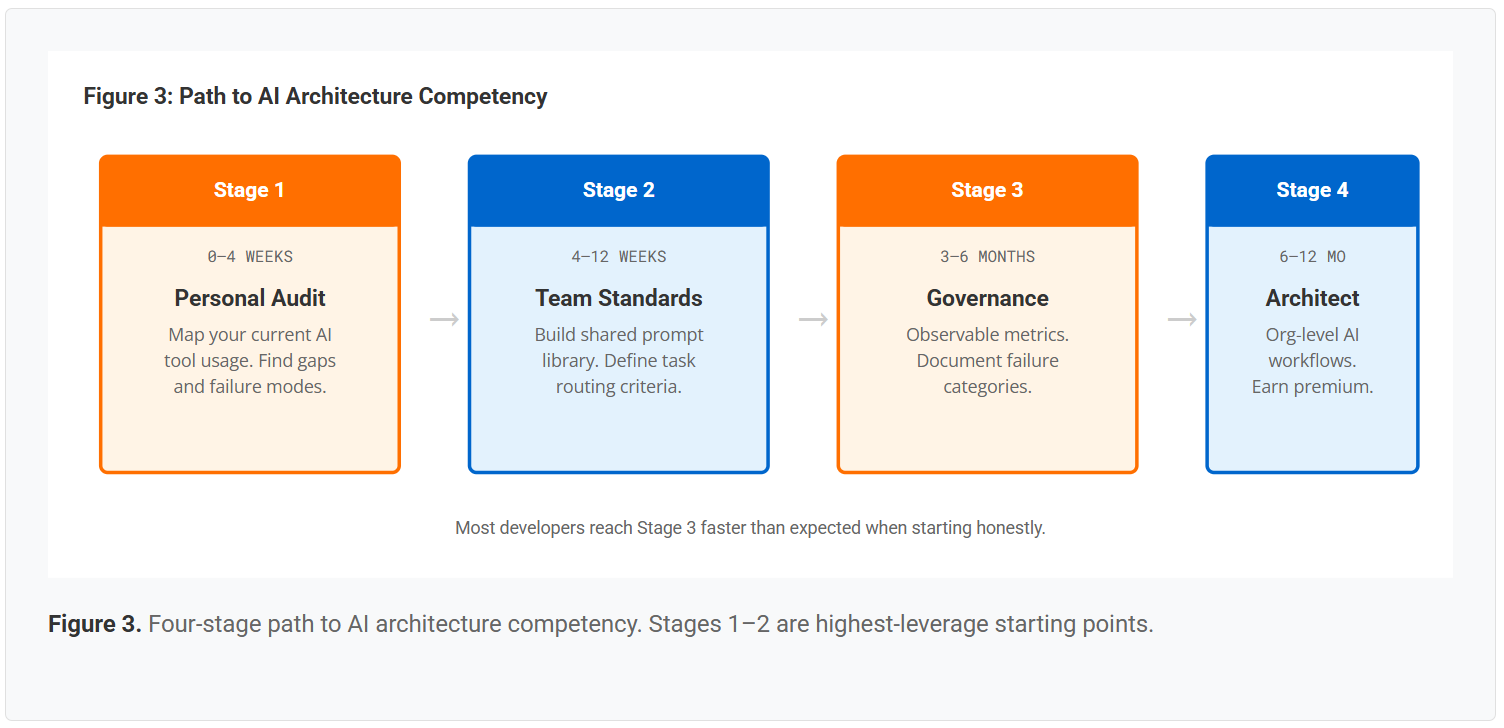
Nobody teaches this in a course yet. There are some good books and a growing number of blog posts, but the skills are mostly developed through deliberate practice and iteration. Based on teams that have successfully made this transition, here's what works.
The starting point is mapping your team's current AI-assisted work honestly. Not aspirationally — honestly. Which tasks are you and your team currently doing with AI assistance? Where does the output go without sufficient review? What are the categories of error you've caught, and what categories might you be missing? This audit, done once and updated quarterly, is the foundation of a governance practice.
From there, the most leveraged thing most senior developers can do is build a shared prompt library for their most common task types. Not a personal one — a shared one, with a versioning and review practice attached. The discipline of reviewing a colleague's prompt and explaining why it produced a wrong output is one of the fastest ways to build the mental model you need for the governance half of the role.
Opinions expressed by DZone contributors are their own.
Comments