

Server-Side Rendering in Rust: A Dall.E Use-Case
In this tutorial, learn how you can create a Web app with server-side rendering and discover another side of Rust: HTML templating with Axum.
Join the DZone community and get the full member experience.
Join For FreeLast week, I decided to see the capabilities of OpenAI's image generation. However, I noticed that one has to pay to use the web interface, while the API was free, even though rate-limited. Dall.E offers Node.js and Python samples, but I wanted to keep learning Rust. So far, I've created a REST API. In this post, I want to describe how you can create a Web app with server-side rendering.
The Context
Tokio is a runtime for asynchronous programming for Rust; Axum is a web framework that leverages the former. I already used Axum for the previous REST API, so I decided to continue.
A server-side rendering Web app is similar to a REST API. The only difference is that the former returns HTML pages, and the latter JSON payloads. From an architectural point of view, there's no difference; from a development one, however, it plays a huge role.
There's no visual requirement in JSON, so ordering is not an issue. You get a struct; you serialize it, and you are done. You can even do it manually; it's no big deal - though a bit boring. On the other hand, HTML requires a precise ordering of the tags: if you create it manually, maintenance is going to be a nightmare. We invented templating to generate order-sensitive code with code.
While templating is probably age-old, PHP was the language to popularize it. One writes regular HTML and, when necessary, adds the snippets that need to be dynamically interpreted. In the JVM world, I used JSPs and Apache Velocity, the latter, to generate RTF documents.
Templating in Axum
As I mentioned above, I want to continue using Axum. Axum doesn't offer any templating solution out-of-the-box, but it allows integrating any solution through its API.
Here is a small sample of templating libraries that I found for Rust:
- handlebars-rust, based on Handlebars
- liquid, based on Liquid
- Tera, based on Jinja, as the next two
- askama
- MiniJinja
- etc.
As a developer, however, I'm lazy by essence, and I wanted something integrated with Axum out of the box. A quick Google search lead me to axum-template, which seems pretty new but very dynamic. The library is an abstraction over handlebars, askama, and minijinja. You can use the API and change implementation whenever you want.
axum-template in Short
Setting up axum-template is relatively straightforward. First, we add the dependency to Cargo:
cargo add axum-templateThen, we create an engine depending on the underlying implementation and configure Axum to use it. Here, I'm using Jinja:
type AppEngine = Engine<Environment<'static>>;                 //1

#[derive(Clone, FromRef)]
struct AppState {                                              //2
    engine: AppEngine,
}

#[tokio::main]
async fn main() {
    let mut jinja = Environment::new();                        //3
    jinja.set_source(Source::from_path("templates"));          //4
    let app = Router::new()
        .route("/", get(home))
        .with_state(AppState {                                 //5
            engine: Engine::from(jinja),
        });
}- Create a type alias.
- Create a dedicated structure to hold the engine state.
- Create a Jinja-specific environment.
- Configure the folder to read templates from. The path is relative to the location where you start the binary; it shouldn't be part of the
srcfolder. I spent a nontrivial amount of time to realize it. - Configure Axum to use the engine.
Here are the base items:
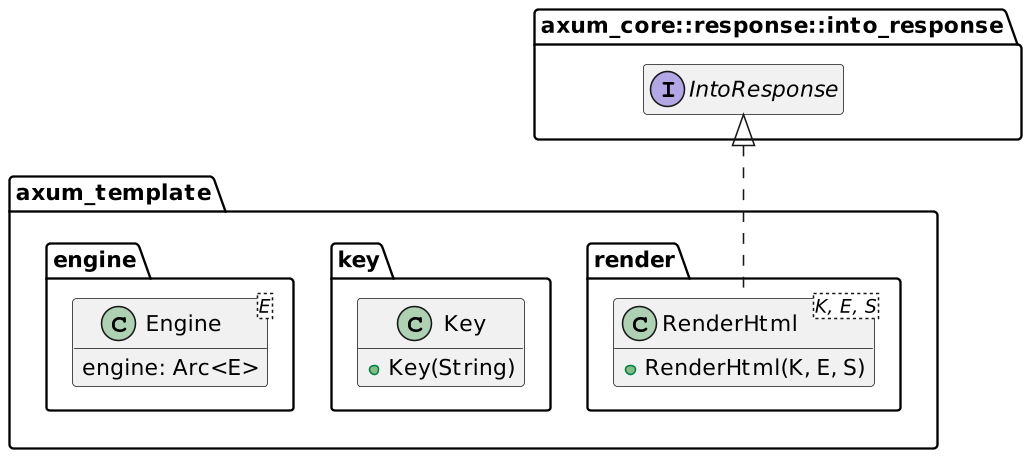
Engineis a facade over the templating library- Templates are stored in a hashtable-like structure. With the MiniJinja implementation, according to the configuration above,
Keyis simply the filename, e.g.,home.html - The final
Sparameter has no requirement. The library will read its attributes and use them to fill the template.
I won't go into the details of the template itself, as the documentation is quite good.
The impl Return
It has nothing to do with templating, but this mini-project allowed me to ponder the impl return type. In my previous REST project, I noticed that Axum handler functions return impl, but I didn't think about it. It's indeed pretty simple:
If your function returns a type that implements
MyTrait, you can write its return type as-> impl MyTrait. This can help simplify your type signatures quite a lot!
However, it has interesting consequences. If you return a single type, it works like a charm. However, if you return more than one, you either need a common trait across all returned types or to be explicit about it.
Here's the original sample:
async fn call(engine: AppEngine, Form(state): Form<InitialPageState>) -> impl IntoResponse {
    RenderHtml(Key("home.html".to_owned()), engine, state)
}
If the page state needs to differentiate between success and error, we must create two dedicated structures.
async fn call(engine: AppEngine, Form(state): Form<InitialPageState>) -> Response {                     //1
  let page_state = PageState::from(state);
  if page_state.either.is_left() {
    RenderHtml(Key("home.html".to_owned()), engine, page_state.either.left().unwrap()).into_response()  //2
  } else {
    RenderHtml(Key("home.html".to_owned()), engine, page_state.either.right().unwrap()).into_response() //2
  }
}- Cannot use
impl IntoResponse; need to use the explicitResponsetype - Explicit transform the return value to
Response
Using the Application
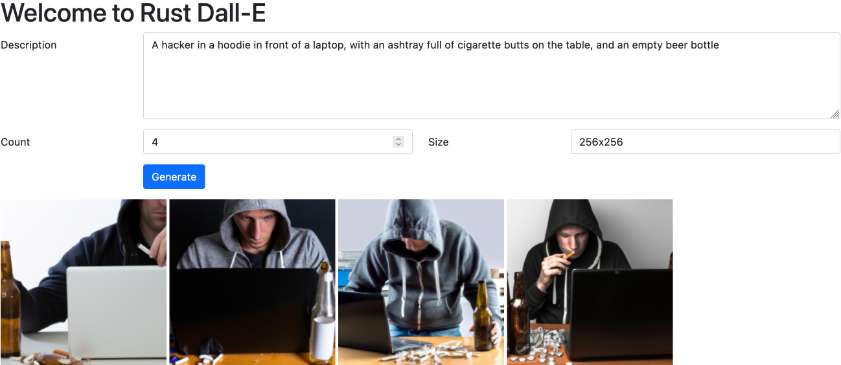
You can build from the source or run the Docker image, available at DockerHub. The only requirement is to provide an OpenAI authentication token via an environment variable:
docker run -it --rm -p 3000:3000 -e OPENAI_TOKEN=... nfrankel/rust-dalle:0.1.0Enjoy!
Conclusion
This small project allowed me to discover another side of Rust: HTML templating with Axum. It's not the usual use case for Rust, but it's part of it anyway.
On the Dall.E side, I was not particularly impressed with the capabilities. Perhaps I didn't manage to describe the results in the right way. I'll need to up my prompt engineering skills.
In any case, I'm happy that I developed the interface, if only for fun.
The complete source code for this post can be found on GitHub.
To Go Further:
Published at DZone with permission of Nicolas Fränkel. See the original article here.
Opinions expressed by DZone contributors are their own.
Comments