

Shifting Left in Software Testing: Integrating AI-Driven Early Defect Detection into Agile Development Workflows
Integrating AI-driven "Shift Left" testing into Agile workflows helps teams detect software defects early, reducing costs, and boosting customer satisfaction.
 ·
·
Join the DZone community and get the full member experience.
Join For FreeNobody likes bugs. Not the developers who accidentally write them, not the testers who hunt them down, and certainly not the users who stumble into them. But here’s the kicker — according to IBM, 5 to 30% of software defects still slip into production, costing companies up to 30 times more to fix post-release than if caught early.
The statistic highlights the essential nature of discovering software defects at the earliest point in development. Testing processes must shift left in development lifecycles according to the shifting left concept.
Building artificial intelligence functions in the early development phases helps teams find more defects, which leads to fewer late-caused software breakdowns. This blog explains how Agile development workflows can integrate AI and automation to reach their objective.
Shift-Left Testing: Fixing Bugs Before They Become "Features"
The "Shift Left" concept shows tremendous popularity growth in software testing primarily because of its rationale. Testing alongside quality assurance activities is inserted at the beginning of the Software Development Life Cycle rather than delayed until after development finishes. Quality development integration at the beginning cycle stages ensures testability while eliminating the future creation of problems.
Apart from basic concepts, this approach contains multiple fundamental elements. The testing begins beforehand, so experts help develop complete specifications that build quality into the end product during its conceptual stages. Developers can test their code directly within their workflow by deploying unit testing and static code analysis techniques.
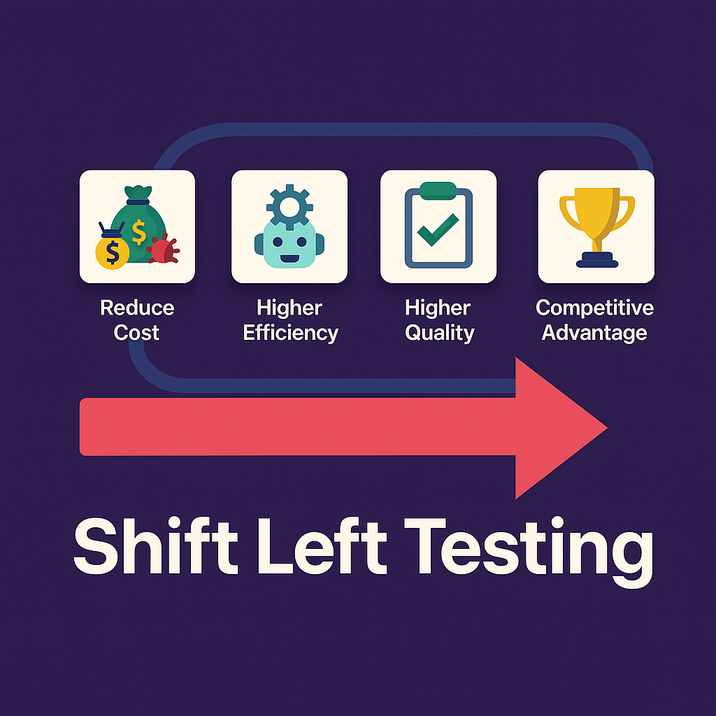
Through the strategic implementation of automation, the development process experiences improved pace, consistency, and total testing depth. Delivering continuous feedback enables prompt defect identification to achieve better efficiency.
Shifting Left reduces costs because detecting and solving bugs during early development stages is less expensive than waiting until after product deployment.
Automation technology installed through shifting left enables fast software delivery and higher product quality, enhancing client satisfaction while eliminating human error and accelerating entire development processes. The methodology strengthens teamwork by establishing open communication and unified quality responsibility between the full development team members.
The AI Revolution in Software Testing
AI, alongside automation, helps software testing teams discover defects at an earlier stage of development because of their advancements in the field. Artificial Intelligence demonstrates excellent capabilities regarding large data analyses, pattern recognition, and accurate prediction, enhancing "Shift Left" testing efficiency.
AI applications deliver multiple solutions that enhance the early identification of defects. Predictive analytics examines past data of bug reports and code modifications to anticipate problems that could occur.
Automated testing software combines existing code analysis with requirement evaluation through AI to produce entire test case suites while increasing initial coverage levels and overall test quality. The system employs AI to discover invisible holes within test suites, which helps test every critical scenario.
Machine learning algorithms detect abnormal system functions as indicators for hidden defects. Risk-based testing focuses on high-priority aspects that are prone to defects and generate the most impact. Self-healing tests support application changes without maintenance requirements because they automatically adjust. Integrating AI testing becomes about preventing defects before they arise while quality moves deeply into the software development process.
Making it Happen: Integrating AI into Agile
Organizations need deliberate plans and suitable software to embed AI systems into Agile workflows for premature defect discovery. Implementing AI during requirements analysis enables Natural Language Processing to examine user stories and acceptance criteria to identify ambiguities while suggesting preliminary testing frameworks at an early stage.
CI/CD pipelines gain additional strength with AI integration, allowing continuous early testing during Agile development processes. AI-operated tests run automatically after any code submission through an integrated system, generating rapid feedback for prompt error-solving.
AI test management systems optimize testing by enabling automatic test case priority selection according to risk assessment and efficient defect analysis. A successful Agile integration with AI demands developers embed artificial intelligence quality check processes into their daily work routine and promote continuous feedback for quality maintenance across the development process.
Quality Soars, Failures Plummet: The Impact of Early AI Testing
AI in early software testing via the "Shift Left" practice leads to superior software quality while lowering subsequent failure occurrences. Getting ahead of potential defects enables teams to stop minor complications from producing complex, expensive problems.
AI’s timely code evaluation during early development stages detects potential issues that get resolved with simpler and more economical solutions. Predictive analysis helps teams detect probable failure spots before they occur, allowing them to apply specific testing approaches that maintain product reliability.
AI automates test case creation to produce detailed examination pathways that cover all possible system conditions that typical manual inspection fails to find. This particular thorough testing method makes strict defect detection more precise. AI technology's early discovery of bugs helps teams execute fewer repairs and decreases technical debt, preventing future development problems.
AI integration with "Shift Left" principles forms a significant partnership that produces efficient, proactive testing. It automatically creates better-quality software while decreasing costly damage to reputation and improving user satisfaction and team productivity.
The Numbers Don't Lie: Cost and Efficiency Gains
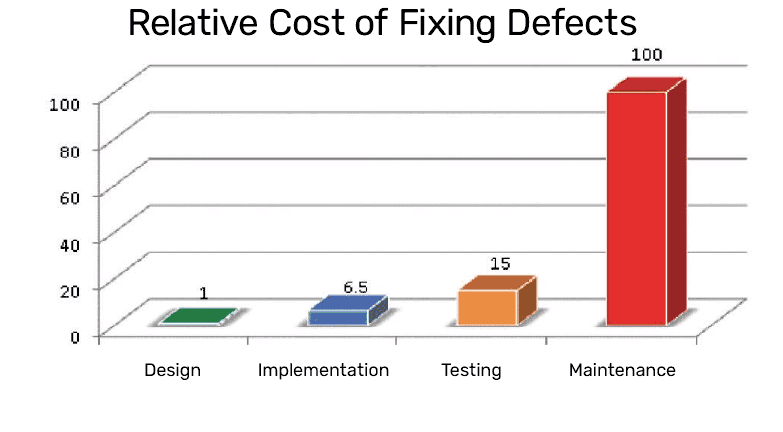
Image: Credit
Numbers demonstrate how early defect identification and AI capabilities significantly lower software development expenses and post-release bugs. When bugs advance from one phase to the next in the Software Development Life Cycle, their repair costs surge substantially.
Table 1: Cost of Fixing Bugs at Different SDLC Stages
|
SDLC Stage |
Relative Cost |
|---|---|
|
Requirements |
1x |
|
Design |
3x-5x |
|
Coding |
~10x |
|
Testing |
15x-20x |
|
Post-Release |
30x-100x+ |
This table shows the exponential cost of resolving issues later in development. Defects during the requirements phase are far cheaper to fix than after software deployment. This stark fact highlights the huge financial benefits of "Shift Left" thinking.
According to the table below, early testing, especially when assisted by AI, significantly reduces post-release defects:
|
Metric |
Result |
|---|---|
|
Reduction in Post-Release Defects |
Organizations practicing early testing reduced post-release defects by 75% compared to traditional timelines. |
|
Reduction in Post-Release Bugs (Company) |
After implementing early testing practices, a mid-sized fintech company reported a 40% reduction in post-release bugs. |
|
Reduction in Post-Release Defects (AI) |
Swisscom integrated AI-driven code analysis and achieved a 30% reduction in post-release defects. |
|
Reduction in Production Bugs (AI) |
Goldman Sachs used AI for unit test generation, leading to a 25% reduction in production bugs. |
|
Reduction in Defect Leakage (AI) |
A Fortune 500 retail client using an AI-powered QA framework saw a 40% reduction in defect leakage. |
Challenges and Considerations
Implementing AI into early defect detection brings numerous benefits, but organizations should recognize potential hurdles during this process.
- Data quality: How well artificial intelligence performs depends entirely on the data quality it receives during training. Predictions require accurate data that is aligned with the specification requirements.
- Tool integration: AI tool implementation succeeds best when developers seamlessly integrate them into current development environments and workflows.
- Human oversight: AI technology must support human judgment instead of substituting it. Developers and testers require critical analysis of AI insights, which should aid their decisions with proper information.
Final Thoughts: Shift Left or Get Left Behind
AI-powered defect prediction and prevention techniques enable software testing through “shifting left” approaches that conduct testing at early stages in continued execution. Such a tactical methodology reduces development costs while speeding up the release process, strengthening system reliability and enhancing customer satisfaction rates.
Many real-world AI-driven testing installations prove that strategic deployment can defeat adoption challenges. Organizations participating in this evolution will produce high-quality software efficiently, which will help them maintain market leadership while effectively meeting rising user requirements.
Opinions expressed by DZone contributors are their own.
Comments