

6 Software Development and DevOps Trends Shaping 2026
In 2026, software teams scale delivery safely and efficiently using AI agents, semantic layers, platform engineering, supply-chain security, observability, and FinOps.
 CORE
·
CORE
·
Join the DZone community and get the full member experience.
Join For FreeIn 2025, many teams tried new things in software development and DevOps — AI copilots, new platforms, more automation, and more security checks. Some of it worked great, some of it created new mess (tool sprawl, unclear ownership, higher cloud bills, and “we ship faster but break more”).
Heading into 2026, the focus is shifting from experimentation to ensuring reliability and repeatability. Leaders and practitioners are asking the same questions: How do we move fast without losing quality? How do we keep systems secure without slowing teams down? How do we reduce toil, control costs, and still deliver features that matter?
This article breaks down six trends shaping the next year: agentic AI across the SDLC, semantic layers/ontologies that give AI real business context, platform engineering with internal developer platforms, software supply chain security, observability built on standard telemetry, and FinOps becoming part of daily engineering decisions. Together, these trends solve one big problem: they help teams scale delivery — with less chaos, fewer surprises, and more confidence.
Trend 1: Agentic AI Across the SDLC
The SDLC is the software development life cycle — the end-to-end process of planning, building, testing, deploying, and operating software. It matters because most delays don’t occur only in coding but also in handoffs and “glue work” between steps.
Agentic AI is AI that can work toward a goal with limited supervision, by planning steps and using tools (not just generating text). Think: “take this issue, make a change, run checks, and prepare a pull request for review.”
Why Does It Matter in 2026?
Teams are overloaded by repetitive tasks around delivery — triage, updating configs, chasing flaky tests, fixing CI, writing PR summaries, and digging through logs. Agents can reduce that toil and shorten feedback loops, so engineers spend more time on decisions and design (and less time on copy-and-paste work). For example, GitHub documents workflows in which Copilot can be asked to create a pull request, with the developer approving it before it proceeds.
But there’s a catch: AI tends to amplify what already exists in your engineering system. If your foundations are strong (good tests, clear standards, solid CI), you get faster. If things are messy, you might ship faster… into more problems. That’s why 2026 is about agents plus guardrails, not agents alone.
If GitHub Copilot feels weak for our use case, there are solid open-source alternatives:
- Continue (open-source assistant for VS Code/JetBrains; we can connect different models and contexts, and it supports agent-style workflows)
- Tabby (open-source, self-hosted coding assistant, often positioned as an on-prem alternative to Copilot)
And if we want “more agent, less IDE autocomplete,” these are worth a look:
- OpenHands (agentic developer assistant project)
- Aider (terminal-first coding agent that works via git changes)
Trend 2: Ontologies/Semantic Layer for AI context (Semantic grounding for real business meaning)
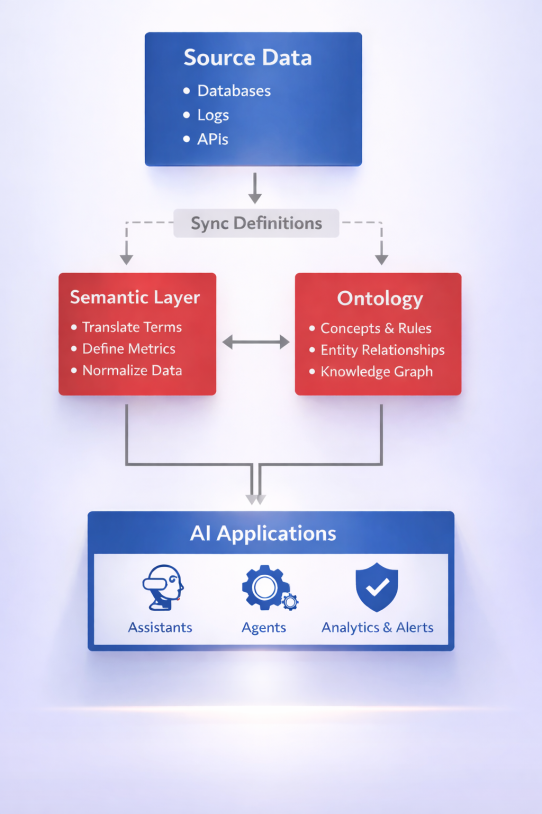
A semantic layer is a part of data architecture that translates complex data into business-friendly terms, so “revenue,” “active customer,” or “incident severity” mean the same thing everywhere.
An ontology is a more formal version of that idea: a shared domain model with clear definitions and relationships (for example: Customer owns Contract, Contract relates to Product, Product has Region rules). OWL is a common standard for representing ontologies.
Under the hood, many ontology/knowledge-graph approaches build on RDF, which represents facts as simple graph statements.
What problem does this solve? Data quality issues are real (missing values, inconsistent records, stale data). But even when the data is “good enough,” teams still hit a second issue: meaning and consistency. The same metric name can mean different things across teams, dashboards, and services. When AI systems learn from conflicting definitions, they can sound confident but still be wrong, and it’s hard to explain why. A semantic layer and ontology provide AI with a reliable map of the domain, so answers are grounded in shared definitions and relationships rather than guesswork. We can see it in Figure 1.
Why Does It Matter in 2026?
As we use more AI assistants and agents in engineering and ops, they need trusted context to make safe decisions. Graph-based RAG approaches are gaining attention because they can combine text with relationships, not only similarity search. GraphRAG is one example of this direction.
And to keep this domain model clean over time, we can validate graph data with constraint rules like SHACL, so “domain truth” doesn’t drift into chaos.
Trend 3: Platform Engineering 2.0/AI-ready Internal Developer Platforms
Platform engineering is about building internal developer platforms (IDPs) — shared, self-service infrastructure and tools that help teams build, test, deploy, and operate software more consistently. Rather than each team reinventing its own pipeline, platform teams create golden paths (pre-approved, repeatable ways to get things done). As we move into 2026, these platforms are evolving beyond CI/CD automation into AI-ready platforms that embed intelligence, security, and observability into the developer experience.
Why Does It Matter in 2026?
Many teams experimented with DIY automation in 2024–2025 and now face “integration tax”: dozens of custom scripts, inconsistent standards, unclear ownership, and slow onboarding for new developers. AI-ready IDPs aim to solve these issues by providing patterns, guardrails, and intelligent defaults that scale across teams. They can offer context-aware recommendations (e.g., which tests to run and which security rules apply), enforce policy-as-code, generate environment previews, and integrate AI assistants directly into workflows. This reduces cognitive load on developers and accelerates delivery without compromising quality or governance.
What problem it solves: Traditional DevOps pipelines often lack standardization and visibility at scale. Platform engineering creates a shared foundation so teams don’t spend time on plumbing, maintain consistency across services, and adopt new practices (such as AI-augmented workflows) more safely. In 2026, these platforms will also help balance productivity with compliance, cost, and reliability by baking in best practices rather than leaving them as optional add-ons.
Links and trend signals:
- Gartner highlights the strategic shift toward platform engineering and embedded intelligence as a key trend for software teams.
- Industry discussions increasingly position IDPs as the backbone of scalable DevOps practices.
- Patterns like policy-as-code and standardized pipelines are growing as larger organizations prioritize compliance and auditability.
Trend 4: Supply-Chain Security as the New DevSecOps Baseline
What it is: Traditionally, DevSecOps has focused on finding and fixing vulnerabilities in code or containers. In 2026, the emphasis is expanding to software supply-chain security — meaning we protect not just our code, but every piece that goes into building, packaging, and delivering software: dependencies, build systems, artifacts, and deployment pipelines. Practices like Software Bill of Materials (SBOMs), artifact signing, provenance tracking, and attestation frameworks (e.g., SLSA) are becoming baseline expectations, not optional add-ons. [source: https://www.cisa.gov/resources-tools/resources/2025-minimum-elements-software-bill-materials-sbom]
Why Does It Matter in 2026?
High-profile incidents in recent years have shown that attackers often exploit vulnerabilities outside the app’s codebase — for example, compromised open-source libraries or malicious updates in CI/CD pipelines. As teams move faster with AI-augmented workflows, it’s even easier for risky components to creep into releases. Strengthening the supply chain means verifying the origin of each artifact, who signed it, and which policies it complies with before deployment. This reduces unexpected properties and limits blast radius. [source: https://www.itpro.com/software/enterprises-need-to-sharpen-up-on-software-supply-chain-security]
What problem it solves: It tackles two significant issues at once: preventing untrusted code from entering production, and making compliance and auditability part of everyday workflows. In 2026, supply-chain security won’t be something done “if we have time” — it will be part of the delivery pipeline itself, giving teams confidence they can ship fast and safe.
Links and trend signals:
- CISA guidance on baseline SBOM elements for software supply chains. [source: https://www.cisa.gov/resources-tools/resources/2025-minimum-elements-software-bill-materials-sbom]
- Enterprise pressure to mature supply-chain practices. [source: https://www.itpro.com/software/enterprises-need-to-sharpen-up-on-software-supply-chain-security]
Trend 5: Observability and Telemetry Engineering
What it is: Observability is the practice of understanding how systems behave in production by collecting signals like logs, metrics, and traces. In 2026, this is evolving into telemetry engineering — a more intentional, standardized approach to how we define, collect, store, and use observability data across services and teams. Rather than ad-hoc dashboards and random logs sprinkled everywhere, telemetry engineering treats signals as first-class artifacts that are designed, reviewed, and governed much like code or APIs.
Why does it matter in 2026?
As architectures become more distributed and AI-driven automation touches more parts of the stack, blind spots can quickly turn into outages or degraded user experience. Teams can’t afford to guess what’s happening anymore; they need reliable, consistent signals that can drive automated insights and even feed AI assistants for problem diagnosis. Standardization efforts (like OpenTelemetry) are unifying how data is collected and transmitted, making it easier to correlate traces with metrics and logs, and to automate alerting, root cause analysis, and cost optimization. [source: https://opentelemetry.io/docs/]
What problem it solves: Traditional logging or monitoring often results in signal silos — each tool with its own format and blind spots. Telemetry engineering breaks these silos by aligning on shared schemas, sampling strategies, tagging conventions, retention policies, and cost controls. This gives engineering teams a consistent lens into their systems, reduces noise, and supports AI-assisted debugging and predictive analysis.
Links and trend signals:
- OpenTelemetry growing in adoption as the de facto standard for traces, metrics, and logs
- Industry focus on treating observability as a platform concern, not a team hack
Trend 6: FinOps Meets DevOps (Cost as a First-Class Engineering Signal)
What it is: FinOps is the practice of managing and optimizing cloud spend through shared ownership between engineering, finance, and product teams. When FinOps meets DevOps, cost stops being something reviewed after deployment and becomes part of everyday engineering decisions — alongside performance, reliability, and security. In practice, this means teams see cost impact early and often, not only in monthly reports.
Why it matters in 2026: Cloud and AI costs are no longer predictable or linear. Ephemeral environments, GPU workloads, managed services, and AI inference can change spend dramatically in days, not months. In 2026, teams that treat cost as “someone else’s problem” will struggle. Instead, DevOps pipelines increasingly include cost guardrails: budget alerts, environment TTLs, right-sizing checks, and cost regression detection before changes hit production.
What problem it solves: It closes the gap between speed and sustainability. By integrating cost visibility directly into DevOps workflows, teams can move fast without accidentally burning budget, and leaders can make trade-offs explicit instead of reactive.
Links and rend signal:
-
The FinOps Foundation reports growing adoption of engineering-led cost ownership as cloud maturity increases.
Conclusion
Looking ahead to 2026, all these trends point to the same idea: teams need to scale software delivery with more structure, not more tools. AI, platforms, security, observability, and cost control only help when they are built into the way we work, not added at the end. Teams that connect these areas will move faster, with less stress and fewer surprises.
Simple next steps to start now:
- Pilot one AI workflow, like helping with issue handling or pull requests, with clear rules and human review.
- Invest in IDP golden paths, so security, observability, and AI tools are the default, not optional.
- Set a basic supply chain security baseline, including SBOMs and artifact signing.
- Create a small semantic “thin slice” for one business domain to give AI shared context.
- Standardize telemetry and cost guardrails, so teams see reliability and cost early, not too late.
These steps don’t require a big redesign on day one. But together, they help teams build software that is faster, safer, and more sustainable in 2026.
Opinions expressed by DZone contributors are their own.
Comments