

Standards as the Invisible Infrastructure of Software
Standards align ecosystems, preserve knowledge, and prevent fragmentation — enabling portability, innovation, and long-term stability.
 CORE
·
CORE
·
Join the DZone community and get the full member experience.
Join For FreeStandards are often treated as bureaucracy — something slow, heavy, and occasionally disconnected from “real engineering.” Yet if we look at history with a bit more rigor, that narrative collapses quickly. Software development is not exempt from the forces that shaped civilization. It is, in fact, one of the latest chapters in a very old story: the story of standardization as a multiplier of human capability.

The word “standard” itself comes from the Old French estandart — a rallying flag, a visible sign under which people gather. That origin is revealing. A standard is not merely documentation; it is a coordination mechanism. It allows independent actors to align around shared expectations. Without that alignment, scaling knowledge becomes nearly impossible.

Human progress has always depended on standards. Writing systems transformed ephemeral speech into persistent knowledge. Once symbols were formalized, ideas could survive generations. When Isaac Newton famously wrote that he stood “on the shoulders of giants,” he was acknowledging accumulated knowledge preserved through standardized language, notation, and scholarly norms. Mathematics itself works only because its symbols and rules are shared and stable.
The Industrial Revolution amplified this principle. Mass production did not emerge merely from better machines; it required interchangeable parts. That meant tolerances, measurements, and repeatable specifications. A bolt had to fit a nut regardless of where it was manufactured. Standards turned craftsmanship into scalable industry.
Why should software be different?
In the browser you are using right now, a silent agreement is in effect: the World Wide Web Consortium defines the specifications for HTML, CSS, and related technologies. Browser vendors interpret and implement these documents independently, yet the web works because they converge on shared behavior. Imperfectly? Sometimes. But without a common reference, the web would fragment into incompatible silos.
A typical software standard has multiple structural elements.
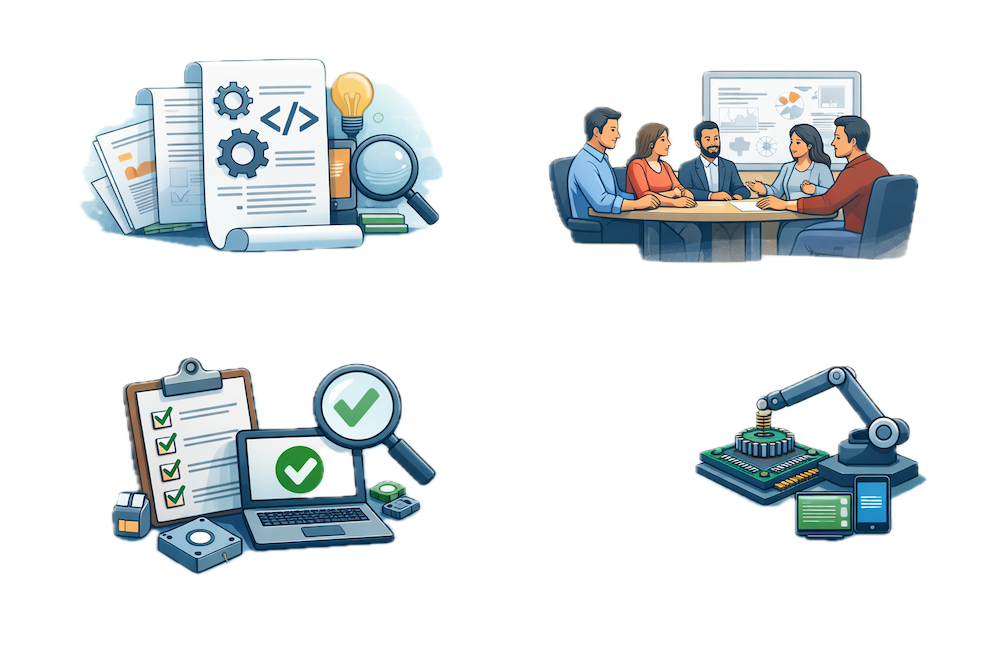
First, there is the specification — the formal description of APIs, semantics, and expected behavior. A specification is not an implementation. It defines what must happen, not how it must be achieved.
Second, there is the committee or expert group responsible for evolving that specification. This governance layer is often misunderstood. Its purpose is not control; it is consensus-building. Diverse stakeholders — vendors, independent experts, and community representatives — debate trade-offs so that no single company dictates the ecosystem.
Third, there are vendors or implementers. These are the runtime engines, frameworks, or tools that bring the specification to life. Multiple implementations introduce competition, innovation, and resilience.
Finally, there is verification. In some ecosystems, partial conformance is tolerated. In others, compliance is binary. In the Java ecosystem, the Technology Compatibility Kit (TCK) model enforces strict alignment: you either pass all required tests, or you cannot claim compatibility. This binary approach dramatically reduces ambiguity and vendor fragmentation.
To understand the power of standards in modern software, consider the Java platform. Java is not defined solely by a single company’s runtime. It is defined by specifications maintained through the Java Community Process. Multiple vendors implement the language and platform — yet all must adhere to the same specification and compatibility requirements. This is what makes Java portable in practice rather than merely in marketing.
Without a standard, “Java” would become a brand attached to incompatible dialects. With a standard, it becomes a contract.
The same architectural logic applies to Jakarta EE, stewarded by the Eclipse Foundation. Jakarta EE is not just a collection of APIs. It is a coordinated effort: specifications, open governance, multiple compatible implementations, and TCK validation. This structure enables innovation at the implementation layer while protecting portability at the application layer.
Standards are not limited to languages and platforms. They shape architectural thinking itself. Design patterns, for example, became influential not because they were mandated, but because they were documented, named, and conceptually standardized. A shared vocabulary — “Factory,” “Strategy,” “Observer” — allows teams across continents to collaborate efficiently. In architecture, REST became dominant because Roy Fielding formalized its constraints. Naming and formalization are acts of standardization.
At this point, it is worth distinguishing between related but distinct concepts: open source and open standards.
Open source refers to software whose source code is publicly available, typically under licenses that allow inspection, modification, and redistribution. It is an implementation model.
An open standard, on the other hand, refers to a publicly accessible specification developed through a transparent and inclusive process. It is a governance model.
You can have open source without an open standard — a single project, fully transparent, but controlled by one vendor without formal specification processes. You can also have an open standard implemented by proprietary software. The most resilient ecosystems combine both: open governance for the specification and open implementations that compete on quality and performance.
When these two forces align, something powerful happens. Developers gain portability. Organizations reduce vendor lock-in. Innovation accelerates because differentiation shifts from reinventing interfaces to optimizing implementations.
Standards also provide long-term stability. In a world obsessed with rapid iteration, it is tempting to view standards as a form of friction. But from an engineering perspective, stability is not the enemy of innovation; it is its enabler. When APIs remain predictable, teams can invest in higher-level abstractions, tooling, and architecture without fear of constant foundational shifts.
Critics often argue that standards slow progress. The more precise question is: slow progress compared to what? A proprietary ecosystem may move faster initially, but it risks fragmentation, lock-in, and incompatibility. Standards introduce negotiation and consensus, which can feel slower, yet they produce ecosystems that endure for decades.
Consider the analogy with manufacturing. Interchangeable parts may have required additional upfront coordination, but they enabled exponential scaling. Software standards function similarly. They are coordination overhead that unlocks systemic scale.
For software engineers, standards are not merely abstract governance constructs. They are daily tools. Every HTTP request relies on standardized semantics. Every SQL query depends on decades of evolving agreement. Every JVM-based application trusts compatibility guarantees defined outside its codebase.
If we step back, the skeptical question becomes unavoidable: what would modern software look like without standards? Likely a patchwork of incompatible protocols, isolated frameworks, and fragile integrations.
Standards are not glamorous. They rarely trend on social media. But they are the invisible infrastructure that allows distributed collaboration at a planetary scale. They enable thousands of engineers, across companies and continents, to build systems that interoperate reliably.
In the end, standards are not about restriction; they are about shared foundations. They embody the same principle that enabled writing, science, and industrialization: codify knowledge, align expectations, and allow independent actors to build upon a stable base.
Software is no different from any other engineering discipline. If history teaches us anything, it is this: progress scales when agreement scales. Standards are how agreement becomes durable.
Opinions expressed by DZone contributors are their own.
Comments