

Leveraging a Balance Between DevOps and ITOps
What's the difference between DevOps and ITOps? Learn how they're different and how the two approaches can work together.
Join the DZone community and get the full member experience.
Join For FreeWe have seen these words on the internet – often used interchangeably. Today, we are going to clear the air. ITops and DevOps are all different segments of IT that together help an organization to be in business.
ITOps and DevOps are polar opposites. One group wants to move fast and drive change; the other group is hard‑wired to provide security and reliability. Yet both groups have one common goal: to turbocharge performance and create innovative solutions to impact the business.
DevOps is an approach that encapsulates collaboration among the Development, Operations, Testing and Support teams of an organization, with the aim of speeding time to market through agile development. The approach consists of the various steps in a release (Development and Testing) – planning, coding, building release, testing for accuracy and the actual release. The Ops (Operations and Support) efforts roll in the form of deployment, operation, and maintenance of the product.
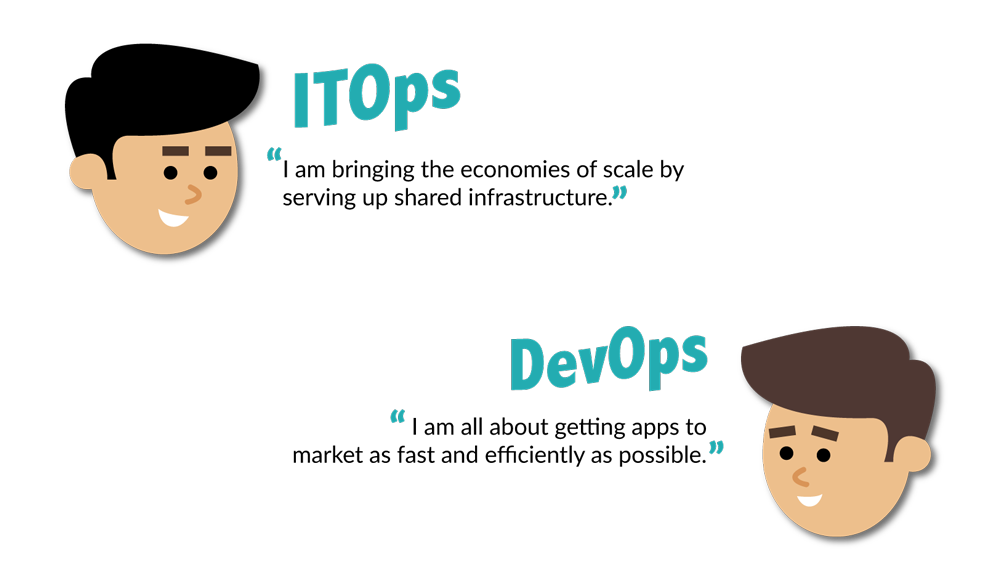
ITOps provides network infrastructure, computer operations and helps desk and server and device management. It is clear that the demands on modern organizations to move faster, be more agile, and be more responsive to customers and users are key drivers in the success of modern business.
Delivering four seemingly contradictory objectives: innovation, speed, security, and compliance.
Value‑stream thinking vs. framework thinking.
Lean IT, DevOps, and agile development.
ITSM is critical in agile environments when defining non‑functional requirements.
DevOps and ITOps can leverage the concepts of automation, from continuous integration to deployment.
Value‑stream thinking vs. framework thinking:
Value Streams represent the series of steps that an organization uses to build Solutions that provide a continuous flow of value to a Customer. A value stream is a long-lived series of steps used to deliver value, from concept or customer order to delivery of a tangible result for the customer.
Framework thinkers are able to bring clarity to situations. Good frameworks focus everyone’s thinking, allowing the team to drown out the noise and hone in on the questions that really matter.
Framework thinkers make more progress. Frameworks can clear logjams and facilitate faster solutions. There are rarely perfect answers in business, and the ability to make faster decisions can often mean the difference between success and failure.
Lean IT, DevOps and Agile developments:
- Lean tells you to optimize the end-to-end process which creates value for your customer – from the initial idea to collecting cash. Lean principles focus on flow more than anything else: bottlenecks in the process must be removed and wasteful activities need to be identified and avoided.
- The cultural aspect of concentrating on business results rather than technical details. Devops incorporates a lot of lean principles, focusing on improving the collaboration between developers and operations folks.
ITSM is critical in agile environments:
ITIL and SCRUM do not contradict each other. There is no incompatibility. SCRUM is a specific way to deliver projects, it’s an iterative, adaptive and incremental approach to project management. You can use it for any kind of project, even outside IT, and has become by far the most popular agile methods. ITIL is about best practice IT Service Management. It’s a holistic collection of ideas and processes on how to define, design, transition, run and finally continuously improve services (-> that’s the service lifecycle).
Opinions expressed by DZone contributors are their own.
Comments