

TensorFlow vs PyTorch: The Real Difference Isn’t Accuracy
A direct CNN benchmark on CIFAR-10 shows TensorFlow and PyTorch achieve identical accuracy (~68%). Choose TensorFlow for production and PyTorch for flexibility.
 ·
·
Join the DZone community and get the full member experience.
Join For FreeA few days ago, I set out to build a simple image classification model using convolutional neural networks (CNNs). The task itself wasn’t particularly complex, but choosing the right framework proved more challenging than expected. I found myself choosing between TensorFlow and PyTorch, two powerful frameworks for building high-performance CNNs.
To explore this, I implemented the same CNN in both frameworks under identical conditions and compared them across key aspects like learning curve, flexibility, debugging, and performance.
A Quick Look at the Frameworks
Before deep-diving into the comparison, it’s worth briefly understanding the two frameworks used throughout this experiment.
1. TensorFlow
TensorFlow is an open-source deep learning framework developed by Google. It is widely known for its strong ecosystem and production-ready capabilities.
One of its key strengths is its integration with high-level APIs such as Keras, which simplifies model building and training. TensorFlow is commonly used in large-scale applications, offering tools for deployment across web, mobile, and edge devices.
Overall, it is often preferred when moving models from experimentation to production environments.
2. PyTorch
PyTorch is an open-source deep learning framework developed by Meta Platforms. It has gained significant popularity, especially in the research community, due to its simplicity and flexibility.
PyTorch uses a dynamic computation graph, which makes it feel more like standard Python code. This makes model development more intuitive and debugging significantly easier.
It is often the preferred choice for experimentation, rapid prototyping, and research-driven projects.
Experiment Setup
To ensure a fair and meaningful comparison between TensorFlow and PyTorch, both implementations were designed under identical conditions.
1. Dataset
- The models were trained and evaluated on the CIFAR-10 dataset, a widely used benchmark for image classification tasks.
- It consists of 60,000 color images across 10 classes, making it suitable for evaluating CNN performance.
- CIFAR-10 is publicly available for research purposes and is commonly distributed under a permissive academic license, allowing free use for educational and non-commercial applications.
2. Model Architecture
A simple yet effective Convolutional Neural Network (CNN) architecture was used in both frameworks. The structure includes:
- Convolutional layers for feature extraction
- ReLU activation functions
- Max-pooling layers for dimensionality reduction
- Fully connected layers for classification
Care was taken to ensure that the architecture remained identical in both implementations.
3. Training Configuration
To maintain consistency, the following hyperparameters were used across both frameworks:
- Optimizer: Adam
- Learning rate: 0.001
- Batch size: 64
- Number of epochs: 10
- Loss function: Cross-Entropy Loss
4. Environment
All experiments were conducted using Google Colab. Both TensorFlow and PyTorch implementations were executed in the same runtime environment.
The configuration used includes:
- Runtime Type: GPU-enabled environment
- Python Version: 3.x
- Deep Learning Libraries: TensorFlow and PyTorch (latest stable versions)
The experiments were run on the same Colab runtime session to maintain consistency in resource allocation.
Implementation
To ensure a fair comparison, the same CNN architecture and training configuration were implemented using both TensorFlow and PyTorch. While the underlying model remains identical, the implementation approach differs significantly across the two frameworks.
1. CNN Implementation in TensorFlow
The model was first implemented using TensorFlow with its high-level Keras API, which provides a concise and structured way to define deep learning models.
Model Definition
model = models.Sequential([
    layers.Conv2D(32, (3,3), activation='relu', input_shape=(32,32,3)),
    layers.MaxPooling2D((2,2)),
    layers.Conv2D(64, (3,3), activation='relu'),
    layers.MaxPooling2D((2,2)),
    layers.Flatten(),
    layers.Dense(64, activation='relu'),
    layers.Dense(10, activation='softmax')
])
The Sequential API allows layers to be stacked in a linear fashion, making the architecture easy to read and implement. This significantly reduces boilerplate code and is especially helpful for beginners.
Model Compilation and Training
model.compile(optimizer='adam',
              loss='sparse_categorical_crossentropy',
              metrics=['accuracy'])

history = model.fit(x_train, y_train,
                    epochs=10,
                    batch_size=64,
                    validation_data=(x_test, y_test))
Training in TensorFlow is handled using a single high-level function. It automatically manages the training loop, backpropagation, and metric tracking, making the process highly streamlined.
Observation: TensorFlow offers a compact and beginner-friendly implementation. With minimal code, it handles most of the underlying complexity, making it ideal for rapid development and production-oriented workflows.
2. CNN Implementation in PyTorch
The same CNN architecture was implemented using PyTorch, which follows a more explicit and flexible approach.
Model Definition
class CNN(nn.Module):
    def __init__(self):
        super().__init__()
        self.conv1 = nn.Conv2d(3, 32, 3)
        self.pool = nn.MaxPool2d(2,2)
        self.conv2 = nn.Conv2d(32, 64, 3)
        self.fc1 = nn.Linear(64*6*6, 64)
        self.fc2 = nn.Linear(64, 10)
In PyTorch, models are defined using Python classes. This provides greater flexibility but requires a more detailed understanding of how each component works.
Forward Pass
def forward(self, x):
    x = self.pool(torch.relu(self.conv1(x)))
    x = self.pool(torch.relu(self.conv2(x)))
    x = x.view(-1, 64*6*6)
    x = torch.relu(self.fc1(x))
    x = self.fc2(x)
    return x
The forward pass must be explicitly defined, giving full control over how data flows through the network. This makes it easier to customize and debug complex models.
Training Loop
for inputs, labels in trainloader:
    optimizer.zero_grad()
    outputs = model(inputs)
    loss = criterion(outputs, labels)
    loss.backward()
    optimizer.step()
Unlike TensorFlow, PyTorch requires a manual training loop. While this increases the amount of code, it also provides complete transparency and control over the training process.
Observation: PyTorch offers a more flexible and transparent approach. Although it requires more code, it allows finer control over model behavior, making it a preferred choice for experimentation and research.
With both implementations in place, the next step is to evaluate their performance and analyze how they compare across different metrics.
Results and Analysis
With both implementations completed under identical conditions, we now compare TensorFlow and PyTorch using empirical results and practical observations.
1. Accuracy
-
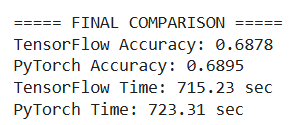
TensorFlow Accuracy: 68.78%
- PyTorch Accuracy: 68.95%
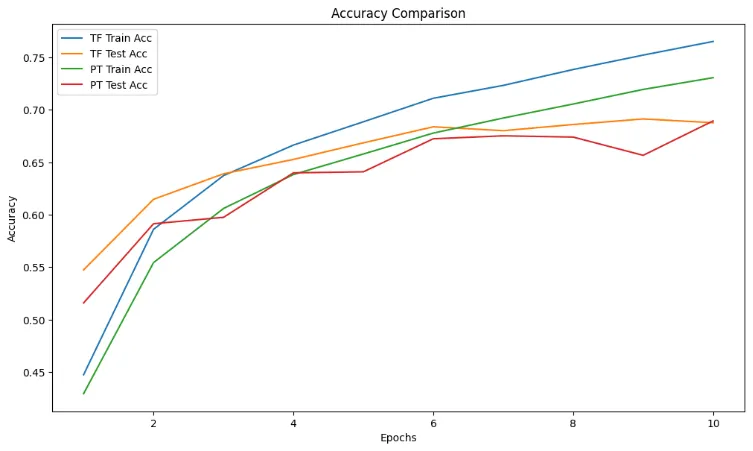
The difference (0.17%) is extremely small and falls within normal training variation. When architecture, data, and hyperparameters are controlled, the choice of framework has virtually no impact on model accuracy.
Additionally, both models show:
- Consistent improvement across epochs
- No signs of severe overfitting
- Stable generalization on test data
2. Loss Convergence
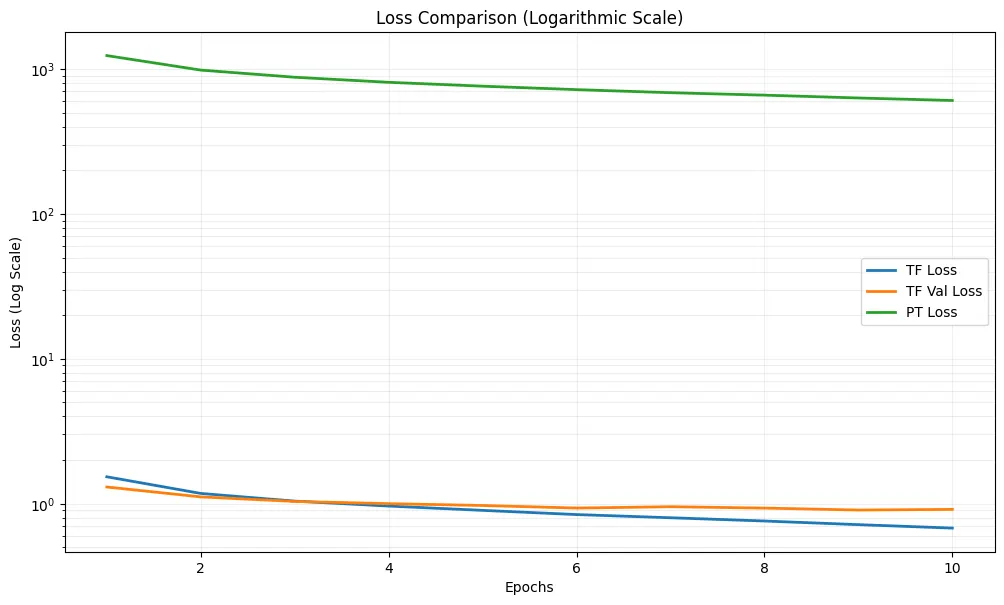
- TensorFlow exhibits a smooth and gradually decreasing loss, both for training and validation.
- PyTorch shows a similar downward trend, but with slightly larger values. The higher loss values in PyTorch are due to loss accumulation across batches, whereas TensorFlow reports average loss per epoch.
Despite differences in scale, both frameworks demonstrate stable and consistent convergence behavior, indicating effective training.
3. Model Training Performance
Training Speed
- TensorFlow: 715.23 seconds
- PyTorch: 723.31 seconds
TensorFlow is slightly faster (~1% difference), but the gap is minimal
For moderate-sized datasets like CIFAR-10, training speed differences are negligible and unlikely to influence framework selection, but TensorFlow provides strong tooling for large-scale deployment, while PyTorch is equally capable in training large models.
4. Scalability and Flexibility
TensorFlow follows a more structured and predefined approach, but provides robust tools such as distributed training and deployment pipelines. It also holds an advantage in large-scale production environments, while PyTorch continues to close the gap.
PyTorch uses a dynamic computation graph, allowing runtime modifications, which makes custom modifications easy. It is better suited for research and experimentation, where flexibility is critical.
5. Learning Curve
From an implementation standpoint:
- TensorFlow (via Keras) allows model creation with minimal and structured code; hence, it is easier to start with.
- PyTorch requires explicit definitions for model architecture, forward passes, and training loops; this results in lengthier code and greater initial effort.
Ultimately, the choice between TensorFlow and PyTorch is less about performance and more about how you prefer to design, experiment with, and deploy deep learning models.
Choosing Between TensorFlow and PyTorch
- TensorFlow is better suited when working on production-ready systems, where scalability, deployment tools, and a structured workflow are important. Its high-level APIs make it easy to develop models quickly and integrate them into real-world applications, including mobile and edge environments.
- PyTorch is more appropriate for research and experimentation, where flexibility and control are critical. Its dynamic nature and seamless debugging experience make it ideal for testing new ideas and building custom architectures.
Conclusion: Choosing the Right Framework
Through this hands-on comparison of TensorFlow and PyTorch using a CNN on the CIFAR-10 dataset, one key insight becomes clear: both frameworks perform almost identically when it comes to core metrics.
The experimental results showed:
- Nearly identical accuracy (~68–69%)
- Comparable training times
- Similar loss convergence patterns
This highlights an important takeaway:
The choice of framework has little to no impact on model performance when architecture and training conditions are kept consistent. However, the real difference lies not in performance, but in how you build, debug, and deploy models.
Ultimately, the best framework is not the one that performs slightly better on benchmarks, but the one that aligns with your workflow, problem domain, and development style.
Connect with me for more updates:
Published at DZone with permission of Rakshath Naik. See the original article here.
Opinions expressed by DZone contributors are their own.
Comments