

The Cost of Technical Debt
How much does technical debt cost your company? Let's look at the research and calculate the real cost of tech debt and how you can save money and ship faster.
Join the DZone community and get the full member experience.
Join For FreeThere are many ways in which technical debt costs us money: lost deals, customer churn, employee churn, lawsuits, and more. However, there are a couple of issues that are more important than others: engineering time, morale, and the missed revenue from software delays.
Engineering time
The cost of engineering time is quite simple:
Engineers spend 33% of their time dealing with technical debt.
On average, developers spend 41.1 hours at work each week, 13.4 hours of which they spend on technical debt. Maintenance of legacy systems and technical debt is the number one cause of productivity loss.
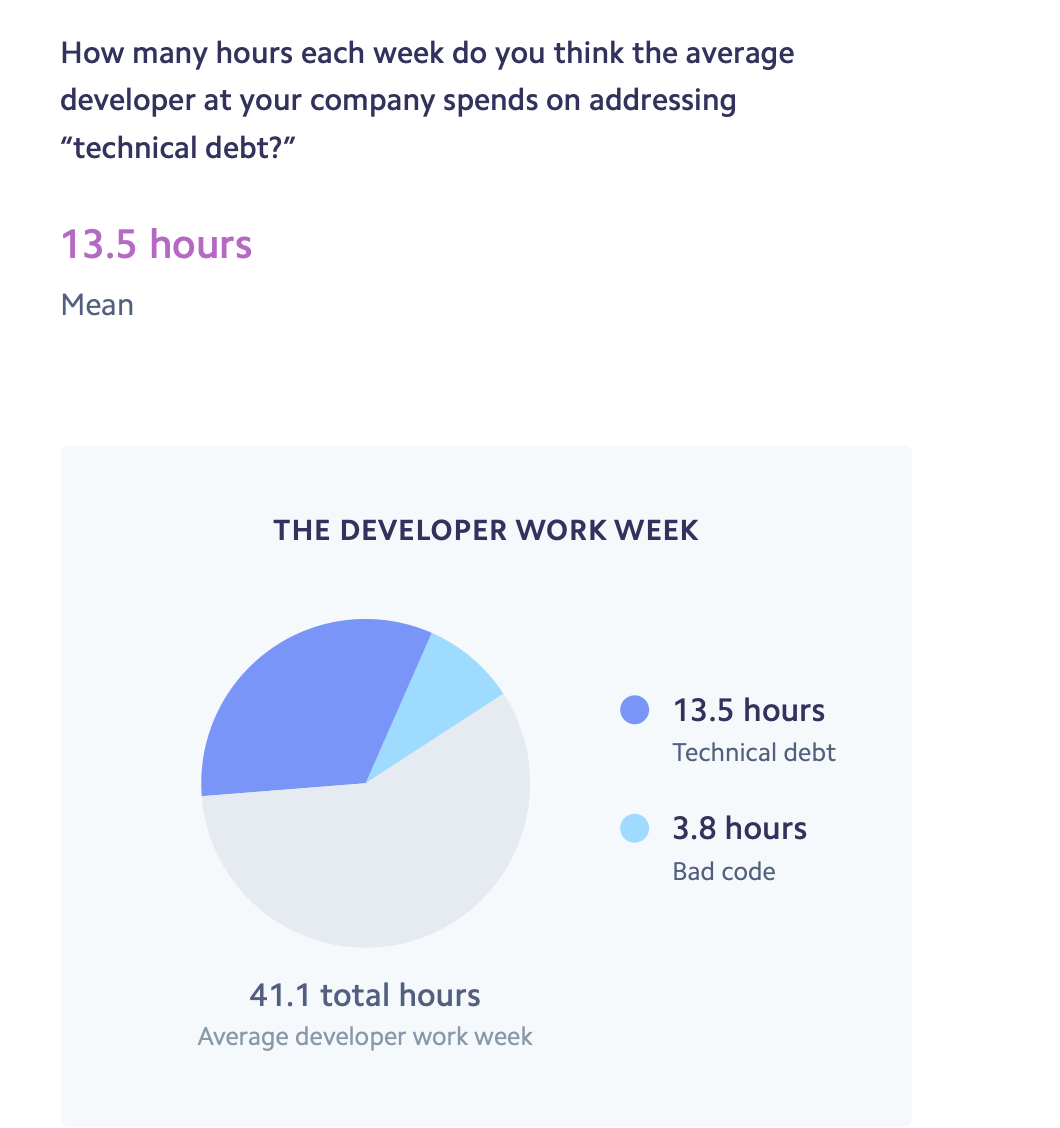
Image from The Developer Coefficient (Stripe)
Think of it like this: if you pay your software engineers $100k, 33% of that goes towards dealing with technical debt. For a 50-person engineering team, that 33% is $1.65M/year.
Stripe estimates technical debt alone has a $3 trillion impact on global GDP.
Delayed Software Product Releases
The effect of delayed product releases on monthly recurring revenue (MRR) is another aspect that is worth diving into. Let’s quickly run through two scenarios where the monthly revenue growth rate remains constant at 15%, and the MRR secured on launch is $5k:
- The product launches in February (month 2 in the chart below)
- The product launches in April (month 4 in the chart below)
Shipping a mere two months later will cost our business 25% of the revenue we could’ve made over this selected period. MRR on month 24 would’ve been over 30% higher if we’d shipped just two months earlier and managed to maintain that shipping pace.
These figures are make-or-break for high-growth SaaS companies.
As Martin Fowler explains, a healthy codebase results in features being shipped faster, so it is crucial for engineering teams to have the purview to continuously manage technical debt as they build the product.
Key Takeaways
Companies need to identify key pieces of tech debt that get in the way of key goals, cost countless engineering hours in productivity losses, or are the root cause for bugs and other issues that impact the customer experience. But most companies remain blissfully unaware of that and bear the enormous costs of tech debt without even realizing it.
To fix that, engineering teams need a clear understanding of the strategy and metrics for technical debt.
By 2023, I&O leaders who actively manage and reduce technical debt will achieve at least 50% faster service delivery times to the business.
Gartner’s research basically says that companies who have a strategy for technical debt will ship 50% faster.
Published at DZone with permission of Alex Omeyer. See the original article here.
Opinions expressed by DZone contributors are their own.
Comments