

Understanding the Data Culture
A data culture fosters data and AI use to improve decision-making, drive innovation, build trust, and ensure organizational success through collaboration.
Join the DZone community and get the full member experience.
Join For FreeA data culture is the collective behaviors and beliefs of people who value, practice, and encourage the use of data and AI to propel organizational transformation. It equips everyone in an organization with intuitive, productive insights for tackling complex business challenges.
Introduction: Data Culture
Creating a data culture helps you accelerate the value of analytics and AI. It transforms the quality and speed of decision-making across an organization and forms a foundation of data trust and transparency.
Building a data culture requires time, investment, and an organization-wide commitment, but a robust data culture is critical to making your data and people AI-ready. This playbook will guide you through the key steps to achieve — and maintain — a data culture for your organization’s long-term success.
Value of a Strong Data Culture
Establishing a strong data culture reaps the rewards across your organization — from rapid innovation, personalized customer experiences, and improved decision-making to reduced costs, higher employee retention, and increased revenue. And while the journey to build a data culture can seem daunting, with the right strategy, you can plan for data and AI success.
1. Build Your Data and AI Strategy
Data is the backbone of every AI strategy — and making high-quality, trusted data accessible to more people is key to unlocking the full potential of AI. And a strong data culture can help you do this by equipping more people with the right technology, processes, and insights to help your entire organization achieve data-driven success.
Data Strategy
To bridge the AI trust gap and increase the broad use of data across your organization, you need to have a data strategy. Building a data strategy will equip you to increase your operational efficiency and revenue streams.
The secret to unleashing actionable insights is marrying trusted analytics with the power of AI. With the power of AI, the secret to unleashing actionable insights consumption at scale is bringing trusted generative AI to the entire platform. By combining analytics and AI with people equipped with data skills, you can maximize your technology investments and uncover opportunities that drive business strategy and strengthen customer trust.
Benefits
- Faster business decision-making
- Operational efficiencies
- Free up time for valuable work
- Automated workflows
- Improved customer satisfaction
How to Create Robust Data
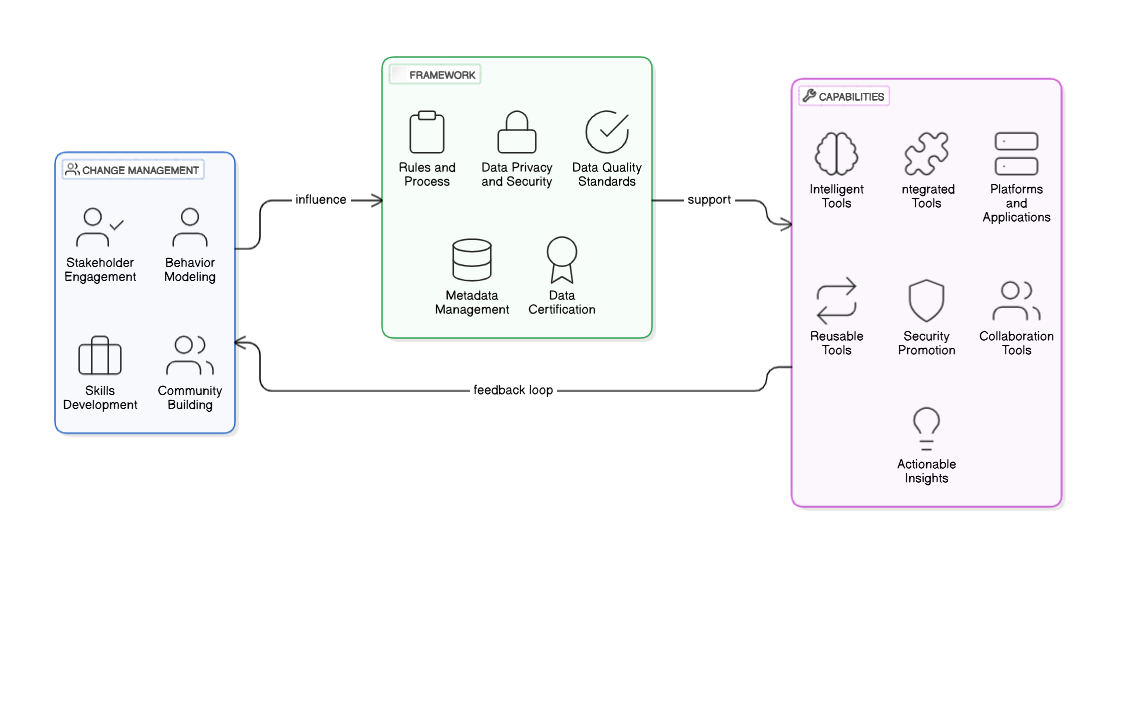
An effective change management plan details how you will engage people across your organization to promote ongoing awareness, education, and a strong data culture. Start by identifying members of a cross-functional team to form your steering community or center of excellence (CoE). Your team will:
- Determine business goals or benchmarks where data and AI can help increase productivity, improve customer understanding, reduce manual efforts, or drive targeted business outcomes.
- List use cases and select quick wins.
- Set and align business goals and performance measures (OKRs).
After you’ve established this framework, you can create a change management plan that articulates the behaviors and beliefs you want to instill in people throughout the organization. First, determine that your stakeholders are engaged and know what to do. Then, address specific steps you will take to:
- Train your community to build data and AI competency
- Establish a data governance council
- Create realistic data maturity model targets
- Learn and improve through a continual feedback loop
2. Empower Teams to Deliver on Data’s Value
To get the most out of your data, you need more than technology alone. Promoting data fluency at every level empowers people to use trusted data and AI tools effectively so they can apply actionable insights and improve their decision-making.
Does your entire workforce have the skills, tools, and curiosity to deliver on data’s value? Most likely not. Start by assessing the skills and gaps in your people’s knowledge that can impact their ability to make insight-driven decisions. Leadership agreement is critical in assessing current skills and identifying workforce needs to identify what is critical to using data effectively.
Audit and assess your workforce and organizational needs for data analytics and AI skills by aligning use cases to employee competency. For example, what data and AI skills do you expect a product manager to have versus a financial analyst? You may want to create a matrix that shows your current and future (ideal state) workforce skills based on data culture behaviors that drive data maturity.
Innovative solutions can also help you address the data skills gap more quickly and across all of your teams. You can use AI in Tableau solutions like Tableau Pulse to democratize data analysis and simplify insights consumption at scale. It accelerates time to value and reduces repetitive tasks for the data analyst with smart suggestions and in-product guidance.
Knowing our AI is built on the Einstein Trust Layer, your organization is enabled with trusted, ethical, and open AI-powered experiences without compromising data security and privacy — which is critical as you grow access to analytics and AI, and nurture data skills.
Continuous Learning
Change management is a key component that can promote your people’s skills and capabilities. After all, investing in data and AI tools will not ensure your people have the skills to use them.
That’s where training and development play an important role. Continuous learning through training, education, and data community involvement ensures your workforce has the skills needed to use your tools. And it is an ongoing investment that should be fully aligned with your corporate strategy.
Consider this a two-step process. First, you need to upgrade your current workforce in terms of data fluency and AI proficiency. And second, you want to recruit and hire talent that aligns with your data and AI strategy.
Invest in Technology and Access to Data
Maximizing analytics investments and capitalizing on the transformative potential of data means that everyone who encounters data — regardless of their skill level — can find insights and take action. Rather than relying on instincts or feelings, your people actively seek to use data in the decision-making. Promote user education, measure adoption and engagement, and increase analytics use within your organizations to support insight-driven decisions.
AI capabilities empower your people by adding automated, plain-spoken explanations to your dashboards in seconds, helping you to discover the “why” behind insights with dynamic visualizations that allow deeper exploration and bring trust and transparent predictions and recommendations to everyone.
3. Advance Your Journey to Data Maturity
Data Maturity Best Practices
To progress on the data maturity roadmap, here are these best practices:
Model and Measure Success
- Define what data maturity looks like and means to your organization.
- Benchmark competency levels and capabilities across people, processes, and technology.
- Measure your ROI using the following key performance indicators: business performance, analytics productivity, organizational alignment, community satisfaction, and adoption.
Ensure Your Data Sources Align With One or Multiple Parts of Your Business Process
- Build curated, analytics-ready data sources to address critical decision points.
- Use a data lake to centralize, secure, process, and organize large amounts of data so that people across your company can access the unified data they need from a single location.
Promote a Culture of Data-Driven Decision-Making
- Use data discovery coupled with AI-infused analytics to improve productivity.
- Get the commitment of executive stakeholders to behavior change and budget allocation for change management.
- Automate analysis and increase data collaboration.
Build a Data Maturity Roadmap
Elements of a successful data maturity roadmap include considerations around your analytics strategy, governance approach, having an agile or flexible deployment, and communicating the value of and facilitating a community that supports analytics.
Streamline Processes
Discuss the integration of AI to automate and enhance data processes
Cultural Shift
Build or support a community that inspires and celebrates data-driven wins.
Conclusion
The data journey begins on the platform, which provides a single source of truth across your organization. Then, AI leverages the data, reveals trends and patterns, and uncovers actionable insights to drive accurate and rapid decision-making without impacting existing technology investments.
Finally, we can leverage the productivity gains of AI without compromising on data security and privacy.
Published at DZone with permission of Abrar Ahmed Syed. See the original article here.
Opinions expressed by DZone contributors are their own.
Comments