

The Only AI Test That Still Humbles Every Machine on Earth
ARC-AGI shows the real gap in AI: humans generalize fast in new situations, while top models still struggle with true adaptive reasoning.
Join the DZone community and get the full member experience.
Join For FreeImagine a video game with no instructions. No tutorial. No hint of what winning even looks like. You get dropped in, and you figure it out.
Most people do this in under a minute.
Every frontier AI model in existence i.e., GPT, Gemini, Claude, Grok scores below 1%.
That gap is not a typo. And it is not going away anytime soon.
This is ARC-AGI-3, the newest and most challenging benchmark in artificial intelligence research. And it may be the most honest mirror the field has ever held up to itself.
Why Most AI Benchmarks Are Lying to You
For more than a decade, the story of AI progress has been told through benchmarks. Models beat humans at chess. Then Go. Then coding tests. Then graduate-level science exams. The headlines keep coming, and each one nudges us a step closer to believing we are near some kind of finish line.
But here is the problem: most of those benchmarks measure skill, not intelligence.
There is a difference. A chess engine is extraordinarily skilled at chess. It has seen millions of games, internalized countless patterns, and optimized purely for that domain. Ask it to play checkers, a structurally similar game and it is starting from scratch. Skill at a specific task does not transfer. Intelligence does.
François Chollet, the AI researcher who created Keras and co-founded the ARC Prize Foundation, formalized this distinction in his influential 2019 paper "On the Measure of Intelligence":
The intelligence of a system is a measure of its skill-acquisition efficiency over a scope of tasks, with respect to priors, experience, and generalization difficulty. - François Chollet, On the Measure of Intelligence
In other words, a truly intelligent system learns fast on new problems. It does not just memorize answers to problems it has seen before.
That insight is exactly what the ARC-AGI benchmark series was built to test.
From Grid Puzzles to Video Games: How ARC-AGI Evolved
ARC-AGI-1 launched in 2019. The format was elegantly simple: you are shown two or three input-output grid examples, you find the pattern, and you apply it to a new input. No specialized knowledge required. No math. No language. Just pattern recognition and logical deduction - the kind of reasoning a child can do.

Humans solved ARC-AGI-1 at close to 100%. Early AI models scored near zero.
Then, as compute scaled and reasoning models improved, scores crept up. By 2025, the best frontier models were approaching 93-94% on ARC-AGI-1. Close to saturation. A new challenge was needed.
ARC-AGI-2 raised the difficulty significantly, requiring multi-step reasoning and deeper symbolic interpretation. On average, a task from ARC-AGI-1 takes a human about 30 seconds to solve. ARC-AGI-2 tasks average around 300 seconds. In 2025, the best Kaggle competition score on ARC-AGI-2 was 24%, achieved by NVIDIA's team using a 4 billion parameter model with test-time training.
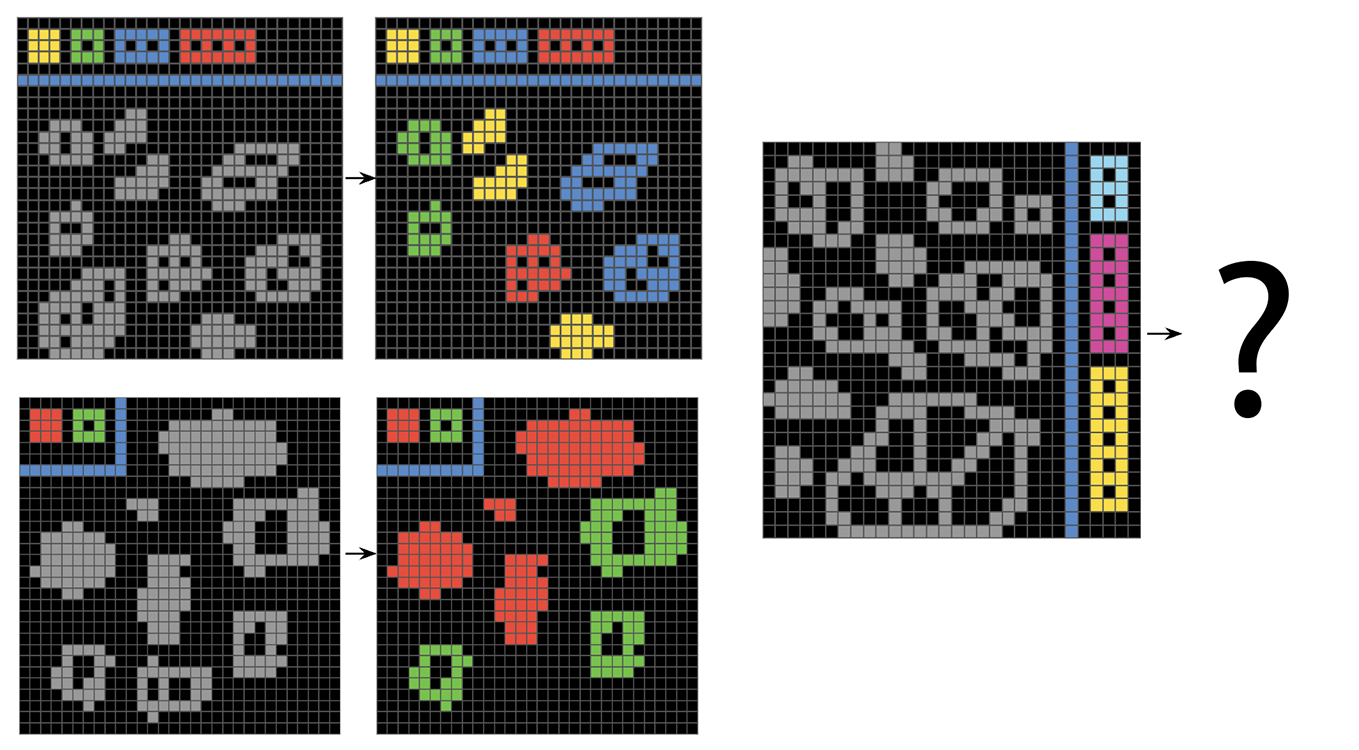
Humans still solved it at 100%.
Now comes ARC-AGI-3, released in late March 2026. And it changes everything about the format.
No Instructions. No Rules. Just Think.
ARC-AGI-3 is not a grid puzzle. It is an interactive, turn-based environment — effectively a video game with no manual. The benchmark paper describes it directly:
ARC-AGI-3 introduces interactive reasoning challenges that require exploration, planning, memory, goal acquisition, and alignment capabilities. - ARC Prize Foundation, ARC-AGI-3: A New Challenge for Frontier Agentic Intelligence, arXiv:2603.24621 (2026)
Here is what that means in practice. You are dropped into a small abstract environment. You see some objects, maybe a character, maybe a bar that might represent movement or health. You get zero information about the objective. You have a limited number of turns. Your job is to figure out what is happening, why, and what you need to do — purely through exploration and real-time inference.
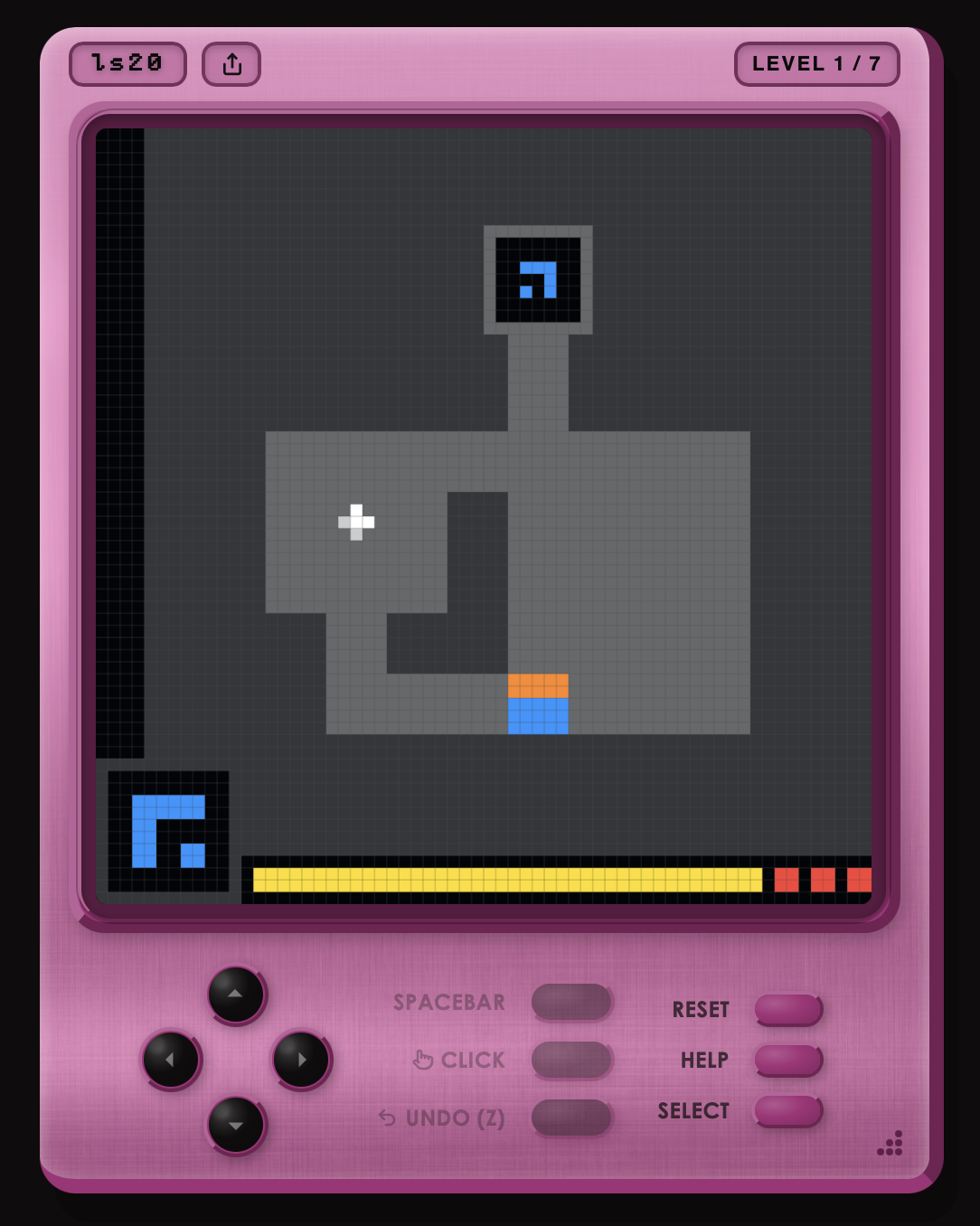
It is the kind of task that exercises what researchers call fluid intelligence: the ability to reason through genuinely novel situations without relying on prior training or memorized answers.
When humans play, they make rapid inferences. They notice a bar going down with each move and hypothesize it is a turn counter. They spot that a symbol in the corner matches one in the environment and guess it represents a destination. They try things, learn from feedback, adjust their mental model, and solve the puzzle in minutes.
Frontier AI models, given direct API access and the full game state, scored as follows as of March 2026: Gemini 3.1 Pro Preview at 0.37%, GPT 5.4 at 0.26%, Claude Opus 4.6 at 0.25%, and Grok-4.20 at 0.00%.

The best-performing human test-takers solved 100% of environments, with no prior knowledge and no instructions.
What the Gap is Actually Telling Us
I have spent over 20 years working on large-scale AI and data systems. I have architected platforms that use machine learning for product classification, multilingual content generation, and automated reasoning. I have watched AI capabilities grow in ways that genuinely surprised me. But the ARC-AGI-3 results are not surprising at all - they are clarifying.
Modern AI systems, even the most powerful ones, are extraordinarily good at retrieving, recombining, and reasoning within domains they have been trained on. They have crystallized intelligence in abundance. Give them a coding problem, a legal brief, or a math proof that resembles something in their training data, and they perform remarkably. That performance has real economic value. I use these systems daily, and the productivity gains are significant.
But what they lack is the ability to build a working mental model of a completely new situation from scratch, with no priors and no feedback loop except the results of their own actions.
That is exactly what ARC-AGI-3 demands. And it exposes a genuine gap in how today's models work.
The ARC Prize 2025 technical report puts it plainly:
Current frontier AI reasoning performance remains fundamentally constrained to knowledge coverage. - Chollet et al., ARC Prize 2025: Technical Report (2026)
When you strip away knowledge coverage — when you put a model in an environment it has never seen, with no language, no hints, and no training signal — the scaffolding falls away. What is left is not intelligence as we understand it in humans. It is sophisticated pattern matching running in the dark.
Why This Benchmark Hits Differently
Every other major AI benchmark has the same structure: it is hard for the best humans, and then AI eventually beats the best humans. It takes the top coders, the top mathematicians, the top scientists — and then a model outperforms them.
ARC-AGI is inverted. The average human passes. The best AI in the world fails.
That asymmetry is the entire point.
It means you cannot close the gap by just scaling compute or adding more training data. The benchmark was explicitly designed to resist that approach. Refinement loops - where a model iteratively improves its answer using a feedback signal — helped push ARC-AGI-2 scores significantly. But ARC-AGI-3 breaks that too, because the environments are unique every time, and there is no correctness signal until you actually play the game through your own actions.
The ARC Prize Foundation has placed a $2 million prize on the table for any solution that matches human performance on the benchmark.
Mike Knoop, co-founder of the ARC Prize Foundation, framed the stakes plainly on the ARC Prize website:
AGI is the most important technology humanity will create, and we believe it is achievable in our lifetime. But ARC shows us we still need new ideas. -- Mike Knoop, arcprize.org
That honesty is rare in this industry. Most AI discourse oscillates between breathless optimism and existential dread. The ARC benchmarks simply measure something specific and let the numbers speak.
What Needs to Change for AI to Actually Pass This
ARC-AGI-3 points at several capabilities that today's architectures do not have in sufficient depth: the ability to form and update an internal world model in real time, plan across a sequence of steps with incomplete information, and stay goal-directed when the goal itself is not given to you.
These are not just academic challenges. They are the same challenges that limit how useful AI agents are in real-world enterprise deployments today. An agent that can only operate in well-defined, known domains is a powerful tool but a narrow one. An agent that can reason in novel environments is something categorically different.
The field knows this. The emergence of agentic AI, test-time computation, and new training paradigms all represent serious attempts to close this gap. But the ARC-AGI-3 leaderboard suggests the gap is still enormous.
The Simplest Test is Still the Hardest One
There is something almost humbling about this benchmark from a technical standpoint. No specialized knowledge. No language. Just the same cognitive primitives a four-year-old already has.
A child looks at a video game with no instructions and figures it out by trying things, paying attention, and updating their understanding as they go.
That is what intelligence looks like in action.
The frontier models of 2026 have absorbed more information than any human could read in a thousand lifetimes. And yet, in front of a simple grid game with no manual, they fail.
ARC-AGI-3 is not measuring how much AI knows. It is measuring whether AI can think. And right now, the honest answer is: not yet.
You can try the benchmark yourself at arcprize.org. The game is free to play. If you solve it in under a minute, you are already beating every AI lab in the world.
If you found this article useful, give it some likes and share it with someone who thinks AI has already figured everything out.
Follow me on LinkedIn or my blog for more writing on AI architecture, enterprise intelligence systems, and what the benchmarks are actually telling us.
Opinions expressed by DZone contributors are their own.
Comments