

Toying With Kotlin’s Context Receivers
Kotlin added the idea of Context Receivers in version 1.6.20. In this post, I'd like to toy with them to understand how useful they can be.
Join the DZone community and get the full member experience.
Join For FreeKotlin added the idea of Context Receivers in version 1.6.20. In this post, I'd like to toy with them to understand how useful they can be.
Note that if you want to play along, you'll need to compile with the -Xcontext-receivers flag.
The main idea behind context receivers is to pass additional parameters to a function without having to do it explicitly.
A Simplified Model Sample
Let's start with a simple example to show how it works. We want to model a simple transfer operation between two bank accounts. Accounts balance is stored in a database, and respective credit/debut operations must be transactional.
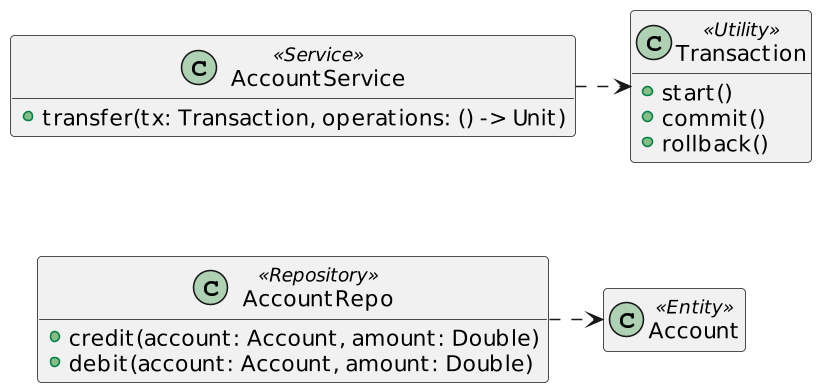
Let's focus on the AccountService.transfer() function. It requires a Transaction instance that wraps several operations:
class AccountService {
    fun transfer(tx: Transaction, vararg operations: () -> Unit) {
        tx.start()
        try {
            operations.forEach { it.invoke() }
            tx.commit()
        } catch (e: Exception) {
            tx.rollback()
        }
    }
}
We can call the above code as:
val service = AccountService()
val transaction = Transaction()
val repo = AccountRepo()
service.transfer(
    transaction,
    { repo.credit(account1, 10.5) },
    { repo.debit(account2, 10.5) }
)
Improving the Code With Extension Functions
We can slightly improve the above code by making use of extension functions. Instead of defining the Transaction as a parameter to the transfer() function, we can migrate the latter to an extension function.
class AccountService {
    fun Transaction.transfer(vararg operations: () -> Unit) {
        start()                                                    // 1
        try {
            operations.forEach { it.invoke() }
            commit()                                               // 1
        } catch (e: Exception) {
            rollback()                                             // 1
        }
    }
}
1. Implicit this References the Transaction Object
Within the context of an AccountService, we can now call the transfer() function on an existing Transaction.
with(service) {                               // 1
    transaction.transfer(                     // 2
        { repo.credit(account1, 10.5) },
        { repo.debit(account2, 10.5) }
    )
}
2. Bring the service instance in scope so it's valid to call transfer on the transaction object.
One can analyze the new calling code from two different viewpoints:
- The raw number of characters typed is less: it's more concise.
- The semantics are radically different, though. The new code means that in the context of an
AccountService, we can calltransfer()on an existingTransactionobject.
I think the semantics are wrong: it should be the opposite. In the context of Transaction, we should be able to call transfer() on an existing AccountService object:
with(transaction) {
    service.transfer(
        { repo.credit(account1, 10.5) },
        { repo.debit(account2, 10.5) }
    )
}
IMHO, conciseness has very little value compared to the cost of wrong semantics. Unfortunately, with the current language constructs, fixing semantics means we would need to move the transfer() function to Transaction. It would be lousy modeling as the transfer is the responsibility of the service.
Context Receivers to the Rescue
As I mentioned in the introduction, the idea behind context receivers is to somehow "pass" function parameters without being explicit about them.
context(Foo, Bar, Baz)
fun myfunction() {}
To call such a function, one needs to bring an object of each contextual type "in scope." We can achieve it with the with function:
val foo = Foo()
val bar = Bar()
val baz = Baz()
with(foo) {                     // 1
    with(bar) {                 // 2
        with (baz) {            // 3
            myfunction()        // 4
        }
    }
}- Bring
fooin scope. - Bring
barin scope. - Bring
bazin scope. - Call the function.
While the code above compiles, it's only applicable if we use the contextual objects. The calling syntax is the same as the one of lambdas with receiver:
context(Foo, Bar, Baz)
fun myfunction() {
    println(this@Foo)
    println(this@Bar)
    println(this@Baz)
}
We use context receivers to be able to write code using the wanted code:
class AccountService {
    context(Transaction)
    fun transfer(vararg operations: () -> Unit) {
        start()                                   // 1
        try {
            operations.forEach { it.invoke() }
            commit()                              // 1
        } catch (e: Exception) {
            rollback()                            // 1
        }
    }
}- Implicit
thisreferences theTransactionobject. We don't need to qualify further with the class name as there's no other context object.
We can now call the code accordingly, with the correct semantics:
with(transaction) {                               // 1
    service.transfer(                             // 2
        { repo.credit(account1, 10.5) },
        { repo.debit(account2, 10.5) }
    )
}- Bring
transactionin scope. - Use the
transactionobject in scope.
Discussion
Context receivers allow us to implement the API with the correct calling code semantics. It's not possible without them.
I've dabbled only a bit in Scala, but I've always found Scala 2's implicit poorly implemented. To bring an object in scope, you only need an import at the top of the file, which might be very far from where it's used. It makes understanding the code much harder and increases maintenance costs. Scala 3 has made the implicitness much more explicit and fixed some of my grievances.
I believe that Kotlin's implementation is much saner. You achieve scoping in context receivers with with, which brings the context close to the call site and signals it with a code block.
However, it's not all unicorns and rainbows. In particular, I'm a bit worried that context receivers will be abused. Granted, it's generally the case for every new feature for every language. Yet, I feel the potential for abuse is enormous with this one. Only the future will tell.
In the meantime, I'm curious to see more different usages of context receivers and what patterns they can unlock.
To go further:
Published at DZone with permission of Nicolas Fränkel. See the original article here.
Opinions expressed by DZone contributors are their own.
Comments