

Turbocharging Development: The Force of Automation Testing
The primary objectives of automation processes are to shorten production times, improve production accuracy, and reduce the need for human labor.
Join the DZone community and get the full member experience.
Join For FreeWhat's the significance here to automating testing? To comprehend the definition, we must comprehend that automation testing is a process. Automation is the most common way of fostering innovation that can be utilized to make items and administrations. This methodology presently considers the observation of the creation that was recently done by people.
Transportation, production, data innovation, office executives, and numerous different areas can all profit from mechanization as a technique. The primary objectives of automation processes are to shorten production times, improve production accuracy, and reduce the need for human labor.
What Exactly Is Automated Testing?
Automated testing assesses programming things with specific testing structures and devices to expand quality while limiting human inclusion. Software that directs the execution of written test scripts is used in automation testing. They are then compared to the expected results to verify the app's accuracy and dependability.
Along these lines, one can do critical, tedious exercises and those that are attempting to do manual testing by using motorization testing.
For What Reason Are Automation Testing Services Required?
For what reason do we want automation testing? Indeed, an item that a business creates will unavoidably have imperfections. To ensure a seamless customer experience, the company must identify any issues before releasing the product. The testing group uses different utilitarian and non-practical testing methodologies to guarantee the general item's dependability, adequacy, and improved client experience.
Even though analyzers do both manual and automated testing, testing requires less human work and yields more dependable outcomes. It saves a ton of time, which assists the item with being conveyed more quickly!
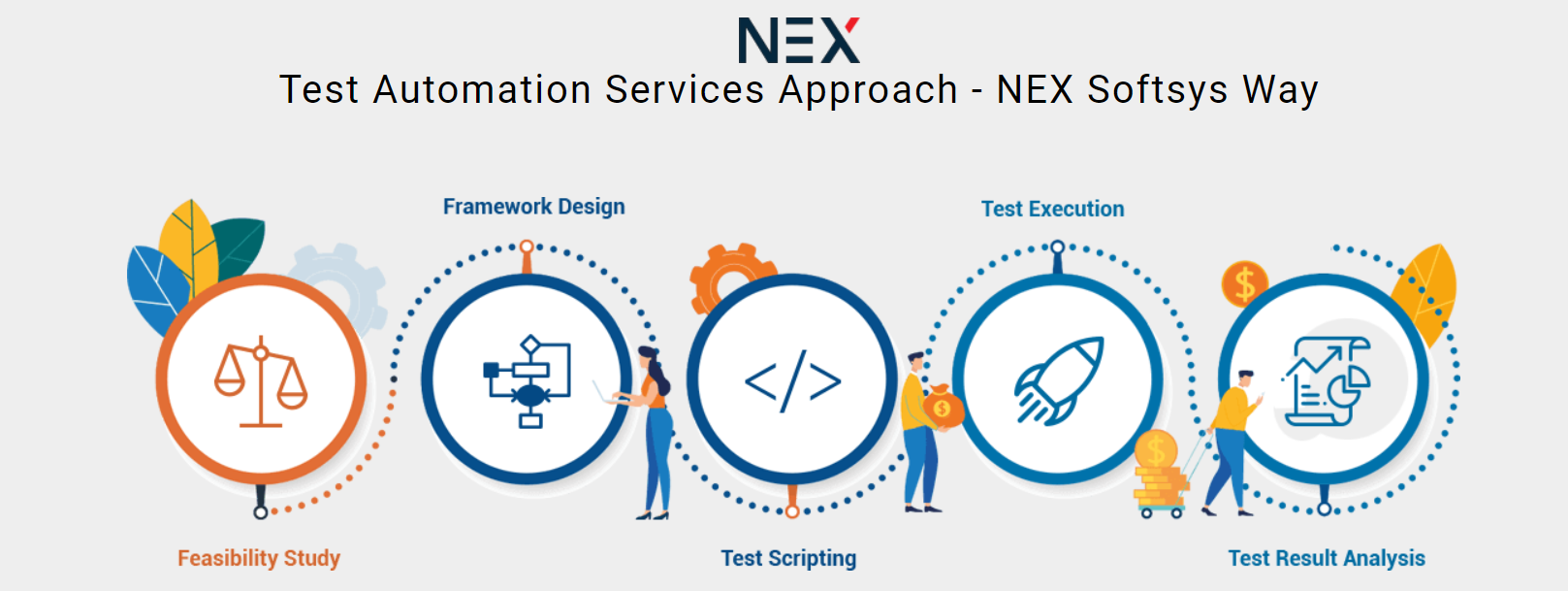
Phases of Automating Testing Services
The phases of an automatic testing service process are as per the following:
1. Test Device Determination
For automation to find success, choosing the fitting apparatus in light of the sort of test included is urgent. Picking the proper instruments for code-driven testing, process-based testing, or graphical UI-based testing is fundamental. The project's requirements, programming abilities, budget, and decision about whether to use a free or paid tool, among other things, play a part in the device determination process.
2. Characterize the Extent of Automatic
The extent of mechanization testing alludes to the piece of your application being tested that will be automated. The scope is determined by the following factors: the factors that are necessary for the business's success in scenarios involving a large amount of data, the features shared by multiple apps, and the possibility, from a technological point of view, of having a proportion of recycled business components.
3. Arranging, Planning, and Advancement
One should pick what a mechanized test would do after settling on the point and the testing type as automatic. To start with, separate the experiments into more modest, legitimate tests. Then, make test scripts and test suites, which are run consecutively through computerization. By creating a test with numerous test cases in a framework resembling a library, this is accomplished.
4. Execution
During this stage, automation scripts for test execution are run. The contents require test input before they can be set up to execute. After running, they produce exhaustive test discoveries. The automation tool can be used directly or launched by the test management tool. For other tests to use the report as a reference, a comprehensive report on each test must be created after the final execution.
5. Maintenance
Each cycle requires new, refreshed, and kept up with mechanization scripts. For example, after writing code, we check it to see if it has any bugs or fails. Thus, we find the hazardous code segment, right it, and run the whole program without any preparation. As a result, automation scripts are more necessary because maintenance is so important.
Various Sorts of Automated Testing Services
In the accompanying area, we should find out about the various kinds of automatic testing services.
Smoke Testing
This test is referred to as a "smoke test" because it ensures that the software can be evaluated further without risking starting a fire. The software's stability and functionality are checked with smoke tests. If the application doesn't satisfy that guideline at this stage, it ought to be sent back to the improvement group.
Unit Testing
As its name suggests, this step includes testing every one of the product's different parts or pieces. Before sending the product to testers, the very first stage of testing, known as unit testing, is typically carried out manually by developers. However, it is also possible for it to be automated.
Combination Testing
The primary objective of coordination testing is to assess the different parts and modules of the program. It decides if every product reconciliation fulfills the arrangement's utilitarian prerequisites. The interactions between each integration are examined in this testing procedure.
Functional Testing
A software system's compliance with functional specifications and requirements is verified through a method of software testing known as functional testing. Each capability of the product program is tried using utilitarian tests, which include providing the right information and contrasting the result with the practical prerequisites.
Catchphrase Testing
The primary objective of catchphrase-driven testing is to connect a specific term or gathering of watchwords to a specific arrangement of activities. At the point when a watchword is used, it concludes whether the arranged activity is done. Since it is versatile, reusable, and easy to utilize, word-driven testing is popular even with non-specialized clients.
Relapse Testing
This test guarantees that an application has been suitably refreshed with new usefulness, elements, or code. Every time a program is changed in any way, regression testing is used. It checks to see if the new change causes the application to work as intended.
Data-Driven Testing
The data for each test case is typically stored separately in a table or spreadsheet. You waste time and resources each time you create new data. Data-driven testing implies that various test cases use the same data. By encouraging code reuse, this procedure is made simpler.
Black-Box Testing
The product testing strategy known as "black box testing" is one in which the analyzers know nothing about the inward functions of the program being tried. Black box testing gets its name from the fact that the analyzer knows nothing about anything inside the product being tried.
Different Automatic Tools Available in the Market
While the test automation apparatus market is overflowed with both paid and neglected choices, recorded beneath are the absolute most broadly utilized test robotization instruments that anyone could hope to find:
- Selenium: Selenium is a test automation tool that is freely available. It boasts a substantial and active community. It allows scripting in a variety of languages, including Java, Python, Ruby, Javascript, C#, and others, and has the largest market share of all the well-known tools.
- TestProject: Tricentis' TestProject is a free local area-driven mechanized testing stage. It is possible to automate mobile and web applications with it.
- Ranorex: A paid instrument with record and playback highlights. This permits us to robotize applications for Android, iOS, and Windows. It supports scripting with VB and C# scripts in addition to recording and playback.
- Tosca: A business arrangement from Tricentis offers record and playback capacities for computerizing Windows programs, web applications, and APIs. It is regarded as one of the most popular technologies for codeless automation, which may eliminate scripting.
- UFT One: A superior miniature center item can computerize Windows and Web applications. This instrument supports only scripting in VBScript.
How To Select The Best Test Automation Software
The elements expressed underneath ought to be searched for while picking a mechanization apparatus.
- Assistance for the Environment Database Testing for Object Identification, Images, and Error Recovery Support for Multiple Frames to Minimize the Costs of Comprehensive Test Reports.
- Easy to understand
- Information base Approval
- Support for an assortment of test sorts, for example, useful, test the board, versatile, and that's just the beginning.
- Primary concern
Conclusion
You presently find out about automatic testing services, how they differ from manual testing, how they benefit organizations, the kinds of automatic testing, etc. As a result of improving their markets, every industry is increasingly utilizing automated processes daily. The approach contributes to time savings, lower production costs, and increased productivity.
Opinions expressed by DZone contributors are their own.
Comments