

Understanding Agentic SDLC: The Future of Software Engineering
This article walks you through the fundamentals of agentic SDLC, its core components, and how it works in modern software engineering.
 CORE
·
CORE
·
Join the DZone community and get the full member experience.
Join For FreeAgentic SDLC, or agentic software development life cycle, is the next major shift in how I think about building and shipping software. It is not simply AI writing a few lines of code inside an IDE. It is an end-to-end approach where specialized AI agents participate across planning, implementation, testing, review, deployment, monitoring, documentation, and continuous improvement.
The core idea is straightforward: I set the goal, the priorities, guardrails, and approval points. Agents do the operational work, hand context to one another, and help move a feature through the pipeline with far less manual coordination. The result is not removing developers from engineering. It is allowing developers to spend more time on decisions that actually require judgment.
How We Reached the Agentic SDLC Era
Software delivery has been evolving for a long time. Every major methodology solved a real problem, but each one also left gaps that created the need for the next approach.
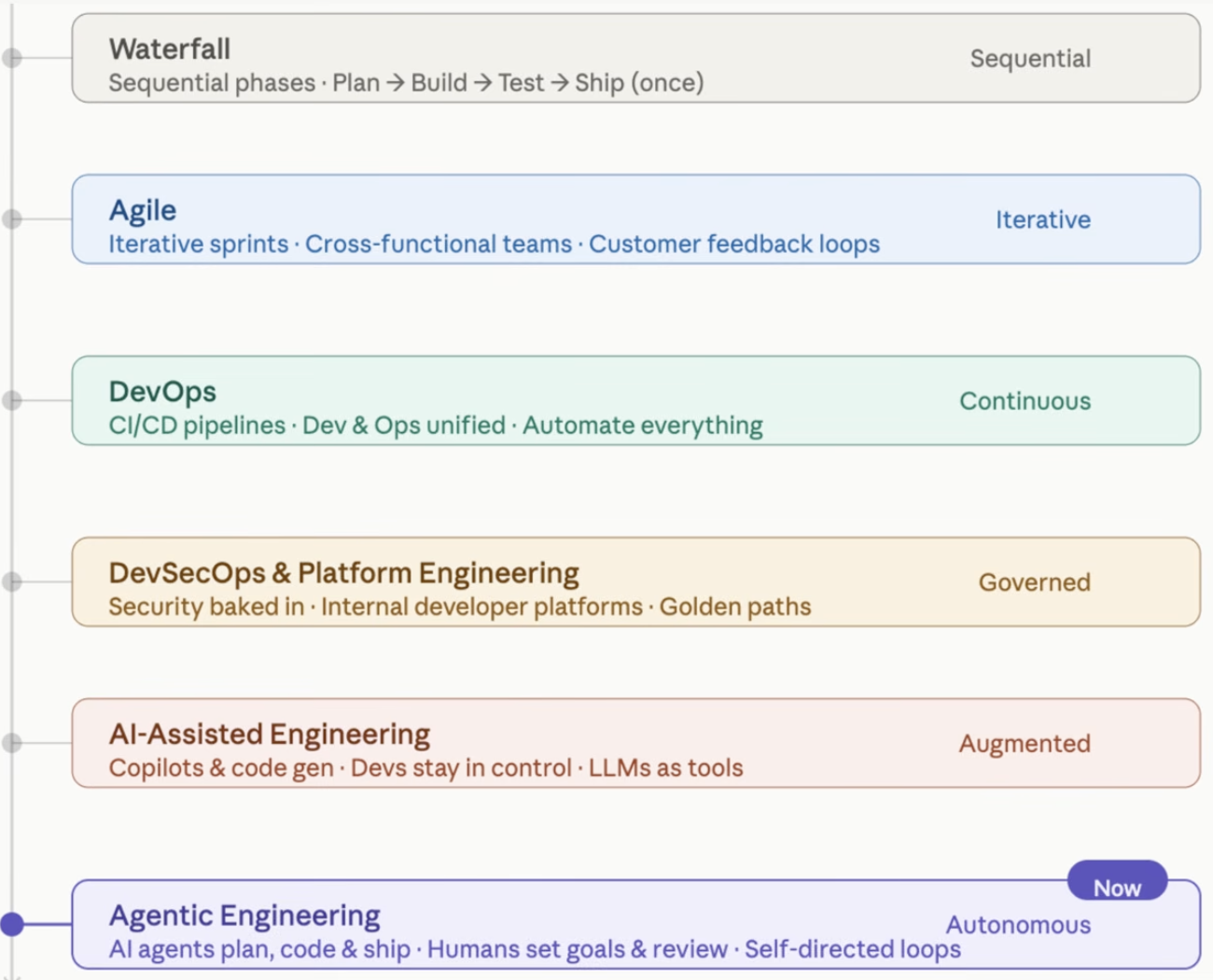
Waterfall: A Sequential Model With Limited Feedback
The waterfall model organized software work into sequential phases: requirements, planning, build, testing, and release. It gave teams a structured process, but it also made change expensive. If something failed halfway through, or if a customer needed a new feature, going backward was difficult because every step depended on the previous one.
There were few meaningful feedback loops between teams. Requirements could become outdated before the product was ready, and delivery was often slow because every phase waited for the earlier phase to finish.
Agile: Faster Learning Through Iteration
Agile introduced iterative sprints, cross-functional collaboration, and regular customer feedback. This was a major improvement. Teams could incorporate changes instead of treating them as disruptions, and product development became more adaptive.
But agile alone did not eliminate operational bottlenecks. Even when teams planned in short sprints, getting a feature through infrastructure provisioning, testing, releases, and production support could still take weeks or months.
DevOps and DevSecOps: Breaking Down Delivery Silos
DevOps helped bring development and operations together. It reduced the classic problem where an application worked perfectly on a developer machine but failed in production because of environment drift. CI/CD pipelines, infrastructure automation, and shared responsibility improved the path from code to release.
Then came the realization that security could not be an afterthought either. DevSecOps and shift-left practices pushed security concerns earlier into planning, implementation, testing, and deployment. Internal developer platforms also became important because they gave teams self-service access to common workflows and infrastructure capabilities.
AI-assisted engineering followed. Tools began helping with code generation, refactoring, test creation, code explanation, and review suggestions. That is useful, but it is only one portion of software delivery.
Why AI Coding Alone Is Not Software Delivery
This is the point that matters most: AI coding is not the same thing as an agentic SDLC Gen.erating code is valuable, but a real feature has a much larger journey.
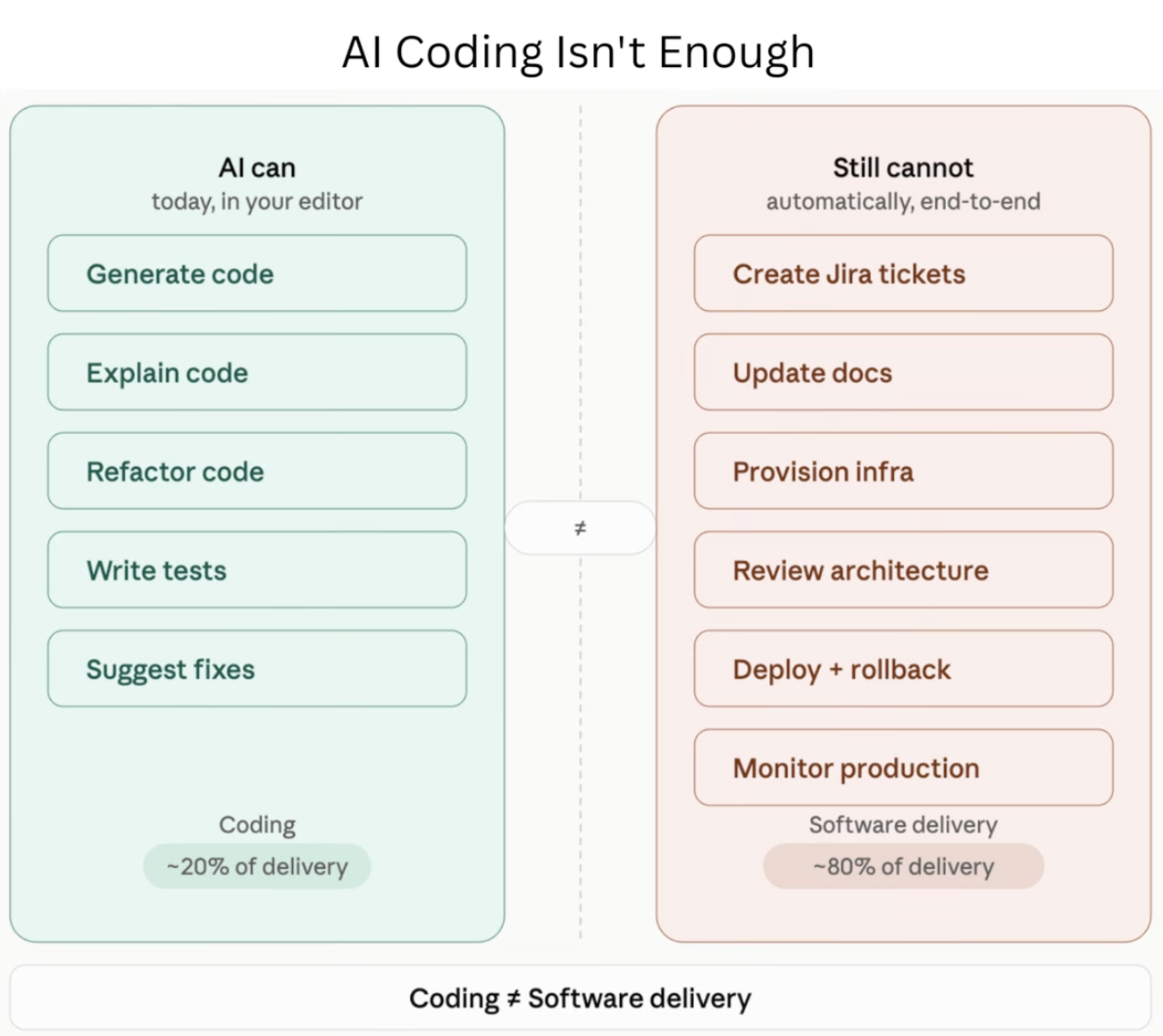
Outside the code editor, engineers still need to create and update work items, understand service ownership, gather requirements, review architecture, provision infrastructure, deploy safely, roll back failures, update documentation, and monitor systems in production. These tasks require constant context switching across issue trackers, source control, CI/CD systems, cloud tools, service catalogs, dashboards, and incident platforms.
On the coding side, AI can help me:
- Generate and explain code
- Refactor existing implementation
- Write tests
- Suggest fixes
- Review code changes
But the wider delivery process still includes:
- Creating and updating tickets
- Writing and maintaining documentation
- Provisioning infrastructure
- Reviewing architecture decisions
- Deploying and rolling back safely
- Monitoring production services
- Triaging incidents and learning from them
An agentic SDLC closes that gap. It connects autonomous, specialized work to the full engineering workflow instead of stopping at a pull request.
What an Agentic SDLC Looks Like
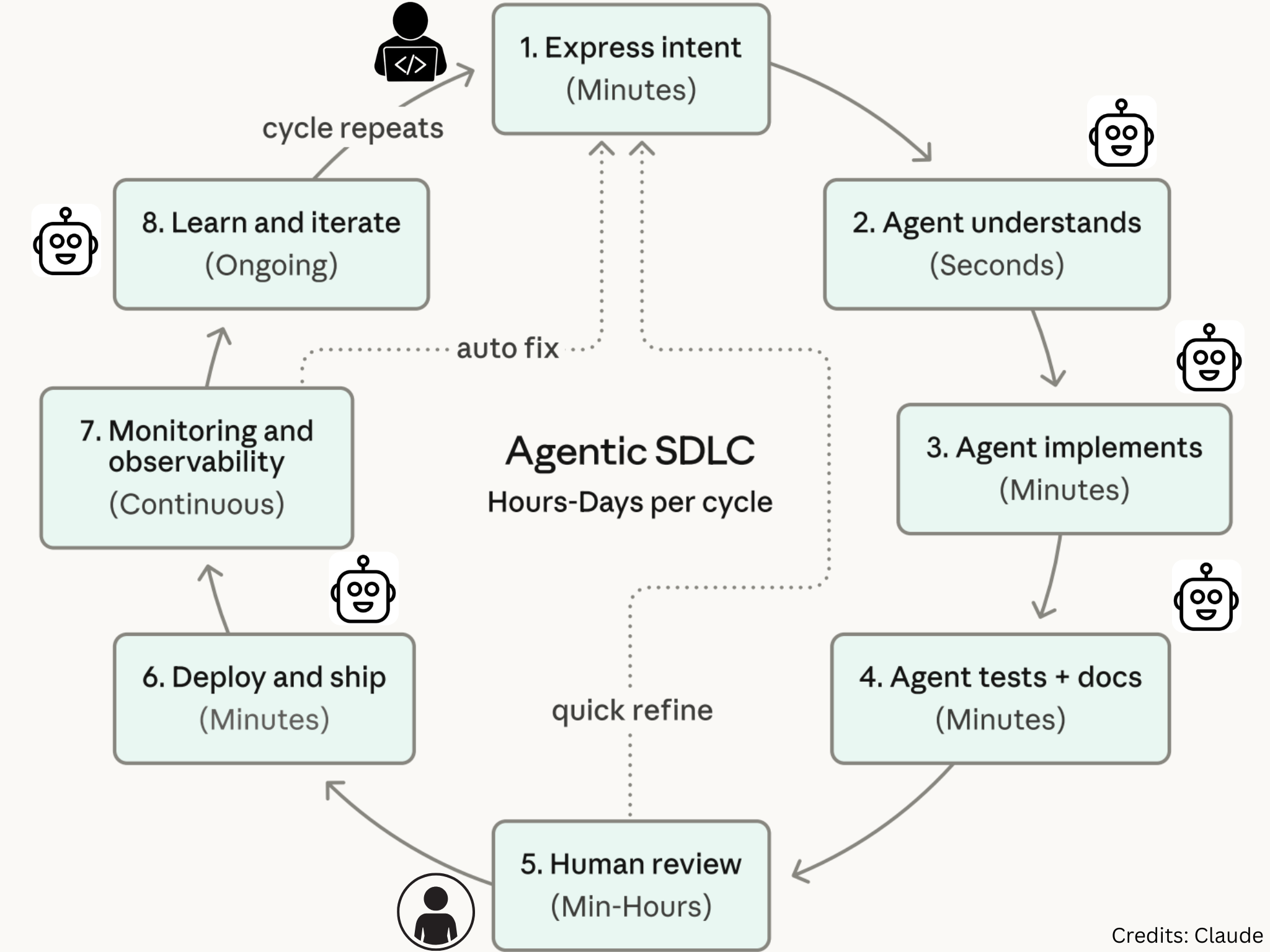
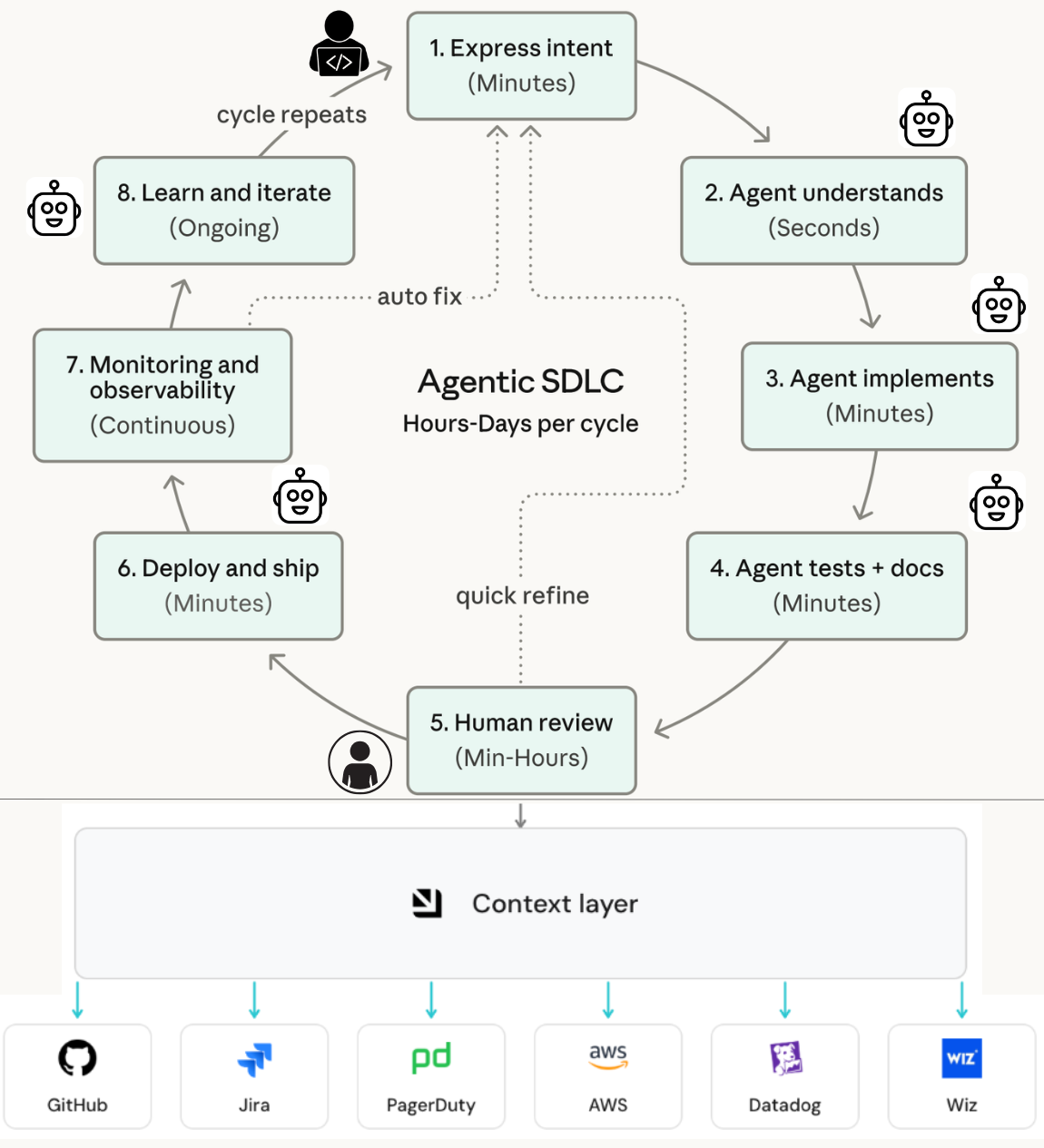
In an agentic SDLC, I begin with intent. I describe what I want to build, such as a feature request, an improvement, or a production fix. The system then uses context from the service, repository, platform, policies, and previous work to guide a series of agents.
A typical flow looks like this:
- Express intent: I define the feature, goal, or problem to solve.
- Understand context: The workflow retrieves service details, ownership, tier, scorecards, architecture information, and relevant policies.
- Plan: A requirements or planning agent produces requirements, acceptance criteria, estimates, implementation steps, and technical considerations.
- Build: A coding agent implements the required changes.
- Test and verify: Testing agents generate, execute, and repair tests where appropriate.
- Review: Human reviewers inspect plans, diffs, risks, and outcomes before key approvals.
- Deploy: CI/CD agents build, validate, and release the change through approved paths.
- Monitor and remediate: Monitoring agents observe production behavior and can trigger remediation or rollback workflows when something breaks.
- Learn and update context: Documentation, catalog data, and operational memory are updated for future work.
The important change is the flow of work. Traditional delivery is often based on slow human handoffs. An agentic SDLC enables agent-to-agent handoffs, with each stage passing structured context to the next stage without requiring a person to manually reconstruct the story.
The Four Layers That Make Agentic SDLC Work
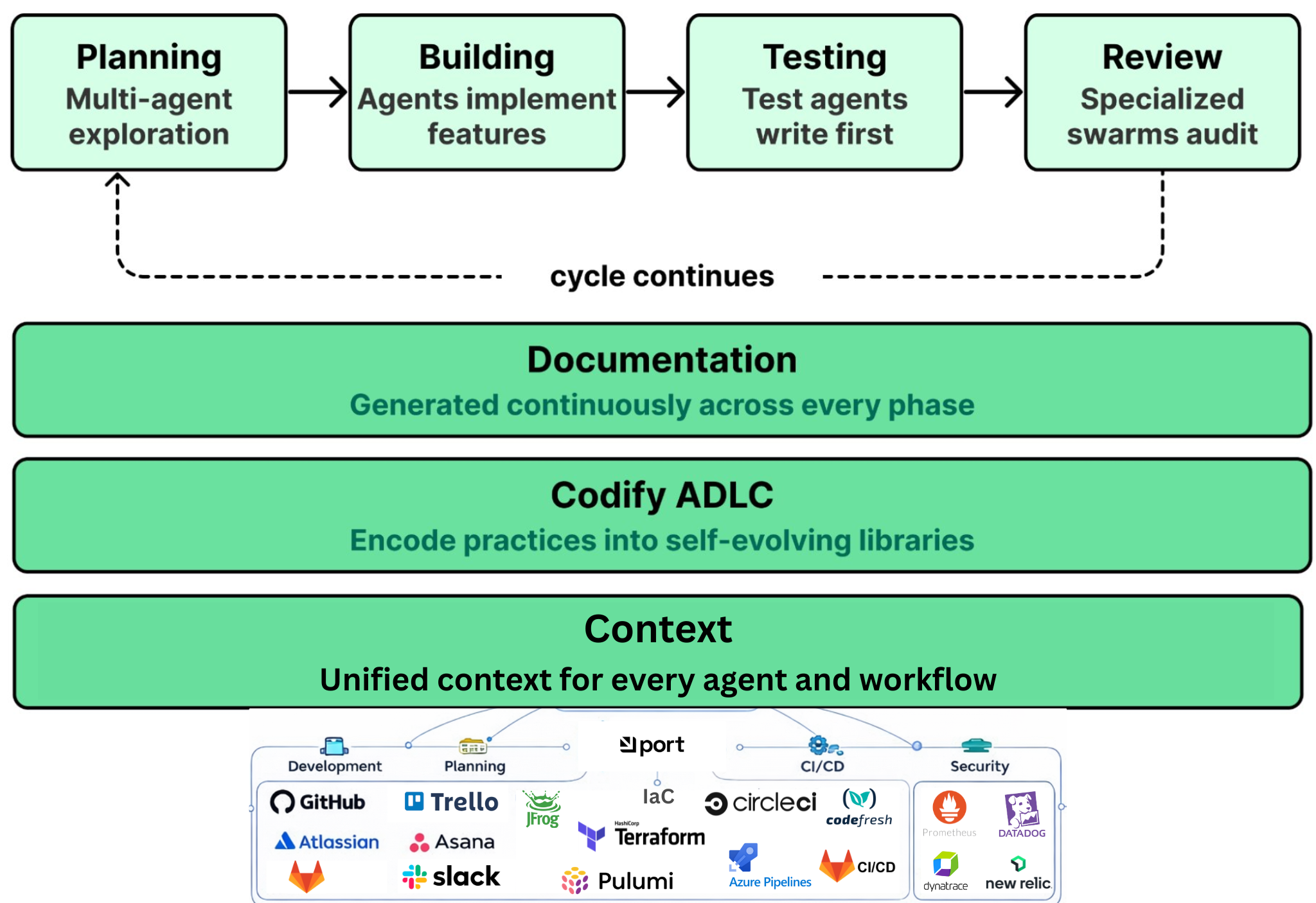
I think of the architecture in four connected layers.
1. Specialized Agents Across the Delivery Cycle
Planning, building, testing, and review are supported by agents with focused roles. A planning agent can behave like a technical lead. A coding agent can act like a senior engineer. A testing agent can focus on verification. A review agent can audit the work against defined standards.
Specialization matters because it prevents one broad agent from trying to do everything with shallow context. Each agent should have a clear responsibility, clear tools, and clear boundaries.
2. Documentation Generated Continuously
Documentation should not appear at the end of a project as an exhausted afterthought. In an Agentic SDLC, documentation is generated and refreshed alongside every delivery stage. Requirements, design decisions, release notes, service changes, and operational knowledge can remain connected to the work that created them.
3. Codified Engineering Practices
Teams already have standards, security requirements, review rules, and preferred ways of working. The opportunity is to encode those practices into reusable libraries, templates, workflows, and agent rules. This creates a self-improving engineering system rather than a collection of one-off prompts.
4. A Unified Context Layer
Context is the foundation of the whole model. Agents need to know which service they are working on, who owns it, how critical it is, what dependencies it has, what policies apply, and what has happened before. Without reliable context, agents can make incorrect assumptions and produce poor outcomes.
A service catalog and workflow orchestration platform can serve as this shared context layer. It connects agents to the actual state of the engineering environment instead of leaving them to operate from a vague prompt.
Humans Still Own the Decisions That Matter
I do not see the agentic SDLC as a system where humans disappear. Human oversight is essential. The real value comes from dividing work correctly.
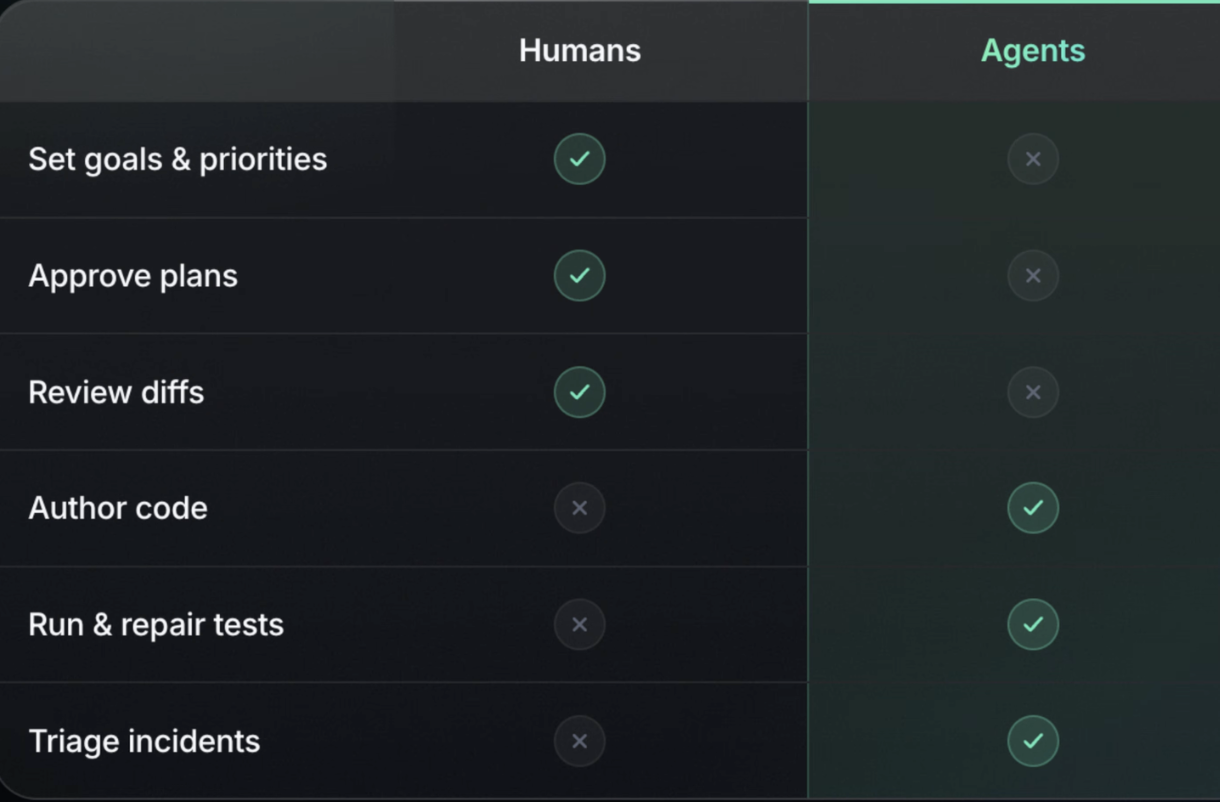
Humans should own:
- Setting goals and priorities
- Defining specifications and expected outcomes
- Designing security guardrails and engineering policies
- Approving plans
- Reviewing code diffs and important changes
- Providing final approval for release decisions
Agents can own:
- Producing implementation drafts
- Writing code and tests
- Running verification workflows
- Repairing straightforward test failures
- Creating supporting documentation
- Triaging incidents
- Updating service records and workflow outputs
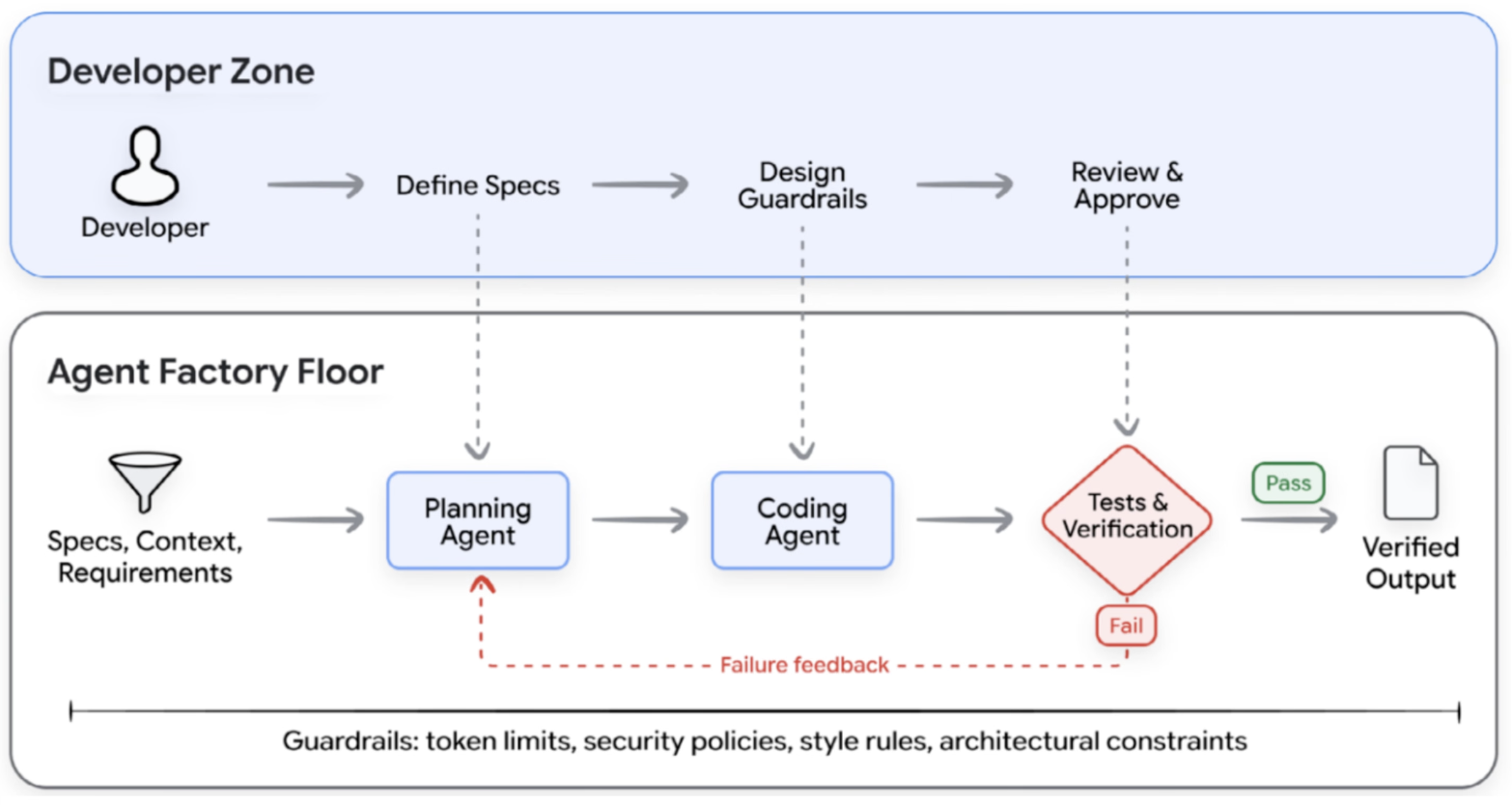
This is why the factory-floor metaphor makes sense. Above the factory floor is the developer zone, where I define the specification, security boundaries, and approvals. On the factory floor, specialized planning, coding, test, review, CI/CD, monitoring, and feedback agents execute the repeatable work.
The best agentic SDLC design includes deliberate human review gates. Automation should accelerate delivery, not bypass accountability.
A Practical Agentic SDLC Workflow
To make this concrete, I can build an Agentic SDLC workflow through a platform such as Port. Port can act as both a context layer and a workflow orchestration layer for developer and engineering operations.
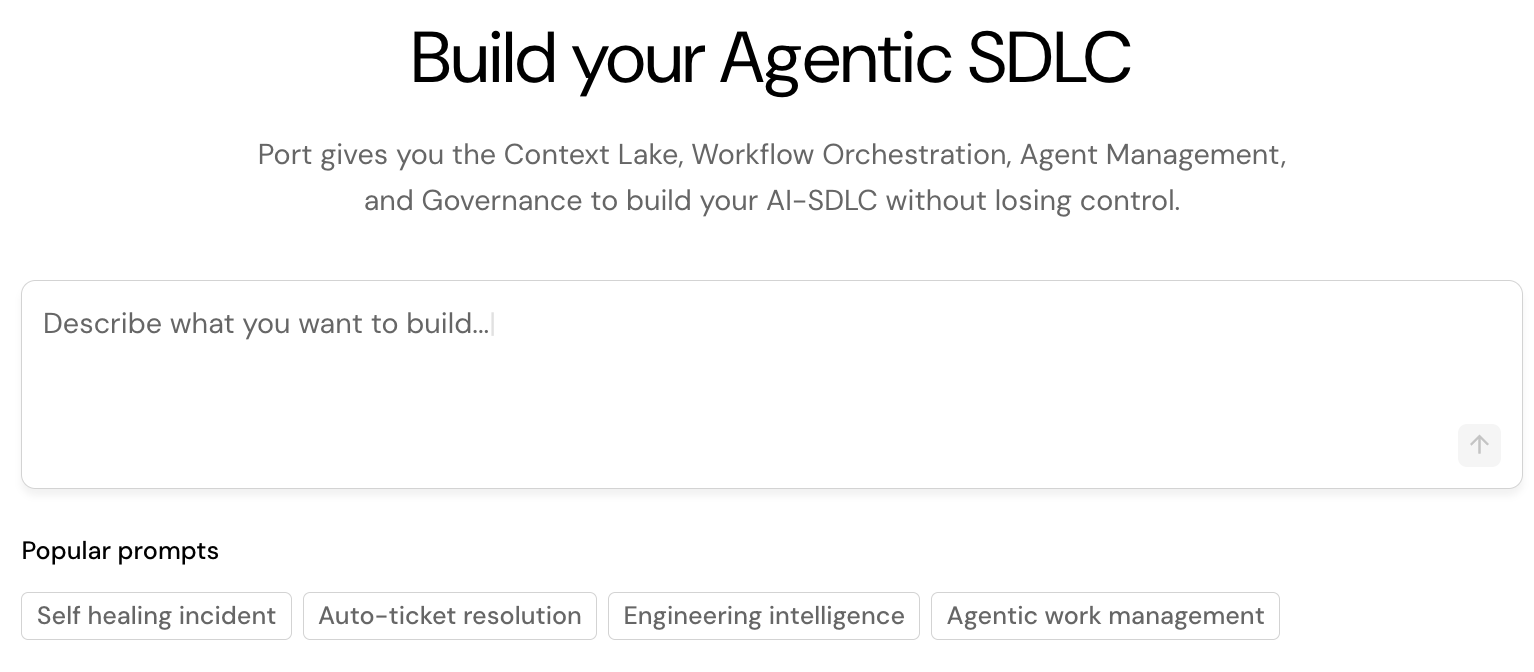
In Port, I have created a dashboard to show a demo of how agentic SDLC works.
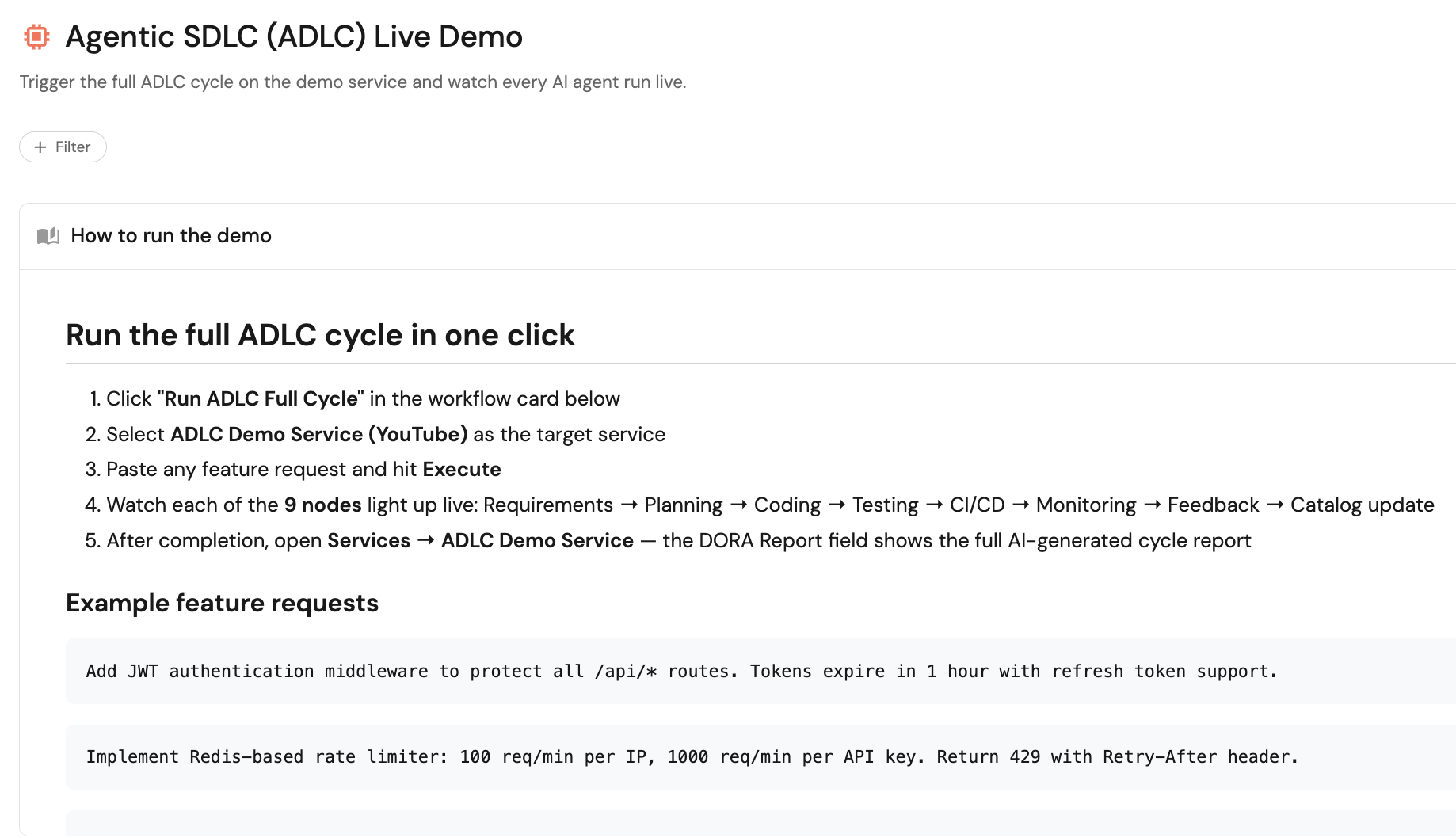
We have a complete workflow created for this.
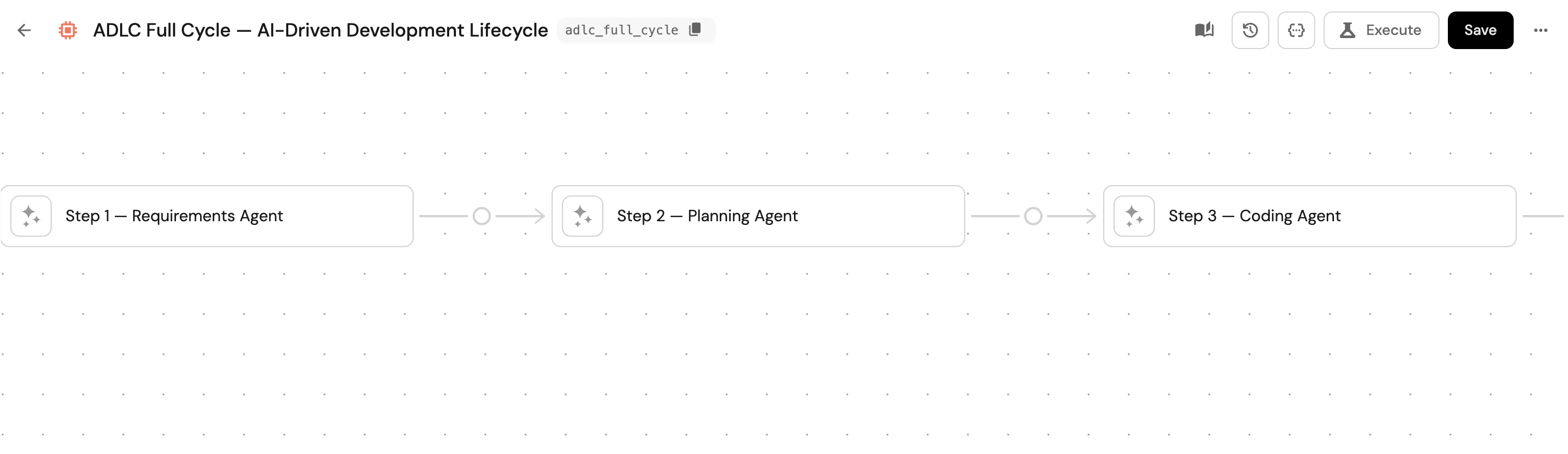
For a feature request, such as 'Add OpenTelemetry distributed tracing. Instrument all HTTP handlers and DB queries. Export to Jaeger', the workflow can follow this path:
- Fetch service context: Retrieve the service tier, team ownership, scorecard information, and catalog context.
- Requirements agent: Produce the problem statement, requirements, acceptance criteria, and relevant sizing information.
- Planning agent: Define a technical plan and identify the implementation approach.
- Coding agent: Write the required code changes.
- Testing agent: Create or run tests and surface failures.
- CI agent: Build and validate the change. If the build fails, notify the developer and stop the release path.
- Human review gate: Require a person to assess the work before deployment.
- CD or release agent: Deploy the approved change.
- Monitoring agent: Observe the service after release and detect incidents.
- Remediation and feedback: Roll back to a stable version when needed, record the outcome, and update the service catalog.
In this setup, each node has a defined responsibility. The requirements agent can operate with product and engineering thinking. The planning agent can take a technical-lead role. The coding agent can work as a senior engineer. The testing agent takes the QA role, CI/CD handles DevOps work, and monitoring takes the site reliability perspective.
That structure is what makes an agentic SDLC more reliable than a single generic AI assistant. Every stage receives the right context and has a clear output that becomes input for the next stage.
Start Small, Then Build the Full Agentic SDLC
I would not begin by trying to automate every possible activity. Start with one high-friction workflow that has clear inputs, repeatable steps, and measurable outcomes.
- Automatically tag new pull requests
- Create a work item when a CI build fails
- Generate release documentation
- Run a structured pull-request review workflow
- Trigger incident triage with service ownership context
- Provision a known infrastructure pattern with an approval gate
From there, connect workflows into a fuller agentic SDLC. The goal is not to add AI everywhere just because it is available. The goal is to remove unnecessary handoffs, reduce context switching, preserve engineering standards, and keep human judgment where it has the greatest value.
The Future Is an Engineering System That Learns
The biggest promise of an agentic SDLC is not just faster code generation. It is a software delivery system that can continuously learn from its own work. Every approved plan, release, incident, rollback, and documented decision can improve the context available for the next request.
That is how teams move from isolated automation toward a real engineering operating model. Developers continue to define intent, set priorities, create guardrails, and approve important decisions. Agents take on the repetitive execution across the lifecycle.
Agentic SDLC is where software delivery becomes more fluid, more contextual, and more autonomous, while still remaining firmly under human control.
Published at DZone with permission of Pavan Belagatti. See the original article here.
Opinions expressed by DZone contributors are their own.
Comments