

The Twelve-Factor Agents: Building Production-Ready LLM Applications
This article delves into the concept of the Twelve-Factor Agent, an architectural pattern designed to create robust, scalable, and maintainable applications.
 CORE
·
CORE
·
Join the DZone community and get the full member experience.
Join For FreeAfter exploring and publishing articles around observability tools and architectural patterns related to AI Agents, I came across an interesting talk by Dex Horthy on YouTube and the Twelve-Factor Agent. This article delves into the concept of the Twelve-Factor Agent, an architectural pattern designed to create robust, scalable, and maintainable applications, particularly in the context of modern cloud environments. We will explore the core principles of this approach and how they contribute to building applications that are well-suited for deployment and operation in dynamic and distributed systems.
The rise of large language models (LLMs) has created unprecedented opportunities for building intelligent applications, but it has also introduced new challenges for software engineering. The Twelve-Factor Agent methodology represents a set of principles for building LLM-powered software that's reliable enough to put in the hands of production customers, drawing inspiration from the original Twelve-Factor App methodology by Heroku.
The Twelve-Factor App methodology, originally outlined in 2011, provides a set of best practices for building software-as-a-service (SaaS) applications. While initially focused on web applications, its principles are broadly applicable to any application designed for deployment in a modern, cloud-native environment. The Twelve-Factor Agent extends these principles by focusing on the agent component of a distributed system, ensuring that it adheres to the same standards of robustness, scalability, and maintainability.
After trying every framework out there and talking to many founders building with AI, the key insight is that most "AI agents" that make it to production aren't actually that agentic. The best ones are mostly just well-engineered software with LLMs sprinkled in at key points. This methodology addresses the gap between prototype AI systems and production-ready applications.
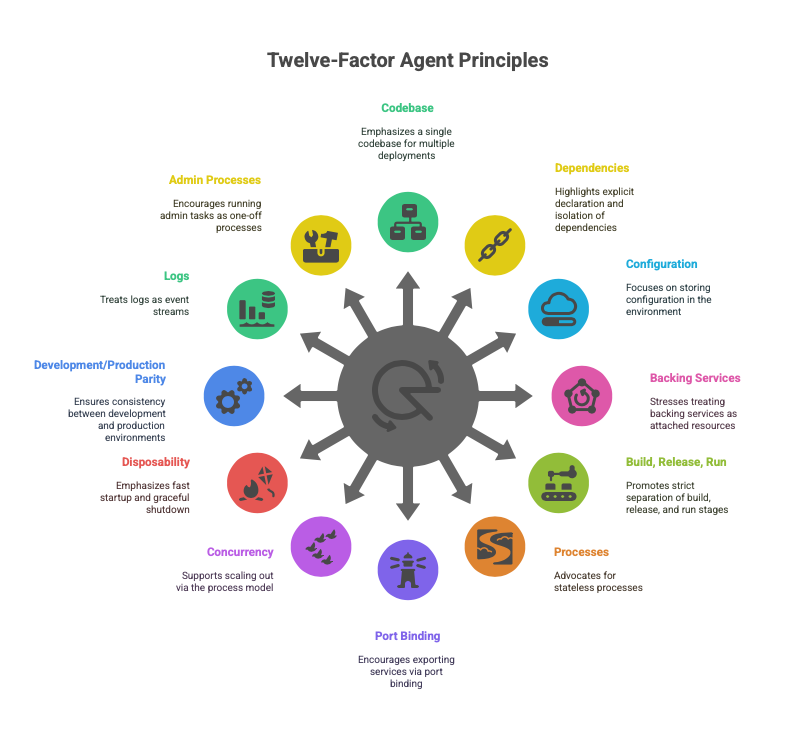
Mapping Twelve-Factor Agents to Twelve-Factor Apps
The Twelve-Factor Agents methodology adapts the proven principles of the original Twelve-Factor App for the unique challenges of LLM-powered applications. Here's how they map:
1. Codebase → Single-Purpose Agents
Original Twelve-Factor App: One codebase tracked in revision control, many deploys
Twelve-Factor Agents: Each agent should have a single, well-defined purpose
Instead of monolithic AI systems that try to do everything, production-ready agents focus on specific tasks. This mirrors the microservices approach but applies to AI functionality.
Example:
- Traditional App: A single codebase for an e-commerce platform
- Agent Application: Separate agents for customer service, inventory management, and recommendation engines
2. Dependencies → Explicit Dependencies
Original Twelve-Factor App: Explicitly declare and isolate dependencies
Twelve-Factor Agents: Declare all model dependencies, API versions, and tool requirements explicitly
LLM applications must explicitly declare model versions, API endpoints, and tool dependencies to ensure reproducible behavior.
Example:
- Traditional App:
requirements.txtspecifying Python package versions - Agent Application: Configuration specifying OpenAI API version, model names (gpt-4-turbo-2024-04-09), and tool schemas
3. Config → Configuration Management
Original Twelve-Factor App: Store config in the environment
Twelve-Factor Agents: Separate configuration from code, including prompts and model parameters
Agent behavior should be configurable through environment variables, not hardcoded in the application.
Example:
- Traditional App: Database URLs in environment variables
- Agent Application: Model temperatures, system prompts, and tool configurations in environment variables
4. Backing Services → External Tool Integration
Original Twelve-Factor App: Treat backing services as attached resources
Twelve-Factor Agents: Treat external APIs, databases, and tools as swappable resources
Agents should integrate with external services through well-defined interfaces that can be easily swapped or mocked.
Example:
- Traditional App: Database connections through environment variables
- Agent Application: Payment processors, email services, and CRM systems as pluggable tools
5. Build, Release, Run → Deterministic Deployment
Original Twelve-Factor App: Strictly separate build and run stages
Twelve-Factor Agents: Ensure reproducible agent behavior across environments
Agent deployments should be deterministic, with clear separation between build-time and runtime configurations.
Example:
- Traditional App: Docker containers with immutable builds
- Agent Application: Frozen model weights, versioned prompts, and deterministic tool configurations
6. Processes → Stateless Execution
Original Twelve-Factor App: Execute the app as one or more stateless processes
Twelve-Factor Agents: Agents should be stateless and rely on external state management
Agents should not maintain internal state between invocations, making them scalable and reliable.
Example:
- Traditional App: Session state stored in external cache (Redis)
- Agent Application: Conversation history stored in external database, not in agent memory
7. Port Binding → Service Interface
Original Twelve-Factor App: Export services via port binding
Twelve-Factor Agents: Expose agent capabilities through well-defined interfaces
Agents should expose their capabilities through standardized interfaces (APIs, message queues, or function calls).
Example:
- Traditional App: HTTP server listening on a specific port
- Agent Application: REST API endpoints or message queue handlers for agent invocation
8. Concurrency → Horizontal Scaling
Original Twelve-Factor App: Scale out via the process model
Twelve-Factor Agents: Scale agents horizontally based on workload
Agent architectures should support horizontal scaling rather than trying to make single agents more powerful.
Example:
- Traditional App: Multiple worker processes handling HTTP requests
- Agent Application: Multiple agent instances processing tasks from a queue
9. Disposability → Fast Startup and Shutdown
Original Twelve-Factor App: Maximize robustness with fast startup and graceful shutdown
Twelve-Factor Agents: Agents should start quickly and handle interruptions gracefully
Agents should be designed for quick startup and graceful shutdown to handle failures and deployments.
Example:
- Traditional App: Graceful shutdown of HTTP connections
- Agent Application: Completing current tasks before shutdown, checkpointing progress
10. Dev/Prod Parity → Environment Consistency
Original Twelve-Factor App: Keep development, staging, and production as similar as possible
Twelve-Factor Agents: Maintain consistent agent behavior across environments
Agent behavior should be consistent across development, staging, and production environments.
Example:
- Traditional App: Same database versions across environments
- Agent Application: Same model versions and prompt configurations across environments
11. Logs → Comprehensive Logging
Original Twelve-Factor App: Treat logs as event streams
Twelve-Factor Agents: Log all agent decisions, tool calls, and model interactions
Comprehensive logging is crucial for debugging and auditing agent behavior.
Example:
- Traditional App: Structured logging to stdout
- Agent Application: Logging model inputs/outputs, tool executions, and decision paths
12. Admin Processes → Human-in-the-Loop
Original Twelve-Factor App: Run admin/management tasks as one-off processes
Twelve-Factor Agents: Implement human oversight for critical decisions
The methodology addresses the architectural decisions that determine whether an AI system can reliably handle business-critical operations at scale, including human oversight mechanisms.
Example:
- Traditional App: Database migrations as separate processes
- Agent Application: Human approval workflows for high-stakes decisions
Key Principles for Production LLM Applications
Focus on Software Engineering Fundamentals
The core insight is that successful agents are "comprised of mostly just software" rather than following the typical "here's your prompt, here's a bag of tools, loop until you hit the goal" pattern. This means:
- Deterministic workflows, where possible
- Clear error handling and recovery mechanisms
- Comprehensive testing strategies
- Monitoring and observability throughout the system
Emphasis on Reliability and Auditability
Production LLM applications require:
- Predictable behavior across different inputs
- Audit trails for all decisions and actions
- Fallback mechanisms when models fail
- Cost control and resource management
Human Oversight Integration
Unlike traditional applications, LLM-powered systems often require human oversight for:
- High-stakes decisions that could have a significant business impact
- Quality control of generated content
- Handling edge cases that the model hasn't seen before
- Continuous learning and system improvement
Implementation Strategies
Here are some sample implementation strategies for you to consider before building applications using Agents. These are basic ideas for you to start with.
1. Start With Small, Focused Agents
Rather than building a single, complex agent, start with small agents that handle specific tasks:
# Good: Focused agent
class EmailClassificationAgent:
    def classify_email(self, email_content):
        # Single responsibility: classify emails
        pass

# Avoid: Kitchen sink agent
class GeneralPurposeAgent:
    def classify_email(self, email_content): pass
    def generate_response(self, email_content): pass
    def manage_calendar(self, request): pass
    def analyze_sentiment(self, text): pass
2. Implement Robust Error Handling
class AgentExecutor:
    def execute_with_fallback(self, task):
        try:
            return self.primary_agent.execute(task)
        except ModelTimeoutError:
            return self.simple_fallback(task)
        except InvalidResponseError:
            return self.request_human_intervention(task)
3. Comprehensive Logging and Monitoring
import logging
from datetime import datetime

class AgentLogger:
    def log_decision(self, agent_id, input_data, decision, confidence):
        log_entry = {
            'timestamp': datetime.utcnow(),
            'agent_id': agent_id,
            'input_hash': self.hash_input(input_data),
            'decision': decision,
            'confidence': confidence,
            'model_version': self.get_model_version()
        }
        logging.info(json.dumps(log_entry))
Benefits of the Twelve-Factor Agents Approach
1. Scalability
By following these principles, LLM applications can scale horizontally and handle increased load without degrading performance.
2. Maintainability
Clear separation of concerns and explicit dependencies make the system easier to maintain and update.
3. Reliability
Stateless design and comprehensive error handling improve system reliability and reduce downtime.
4. Auditability
Comprehensive logging and human oversight mechanisms provide the audit trails required for enterprise applications.
5. Cost Efficiency
By optimizing for specific use cases and implementing proper resource management, costs can be controlled effectively.
Conclusion
The Twelve-Factor Agents methodology speaks directly to the challenges of weaving LLMs into real-world software, emphasizing robustness, maintainability, and the critical role of human oversight. Even as models get exponentially more powerful, these core techniques will remain valuable for building production-ready LLM applications.
The key takeaway is that successful LLM applications are not just about having access to powerful models — they're about applying solid software engineering principles to create reliable, scalable, and maintainable systems. By adapting the proven Twelve-Factor App methodology for the unique challenges of LLM-powered applications, developers can build AI systems that are truly ready for production use.
The Twelve-Factor Agents methodology provides a roadmap for moving beyond prototype AI systems to applications that can reliably serve real users in production environments. As the field of AI continues to evolve, these principles will help ensure that LLM-powered applications are built on solid engineering foundations.
This article is based on the Twelve-Factor Agents methodology developed by Dex Horthy and the HumanLayer team, available at https://github.com/humanlayer/12-factor-agents.Here's the YouTube talk I was referring to in the beginning of this article.
Opinions expressed by DZone contributors are their own.
Comments