

Unified CI/CD Interface: Strategic DevOps Acceleration
The Unified CI/CD Interface streamlines DevOps migrations and workflow by abstracting tool-specific complexities, enabling rapid adaptation with minimal rework.
Join the DZone community and get the full member experience.
Join For FreeContext
- Technology is evolving rapidly, and organizations must continuously adapt to remain competitive. One critical area of evolution is CI/CD (Continuous Integration/Continuous Deployment) methodology, which plays a key role in accelerating software delivery. Various CI/CD tools like Jenkins, Bamboo, and Cloud Build offer powerful features, and with the release of such new platforms, teams often consider migration to enhance efficiency, scalability, and cost-effectiveness.
- Despite shared pipeline stages — Build, Test, Scan, Store, Deploy, Monitor — each tool has:
- Unique syntax
- Proprietary structure
- Distinct execution models
- Lack of standardization complicates tool migration and creates technical debt.
- No seamless way to switch tools based on evolving business needs, scalability, or cost optimization.
Technical Problem
Significant challenges when migrating CI/CD pipelines across platforms:
- Pipeline Syntax Incompatibility
- Each tool uses a different DSL (e.g., Groovy for Jenkins, YAML for GitHub Actions, XML for Bamboo).
- Pipelines cannot be reused across platforms and must be rebuilt from scratch.
- Manual Rewriting Overhead
- Engineers manually reverse-engineer pipelines, translate logic, and test iteratively.
- This process is slow, error-prone, and non-scalable.
- Skills Mismatch & Learning Curve
- Engineers lack cross-platform CI/CD expertise.
- Ramp-up delays impact delivery velocity.
- No Standardized Migration Framework
- No platform-agnostic, intelligent solution exists for end-to-end CI/CD migration.
Solution Overview
- Unified Interface: CI/CD Interface acts as an abstraction layer that internally communicates with various CI/CD platforms.
- Single Configuration Input: A DevOps engineer configures the pipeline once in a standardized format.
- Automated Translation: Whenever a new CI/CD platform is adopted, initiating a migration request via the interface allows the CI/CD Interface to generate the pipeline scripts for the selected CI tool based on the configurations.
- Comprehensive Platform Support: Supports all existing CI/CD tools and extends compatibility for future releases.
- Write Once, Run Forever: Eliminates repetitive configuration efforts, ensuring scalability and flexibility for DevOps teams.
With Unified CI/CD Interface, organizations can reduce migration overhead, accelerate CI/CD adoption, and future-proof their DevOps workflows.
Architectural Design 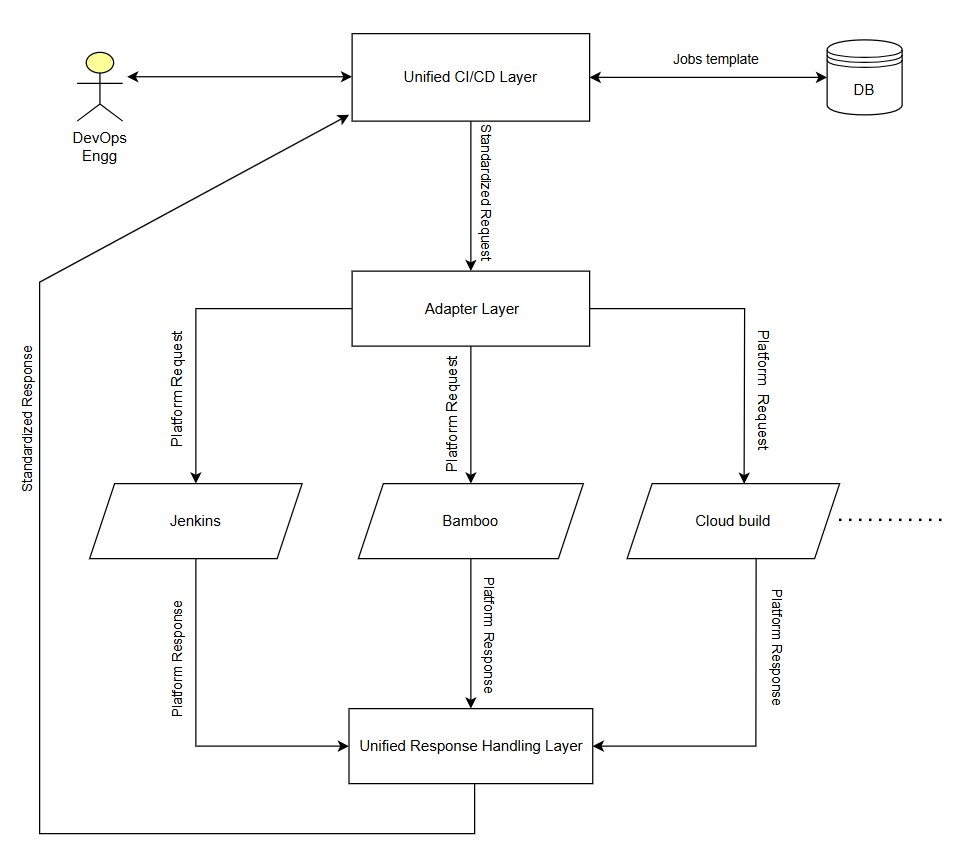
Job Execution Flow
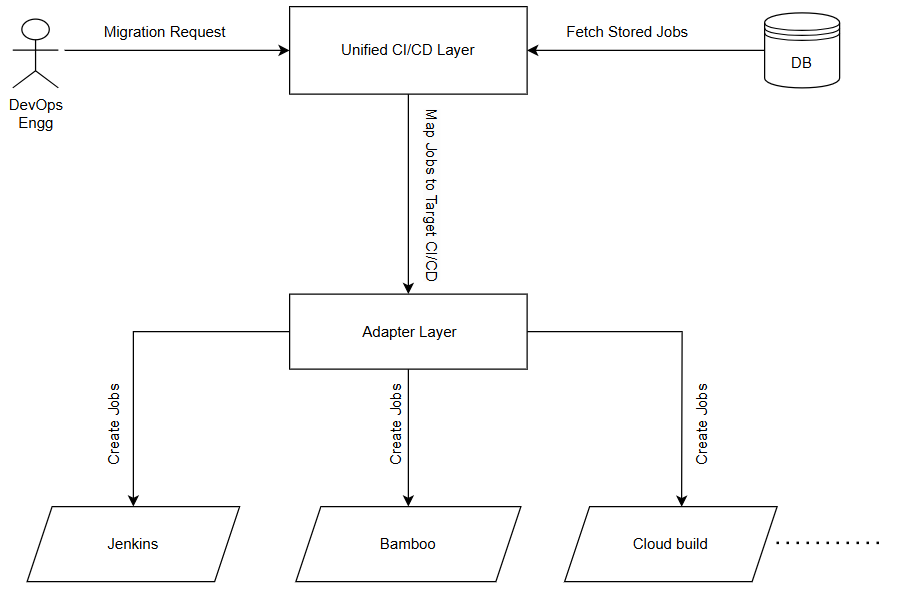
Migration Flow
Job Execution Flow
- Interaction
The DevOps Engineer interacts with the Unified CI/CD Interface to create pipelines, trigger jobs, and manage CI/CD operations. - Request Handling
The Unified API Layer receives the request in a standardized format. All pipeline actions —creation, update, deletion — are persisted in the database to support future platform migration. - Translation
The Adapter Layer translates the unified request into platform-specific API calls, tailored for the target CI/CD tool. - Execution
The translated request is sent to the designated CI/CD platform (e.g., Jenkins, Google Cloud Build, Bamboo) for execution. - Response Handling
The CI/CD platform processes the request and returns a response. - Standardization:
The response is normalized into a unified format and returned to the DevOps Engineer via the interface—ensuring consistent feedback regardless of the underlying platform.
Migration Flow
- Trigger Migration Request
The Admin user initiates the migration, specifying the target CI/CD platform. - Retrieve Stored Jobs
All existing job configurations are fetched from the database, preserving their original definitions and metadata. - Translate Job Definitions
The system maps and converts the stored configurations into the target platform’s native format, ensuring compatibility. - Deploy to Target Platform
The system invokes the target platform’s APIs to create equivalent jobs on the new CI/CD platform. - Validate Migration
A verification step confirms successful job creation, ensuring accuracy and completeness of the migration.
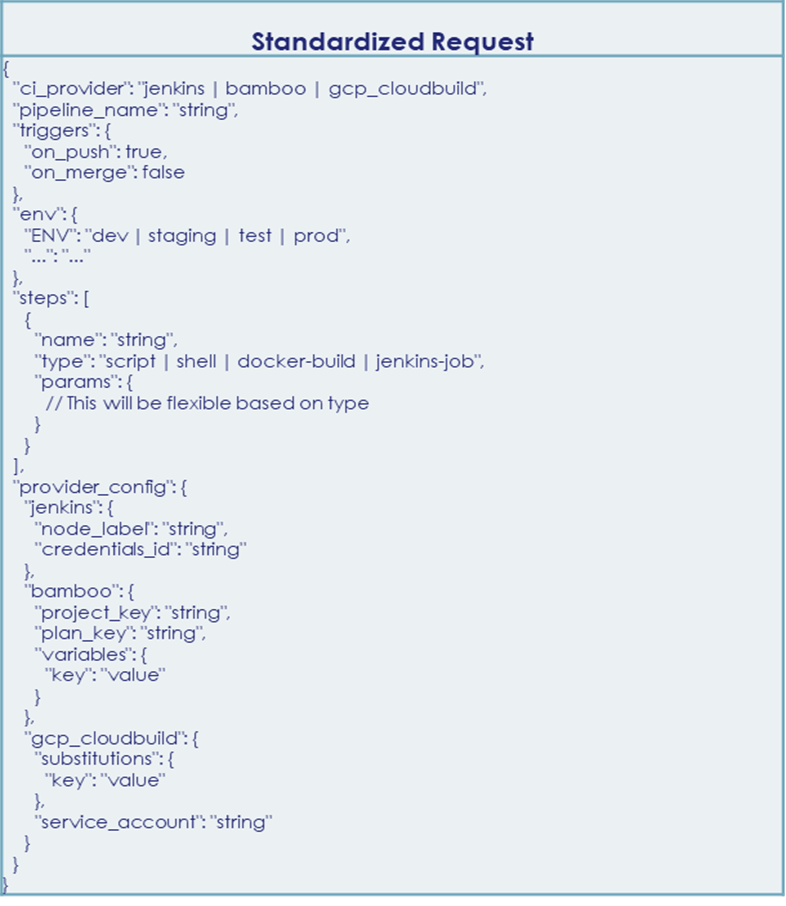
Standardized Request workflow
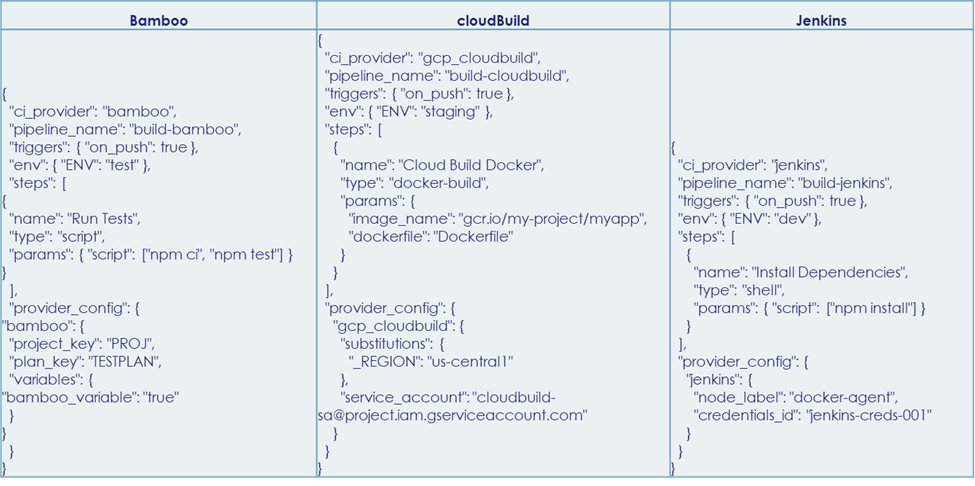
Zoomed in view to each provider_config
Standardized Request Workflow
- Validate CI Provider
Ensure the specified ci_provider is supported and properly configured. - Dispatch to Adapter
Route the request to the corresponding adapter module (e.g., JenkinsAdapter, BambooAdapter, etc.) based on the ci_provider. - Generate Execution Plan
Use shared request fields — such as steps, env, and other pipeline attributes — to generate a provider-specific configuration or execution plan. - Load Provider Configuration
Access only the relevant configuration using provider_config[ci_provider] to ensure accurate and context-aware translation.
Advantages and Business Value
This platform redefines how organizations execute CI/CD pipeline migrations. Traditionally, migrations have been labor-intensive, highly specialized, and prone to delays. We change that narrative through five key technical differentiators:
- Automated Pipeline Translation: We fully automate cross-platform pipeline conversion, eliminating manual rewrites and dramatically reducing error rates.
- Tool-Agnostic Architecture: The solution is inherently compatible with leading CI/CD platforms — Jenkins, GitHub Actions, GitLab CI, Bamboo, Cloud Build — ensuring maximum flexibility and protecting prior investments.
- Plug-and-Play Integration: This slots directly into existing toolchains, artifact repositories, and monitoring ecosystems, ensuring seamless operational continuity.
- Scalable Migration Framework: Whether it’s a one-time migration or ongoing hybrid deployments, the framework scales to meet enterprise-level needs.
- Standardized Migration Framework: It’s platform-independent and intelligent — future-proofing our DevOps strategy.
From a business standpoint, the value is immediate and material:
- Reduced Migration Time & Cost: We’re collapsing migration timelines from multiple weeks to a matter of hours, unlocking both Capital Expenditure and Operational Expenditure savings.
- Increased DevOps Productivity: High-value engineering talent is refocused on core product delivery rather than redundant migration tasks.
- Faster Time-to-Market: We maintain velocity and avoid disruptions during tooling transitions — a critical factor in sustaining competitive advantage.
- Risk Mitigation: Service disruptions and functional regressions are proactively avoided, protecting both customer experience and revenue streams.
- Workforce Enablement: We remove dependencies on niche CI/CD skill sets, allowing broader resource pools to manage and operate the pipelines confidently.
If we look at the net impact, this solution directly drives cost optimization, operational resilience, and business agility — while insulating the organization from the typical risks and delays of platform transitions.
Conclusion
The Unified CI/CD Interface is more than a migration enabler — it’s a strategic accelerator for modern DevOps. By abstracting away tool-specific complexity and automating pipeline translation, it empowers teams to pivot swiftly between CI/CD platforms without disruption. This innovation transforms migration from a painful bottleneck into a seamless, scalable advantage — delivering immediate cost savings, faster product delivery, and long-term agility in an ever-evolving tech landscape.
Opinions expressed by DZone contributors are their own.
Comments