

The Real-Time Revolution: Why Blockchain Needs Data Stream Processing
Blockchain and data streaming are bringing unprecedented levels of security, transparency, and real-time mechanisms to move data across the digital world.
 CORE
·
CORE
·
Join the DZone community and get the full member experience.
Join For FreeBlockchain is an extremely data-driven technology because its primary function is to store, verify, and coordinate independent records in a secure, distributed data network. Without this information, no transaction, smart contract execution, or network activity would be valid, and it could jeopardize the integrity of much larger functions of trust.
The data coming into the blockchain affects the accuracy of the whole system. Blockchain is nothing without the data it connects to, so, as far as transparency, immutability, and safe decisions are concerned, data is the backbone of blockchain.
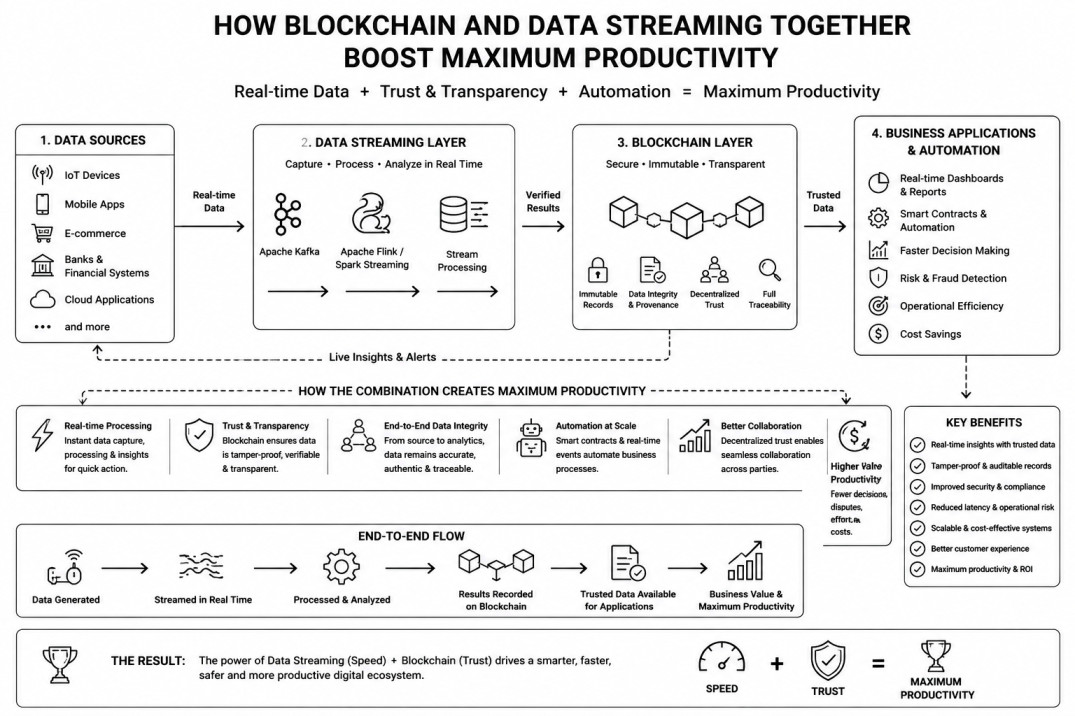
Blockchain and data streaming are bringing unprecedented levels of security, transparency, and real-time mechanisms to move data across the digital world. Blockchain forms an unbreakable chain of trust through keeping decentralized records, and streaming data streamlines the process by allowing for insights when information is constantly flowing. These form the backbone of next-generation applications, unleashing innovation, scalability, and better decision-making across industries.
Both blockchain and data streaming are independently large and powerful technologies as they exist in the present time. However, when combined, data streaming can amplify the potential impact of a blockchain solution.
Real-Time Data Integration
Data streaming platforms, such as Apache Kafka and Apache Flink, continuously process and deliver real-time data. When we integrate with blockchain, transactions can be updated instantly on the ledger, smart contracts can react to live data feeds, and delays can be reduced compared to batch processing. For example, we can visualize it as the IoT sensors streaming temperature data can trigger a blockchain-based smart contract in real time.
Improved Scalability
One major limitation of blockchain systems like Ethereum has been scalability. By leveraging data streaming, we can pre-process and filter large volumes of data before sending it to the blockchain. Can reduce unnecessary transactions that are stored on-chain, and, on top of that, offload heavy computation on-chain and push it to a stream processing engine that is available on data streaming platforms.This results in faster and more efficient blockchain performance.
Enhanced Data Integrity and Trust
Blockchain ensures immutability and transparency; on the other hand, data streaming ensures continuous data flow. As data stream processing enables continuous validation, filtering, and analysis of data elements before they are processed on the ledger, it enhances data integrity and trust in blockchain.
Real-time processing helps identify anomalies in the data, prevent tampering, and ensure that only accurate, high-quality data enters the blockchain. Combining this provides a trusted, secure, and eventually transparent ecosystem in which information can be verified instantly and with confidence. We can consider a use case of supply chain tracking where real-time shipment data is streamed and permanently recorded.
Better Event-Driven Architectures
Blockchain systems can become more dynamic when combined with an event-driven streaming platform such as Confluent, Amazon Kinesis, or the open-source Apache Kafka. Smart contracts can act as automated responders to streamed events and can be enabled for automation across distributed systems, which finally reduces manual intervention. For example, a payment is automatically released when a delivery event is streamed and confirmed.
Efficient Data Storage Strategy
Not all data needs to be stored on-chain, which is expensive and slow, but by leveraging streaming platforms, we can store and process high-volume data off-chain. Streaming platforms can be integrated with streaming databases to store data already processed by stream engines. We can allow the Blockchain to store only critical summaries, hashes, or proofs, maintaining efficiency while ensuring verification.
Real-Time Analytics and Monitoring
Data stream processing facilitates real-time analytics and monitoring in blockchain by analyzing transaction data as it streams over the network. This enables organizations to detect suspicious activity, monitor system performance, and obtain real-time information on blockchain activity by analyzing transaction patterns.
Transparency, responsiveness, and operational efficiency across blockchain ecosystems can be upgraded if we convert the raw data into actionable intelligence by integrating a real-time stream processing platform.
Wrapping Up
Combining these two technologies — data stream processing and blockchain — creates an ecosystem that blends real-time intelligence with secure, immutable record-keeping. Blockchain ensures transparency, trust, and data integrity, while stream processing powers instant analysis, continuous monitoring, and real-time decision-making based on that data.
When combined, they improve power efficiency, enhance security, and enable scalable, data-driven applications. These technologies play an instrumental role in the construction of smarter, more intelligent systems that must respond to increase confidence among organizations relying on that real-time information.
Published at DZone with permission of Gautam Goswami. See the original article here.
Opinions expressed by DZone contributors are their own.
Comments