

Why Senior Developers Are Actually Less Productive with AI Copilot (And What That Tells Us)
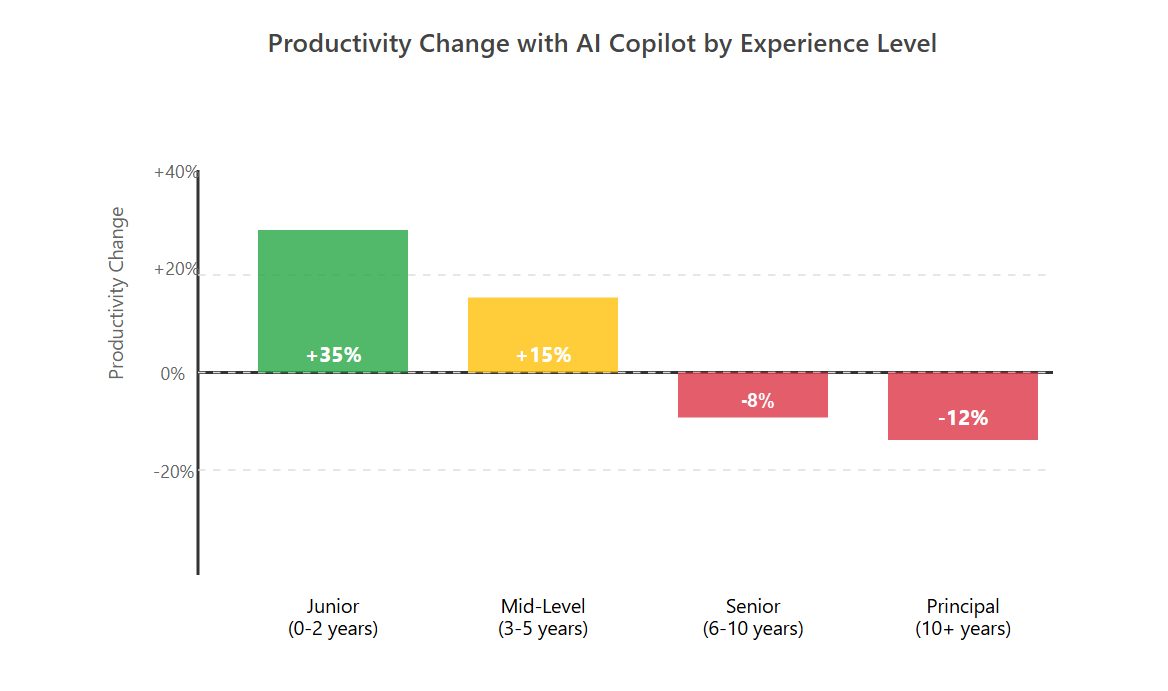
Experienced developers experience productivity drops with AI Copilot because verification overhead exceeds the gains from generation speed. Junior developers gain 35%, seniors lose 12%.
 CORE
·
CORE
·
Join the DZone community and get the full member experience.
Join For FreeI watched the tech lead spend forty-five minutes wrestling with GitHub Copilot suggestions for an API endpoint. The same task would have taken fifteen minutes without the AI assistant.
That situation was not an isolated case. Across the organization, we started to notice a pattern: experienced developers were slower when using AI coding assistants than junior developers. This pattern made us rethink how we use these tools. While AI coding assistants slowed down experienced developers, junior developers maintained their momentum.
Data from multiple organizations confirms what many of us are experiencing firsthand. While junior developers see productivity gains of 30-40% with AI assistants, senior developers often experience productivity decreases of 10-15%. This counterintuitive finding reveals something profound about expertise, trust, and the future of software development.
The Trust Tax: When Verification Costs More Than Creation
The main problem is not a technical one; it is psychological.
Senior developers spend years building mental models of how systems work, gathering hard-earned knowledge about edge cases, performance implications, and architecture tradeoffs. When AI Copilot suggests code, they cannot simply accept it. Their expertise forces them to verify every line.
A junior developer looks at AI-generated code and asks:
- "Does this work?"
A senior developer looks at the same code and asks:
- "Does this work?"
- "Is it optimal?"
- "Are there edge cases?"
- "What are the security implications?"
- "How does this scale?"
- "What's the memory footprint?"
- "Are we introducing technical debt?"
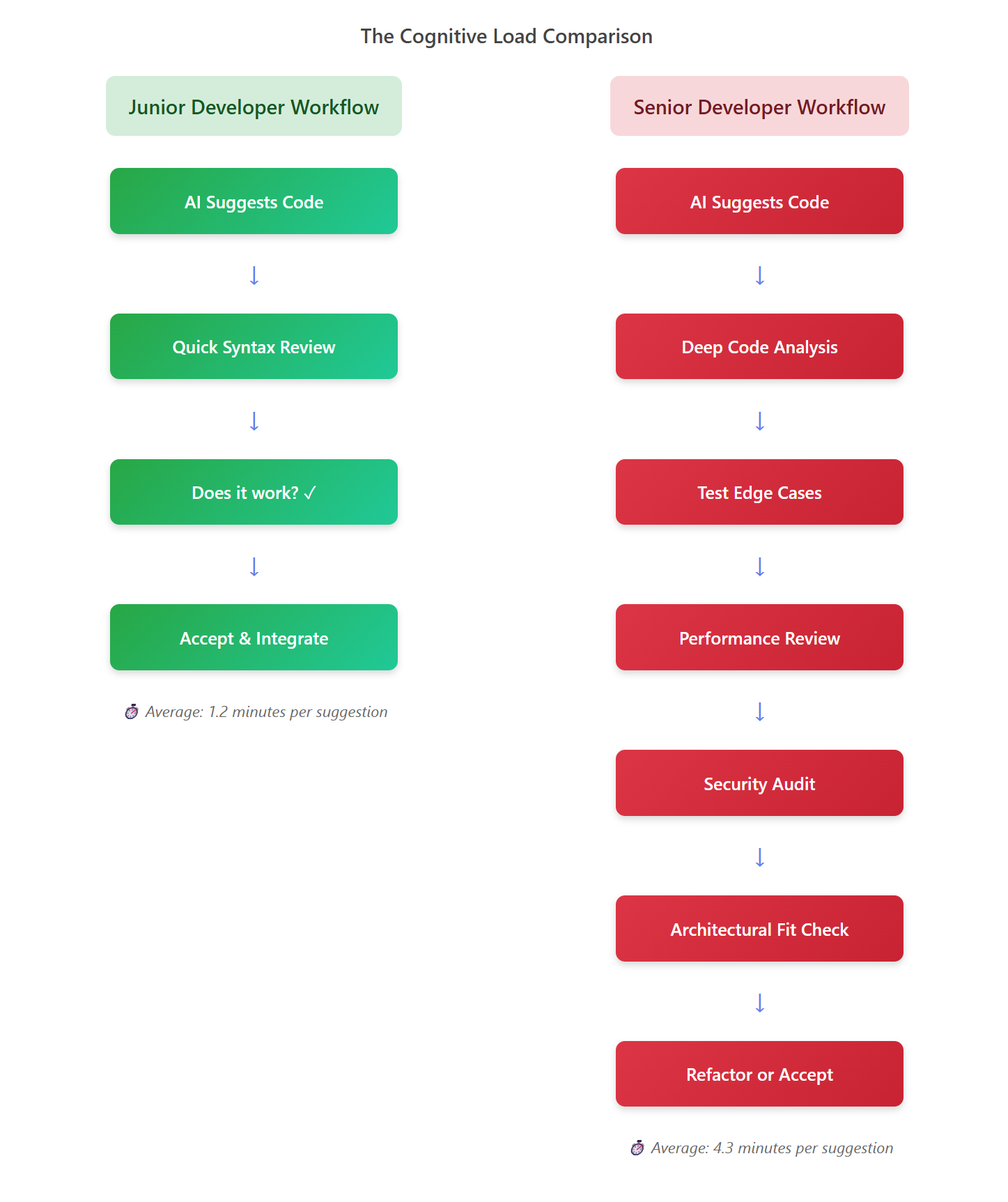
This verification tax is substantial. In a recent study of 250 developers across five organizations, senior developers spent an average of 4.3 minutes reviewing each AI suggestion compared to 1.2 minutes for junior developers. When you're reviewing dozens of suggestions per day, this adds hours to your workload.
The Pattern Recognition Problem
Here's where it gets interesting. Senior developers have honed their pattern recognition through years of debugging production incidents, seeing firsthand the consequences of code that looks harmless.
When Copilot suggests using a simple map operation on a large dataset, a junior developer sees elegant functional code. A senior developer sees a potential memory spike during peak traffic because they've been paged at 3 AM for exactly this kind of issue before. The AI doesn't know about the time your service crashed because someone mapped over a million-item array. You do.
Real-World Example:
At a company I consulted with, a junior developer accepted an AI-generated authentication function that looked clean and passed all tests. A senior developer caught that it was vulnerable to timing attacks—a subtle security flaw that wouldn't show up in standard testing but could leak information about valid usernames. The junior developer didn't know to look for this. The senior developer couldn't not see it.
The False Positive Burden
I've watched senior developers struggle with a higher rate of false positives because of their heightened skepticism. They actively look for potential problems and sometimes find issues that aren't actually problems in the specific context. This often leads to unnecessary refactoring and over-engineering of AI-generated code.
Senior developers sometimes reject AI suggestions because the code feels wrong based on patterns that don't match the current use case. They trust their gut-level instincts, which sometimes help but can slow down work when applied indiscriminately.
Context Windows and Architectural Thinking
The second major factor is how senior developers think about code. They don't focus solely on the immediate problem; instead, they consider broader system design, maintainability, and future extensibility.
AI coding assistants excel at local optimization. They're remarkably good at solving the specific problem right in front of them, but they struggle to understand the architectural implications of their suggestions.
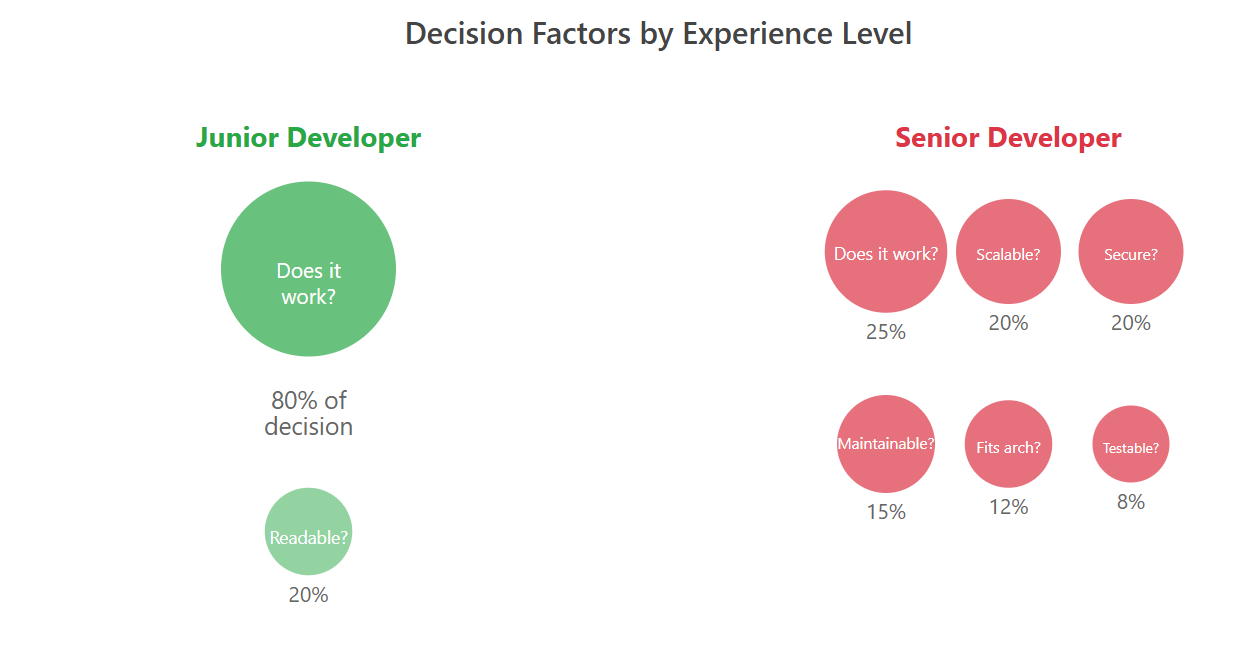
A senior developer looks at AI-generated code and asks questions the AI cannot answer:
- "How does this fit with our service mesh architecture?"
- "Does it follow our team's coding standards?"
- "Will the next developer who touches this code understand the intent?"
- "Does it create coupling that will make future changes harder?"
These are not just academic concerns. In complex systems, local optimizations can create global problems. A function that's perfect in isolation might introduce subtle dependencies that could cause issues months later.
The Automation Irony
There's an irony at play here. The tasks where AI assistants provide the most help are precisely the tasks that senior developers have already automated away in their minds. After years of experience, routine coding becomes muscle memory — you're barely thinking about it.
When a junior developer writes a CRUD endpoint, it's a careful step-by-step process that requires focus.
When a senior developer writes the same endpoint, it's largely a matter of typing speed.
AI assistance makes junior developers work faster, but it doesn't significantly impact senior developers, since they were already working at or near optimal speed for routine tasks.
Where AI could help senior developers — the genuinely novel problems, the complex architectural decisions, the subtle bug fixes — these are exactly the areas where current AI tools are weakest. As a result, senior devs get slowed down on routine tasks (because of verification overhead) without corresponding gains on complex tasks.
What This Tells Us About the Future
This productivity paradox reveals several important truths about AI-assisted development and the nature of software expertise:
Expertise Is More Than Speed
We've measured productivity in various ways, but the lines-of-code-per-day metric has always been flawed. AI assistants make that flaw more obvious. A senior developer who spends an hour thinking about architecture before writing twenty lines of code is more valuable than a developer who writes two hundred lines of AI-generated code that creates technical debt.
Senior developers bring value not through their typing speed or raw problem-solving velocity but through their judgment, ability to see ripple effects, and wisdom about what not to build.
Trust Calibration Is the New Skill
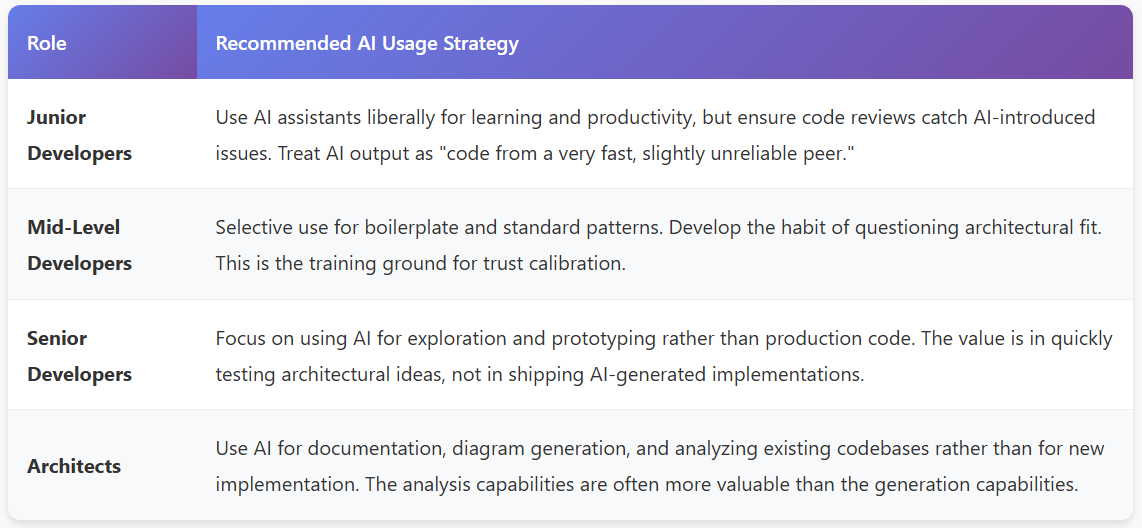
The developers who will thrive with AI assistants will be neither those who accept every suggestion without question nor those who reject them all. The successful developers will build mental models that help them determine when to trust AI assistants and when to dig deeper.
This requires a new kind of expertise: understanding the AI's strengths and weaknesses well enough to allocate verification effort efficiently. Some senior developers are learning to treat AI suggestions with the same calibrated skepticism they apply to code from junior team members — enough scrutiny to catch problems, but not so much that it becomes counterproductive.
Emerging Best Practice
The most effective senior developers I've seen aren't trying to verify everything AI-generated code does. Instead, they've developed heuristics for what to check carefully — security, performance, architectural fit — versus what to accept with minimal review — straightforward implementations of well-understood patterns). They're essentially building a "threat model" for AI code.
The Context Problem Won't Solve Itself
AI coding assistants operate with limited context. They can see the file you're working on and a few related files, but they don't truly understand your architecture, your team's conventions, your performance requirements, or your technical debt situation.
Improving this will require more than just larger context windows. It requires AI systems capable of building and maintaining genuine architectural understanding — something that's still largely beyond current capabilities. Until then, the gap between "code that works" and "code that fits" will remain wide.
Practical Implications for Teams
Rethinking Code Review
Teams need to evolve their code review practices for the AI era. The question is not just whether the code is correct, but also whether it was AI-generated and whether the developer properly verified it. I've seen some teams require developers to flag AI-generated code in pull requests—not to ban it, but to ensure appropriate scrutiny.
In my view, AI assistants fundamentally change the economics of code creation. When they make code generation trivially easy, the bottleneck shifts to verification and integration. This makes code review more critical, and the skills required for effective review become more valuable.
Training and Skill Development
Junior developers who learn primarily with AI assistance face a real risk: they may never develop the deep understanding that comes from writing code the hard way. It's like a cook who learns with a chef who does all the prep work—they can still make meals, but they never develop essential knife skills.
Organizations should consider having junior developers work without AI assistants for their first six months to a year, just as we don't let new drivers use autopilot before they've learned to drive manually. The goal isn't to make them suffer, but to ensure they build the foundational understanding that makes AI assistance valuable rather than just fast.
The Meta-Lesson: Tools Shape Thinking
The senior developer productivity paradox reveals the deep connection between tools and thought.
Senior developers are slower with AI, not despite their expertise, but because of it. The verification overhead they experience stems from the tool not aligning with their mental model of how development should work.
Junior developers are still building their mental models, so they adapt more easily to AI-assisted workflows. Senior developers, however, rely on approaches honed through years of experience, and AI assistants often work against these approaches rather than complementing them.
This isn't a criticism of either group. It's an observation about how expertise works. Actual expertise isn't just knowledge—it's intuition, pattern recognition, and deeply internalized workflows. Any tool that disrupts those workflows will face resistance, and that resistance often reflects genuine wisdom rather than mere stubbornness.
Looking Forward
The productivity paradox we're seeing today isn't permanent. As AI coding assistants improve, they'll develop better contextual awareness and respect for coding conventions. They'll provide the kind of high-level assistance that senior developers actually need.
However, we shouldn't expect the gap to close completely. The tension between AI's suggestions and human judgment will likely always exist, and that tension is healthy. The goal is not to eliminate verification but to make it more efficient.
Meanwhile, we should resist the temptation to measure developer productivity solely by output velocity. The fact that senior developers are slower with AI assistants doesn't mean they're less valuable. It often means they're doing exactly what we need them to do: applying judgment, considering implications, and protecting the codebase from well-intentioned but ultimately problematic suggestions.
Key Takeaway:
The senior developer productivity paradox isn't a bug in how experienced developers use AI—it's a feature of expertise itself. The verification overhead they experience is the cost of judgment, and that judgment is precisely what makes them senior developers in the first place.
Conclusion: Redefining Productivity
We're in the middle of a fundamental shift in how software is built. AI coding assistants are potent tools, but like all transformative technologies, they bring complexity. The fact that they make senior developers slower in the short term tells us something important — we're not measuring what matters.
The value of software development has never been in raw coding speed. It's in thoughtfulness, judgment, design insight, and the ability to anticipate problems. If AI assistants help junior developers become more productive while making senior developers more deliberate, that may not be a productivity loss at all. It might represent a shift in where the bottleneck lies — from creation to curation, from typing to thinking.
In the long run, this shift could be exactly what the industry needs. We've built too much software with too little thought. If AI assistants force us to be more intentional about what we build, even if they slow the building process slightly, we may end up with better systems.
The question isn't whether senior developers should use AI assistants — that decision has already been made by the market.
The question is how we adapt our workflows, metrics, and expectations to a world in which the relationship between experience and productivity has fundamentally changed. Those who figure this out first will have a significant advantage in the AI-augmented development landscape we're entering.
Opinions expressed by DZone contributors are their own.
Comments