

A Comprehensive Comparison of Serverless Databases and Dedicated Database Servers in the Cloud
Serverless databases auto-scale, cut ops overhead, and offer pay-per-use pricing, ideal for cloud apps that prioritize agility over infrastructure.
 CORE
·
CORE
·
Join the DZone community and get the full member experience.
Join For FreeThe cloud computing landscape has revolutionized how businesses manage their data, offering unprecedented scalability, flexibility, and cost-effectiveness. Within this landscape, the choice between traditional dedicated database servers and the emerging paradigm of serverless databases represents a pivotal decision with significant implications for infrastructure management, performance optimization, and overall operational efficiency.
The Shifting Sands of Data Management: A Comprehensive Comparison of Serverless Databases and Dedicated Database Servers in the Cloud
This article argues that while dedicated database servers retain certain advantages in specific scenarios, serverless databases offer a compelling value proposition in the majority of cloud-native applications, particularly due to their inherent scalability, reduced operational overhead, and pay-per-use pricing model, ultimately enabling organizations to focus on innovation rather than infrastructure management.
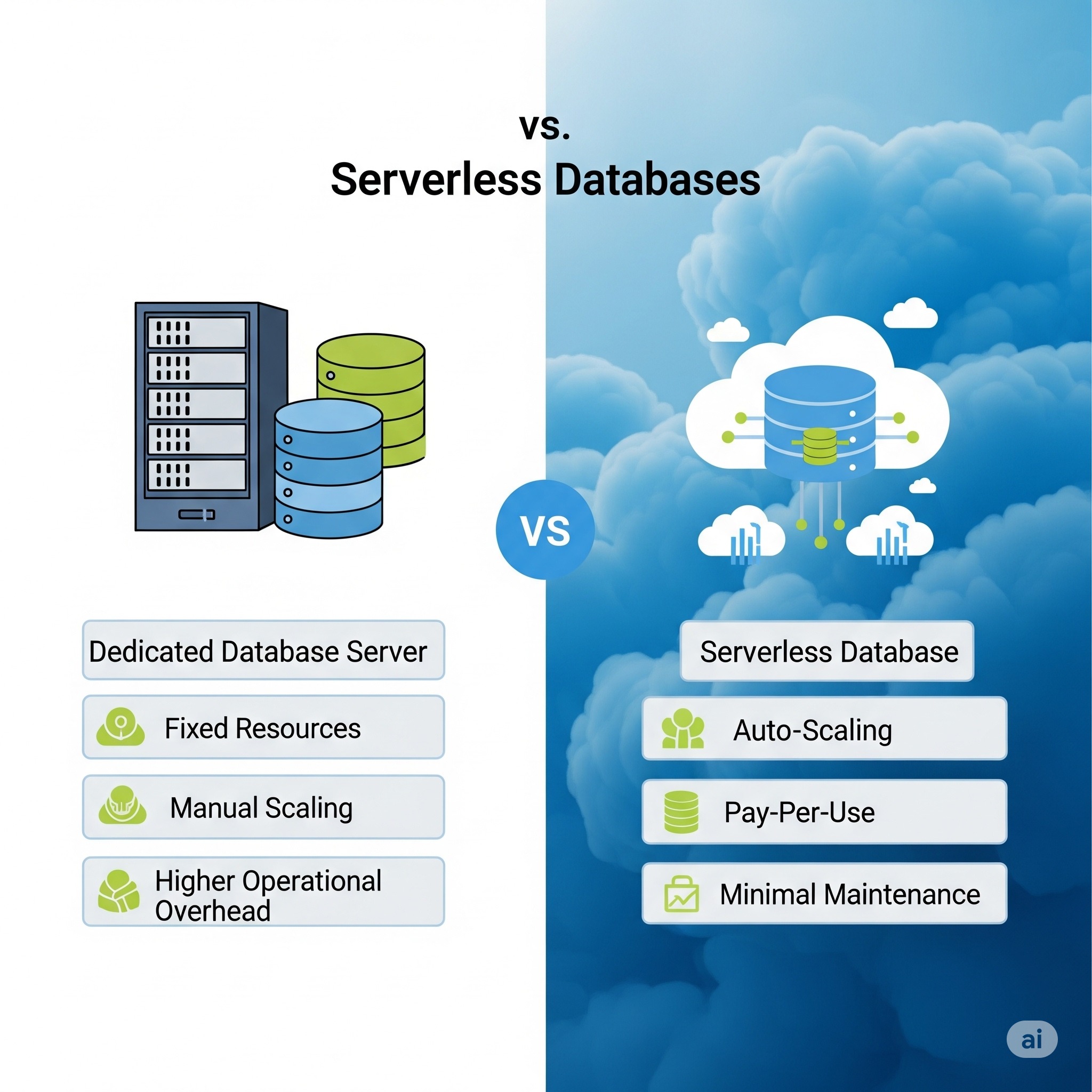
Defining the Landscape: Dedicated Database Servers vs. Serverless Databases
To understand the nuances of this comparison, it's crucial to define the key characteristics of each approach:
- Dedicated Database Servers: These represent the traditional model, where organizations provision and manage entire virtual machines (VMs) or dedicated hardware instances in the cloud. They are responsible for installing the database software (e.g., MySQL, PostgreSQL, SQL Server, Oracle), configuring security settings, managing backups, and scaling resources based on anticipated demand. While cloud providers offer managed database services (e.g., AWS RDS, Azure SQL Database, Google Cloud SQL) that automate some operational tasks, users still retain significant control over instance configuration, resource allocation, and maintenance schedules.
- Serverless Databases: These abstract away the underlying infrastructure, enabling developers to interact with the database directly through APIs without provisioning or managing servers. The cloud provider dynamically allocates resources based on demand, automatically scaling up or down as needed. Notable examples are AWS Aurora Serverless, Azure Cosmos DB, and Google Cloud Firestore—databases designed to scale on demand with minimal operational overhead. The key differentiating factors are the automatic scaling, pay-per-use pricing based on actual consumption, and reduced administrative overhead.
Scalability and Performance: A Tale of Two Architectures
Scalability is often cited as a primary driver for cloud adoption. However, the scalability characteristics of dedicated and serverless databases differ significantly:
- Dedicated Database Servers: Scaling typically involves vertical scaling (increasing the resources of an existing server) or horizontal scaling (adding more servers to a cluster). Vertical scaling has limitations based on the maximum capacity of the hardware, while horizontal scaling requires careful configuration and management of replication, sharding, and load balancing. Scaling operations often involve downtime and require significant expertise to execute effectively. While managed dedicated databases simplify this process, the user still retains responsibility for monitoring and initiating scaling events.
- Serverless Databases: Serverless databases offer inherent automatic scaling capabilities. The cloud provider dynamically adjusts resources based on real-time demand, ensuring optimal performance without manual intervention. When traffic spikes, the database automatically scales up to handle the increased load, and when traffic subsides, it scales down to minimize costs. This elasticity allows applications to handle unpredictable workloads without performance degradation or cost overruns. Furthermore, serverless databases can be designed for distributed architectures from the ground up, incorporating features like automatic sharding and geo-replication to achieve massive scalability and low latency across different regions.
Operational Overhead: The Burden of Infrastructure Management
One of the most significant benefits of serverless databases lies in their reduced operational overhead:
- Dedicated Database Servers: Managing dedicated database servers involves a substantial amount of administrative effort. Tasks such as patching, upgrading, backing up, and monitoring the database are the responsibility of the user or the managed database service provider. This requires specialized expertise and can consume valuable time and resources that could be better spent on application development and innovation. Furthermore, maintaining high availability and disaster recovery configurations necessitates careful planning and ongoing maintenance.
- Serverless Databases: Serverless databases significantly reduce operational overhead. The cloud provider handles most of the administrative tasks, including patching, backups, and maintenance. Developers can focus on building and shipping code and there's no need to worry about provisioning, scaling, or managing infrastructure. High availability and disaster recovery are typically built into the service, further simplifying operations and reducing the risk of data loss. This allows organizations to streamline their operations, reduce staffing requirements, and accelerate time to market.
Cost Considerations: Pay-Per-Use vs. Reserved Capacity
The pricing models of dedicated and serverless databases differ significantly, leading to varying cost implications:
- Dedicated Database Servers: Dedicated database servers typically charge based on reserved capacity. Users pay for the resources they provision, regardless of whether they are actively being used. This can lead to wasted resources during periods of low activity. Moreover, the cost of database licenses, operating system licenses, and management tools can add significant expenses. Optimizing costs requires careful monitoring and capacity planning to ensure that resources are neither over-provisioned nor under-provisioned.
- Serverless Databases: Serverless databases employ a pay-per-use pricing model. Users only pay for the resources they actually consume, such as the amount of storage used, the number of read/write operations performed, and the compute time utilized. This model is particularly advantageous for applications with variable workloads or unpredictable traffic patterns. For applications with low usage, serverless databases can be significantly cheaper than dedicated database servers. However, for applications with consistently high usage, the cost of serverless databases may be comparable to or even higher than dedicated database servers. Therefore, careful monitoring and cost analysis are essential to optimize expenses.
Security Considerations: Trusting the Cloud Provider
Security is a paramount concern in cloud computing. Both dedicated and serverless databases offer security features, but their approaches differ:
- Dedicated Database Servers: Dedicated database servers provide users with more control over security settings. They can configure firewalls, access control lists (ACLs), and encryption settings to meet their specific security requirements. However, this also means that they are responsible for implementing and maintaining these security measures. Organizations must ensure that their security practices are up-to-date and compliant with relevant regulations.
- Serverless Databases: Serverless databases rely on the cloud provider to handle much of the security infrastructure. The provider is responsible for securing the underlying infrastructure and ensuring that data is protected from unauthorized access. Serverless databases typically offer built-in security features, such as encryption at rest and in transit, access control policies, and network isolation. However, users must trust the cloud provider's security practices and rely on their security monitoring and incident response capabilities. It is vital to carefully review the cloud provider's security documentation and certifications to ensure that they meet the organization's security requirements.
Limitations of Serverless Databases: Trade-offs and Considerations
While serverless databases offer numerous advantages, they are not a silver bullet. They have limitations that must be considered:
- Vendor Lock-in: Serverless databases are often proprietary technologies, which can lead to vendor lock-in. Migrating to a different platform or database technology can be challenging and time-consuming.
- Cold Starts: Serverless functions can experience "cold starts" when they are invoked after a period of inactivity. This can result in latency spikes and impact application performance.
- Complexity of Monitoring and Debugging: Monitoring and debugging serverless applications can be more complex than traditional applications due to the distributed nature of the architecture.
- Limited Control over Configuration: Users have limited control over the configuration of serverless databases. This can be a disadvantage for applications that require specific database settings or optimizations.
- Cost Predictability: While pay-per-use seems attractive, predicting costs for complex workloads can be challenging, and unexpected spikes can lead to higher-than-anticipated bills. Thorough cost monitoring and analysis are essential to optimize spending.
Use Case Analysis: Matching Technologies to Requirements
The optimal choice between dedicated and serverless databases depends on the specific requirements of the application:
- Ideal Use Cases for Serverless Databases:
- Applications with Variable Workloads: Web applications, mobile backends, and IoT platforms that experience unpredictable traffic patterns.
- Event-Driven Applications: Applications that respond to specific events, such as user actions or sensor readings.
- New Projects and Prototypes: Serverless databases offer a quick and easy way to get started with a new project without having to provision and manage infrastructure.
- Microservices Architectures: Serverless databases can be used to support microservices architectures, providing independent data persistence for each microservice.
- Ideal Use Cases for Dedicated Database Servers:
- Applications with Predictable, High-Volume Workloads: Applications that require consistent performance and low latency, such as financial trading platforms or high-performance computing applications.
- Applications with Complex Database Requirements: Applications that require specific database features or optimizations, such as custom indexing or stored procedures.
- Applications with Strict Security Requirements: Applications that require control over security settings and compliance with specific regulations.
- Legacy Applications: Migrating legacy applications to serverless databases can be challenging and may require significant code changes. Dedicated database servers may be a more suitable option for these applications.
Conclusion: Embracing the Serverless Revolution
In conclusion, both dedicated database servers and serverless databases offer valuable capabilities for managing data in the cloud. While dedicated servers retain their relevance for specific use cases involving predictable, high-volume workloads and stringent security requirements, serverless databases are rapidly emerging as the preferred choice for the majority of modern cloud-native applications. Their inherent scalability, reduced operational overhead, and pay-per-use pricing model empower organizations to focus on innovation and business value rather than the complexities of infrastructure management.
The transition to serverless databases represents a paradigm shift in data management. By embracing this revolution, organizations can unlock significant benefits in terms of agility, cost optimization, and overall operational efficiency. However, it is crucial to carefully evaluate the trade-offs and limitations of serverless databases and to choose the right technology for the specific requirements of each application. As the cloud continues to evolve, serverless databases are poised to become an increasingly dominant force in the data management landscape, driving innovation and transforming the way businesses interact with their data.
Opinions expressed by DZone contributors are their own.
Comments