

Agent-of-Agents Pattern: Enhancing Software Testing
Multi-agent AI validation replaces slow, costly full regression testing by intelligently selecting and running only the tests relevant to your code changes.
 ·
·
Join the DZone community and get the full member experience.
Join For FreeThe Pre-Production Bottleneck
A pull request (PR) gets merged, code review is complete, unit tests are green, and the feature looks good. But then comes the familiar question: Is this actually ready for production?
Most engineering teams have a checklist: regression tests, security scans, performance validation, and integration checks. The problem is that executing all of this takes significant time. A full regression suite might take one to two hours. For a feature that touched a few files, running everything feels wasteful. But manually picking tests? That's how bugs slip into production.
Both extremes have drawbacks. Run everything, and engineers wait while 800 tests execute — 90% of which are irrelevant to the changes made. Pick tests manually, and there's a real risk of missing that one edge case that breaks checkout flow during peak traffic. Neither approach scales when deploying multiple times daily.
Multi-agent AI systems offer a different approach to pre-production validation. Instead of one AI attempting to handle code review, security analysis, and QA simultaneously, specialized agents collaborate on the task. One analyzes code changes to assess risk. Another determines which tests are actually relevant. A third handles security scanning. An orchestrator coordinates everything and makes the final deployment decision.
How Multi-Agent Validation Works
The architecture centers on an orchestrator managing workflow, with specialist agents handling specific validation tasks. When a PR merges, the orchestrator examines what changed and builds a testing strategy dynamically.
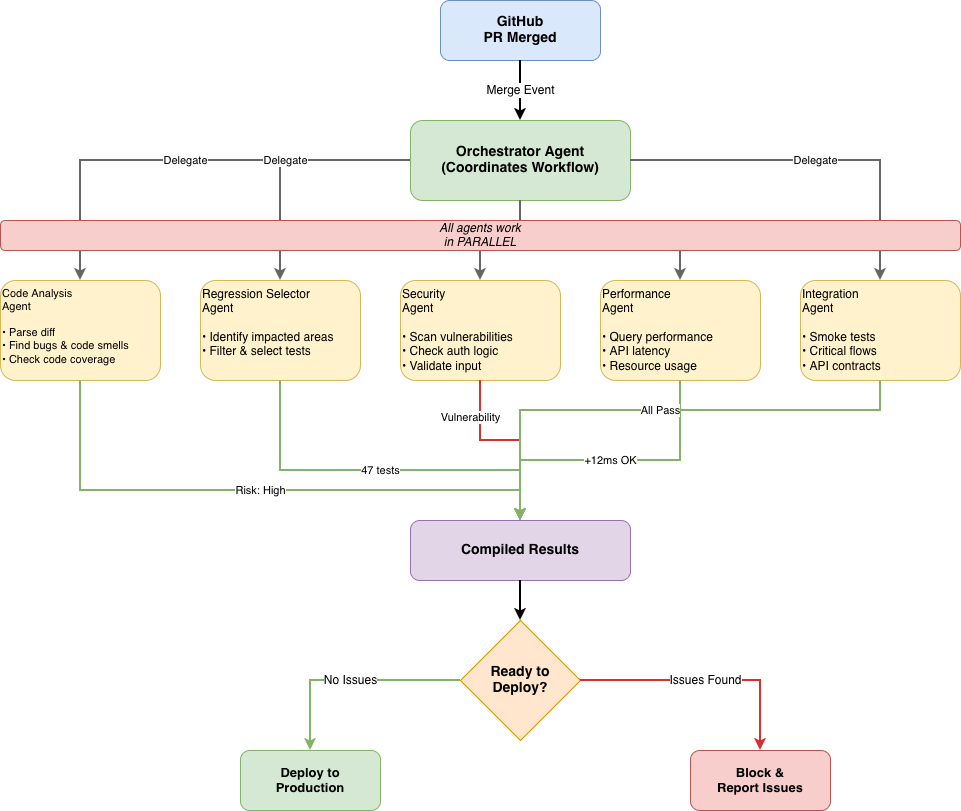
Figure 1: Multi-agent system overview
The orchestrator acts as a coordinator rather than executing tests itself. It analyzes the diff, identifies risky areas, and delegates work appropriately. If the authentication logic has changed, then security validation gets prioritized. If database queries were modified, then Performance testing becomes essential. If frontend components are updated, visual regression is triggered.
Each specialist agent has a focused responsibility. The code analysis agent reviews diffs and identifies risk areas. The regression selector chooses relevant tests instead of running the entire suite. The security agent scans for vulnerabilities specific to the changes. The performance agent validates that modifications don't introduce latency issues.
Agents operate independently and communicate through messages. The orchestrator sends work items, agents process them asynchronously, and results flow back. This enables parallel execution, i.e., security scanning can happen simultaneously with regression test selection. This concurrent approach eliminates sequential bottlenecks, and the orchestrator only waits for the results it needs to make a deployment decision.
The Agent Roles
A functional multi-agent system uses specialist agents plus the orchestrator. Each addresses a specific validation concern.
The orchestrator serves as the entry point. Triggered by the CI/CD pipeline after a PR merge, it parses the diff, identifies affected services, creates a validation plan, and distributes work. After collecting results, it makes the deployment decision and reports back.
The code analysis agent performs static analysis on changed files. It identifies which parts of the codebase are affected. This risk assessment guides all downstream validation.
The regression selector agent addresses test suite efficiency. Rather than running an 800-test suite completely, this agent analyzes changes and selects relevant tests. For example, modifications to checkout logic trigger checkout, payment, and order confirmation tests, but skip unrelated user profile tests. This approach reduces test execution time.
The security agent provides context-aware security validation. It checks whether specific changes introduce security risks. The focus stays narrow and relevant.
The performance agent validates that changes don't degrade performance. It runs focused checks rather than full load tests. The quick validations catch obvious performance issues.
The integration agent runs smoke tests on critical user flows. It validates that changes work correctly with the rest of the system. This catches scenarios where modifying one service creates unexpected breakage elsewhere.
Real-World Application
For instance, when validating a promotional code feature that modified payment and checkout logic, the multi-agent system identified a security vulnerability where single-use codes could be reused through rapid order submissions. The orchestrator flagged the PR as high-risk, the code analysis agent detected the payment complexity, the regression selector chose 47 relevant tests from an 800-test suite, and the security agent caught the vulnerability. The system blocked deployment and provided specific remediation guidance. After the fix was applied, validation passed, and the feature was deployed successfully, preventing what would have been a costly production incident.
Deploying With Docker
Each agent runs in its own container, providing isolation and straightforward scaling through Docker.
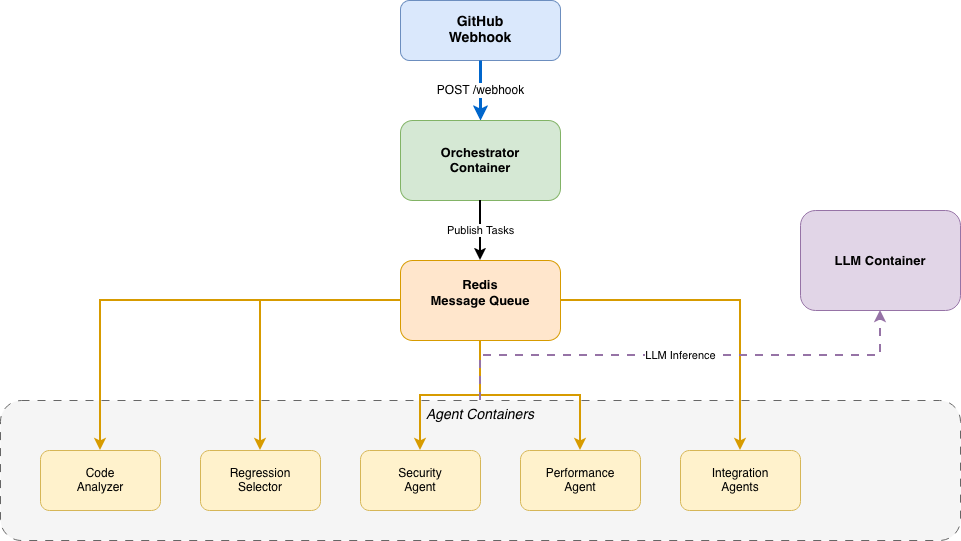
Figure 2: Docker container architecture
The orchestrator exposes a webhook endpoint that receives triggers from GitHub after PR merges. When validation requests arrive, the orchestrator publishes tasks to Redis. Agents subscribe to queues, process messages, and publish results back.
Agents maintain no state. They receive work, process it, return results, and reset. This simplifies scaling and debugging. If an agent crashes, the orchestrator detects the failure and retries.
When This Pattern Applies
Multi-agent validation works best for teams deploying frequently with large test suites, where intelligent test selection can significantly reduce validation time. The pattern fits complex applications. It's less suitable for simple applications or teams deploying infrequently. Consider risk tolerance: systems handling financial transactions, healthcare data, or critical infrastructure may benefit from the extra validation.
Implementation Approach
Building a multi-agent system works best with an incremental approach. Starting with everything simultaneously leads to overwhelm and often abandonment.
Begin with an orchestrator and two agents — code analysis and regression selection provide immediate value. These two components alone deliver measurable benefits. Once the message-passing pattern and agent coordination feel comfortable, additional agents can be introduced.
For LLM inference, local models could be used to eliminate external API dependencies and control costs. Configure agents to use the chosen model provider for code understanding and test selection.
Integrate with CI/CD pipelines incrementally. Start by triggering validation manually on selected PRs. Gather feedback and build confidence in the results. Once trust is established, add it as a GitHub Action. Configure it as a required check that blocks merges when critical issues surface.
Conclusion
Engineers no longer wait extended periods for validation when using the multi-agent validation system. Real issues get caught before reaching users. The targeted test selection alone provided sufficient value to justify the investment.
The most significant benefit isn't purely technical; it’s the shift in thinking about testing strategy. Understanding that different changes carry different risk levels, and that the validation strategy should reflect those risks. The multi-agent system codifies this thinking into the deployment process.
For teams dealing with frequent deployments, large test suites, and complex applications where quality directly impacts users, this pattern merits exploration.
Opinions expressed by DZone contributors are their own.
Comments