

How to Build a Solid Test Pipeline in the Era of Agentic AI Development
Learn to build a strong testing pipeline to ensure code quality, as in enterprises today most code is generated by AI agents at a huge volume and scale.
 ·
·
Join the DZone community and get the full member experience.
Join For FreeAI agents!! AI agents!! AI agents is the new buzzword.. they can generate code far faster than any human can review it. Because of this shift in software development, engineering teams are transitioning away from writing code to serving as pure reviewers. The sheer volume of daily commits has skyrocketed, leaving developers drowning in pull requests. This review fatigue sets in quickly, creating a massive blind spot for software quality.
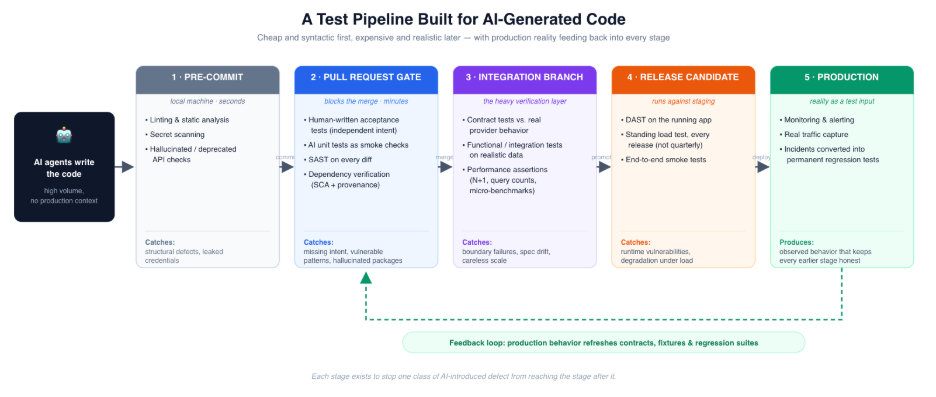
To adapt, testing teams must construct a multi-layered defensive pipeline. This pipeline shouldn't just check if the code works; it needs to validate performance, functionality, and security at scale.
Layer 1: Static Analysis and Secret Scanning: Pre-Commit First Gate
The easiest defects to catch are those found before code leaves the developer's machine, and agents known to produce many of them, like hallucinated APIs, deprecated patterns from training data, and credentials handled incorrectly.
Static analysis and secret scanning run in seconds as pre-commit hooks. Their job is not to prove correctness; rather, they identify and flag any security concerns. It is to guarantee the expensive layers downstream never waste a run on code with problems a regex could have caught. Secret scanning is non-negotiable; for example, an agent pasting a connection string into source is not hypothetical, and once a secret reaches a remote branch, you are doing incident response, not code review.
Layer 2: Unit Tests: Useful, But Only With an Independent Author
This is the large gap I've personally encountered. An agent writes the implementation, then writes unit tests for it, and coverage hits 90%. But the problem is those tests were derived from the same assumptions as the code, often in the same session.
Unit tests still belong in the pipeline, but with a changed role. AI-generated unit tests don't always catch all the issues, as the tests are also written by an agent with the same context, so it can be biased. These tests should be written by another agent with no implementation context who comes up with a new plan and validates it, or by a human who has no bias.
Layer 3: Integration and Functional Tests: The Center of Gravity
The most consistent finding about AI-generated code is that it works well in isolation and on the happy path. It often breaks at boundary conditions and edge cases.
Let's take a real-life example at work: An agent working on building an order history endpoint. The code gets written as per specification, the unit tests pass, and it runs fine with the test data. In a production system, if a fraction of accounts have null shipping addresses, this could break the API response, and nothing earlier in the pipeline had any chance of catching it, because every earlier check validated the code against the same clean assumptions the agent generated it from.
Integration and functional testing are slow to write and brittle to maintain. It is the first point in the pipeline where agent-written code meets something resembling the actual system rather than a mock of it. It must run against real or realistically simulated dependencies, because mocks written from the same specification the agent used prove nothing. It must use realistic test data that can be created from production patterns. And its failures must be treated as hard blockers. If you can invest heavily in only one layer of this pipeline, invest here.
Layer 4: Performance Tests: Catching Code That Is Correct and Careless
AI-generated code has a serious scalability problem because the prompt's focus is always more on implementation than on efficiency and performance. Things I have personally faced are: a query inside a loop that becomes an N+1 problem at volume, a full table loaded into memory, and missing pagination that returns 50 rows in staging and 5 million in production.
Performance testing therefore moves earlier than it traditionally sat. Full load tests per commit are unrealistic, but lightweight suites are not. Creating a standard load/performance test which measures the performance of API’s before the change and with this new change and if it degrades a certain percentage then immediately flag it to avoid scalability issues in production.
Layer 5: Security Tests: The Layer Where AI Is Actively Dangerous
Every other layer compensates for what agents do not know. Security compensates for what they learned wrong. Models have been trained on past code and patterns that had various exploitable vulnerabilities in today's world. So, ensuring all the code written by AI is security compliant is a must to keep your application secure.
- SAST (Static Application Security Testing): Identifies known vulnerable patterns in the code
- SCA (Software Composition Analysis): Automatically checks every newly added packages/library for known CVEs in CVE databases.
- DAST (Dynamic Application Security Testing): Identifies vulnerabilities that only happen at runtime.
Layer 6: Refined Regression Tests from Production Telemetry: Closing the Loop
Every layer above shares one weakness, i.e., agents write code from documents, and documents drift from reality. The final piece attacks that drift directly by feeding observed production behavior back into the suite. Real traffic patterns become regression cases, real dependency responses refresh the contracts and fixtures, and real incidents become permanent tests. Without this loop, your environments and mocks age quietly until they describe a system that no longer exists.
The Pipeline
The Bottom Line
Having this multi-layered pipeline, which focuses on various aspects of code quality in terms of functional and non-functional, is super critical. Having robust pipelines in place builds confidence in code being pushed to production and helps catch issues at very early stages, saving enterprises a lot of time and money in the era of agentic development.
Opinions expressed by DZone contributors are their own.
Comments