

A Field Guide to AI Agent Frameworks
This piece covers the managed AI teammate apps, the open-source runtimes you host yourself, and the developer frameworks you write code.
 CORE
·
CORE
·
Join the DZone community and get the full member experience.
Join For FreeI have spent most of 2026 writing about agent frameworks on DZone. In MCP vs Skills vs Agents With Scripts, I made the case that these are not competing choices; they are layers you stack. In Loop Engineering and the follow-up on Graph Engineering, I went a level deeper into how the loop itself gets structured once you decide to build something. This month the question changed shape on me again. It stopped being "how do I build an agent" and became "which of the fifteen tools with agent in the pitch do I actually install?"
So I widened the comparison. This piece covers the managed AI teammate apps (Grok Bot, Claude Cowork, CellCog), the open-source runtimes you host yourself (OpenWork, OpenClaw), and the developer frameworks you write code against when a packaged app will not cut it (LangGraph, CrewAI, AutoGen, Microsoft Agent Framework, Google ADK, the Claude Agent SDK, Pydantic AI), plus where no-code tools like n8n still fit. Same rule as always: I am not picking a winner. I am telling you which one matches the job in front of you.
Three Very Different Categories
Before the table, it helps to sort these into buckets, because comparing CrewAI to Grok Bot is like comparing a Python library to a phone. They are not the same kind of thing.
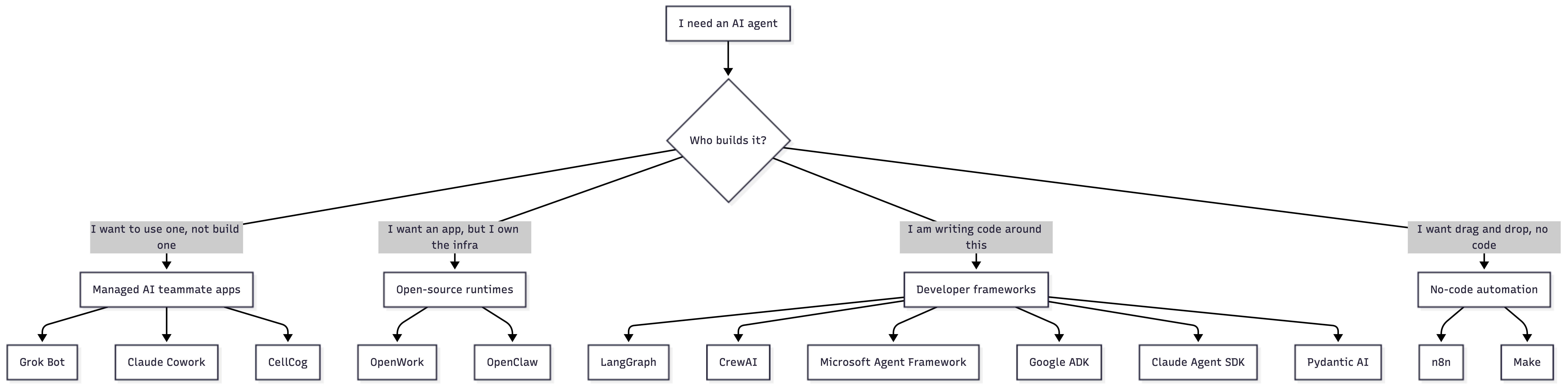
Managed AI Teammate Apps
These are products, not libraries. You sign in, you do not deploy anything, and someone else runs the compute.
Grok Bot is xAI's agent product, now shipped under the SpaceXAI banner after the SpaceX-Cursor deal closed in August. Each bot gets its own cloud computer, signs into apps you already use, and works through a task until it needs your approval. The interface looks like a messaging app: a list of named bots instead of one chat thread. Access runs through Cursor's subscription tiers (SuperGrok Plus, SuperGrok Heavy, Cursor Pro+, Cursor Ultra, Cursor Teams) rather than a standalone plan.
Claude Cowork is Anthropic's equivalent: an agentic knowledge-work app for non-developers that can reach into files, browse, and use spreadsheets and slides as tools. It is the product OpenWork explicitly built itself to be an open alternative to, which tells you a lot about how the market reads it: capable, but closed and vendor-tied.
CellCog takes the teammate idea one step further and calls its agents employees. Each one gets an isolated workspace with its own inbox, task board, shifts, and memory that carries over between sessions. Entry is self-serve from around $8 a month, with usage billed per shift of real work rather than a flat seat price.
Use this category when the person running the agent does not want to think about infrastructure, ever. The trade-off is the same across all three: your credentials and files live in someone else's cloud, and you are betting on their roadmap and uptime.
Open-Source Runtimes You Host Yourself
I covered these two in depth last time, so I will keep it tight here.
OpenWork is a free desktop app built on OpenCode. It runs 50+ model providers with your own API keys and keeps files local by default. Good middle ground if you want the Claude Cowork experience without the vendor lock-in.
OpenClaw is the MIT-licensed, self-hosted daemon that started as Peter Steinberger's weekend project and now has OpenAI, GitHub, NVIDIA, and Vercel backing its foundation. Agent behavior lives in a plain SOUL.md file, and the whole runtime, model router, memory layer, and messaging connectors are yours to audit and modify.
Use this category when you want an app-like experience but refuse to hand your files or your model choice to a vendor.
Developer Frameworks: What You Reach for When You Are Writing the Agent Yourself
This is the category that grew the most this year, and it is the one most DZone readers will actually touch, since most of us are not shipping a consumer app; we are building an agent into a product or an internal tool.
| Framework | Orchestration model | Best at | Learning curve | Model lock-in |
|---|---|---|---|---|
| LangGraph | Directed graph, explicit state, checkpointing | Complex, long-running, auditable workflows | Steepest | None |
| CrewAI | Role-based crews, sequential or hierarchical process | Fast prototyping of multi-agent workflows | Easiest | None |
| AutoGen / AG2 | Conversational group chat between agents | Brainstorming, debate, code review with multiple perspectives | Medium | None |
| Microsoft Agent Framework | Unified SDK, merged Semantic Kernel and AutoGen | Enterprise .NET and Microsoft-stack shops | Medium | None, but tuned for Azure |
| Google ADK | Hierarchical agent tree | Teams already on Gemini and Google Cloud | Medium | Optimized for Gemini, supports others |
| Claude Agent SDK | Tool-use chain with hierarchical subagents | Anthropic-native production agents | Low to medium | Claude models |
| Pydantic AI | Type-safe, harness-first | Python teams that want strict schemas and validation | Low | None |
A few notes worth calling out beyond the table. LangGraph pulled ahead of CrewAI in GitHub stars this year, largely because its graph model maps cleanly onto production needs like audit trails and rollback points. CrewAI still wins on pure iteration speed. AutoGen is the odd one out: Microsoft put the original project into maintenance mode and folded its ideas into Microsoft Agent Framework, so the community fork AG2 is now the one carrying the conversational-agent torch forward. If your org already lives on Azure and .NET, Microsoft Agent Framework is the safer long-term bet over legacy AutoGen. If you are all-in on Claude models, the Claude Agent SDK gives you hierarchical subagent spawning and fallback model chains without pulling in a general-purpose framework you will only use a third of.
I wrote about the shape of this decision- structure the loop yourself versus leaning on a framework's opinions for you- back in Loop Engineering. Nothing about that logic changed this year. What changed is how many good options now exist at each rung of the ladder.
No-Code Automation Still Has a Seat at the Table
Not every agent needs a framework. n8n and Make let you wire an LLM call into a visual workflow next to your existing integrations: a CRM update, a Slack post, a database write. If the "agent" part of your workflow is really one LLM call sitting inside a larger pipeline that already has clear steps, reaching for LangGraph is over-engineering. Reach for n8n instead and save the framework for the part of the system that actually needs a reasoning loop.
The Full Comparison
| Dimension | Grok Bot | Claude Cowork | CellCog | OpenWork | OpenClaw | LangGraph / CrewAI / etc. | n8n / Make |
|---|---|---|---|---|---|---|---|
| Who hosts it | Vendor | Vendor | Vendor | You (local-first) | You | You | Vendor or self-hosted |
| Setup effort | Sign in | Sign in | Sign in | Install the app | Clone and configure | Write code | Drag and drop |
| Model choice | Grok only | Claude only | Configurable | 50+ providers | Any provider | Depends on framework | Whichever LLM node you use |
| Audience | Non-technical teams | Non-technical teams | Teams that want "employees" | Privacy-conscious teams | Developers and platform teams | Developers | Ops and automation teams |
| Cost model | Bundled subscription | Bundled subscription | Per-seat plus per-shift usage | Free, pay for API calls | Free, pay for hosting and API | Free, pay for API calls | Free tier, paid for scale |
| Best for | Speed, zero infra | Anthropic-native knowledge work | Standing roles with memory | App experience without lock-in | Full ownership and auditability | Custom production agents | Wiring an LLM into existing ops |
When to Use What
If you are a non-technical team lead who wants an AI teammate today and does not want to hear the word Docker, pick Grok Bot or Claude Cowork based on whichever model ecosystem your org already trusts, and treat CellCog as the option if you specifically want standing roles rather than one-off task delegation.
If you want that same app-like experience but your files cannot leave your machine and your model bill needs to stay transparent, OpenWork is the one to install first. Read up on the security tradeoffs in Trust No Agent before you connect it to anything that touches production credentials.
If you are a platform or infrastructure team that needs to own every layer, including the messaging connectors and the memory store, OpenClaw is worth the setup time. It is also the option NVIDIA chose to build its NemoClaw enterprise stack on, which tells you it holds up under real compliance scrutiny.
If you are writing an agent into a product, pick your developer framework by what your team already knows, not by star count. CrewAI if you need something running by Friday. LangGraph if the workflow has real branching logic and needs to be auditable six months from now. Microsoft Agent Framework if you live in Azure. Claude Agent SDK if you have already standardized on Claude. Pydantic AI if your team cares more about type safety than flexibility.
And if the task is mostly plumbing with one smart step in the middle, do not reach for a framework at all. n8n or Make will get you there faster and with less to maintain.
Conclusion
Here is the thing I keep telling people who ask me to rank all of this. None of these tools are fighting over the same buyer. A managed app trades control for convenience. A self-hosted runtime trades setup time for ownership. A developer framework trades a learning curve for precision. A no-code tool trades flexibility for speed. That is the same argument I made about MCP, Skills, and Agent scripts: the question was never which layer wins; it was which layer matches the job in front of you.
Ask yourself three questions before you pick anything: who is allowed to see the data this agent will touch, who is on the hook when it does something wrong at 2 a.m., and how much time does your team actually have to babysit infrastructure versus paying someone else to do it. Answer those honestly, and the right column in the table above picks itself.
I will keep testing new entrants as they show up, and given how fast this category moved between August and now, I expect this list to be out of date within a quarter. That is fine. Pick based on your risk tolerance and your ops budget today, not on which name is trending on GitHub this week.
Opinions expressed by DZone contributors are their own.
Comments