

Putting Guardrails Around What Your AI Agent Is Allowed to Touch
Governance that stops at the model is theater. Put a guardrail gate at the runtime boundary: bind identity, scope retrieval, gate actions, log everything.
Join the DZone community and get the full member experience.
Join For FreeThis article is for platform engineers, data engineers, security architects, and AI application teams building enterprise agents that retrieve data, call tools, or trigger workflows on behalf of users.
Imagine a support engineer asking an internal AI agent for a customer summary. The user is cleared to see support tickets, but the agent runs under a broad service account that can also reach contract terms, payment history, and escalation notes. The agent does not need malicious intent to create a breach. If it retrieves contract terms the user could not normally access, governance has already failed at the data boundary.
That is why enterprise AI governance cannot stop at the model. Eval sets, content filters, and prompt rules are useful, but they sit above the point where the real risk lives: the moment the agent reaches into your systems and pulls something back.
This article focuses on that exact moment: the boundary where an AI agent moves from reasoning about a request to touching enterprise data or executing a tool. That boundary deserves to be treated as a first-class security control.
The Problem With the Account the Agent Runs As
Traditional data access control assumes one of two callers. Either a human is behind the query, authenticated and carrying their own permissions, or a fixed service account is running a known, reviewed workload. Role-based access control was designed for both.
An agent is neither.
An agent composes queries at runtime. It decides which tool to call, which data to fetch, and how to chain those calls in sequences nobody reviewed in advance. If it runs under a broad service account, every user talking to that agent can inherit that account's reach.
The fix is not to make the model sound more careful. The fix is to put a control layer between the agent and enterprise systems, then enforce that control at the moment each data or tool call is made.
The Pattern: A Guardrail Gate on Every Data Access
A guardrail gate is a runtime enforcement layer between the agent and the systems it wants to access. The agent must pass through this gate on every data or tool call. The gate performs four jobs in sequence: bind the caller's real identity, scope what can be retrieved, gate the action, and record the decision.
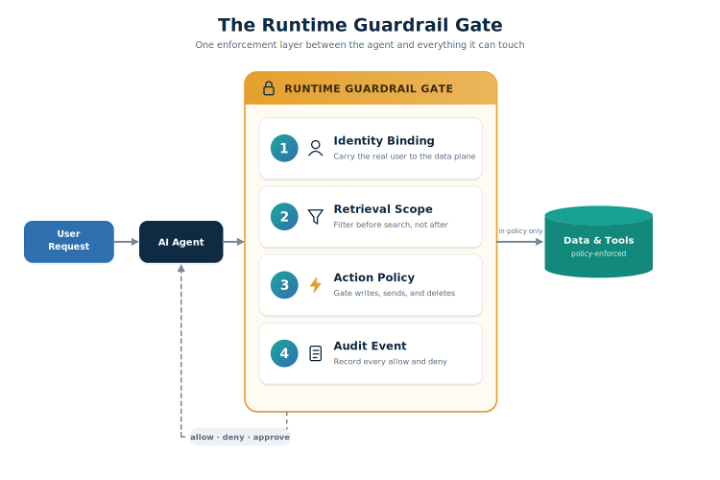
Figure 1. The guardrail gate: four control points between the agent and your data.
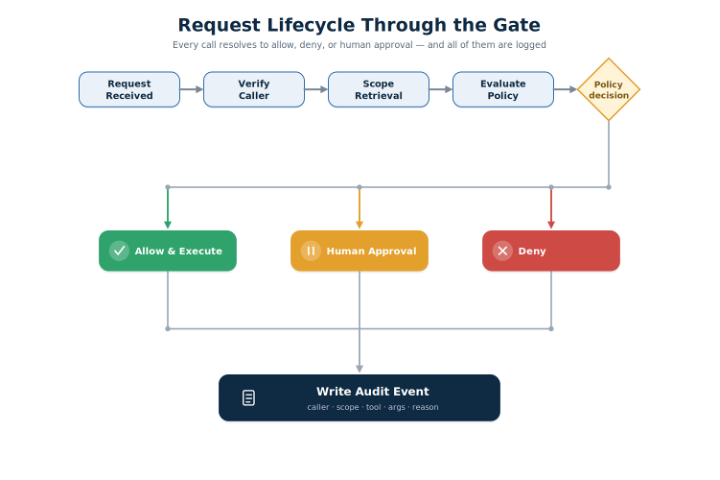
The same pattern is easier to operationalize as a decision flow, because the important behavior is in the branches: allow, deny, or require human approval.
1. Bind the Caller's Real Identity, and Carry It All the Way Down
This is the control most teams get wrong, so it is worth slowing down on.
The agent should not act with standing privileges. It should act as the human it serves, resolved fresh on every request. The key is mechanical: the user's identity must travel from the chat box to the data access layer without being swapped for a service account.
The clean way to do this is a token exchange. The agent forwards the user's token, and the guardrail trades it for a short-lived downstream credential that authorizes as that user, not as the agent. This aligns with the OAuth 2.0 Token Exchange pattern described in RFC 8693, which defines how a security token service can issue a new token for delegation or impersonation across security domains.
def exchange_on_behalf_of(user_token):
    # Trade the user's token for a short-lived downstream credential
    # that carries THAT user's identity, not the agent's.
    if not verify_signature(user_token):
        return None
    return sts.exchange(
        subject_token=user_token,
        audience="data-plane",       # who the credential is for
        # the resulting credential authorizes AS the user
    )
Now the data layer can enforce row-level security under the user's identity instead of trusting the agent. If this control is right, the data plane already refuses anything the user could not see directly.
2. What the Agent Can Retrieve Before the Query Runs
Even a correctly identified user can ask a question whose honest answer would require data they should not see. Retrieval scoping narrows the searchable surface before the agent ever runs a query, rather than filtering results after the fact.
The distinction matters. Post-filtering means the sensitive rows were fetched, sat in memory, possibly landed in a log, and only then got dropped. Pre-scoping means they were never reachable.
Here is the crux made concrete: an agent doing retrieval-augmented generation over a vector store, with the guardrail enforcing per-user access at retrieval time.
def handle_agent_retrieval(agent_request):
    # (1) Bind the real caller. The agent forwards the user's token,
    #     never its own service credential.
    principal = exchange_on_behalf_of(agent_request.user_token)
    if principal is None:
        return audit_and_deny(agent_request, reason="no verifiable caller")

    # (2) Turn the user's clearances into a metadata filter the vector
    #     search cannot escape. This is a PRE-filter, not a post-filter.
    allowed_filter = access.metadata_filter_for(principal)
    #   e.g. {"region": principal.region, "dept": principal.dept}
    if not allowed_filter:
        return audit_and_deny(agent_request, reason="no in-policy corpus")

    hits = vector_store.search(
        embedding=agent_request.query_embedding,
        top_k=8,
        metadata_filter=allowed_filter,   # out-of-policy chunks are never returned
    )

    audit.record(principal, "retrieval", allowed_filter, len(hits))
    return hits
The one line that does the work is metadata_filter=allowed_filter. Out-of-policy chunks are never retrieved, so they never enter the prompt, never reach the model, and never show up in a trace.
3. Gate the Action, Not Just the Read
Retrieval is only half of what an agent does. The other half is acting: writing a record, triggering a workflow, sending something outward. A read policy that is airtight does nothing if the agent can then take an action the user was never allowed to take.
Every tool the agent can call needs an explicit policy that answers three questions: Is this user allowed to invoke this tool? Are the arguments within approved bounds? Does the action require a human approval step before it commits?
def check_action(principal, tool_call):
    policy = action_policy_for(tool_call.name)
    if not policy.permits(principal, tool_call.args):
        return deny(f"{tool_call.name} not permitted for this caller")
    if policy.requires_confirmation(tool_call.args):
        return require_human_approval(tool_call)   # high blast-radius path
    return allow(tool_call)
The high-blast-radius actions — anything that writes, spends, sends, or deletes — are the ones that most deserve a confirmation step. Be conservative here early and loosen later, rather than the reverse.
4. Record Every Access as an Event
The last control point does not block anything, which is why people skip it, and it is the one that saves you when something goes wrong. Every access decision the guardrail makes — allow or deny — with the resolved identity, the scope, and the tool call, should be written as an audit event.
This is not logging for its own sake. When an agent produces a surprising result three weeks from now, the audit trail is the only thing that lets you answer: What did it actually touch, on whose behalf, and why was that allowed? Without it, you are guessing.
Putting the Four Controls Together
Each control is simple on its own. The payoff comes when they compose into a single gate that every agent call passes through, retrieval and tool execution alike. In practice, that is one function, or one middleware, wrapping the agent's access to the outside world:
# The four controls, composed into one gate every agent call passes through.
# Wrap the agent's access to data and tools with this single entry point.

def guardrail(agent_request):
    # 1. Identity: bind the real user, never the agent's service account.
    principal = exchange_on_behalf_of(agent_request.user_token)
    if principal is None:
        return audit_and_deny(agent_request, reason="no verifiable caller")

    # 2. Retrieval: scope the searchable surface BEFORE any query runs.
    if agent_request.kind == "retrieval":
        allowed = access.metadata_filter_for(principal)
        if not allowed:
            return audit_and_deny(agent_request, reason="no in-policy corpus")
        hits = vector_store.search(
            embedding=agent_request.query_embedding, top_k=8,
            metadata_filter=allowed,          # pre-filter, not post-filter
        )
        audit.record(principal, "retrieval", allowed, len(hits))
        return hits

    # 3. Action: gate tools, route high-blast-radius calls to a human.
    if agent_request.kind == "tool_call":
        decision = check_action(principal, agent_request.tool_call)
        audit.record(principal, "action", agent_request.tool_call, decision.status)
        return decision       # allow, deny, or require_human_approval

    return audit_and_deny(agent_request, reason="unknown request type")
Every path through the gate, including each denial, ends in an audit record, so nothing the agent does escapes review. The four controls are not four features to build separately; they are one checkpoint the agent cannot go around.
Why This Belongs at Runtime
These controls belong at runtime because an agent's behavior is not fixed in advance. A pipeline's access can be reviewed once; an agent's access depends on the user request, model decision, and tool chain. The boundary must be enforced where each call is made.
None of this requires a new platform. It requires treating the space between your agent and your data as a first-class component with its own responsibilities. That idea is consistent with the broader Zero Trust principle that access decisions should be explicit and resource-centered rather than assumed from network location, as described in NIST SP 800-207.
Where the Guardrail Gate Sits in the Stack
In production, the guardrail gate sits between the agent runtime and every system the agent can touch, exactly as Figure 1 shows. Beyond the agent, the gate, and the data plane already in that diagram, a real deployment leans on three supporting services:
- Identity provider or token exchange service: issues the short-lived, user-scoped credentials the gate binds to each request.
- Policy engine: decides whether this user, resource, operation, and set of arguments are permitted.
- Audit sink: receives allow, deny, and approval events for logs, governance dashboards, or a SIEM.
This placement keeps the model useful while preventing it from becoming the security boundary. The model proposes; the gate, backed by identity, policy, and audit, decides.
Before and After: Broad Service Account vs. User-Bound Retrieval
Before: The support agent from the opening runs on one broad service account and searches the entire customer corpus. The app tells the model to avoid sensitive content, but the vector store still returns contract, finance, and escalation chunks. The model may ignore some of them, but unauthorized data has already entered the runtime.
After: The same request flows through the guardrail gate. It exchanges the user's token, builds a metadata filter from the user's role and scope, and applies it before vector search. Out-of-scope chunks are never fetched, and the audit trail records the user, scope, query class, and result count.
That one shift changes the security model. Instead of trusting the model to behave after it has seen too much, the system ensures it never receives data outside the user's allowed scope.
Production Implementation Checklist
For teams turning this pattern into production controls, the checklist works best when it is grouped by control area.
Identity and Delegation
- Do not let agents use broad standing service credentials for user-facing requests.
- Exchange the user's token at runtime and carry the resolved user identity to the data plane.
- Use short-lived downstream credentials that expire quickly and are scoped to the requested resource.
Retrieval Controls
- Apply retrieval filters before search so out-of-policy chunks are never fetched.
- Keep metadata filters close to the search layer rather than relying on the model to ignore unauthorized context.
- Treat vector indexes, document stores, and SQL endpoints as policy-enforced data planes, not passive context providers.
Action Controls
- Define explicit policies for every tool the agent can call, including argument bounds.
- Require human approval for write, send, delete, spend, or other high-impact actions.
- Start conservative for high-blast-radius actions and loosen policy only after reviewing real usage patterns.
Auditability and Review
- Record allow, deny, and approval decisions as audit events with caller, scope, tool, arguments, and reason.
- Review guardrail decisions periodically against security guidance such as the OWASP GenAI LLM Top 10 and risk-management practices such as the NIST AI Risk Management Framework.
- Feed denied requests, approval patterns, and near misses back into policy tuning and threat modeling.
What Not to Do
A few anti-patterns show up repeatedly in early agent deployments. They are tempting because they make the first demo easier, but they also move the security boundary to the weakest possible place.
- Do not let the agent use one broad service account and hope the prompt keeps it honest.
- Do not retrieve everything first and filter sensitive results afterward.
- Do not treat prompt instructions as access control.
- Do not give write-capable tools to an agent without a policy layer and an approval path.
- Do not log only the final answer; log the access decision that produced it.
Governance that stops at the model is theater. The real control point is the runtime boundary between the agent and the systems it can touch. Bind the user, scope retrieval before search, gate actions before execution, and record every decision. Then inventory every data source and tool your agent can reach, and force each path through one guardrail gate before production.
References
The references below provide the identity, Zero Trust, and AI risk-management standards behind the pattern.
Opinions expressed by DZone contributors are their own.
Comments