

Building Enterprise File-Heavy AI Workflows: From Secure Uploads to Governed Document Intelligence
A reference architecture for secure, scalable enterprise Document AI, covering ingestion, processing, retrieval, governance, and lifecycle management.
 CORE
·
CORE
·
Join the DZone community and get the full member experience.
Join For FreeEnterprise AI is increasingly moving beyond clean, structured datasets and into the much larger world of documents, files, images, forms, emails, reports, contracts, claims, clinical records, and other unstructured content. These files often contain the information enterprises need most, but they are also among the hardest data assets to process reliably at scale.
A document AI production system is much more than an LLM, a vector database, or an RAG application. Before a document can become useful AI context, it may need to be securely uploaded, validated, scanned, classified, parsed, OCR-processed, enriched with metadata, protected from sensitive-data exposure, and transformed into retrievable knowledge. The resulting content must then remain traceable to the source through retrieval, reasoning, human review, and downstream execution.
That means the architecture must account for much more than the model:
Ingestion → Validation → Processing → Enrichment → Indexing → Retrieval → Reasoning → Human Review → Action → Retention → Deletion
This is especially important in file-heavy industries such as healthcare, financial services, insurance, and life sciences, where data can be large, heterogeneous, sensitive, and subject to long retention periods.
Healthcare provides a useful example. A single enterprise may simultaneously manage clinical documents, medical images, pathology slides, claims data, genomic datasets, audio/video recordings, and medical-device telemetry.
This article presents a reference architecture for building secure, scalable, observable, and governable AI workflows around these workloads. The focus is not on a particular LLM or cloud provider. Instead, the article examines the engineering capabilities required before, around, and after the LLM.
Enterprise Document AI is not primarily an LLM problem. It is an end-to-end data, security, processing, retrieval, and workflow-engineering problem with AI embedded into it.
Why File-Heavy AI Is Different
Traditional application architectures often assume that inputs are relatively small and well-structured. An API may receive a JSON request containing a few kilobytes of data. The application validates it, executes business logic, and returns a response. Document-heavy AI workloads are fundamentally different.
A single request may contain:
- A scanned PDF
- A multi-gigabyte medical image
- A pathology slide
- A spreadsheet containing thousands of records
- An email with multiple attachments
- A contract containing tables and embedded images
- A clinical document containing sensitive information
- A genomic data file
- An audio or video recording
The system therefore must solve several problems simultaneously:
- Reliable ingestion
- Large-file transfer
- Security and malware protection
- Document understanding
- OCR and extraction
- Metadata management
- PII/PHI detection and protection
- Knowledge preparation
- Retrieval
- AI reasoning
- Human review
- Business workflow execution
- Observability
- Retention and deletion
- Lineage and provenance
The important architectural implication is that the document pipeline cannot simply be treated as an extension of an LLM API. It needs to be engineered as a first-class enterprise data-processing platform.
Healthcare as a File-Heavy Enterprise
Healthcare organizations manage everything from electronic health records and claims to high-resolution imaging, pathology slides, genomic data, clinical recordings, and device-generated telemetry.
Unlike traditional enterprise documents measured primarily in kilobytes or megabytes, healthcare workloads can contain files ranging from several gigabytes to hundreds of gigabytes.
At enterprise scale, repositories can grow into petabytes and must remain accessible, secure, and governed for many years. The challenge therefore extends beyond storage. Healthcare platforms must simultaneously support:
- Secure ingestion
- Large-file transfer
- PHI/PII protection
- Document understanding
- Rapid retrieval
- AI processing
- Lineage
- Governance
- Retention
- Archival
- Deletion
Major Healthcare Data Challenges
| challenge | description | enterprise impact |
|---|---|---|
|
Security & Compliance |
PHI/PII must be protected throughout ingestion, processing, storage, and access |
Breach exposure, compliance risk, regulatory consequences, and loss of trust |
|
Large File Uploads |
Imaging, pathology, and genomic datasets can be multi-gigabyte or larger |
Failed transfers, delays, repeated uploads, and network utilization |
|
AI Pipeline Processing |
Files may require scanning, OCR, classification, extraction, redaction, summarization, and AI analysis |
Higher compute cost, latency, and processing complexity |
|
Massive File Sizes |
Imaging, pathology, genomics, and clinical video can produce very large objects |
Storage, transfer, retrieval, and processing challenges |
|
Storage Growth |
Long retention periods continuously increase repository size |
Infrastructure cost, replication requirements, and operational complexity |
|
Upload / Data Transfer |
Files originate from hospitals, clinics, laboratories, devices, and other locations |
Network latency, transfer failures, and processing delays |
|
AI Readiness & Governance |
Data must be scanned, validated, enriched, indexed, governed, and traceable before AI consumption |
Longer preparation time, higher costs, and compliance complexity |
The architecture must also account for the fact that "a document" is not a single data type.
| data type | typical scale | key challenge |
|---|---|---|
|
Medical Imaging Files |
MB to multiple GB |
DICOM, CT, MRI, PET, mammography, ultrasound files which are complex in nature |
|
Digital Pathology Files |
2 GB to 100+ GB |
Large storage requirements, viewing performance, AI processing, replication |
|
Clinical Documents |
KBs to GBs |
EHR, CCD, FHIR bundles, metadata, PHI protection, compliance |
|
Claims & Encounter Data |
Hundreds of MBs to large, structured datasets |
Validation, processing at scale, reporting |
|
Forms & Patient Documents |
KBs to 50 MB |
OCR accuracy, poor image quality, extraction errors |
|
Genomics and Sequencing Data
|
Tens to hundreds of GB |
FASTQ, BAM, CRAM, VCF processing and storage |
|
Audio & Video Clinical Content
|
1–100 GB per recording |
Transcription, retrieval, secure access, long retention |
|
Medical Device Data
|
KBs to hundreds of MB per patient/device per day |
High-velocity ingestion and real-time analytics |
These workloads illustrate why one ingestion mechanism or one processing strategy is unlikely to be sufficient for enterprise Document AI. Modern healthcare platforms require specialized architecture incorporating cloud object storage, resumable uploads, event-driven processing, intelligent lifecycle management, and compliance-focused security controls.
Characteristics of Enterprise Document Processing Using AI
Reliable enterprise AI document workflows begin before a file reaches an LLM. Enterprises need a controlled document-processing pipeline that can securely accept large, varied files; validate and normalize them; extract usable content and metadata; identify and protect sensitive information; prepare content for downstream retrieval or inference; and enforce retention policies throughout the file lifecycle.
Document Processing Pipeline for AI
Raw enterprise documents should not be sent directly to an LLM. Build an event-driven, layered pipeline with separate stages for ingestion, validation, OCR/parsing, enrichment, indexing, retrieval, LLM reasoning, human review, and final workflow execution. The document-processing pipeline converts untrusted enterprise content into governed AI-ready knowledge.
Large Uploading of Data Files Using AI
Land uploads in secure object storage first, not directly into the app or LLM path. For very large files, use an asynchronous ingestion flow that can split/burst files into smaller units before downstream processing.
PII in AI Document Workflow
Treat PII/PHI as a policy-controlled data class. Minimize it, classify it, redact/tokenize where possible, and only store/process it in approved environments. Add access control, encryption, logging, monitoring, and output filtering. Requires approved production environments with encryption in transit/at rest, access controls, logging, and 24/7 monitoring. Sanitized inputs, structured prompts, and output moderation guardrails should be enforced.
Document Chunking for AI and RAG
Use layout-aware and semantic chunking (by paragraph, heading, table, or section) rather than naive fixed-character splitting. Maintain document metadata, parent-child section context, and overlap to preserve full context across chunk boundaries. Preserve source lineage, section headers, and page numbers in chunk metadata for accurate citation, auditability, and precise retrieval quality.
OCR and Metadata Extraction in AI Pipeline
OCR, layout parsing, and metadata extraction should happen in the asynchronous document-processing layer. CPU- and GPU-intensive workloads can be executed through scalable worker pools and queues rather than blocking interactive requests. Metadata is particularly important because it becomes an input to downstream retrieval and policy decisions.
Document Archival
Implement strict lifecycle, retention, and legal hold policies in object storage and databases. Automate document purging or archiving based on business retention schedules and regulatory compliance (e.g., GDPR, HIPAA). Enforce immutability during required retention windows, implement soft deletes with audit logs, and ensure cryptographic erasure or full deletion across object storage, indexes, vector stores, and cache layers when retention expires.
Data Lifecycle Management for Enterprise Document AI
Enterprise document AI requires lifecycle management that extends beyond ingestion and processing to the complete journey of data and its derived artifacts. This includes creation, ingestion, validation, storage, processing, enrichment, retrieval, AI consumption, retention, archival, and eventual deletion. Each stage should maintain appropriate security, governance, lineage, and audit controls while ensuring that policies are consistently applied to originals and derived artifacts such as OCR output, metadata, chunks, embeddings, and indexes.
The following table describes the life cycle of documents and AI data life cycle,
| life cycle stage | activties | key controls |
|---|---|---|
|
Create / Source |
Documents originate from users, applications, scanners, email, EHR/ECM, APIs, devices, and other systems |
Source identity, ownership, metadata, classification |
|
Ingest |
Files enter through APIs, connectors, SFTP, events, or resumable uploads |
Authentication, authorization, checksum, upload session, encryption |
|
Validate & Secure |
File type, integrity, malware, and policy checks are performed |
Malware scanning, quarantine, validation, content policy |
|
Store |
Original document is placed in durable object storage |
Immutable originals, encryption, access control, versioning |
|
Process & Transform |
OCR, parsing, layout analysis, table extraction and normalization occur |
Processing isolation, lineage, versioning, confidence |
|
Enrich & classify |
Classification, entities, metadata, PII/PHI detection, redaction and segmentation |
Policy enforcement, provenance, sensitivity tags |
|
Index & Retrieve |
Content becomes searchable through keyword, vector, and hybrid indexes |
ACL/ABAC, tenant isolation, metadata filtering |
|
Use AI |
RAG, summarization, extraction, agents and downstream workflows consume the data |
Grounding, guardrails, tool authorization, audit |
|
Retain / Archive |
Data and derived artifacts are retained according to business/regulatory policy |
Retention schedules, legal hold, archival, immutability |
|
Delete / Dispose / Verify |
Expired data and derivatives are removed, and deletion is verified |
Deletion propagation, audit trail |
Enterprise Document Intake and AI Pipeline
Document-heavy enterprises usually need to:
- Ingest large volumes of PDFs, scans, emails, forms, images, and Office files
- Extract structured and unstructured knowledge
- Route documents to the right workflow
- Answer questions or generate outputs with traceability
- Keep security, compliance, and auditability intact
- Scale across many business units, document types, and tenants
A good enterprise design separates the system into layers that can scale ingestion, understanding, retrieval, and workflow execution independently. The following diagram depicts the detailed view of the Enterprise Document knowledge pipeline and the steps involved in processing.
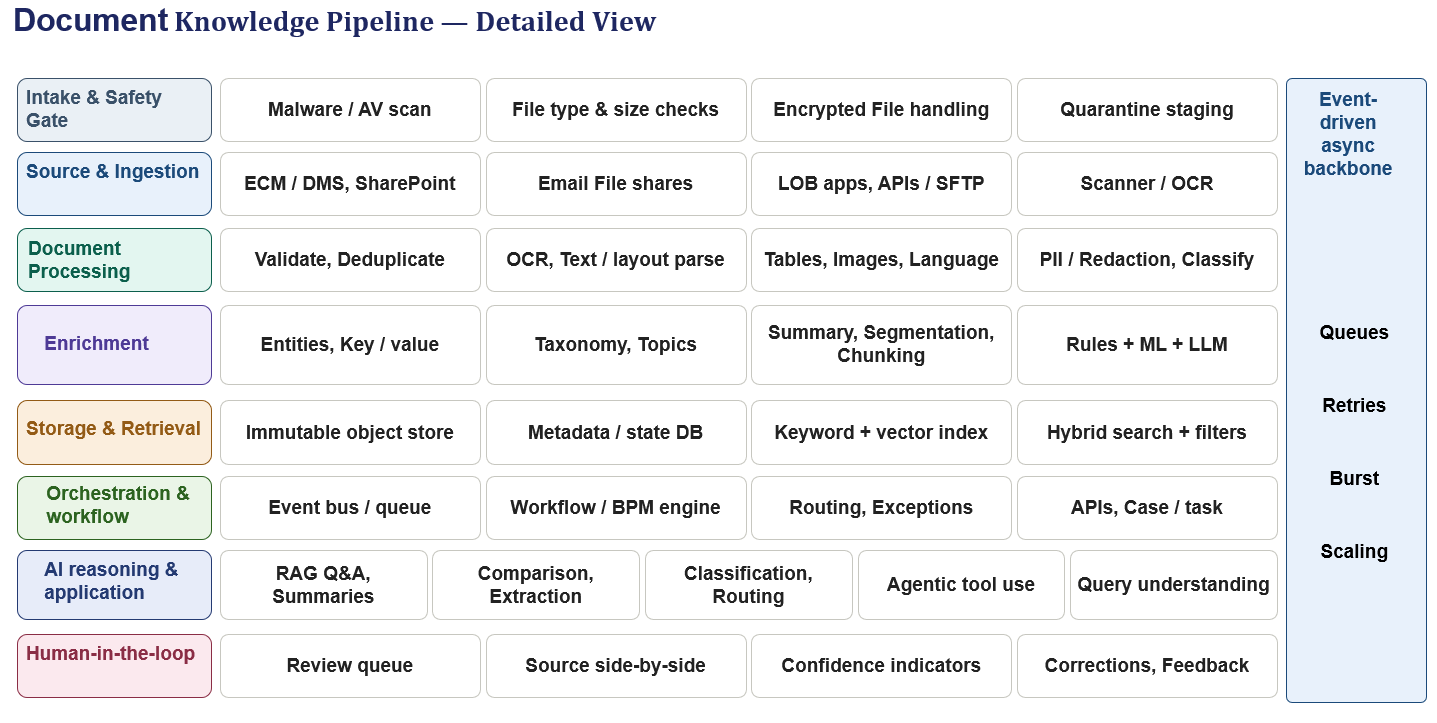
Intake and Safety Gate
Every incoming file should pass through authentication, authorization, file-type and integrity validation, malware/security scanning, size and policy checks, and quarantine handling before it becomes available to downstream processing. The intake layer should be isolated from the AI execution path so that untrusted content cannot directly reach parsers, models, tools, or retrieval systems.
Source and Ingestion Layer
It brings documents into the platform reliably. Core functions are connector management, deduplication, incremental sync, metadata capture, versioning, and checksum/integrity checks. Typical sources are:
- ECM/DMS systems
- SharePoint/OneDrive/file shares
- email inboxes
- line-of-business apps
- APIs, SFTP, event streams
- scanner/OCR pipelines for paper documents
Document Processing Layer
This layer normalizes documents into AI-ready assets. The most common steps are file type detection, text extraction, OCR for scanned content, layout parsing, table extraction, image understanding, language detection, redaction or PII detection, and document classification
It generates the output in the following formats:
- Raw text
- Structured blocks
- Page/layout coordinates
- Document metadata
- Confidence scores
This layer should be asynchronous and queue-based so large batches don't block the system.
Enrichment and Understanding Layer
It converts raw extracted content into usable knowledge. Typical enrichments are: classification by document type, entity extraction, key-value extraction, taxonomy tagging, topic detection, summary generation, document segmentation by section, clause, or paragraph, duplicate and near-duplicate detection. For enterprise use, this layer often combines:
- Deterministic rules
- ML models
- LLMs for semantic interpretation
Indexing and Retrieval Layer
It makes content searchable and retrievable at scale.
Usually includes a keyword index, vector index, metadata store, and object store for original and processed artifacts. Retrieval patterns are:
- Keyword search for exact match
- Vector search for semantic match
- Hybrid retrieval for best quality
- Metadata filters for tenants, region, business unit, document type, date, retention class
For document-heavy systems, hybrid retrieval is usually the most reliable.
Orchestration and Workflow Layer
This layer manages end-to-end business processes by connecting AI output to real business actions. Examples are routing a contract to legal review, sending a document to an extraction pipeline, triggering exception handling if confidence is low, creating a case, task, or approval when needed, and invoking downstream systems through APIs.
AI Reasoning/Application Layer
It performs the user-facing or workflow-facing AI task. Common patterns include RAG Q&A over enterprise documents, document summarization, version comparison, clause extraction, classification and routing, form-filling and auto-population, and agentic workflows with tool use. Best practice is to keep the model layer behind the controls as part of enterprise settings. It covers:
- Policy checks
- Prompt templates
- Retrieval constraints
- Grounding to approved sources
- Guardrails against unsupported generation
Human-in-the-Loop Layer
It handles exceptions and maintains quality. This is needed for: low-confidence extraction, policy-sensitive decisions, regulated content, disputed outputs, and approval workflows. This supports:
- Review queue
- Side-by-side source view
- Confidence indicators
- Correction capture
- Feedback loop to improve models and rules
Reference Architecture for Enterprise Document AI Platform
The complete platform can be organized into six major architectural layers,
- Users and Experience
- AI Application and Agent Layer
- AI Control Plane
- Knowledge and Tools Plane
- Document Knowledge Pipeline
- Data Plane
Cross-cutting capabilities span all six layers:
- Security and Governance
- AI Safety
- Observability and MLOps
- Reliability
The document pipeline therefore sits inside a broader enterprise AI platform rather than operating as an isolated OCR or RAG subsystem.
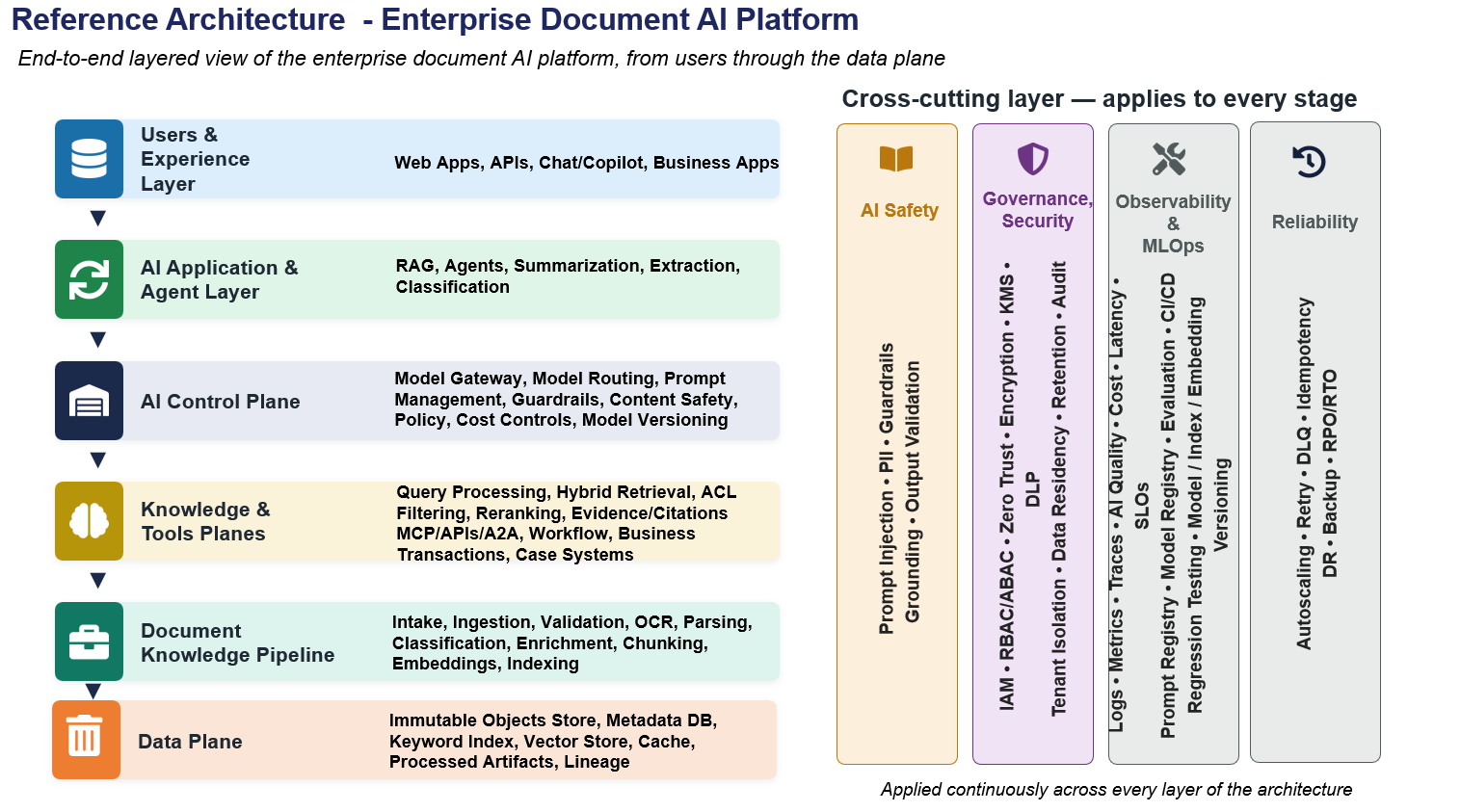 Figure 2: Enterprise Document AI Platform Reference Architecture
Users and Experience Layer
This is the layer users and upstream systems interact with. It typically covers web and mobile apps, partner and batch APIs, and chat or Copilot-style interfaces. This is a single point of entry for the user, where the user gets authenticated and the intent of what is being uploaded and why is captured. Once the request is captured in the structured form, it is handed over to the AI application layer without embedding any business logic.
Examples include claims processing and prior authorization workflows.
AI Application and Agent Layer
This layer hosts the actual AI-facing capabilities covering RAG-based question answering and summarization, extraction of structured fields from unstructured text, classification of documents and requests, and increasingly, agents that carry out multi-step tasks. Examples are,
For example, a claims-processing agent might: retrieve a denial rationale, locate supporting attachment pages, extract relevant information, draft a response, request human approval.
A prior-authorization agent might: classify an inbound document, identify the requested medication or procedure, extract relevant codes, route the request to the appropriate workflow
AI Control Plane
It governs model and AI behavior across applications. The model gateway is the governed entry point to every model. Model routing sends the request to the model to handle it reliably. Prompt management version controls the prompts. Guardrails and Content Safety screen both inputs and outputs.
Knowledge and Tools Planes
It has two distinct capabilities covering the Knowledge and RAG Plane and Tools/Action Plane. This separation is useful because retrieving information and taking an action are different capabilities with different security requirements.
- Knowledge/RAG Plane: Query processing that turns a natural language question into a retrieval query.
- Tools/Action Plane: These tools help in calling other systems via MCP, APIs, or agent-to-agent (A2A) protocols, integrating with enterprise applications, pushing work into workflow or case-management systems, and executing business transactions.
Document Knowledge Pipeline
This is the pipeline intake and the pre-ingestion safety gate, validation and OCR, enrichment including explicit chunking. It also addresses retrieval quality, PHI/PII detection and redaction, storage and indexing, and retrieval-time access control before the document reaches the Knowledge Plane above it.
- Claims processing: Claim attachments are split, OCR'd, tagged with claim ID and line-of-business metadata, chunked by section (correspondence, EOB, clinical attachment), and redacted for member PHI
- Prior authorization: Faxed clinical packet is validated and quarantined if password-protected, OCR'd, member and diagnosis identifiers are detected and minimized, and the remaining clinical content is chunked.
Data Plane
An immutable object store holding original source files, a metadata/state database, keyword and vector indexes for hybrid search, a cache layer for frequently accessed results, and lineage records tying every derived artifact back to its source.
Cross-Cutting Platform Controls
These categories apply continuously across every layer. It covers:
- Security and governance: It makes the system enterprise-safe. It implements Identity and access management, RBAC/ABAC, zero trust, encryption, key management, data-loss prevention, tenant isolation, data residency, retention, and audit.
- AI safety: It implements Prompt injection defense, PII handling, guardrails, grounding that ensures answers are tied to retrieved evidence rather than unsupported generation, and output validation.
- Observability and MLOps: Keep the system healthy and measurable. It implements logs, metrics, traces, AI-quality monitoring, cost tracking, latency, and SLOs. It also covers Prompt and model registries, evaluation pipelines, CI/CD, regression testing, and model/index/embedding versioning.
- Reliability: Autoscaling, retry logic, dead-letter queues, idempotency, disaster recovery, backup, and recovery-point/recovery-time objectives (RPO/RTO)
Best Practices for Document Processing
The recommended architecture patterns for enterprise scale are to use a decoupled, event-driven pipeline. These are best suited as they help:
- Ingestion spikes won't break the AI layer
- OCR/extraction can scale separately from retrieval
- Workflow steps can be retried independently
- Swap models without redesigning the system
- Easier governance and auditability
A good reference pattern to be used is:
- API gateway for ingestion and user requests
- Message queue/event bus for async processing
- Object storage for original and processed files
- Metadata database for document state and workflow status
- Search index for keyword retrieval
- Vector database for semantic retrieval
- Workflow engine for business process coordination
- Model gateway to route to approved AI models
- Review UI for exceptions and approvals
- Policy engine for security and compliance
Engineering Principles for Production Document AI
- Never send untrusted files directly to an LLM.
- Use durable object storage as the document system of record.
- Separate ingestion, processing, retrieval, reasoning, and execution.
- Treat security and authorization as runtime controls, not post-processing.
- Preserve provenance from source document to AI response.
- Make every processing stage asynchronous, re-triable, and re-playable.
- Evaluate document AI quality independently from model quality.
- Design retention and deletion across originals and every derived artifact.
The following are the best practices that need to be followed for document processing,
- Separate document processing from user interaction: Batch processing and interactive Q&A have different latency and scaling needs.
- Manage the Full Data and Artifact Lifecycle: Treat every document and its derived artifacts as lifecycle-managed assets. Maintain lineage from the original file through OCR output, extracted metadata, chunks, embeddings, indexes, AI-generated outputs, and downstream records. Apply retention, legal hold, archival, versioning, and deletion policies consistently across the entire artifact chain. When a document expires or is deleted, deletion should propagate to all applicable derived artifacts and be auditable and verifiable.
- Store source of truth separately from derived artifacts: Keep originals immutable. Generate processed outputs as versioned artifacts.
- Use hybrid retrieval: Keyword + semantic retrieval beats either one alone for messy enterprise documents.
- Ground AI outputs in evidence: Require source passages or citations internally so answers can be audited.
- Route by confidence: High-confidence automation; low-confidence human review.
- Treat security as a first-class workflow step: Do not bolt it on after retrieval or generation.
- Design for document variability: Expect scans, tables, handwriting, multi-language content, and inconsistent templates.
- Make feedback operational: User corrections should feed back into taxonomy, prompts, rules, and extraction models.
- Design for replayability: Every processing stage should be independently replayable without re-uploading the original document. Preserve immutable originals, processing versions, model versions, prompt versions, extraction configuration, and lineage so that documents can be reprocessed when parsers, models, or policies change.
Conclusion
Enterprise document AI is not primarily an LLM problem. It is an end-to-end data, security, processing, retrieval, and workflow engineering problem.
For file-heavy enterprise workloads, documents must first be securely ingested, validated, scanned, normalized, extracted, enriched, classified, and protected. Their derived representations must retain provenance and access controls as they move into search, RAG, AI reasoning, human review, and downstream business workflows.
Production-grade architecture therefore needs more than a model gateway and a vector database. It requires a durable document intake layer, asynchronous processing, scalable OCR and extraction, metadata and lineage management, ACL-aware retrieval, AI safety controls, policy enforcement, observability, evaluation, human oversight, and deterministic lifecycle management.
The architecture presented in this paper separates these concerns into independently scalable layers while connecting them through common enterprise controls for security, governance, AI safety, reliability, and observability. This separation allows organizations to evolve document processors, retrieval technologies, models, and agent capabilities without redesigning the entire platform.
Practical recommendations for the enterprise document intake and AI pipeline implementation are:
- Use object storage as the system landing zone; keep the LLM out of the upload path.
- Separate originals, processed text, metadata, and indexes.
- Chunk after OCR/extraction, before RAG.
- Treat PII as a workflow control point, not just a redaction step.
- Make retention/deletion deterministic and auditable.
For healthcare and other highly regulated environments, the principle is even more important. Sensitive data must remain protected throughout its lifecycle, while every transformation from the original document through OCR, chunks, embeddings, retrieved evidence, model output, and business action must remain traceable and governed.
Disclaimer
The views and opinions expressed in this article are solely those of the authors and do not necessarily reflect the position or policies of any organization with which they are affiliated.
Opinions expressed by DZone contributors are their own.
Comments