

Why AI Agents Need a Shared Enterprise Ontology
AI agents can communicate, but without a shared ontology, they cannot consistently understand enterprise meaning, context, and policies.
 CORE
·
CORE
·
Join the DZone community and get the full member experience.
Join For FreeAgents Can Communicate, But Do They Understand Each Other?
Two agents. Same customer ID. Different decisions. That is the semantic gap hiding inside most multi-agent enterprise deployments today — and protocols like MCP and A2A alone cannot close it (nor will they ever).
AI agents are getting better at interacting through APIs, events, messages, and shared protocols. They can exchange data, invoke services, and coordinate tasks across enterprise systems.
But communication doesn’t guarantee understanding.
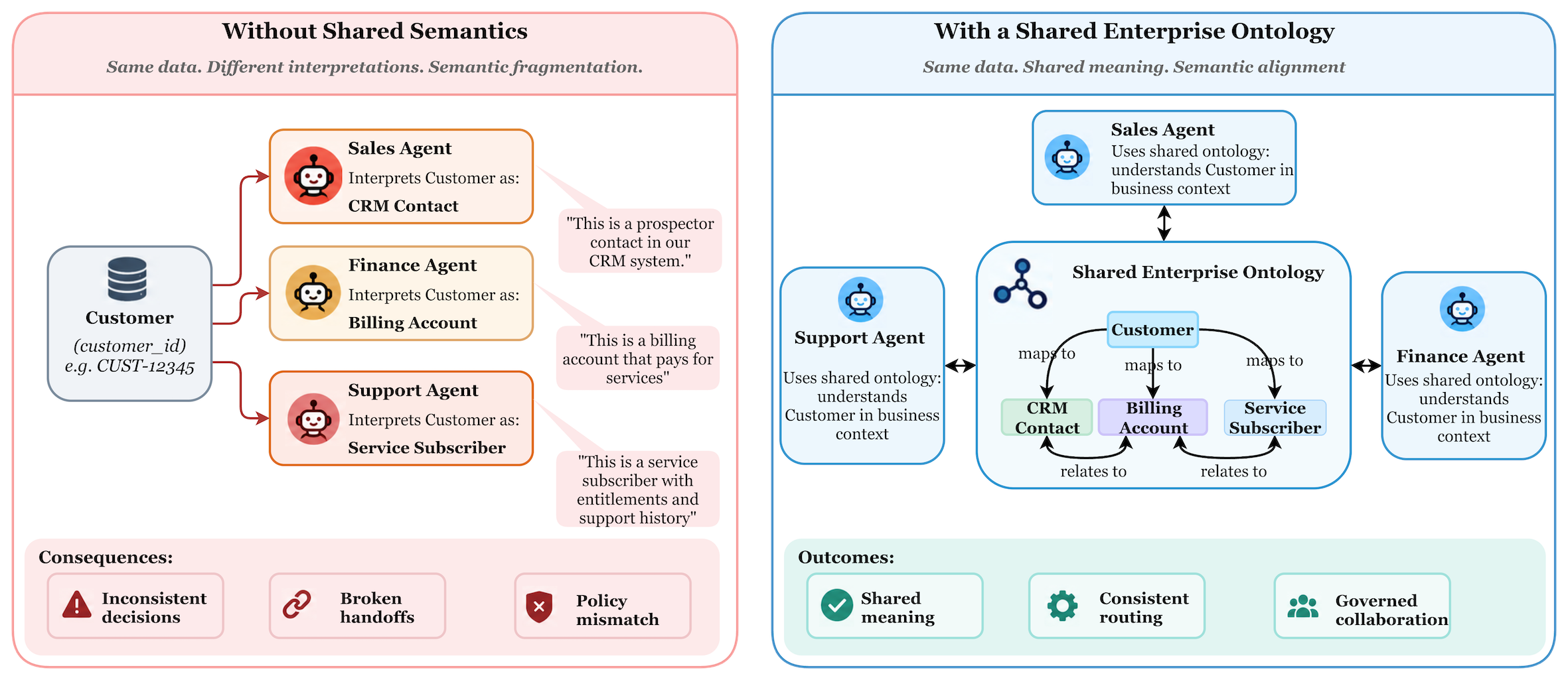
Imagine three agents dealing with the same customer request. One sees a customer as an account holder, another as a billing entity, and a third as a CRM contact. Data is exchanged, but each agent interprets it differently.
This exposes a fundamental challenge in multi-agent enterprises: agents can exchange information without sharing the same meaning.
Protocols define how information is exchanged. APIs define what data is exchanged. Neither defines what enterprise concepts such as customer, product, entitlement, incident, or approval actually mean.
As organizations deploy specialized agents in sales, finance, ops, security, and engineering, semantic consistency is paramount. Agents need more than connectivity — they need a shared understanding of business concepts, relationships, and constraints.
“Agent interoperability is not only a protocol problem; it is a semantic problem.”
The Semantic Gap in Multi-Agent Enterprises
In a multi-agent enterprise, different agents are built by different teams, trained on different data sets, connected to different systems, and designed around different business contexts. They may all exchange valid JSON messages, call the same APIs, or participate in the same workflow but still interpret the underlying business concepts differently.
This is the semantic gap: what’s different between exchanging data and agreeing on what that data means?
For example, the term customer may refer to a:
- CRM contact for a sales agent
- Billing account for a finance agent
- Service subscriber for a support agent
- Legal entity for a compliance agent
Similarly, priorities, incidents, owners, entitlements, or approvals may have different meanings in systems and domains.
These differences are manageable when humans are involved because people infer context, ask clarifying questions, and reconcile ambiguity. Autonomous agents cannot do this reliably unless the semantics are explicitly represented.
Without shared semantics, multi-agent systems can suffer from:
- Inconsistent interpretations of the same enterprise data
- Incorrect agent-to-agent handoffs
- Duplicated or conflicting decisions
- Brittle mappings between systems
- Governance rules that are applied differently across agents
The challenge therefore moves beyond technical interoperability. Enterprises need semantic interoperability — a common model of concepts, relationships, constraints, and vocabulary that gives every participating agent the same frame of reference.
That semantic foundation is provided by a shared enterprise ontology.
What Is a Shared Enterprise Ontology?
A shared enterprise ontology is a common semantic model that describes the concepts an enterprise uses (and how they are related to each other), as well as rules that give meaning to those concepts.
It gives business knowledge a machine-readable format so that people, applications, and AI agents interpret enterprise information consistently.
An ontology may define concepts such as:
- Customer
- Product
- Order
- Service
- Incident
- Entitlement
- Employee
- Approval
More importantly, it defines how these concepts relate. For example:
Customer → purchases → Product
Customer → owns → Account
Product → provides → Service
Incident → affects → Service
Employee → approves → Request
This is different from simply maintaining a common vocabulary. An ontology captures meaning, relationships, hierarchy, and constraints. A shared enterprise ontology thus becomes a semantic reference layer that agents can use to interpret data from different systems in the same way.
Instead of each agent deciding what a customer, incident, or approval is, the enterprise defines those concepts once and reuses them across the enterprise.
For multi-agent systems, this shared semantic model can become the common language that enables agents not only to exchange information but also to reason about it consistently.
Why APIs, MCP, and A2A Are Not Enough on Their Own
APIs, MCP, and A2A are examples of how interoperability problems are solved. Agents discover capabilities; they exchange messages; invoke tools; coordinate actions across systems. But they are more about connectivity and interaction than shared meaning.
An API can have a field called customer_id. MCP can expose a tool to get customer data. An A2A interaction can send that information from one agent to another, but none of these mechanisms by themselves guarantees that every participating agent will interpret customer, account, service, or entitlement in the same way.
This distinction matters.
- APIs specify how applications exchange data and invoke functions.
- MCP standardizes how models and agents access tools, resources, and context.
- A2A allows agents to communicate, delegate, and collaborate.
These mechanisms provide technical interoperability, but semantic interoperability requires an additional layer: a common understanding of enterprise concepts and relationships.
For example, two agents may exchange an incident object through an API or agent protocol, but one interprets an incident as a customer support ticket and the other an operational outage. Technically, they succeed in communication, but the decision made may still be wrong.
An ontology for shared enterprise complements APIs, MCP, and A2A by specifying the semantic contract behind the information exchanged. In that model:
- APIs provide access.
- MCP provides tool and context interoperability.
- A2A provides agent collaboration.
- Ontology provides shared meaning.
Together, these layers create a stronger foundation for reliable multi-agent enterprise systems.
What Should an Agent-Aware Enterprise Ontology Describe?
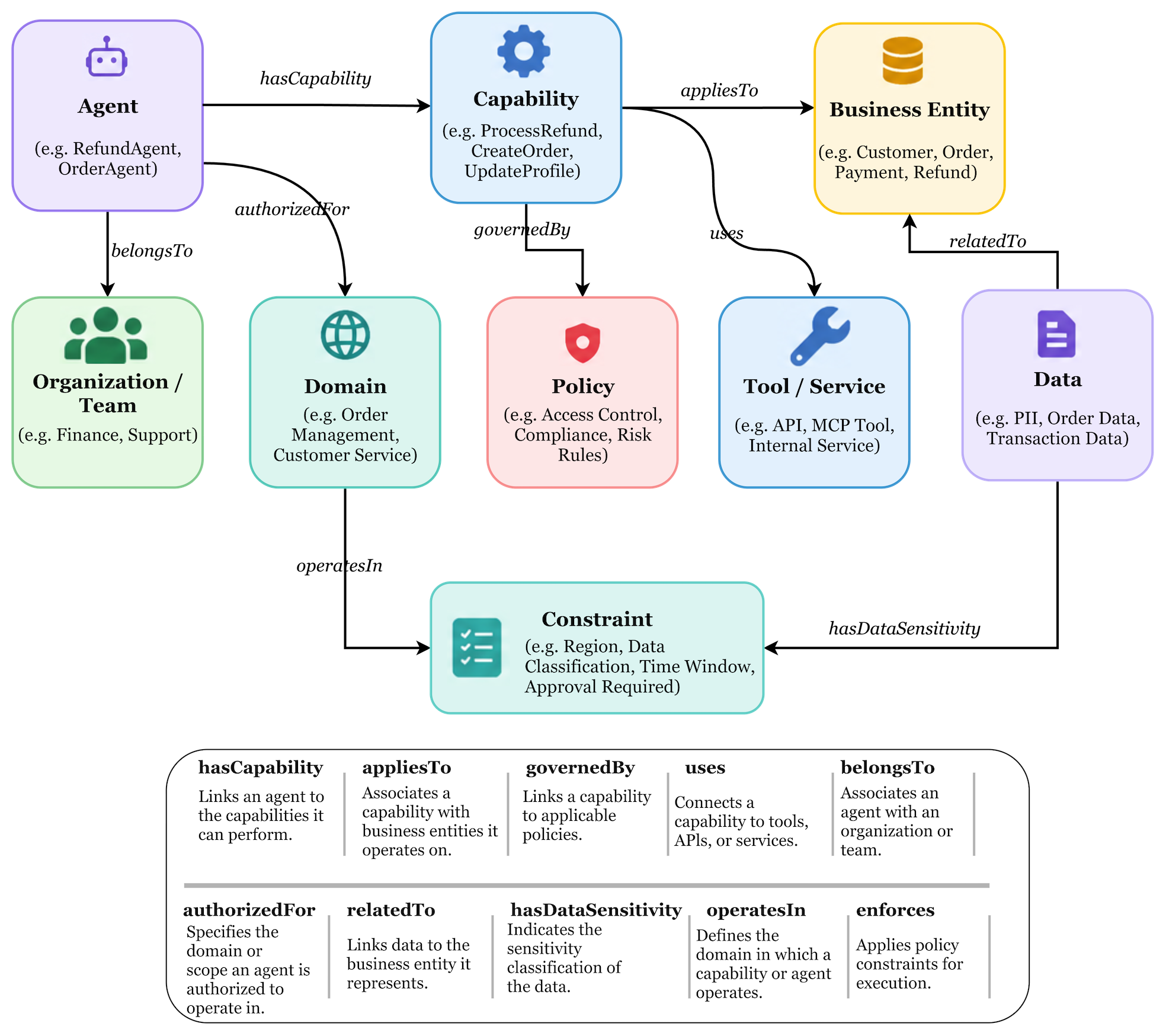
A traditional enterprise ontology describes business concepts (customers, products, services, orders, assets, and incidents). An agent-aware enterprise ontology should also go further by describing the agents that operate on those concepts.
At minimum, it should capture five areas:
- Enterprise entities – customer, product, service, account, incident, policy, asset, employee.
- Relationships – owns, depends on, affects, approves, belongs to, consumes, manages.
- Agent capabilities – what an agent can search, analyze, create, modify, approve, or execute.
- Permissions and constraints – what an agent is allowed to access or change, under which conditions.
- Operational context – which system owns the data, its sensitivity, lifecycle state, provenance, and applicable governance rules.
For example, the ontology could say that a Support Agent can read customer entitlement data; create an incident; recommend a resolution — but cannot approve a refund above some threshold. A Finance Agent can access billing records and authorize certain financial actions.
This is what makes the ontology useful not only for understanding enterprise data but also for understanding who can act on that data, how they can act, and under what constraints. An agent-aware ontology can therefore answer questions like:
- What does this concept mean?
- Which agent owns this capability?
- What data can the agent access?
- Which actions are permitted?
- What policies apply before execution?
This turns the ontology from a passive knowledge model into a semantic foundation for agent discovery, coordination, authorization, and governance.
From Skill Discovery to Semantic Capability Discovery
Most agent platforms can already discover skills or tools: search a catalog, inspect a description, and invoke a capability.
The limitation is that skill discovery is usually done based on names, keywords, or interface descriptions. An agent may find a tool called create_ticket, but still not understand:
- What type of ticket it creates
- Which business entity the ticket relates to
- What prerequisites apply
- What permissions are required
- Whether another capability is semantically equivalent
This is where semantic capability discovery becomes important. Instead of asking only: “Which skill matches this request?” an agent can ask:“Which capability can perform this business action on this enterprise entity under these constraints?”
For example, an ontology could describe that:
RefundProcessingAgent → canPerform → IssueRefund
IssueRefund → appliesTo → CustomerOrder
IssueRefund → requires → ApprovedReturn
IssueRefund → governedBy → RefundPolicy
Now the agent isn’t finding a skill by name alone. It is finding a capability based on meaning, relationships, prerequisites, and policy context.
This is especially useful when multiple agents expose overlapping capabilities (one agent may support refunds on retail orders, another on subscriptions, and another only for low-value transactions). Semantic metadata lets the orchestrating agent choose the right capability based on business context rather than just string matching.
In this model, the ontology becomes a semantic capability graph connecting:
Agent → Capability → Business Entity → Preconditions → Policies → Constraints
This enables richer agent discovery, better routing, safer composition, and more reliable delegation across the enterprise.
Ontology-Driven Agent Selection and Governance
As enterprises deploy more specialized agents, choosing the right agent gets harder. A request may match several agents, but not every agent will have the same capability, authority, data access, or policy constraints.
An enterprise ontology can make this selection more intelligent. Instead of routing a request based only on keywords or static configuration, an orchestrator can use semantic relationships such as:
Agent → hasCapability → ApproveRefund
ApproveRefund → appliesTo → CustomerOrder
Agent → authorizedFor → Region
Capability → constrainedBy → RefundPolicy
When a task arrives, the system can evaluate not only which agent can perform it, but also:
- Whether the agent has the required capability
- Whether it can access the relevant enterprise data
- Whether it is authorized for the requested action
- Which policies and constraints apply
- Whether human approval is required
For example, two agents can both process refunds - one may be limited to transactions below a defined threshold, while another may handle high-value refunds but require managerial approval. The ontology provides the semantic context needed to route the request correctly.
The same model can also support governance. Policies can be directly associated with business entities, capabilities, roles, and actions, so agents can reason about constraints before execution.
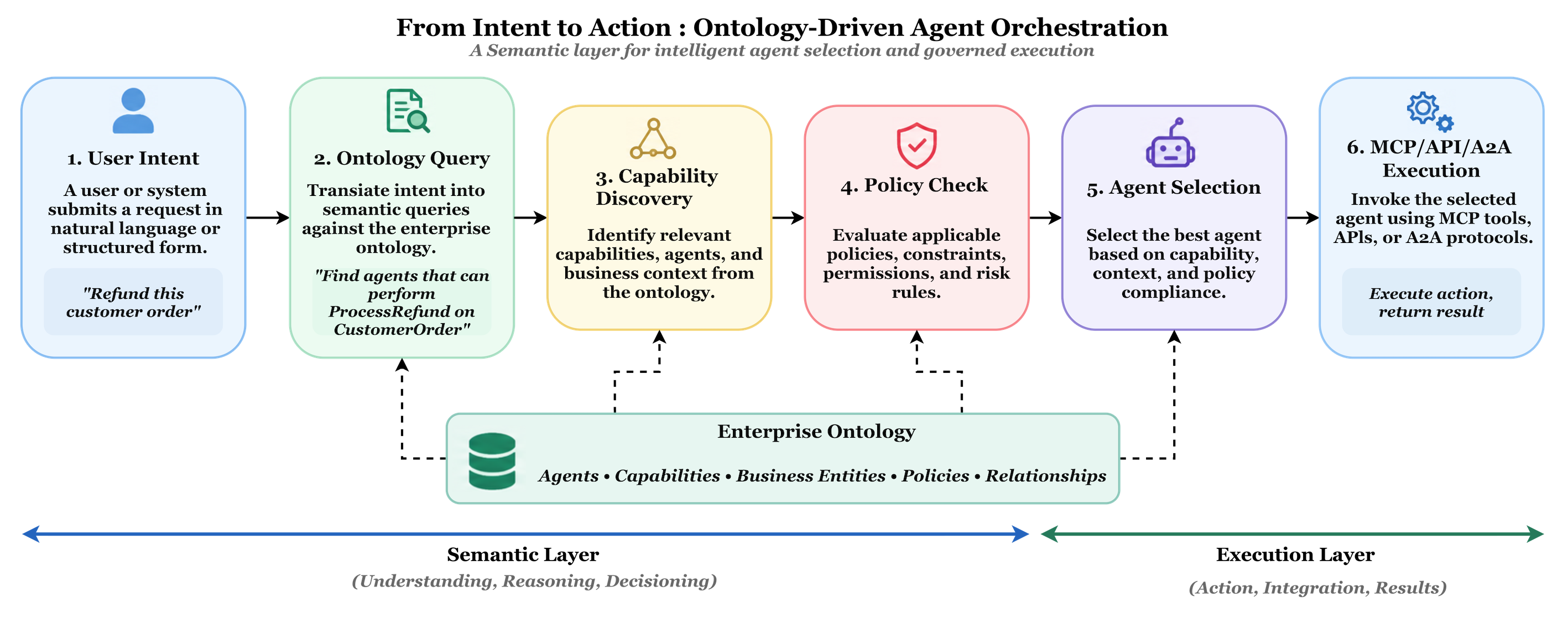
This creates an ontology-driven decision flow:
Request → Business Intent → Required Capability → Eligible Agents → Policy Evaluation → Selected Agent → Execution
The result is more than smarter routing. It enables policy-aware, context-aware, and explainable agent selection across the enterprise.
Building a Minimal Agent-Aware Enterprise Ontology
- Agents
- Capabilities
- Enterprise entities
- Policies and constraints
Consider a simple refund-processing scenario. An enterprise has a support agent that can process refunds for customer orders, but that capability is governed by a refund policy. A minimal semantic model could look like this:
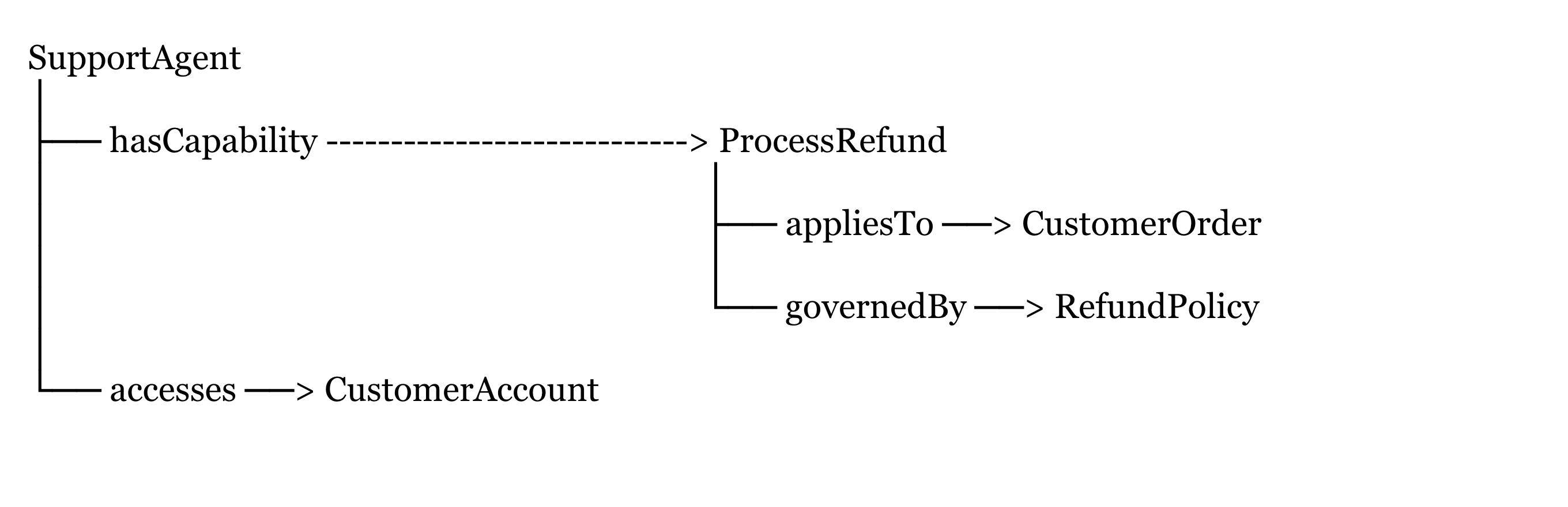
This can be represented using RDF/OWL-style semantics. For example, using Turtle:
@prefix ex: <http://example.com/enterprise#>
ex:SupportAgent
         a ex:Agent ;
        ex:hasCapability ex:ProcessRefund ;
        ex:accesses ex:CustomerAccount
ex:ProcessRefund
        a ex:Capability ;
       ex:appliesTo ex:CustomerOrder ;
       ex:governedBy ex:RefundPolicy .
ex:RefundPolicy
        a ex:Policy ;
       ex:maxAutomaticRefund "500"
Even this small ontology gives an orchestrating agent more information than a conventional tool catalog. Instead of discovering only process_refund(order_id), the agent can understand that the capability:
- Operates on a CustomerOrder
- Is provided by the SupportAgent
- Depends on access to customer information
- Is governed by a specific refund policy
The next step is to query the ontology. For example, an orchestrator could ask:
SELECT ?agent
WHERE {
    ?agent ex:hasCapability ex:ProcessRefund .
}
The result identifies agents that semantically provide the required capability. A richer query could also include policy and business context:
SELECT ?agent ?policy
WHERE { ?agent ex:hasCapability ?capability . ?capability ex:appliesTo ex:CustomerOrder . ?capability ex:governedBy ?policy . }
This creates the foundation for semantic agent selection. The important point is that the ontology does not replace APIs, MCP tools, or agent protocols. It sits above them as a semantic decision layer.
The ontology determines:
- What does the request mean?
- Which capability is required?
- Which agent provides it?
- Which enterprise entity is affected?
- Which policy applies?
The execution layer can then use an API, MCP tool, or A2A interaction to perform the actual action. For a production environment, this minimal model can gradually expand to include concepts such as roles, data sensitivity, regions, approval thresholds, provenance, dependencies, risk levels, and human-approval requirements.
The key is to start small. A handful of well-defined enterprise concepts and relationships can already move agent orchestration from simple tool matching toward semantic, policy-aware capability discovery.
Where This Architecture Fits in the Emerging Agent Stack
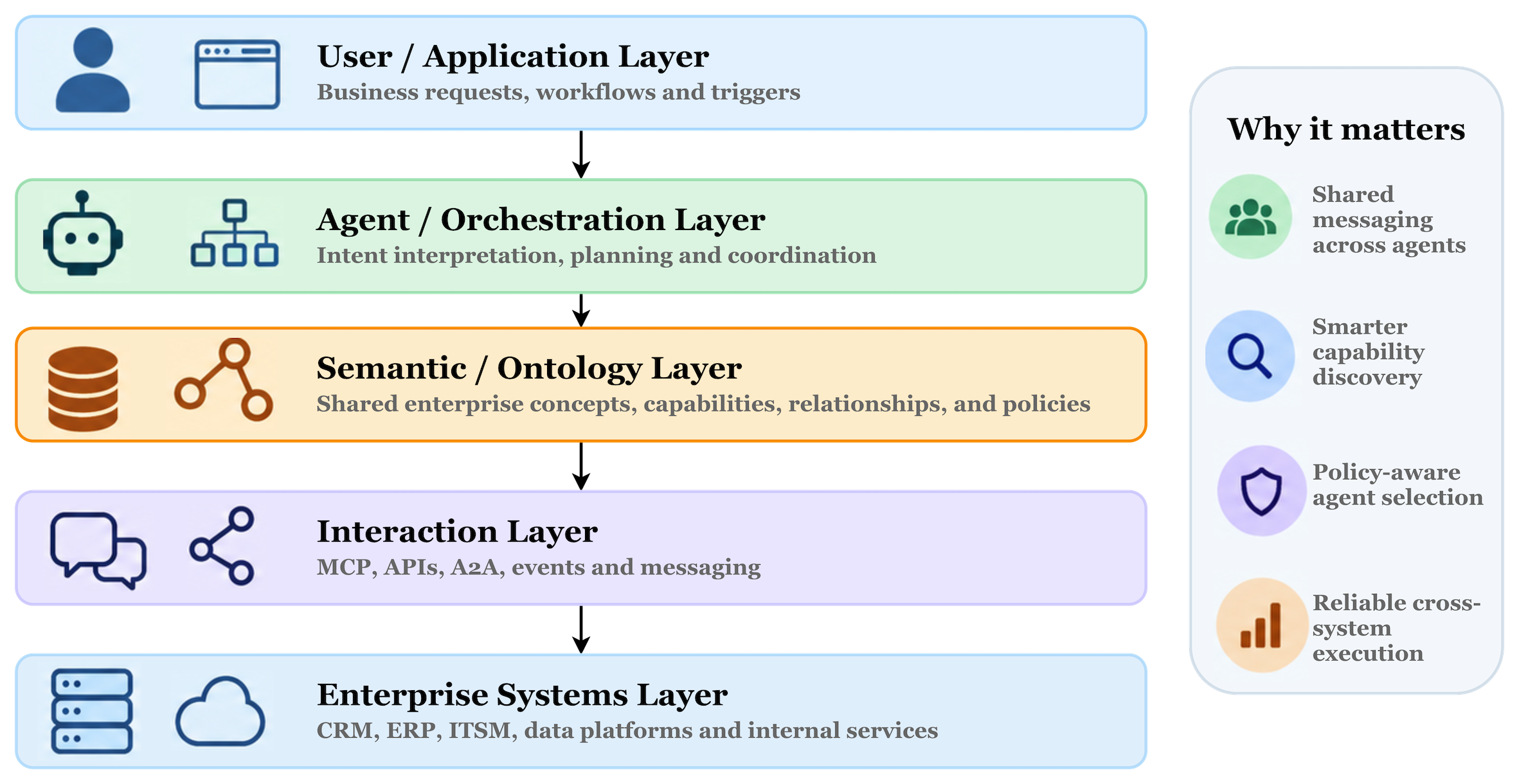
The ontology-driven architecture fits between the agent reasoning layer and the execution layer of the emerging enterprise agent stack.
A typical enterprise agent stack may include:
- User or application layer – where requests originate
- Agent/orchestration layer – interprets intent and coordinates work
- Semantic layer – maps intent to enterprise concepts, capabilities, policies, and eligible agents
- Interaction layer – MCP, APIs, A2A, events, and messaging
- Enterprise systems layer – CRM, ERP, ITSM, data platforms, and internal services
The shared enterprise ontology belongs primarily in the semantic layer. Its role is not to replace the LLM, agent framework, MCP server, API gateway, or A2A protocol. Instead, it provides the semantic context needed before those components are used.
This separation is important because each layer solves a different problem.
- The reasoning layer determines what the user is asking.
- The ontology layer determines what that request means within the enterprise.
- The orchestration layer determines which agent should handle it.
- The interaction layer determines how the selected agent or tool is invoked.
- The enterprise systems layer performs or records the actual business action.
As agent ecosystems become more distributed, this semantic layer can act as connective tissue across otherwise independent agent platforms. Different agents may use different models, frameworks, protocols, or runtime environments while still relying on the same enterprise definitions of capabilities, entities, and policies.
The architecture therefore adds a missing layer to the emerging agent stack: semantic interoperability between reasoning and execution.
Challenges: Ontology Evolution, Ownership, Federation, and Governance
A shared enterprise ontology improves semantic interoperability but also brings its own operational and governance problems. Enterprise concepts are not fixed: products change, organizational structures evolve, regulations shift, and new agents bring new capabilities; the ontology must therefore evolve without breaking existing consumers.
Ontology Evolution
In a federated ontology landscape, a change in one domain propagates to the entire semantic layer. Changing CustomerAccount in the Customer/CRM ontology, tightening the Entitlement definition in the Product ontology, or adding a new relationship between Incident and Risk in the IT and Operations domain can affect every agent that reasons over those concepts (sometimes not immediately visible).
A database schema change usually only affects one system, whereas an ontology change can impact how a sales agent qualifies a lead, how a support agent resolves a ticket, how a finance agent authorizes a payment, and how a compliance agent evaluates a policy, all at the same time. The blast radius is wide because the semantic layer is shared.
Ontology evolution therefore needs practices borrowed from API lifecycle management:
- Versioning – URI-based version identifiers on classes and relationships (for example, ex:v2/CustomerAccount) so that agents can declare which ontology version they depend on.
- Backward compatibility – additive changes are preferred; breaking changes require a deprecation period with the old and new definitions coexisting.
- Deprecation policies – a defined timeline for retiring concepts, with explicit successor mappings so consuming agents can migrate incrementally.
- Change impact analysis – before publishing a change, tooling should identify which agents, tools, and downstream applications reference the affected concepts.
- Validation before rollout – semantic regression tests that verify existing agent queries and capability graphs still resolve correctly against the new version.
Agents should declare which ontology version they are using, and orchestrators should be able to route requests to agents that share a compatible semantic baseline. This prevents a situation where two agents with different ontology versions interpret the same concept differently — which is precisely the problem the ontology was introduced to solve.
Ownership
A central question is: who owns the meaning of enterprise concepts?
The answer is rarely the team that builds the ontology infrastructure. A platform or architecture team may maintain tooling, graph store, versioning pipeline, and publishing process — but it shouldn’t define what Customer, Risk, Incident, Entitlement, or Approval mean independently of those concepts. Those definitions carry business, legal, and operational weight.
Semantic ownership should be closer to the business domain. Customer/CRM ontology should belong to teams that run CRM processes and understand what a customer relationship means commercially; Finance ontology should be owned by finance and accounting because they know the difference between an Invoice, Payment, Cost Center, and Financial Account; Security ontology (Identity, Role, Permission, Policy, and Risk) should belong to security teams who understand the compliance implications of each concept.
This model (central semantic governance with distributed domain ownership) is how platform engineering works at scale. The platform team sets standards, tooling, and alignment rules across domains. Domain teams set meaning within their area. Neither can override the other unilaterally.
In practice, this means having ownership metadata on every ontology concept: who owns it (team), who is the subject-matter expert, and which review process applies when that definition needs to change. If not, the ontology becomes either a bottleneck controlled by one central team or an inconsistent patchwork where every team modifies concepts without coordination.
Federation
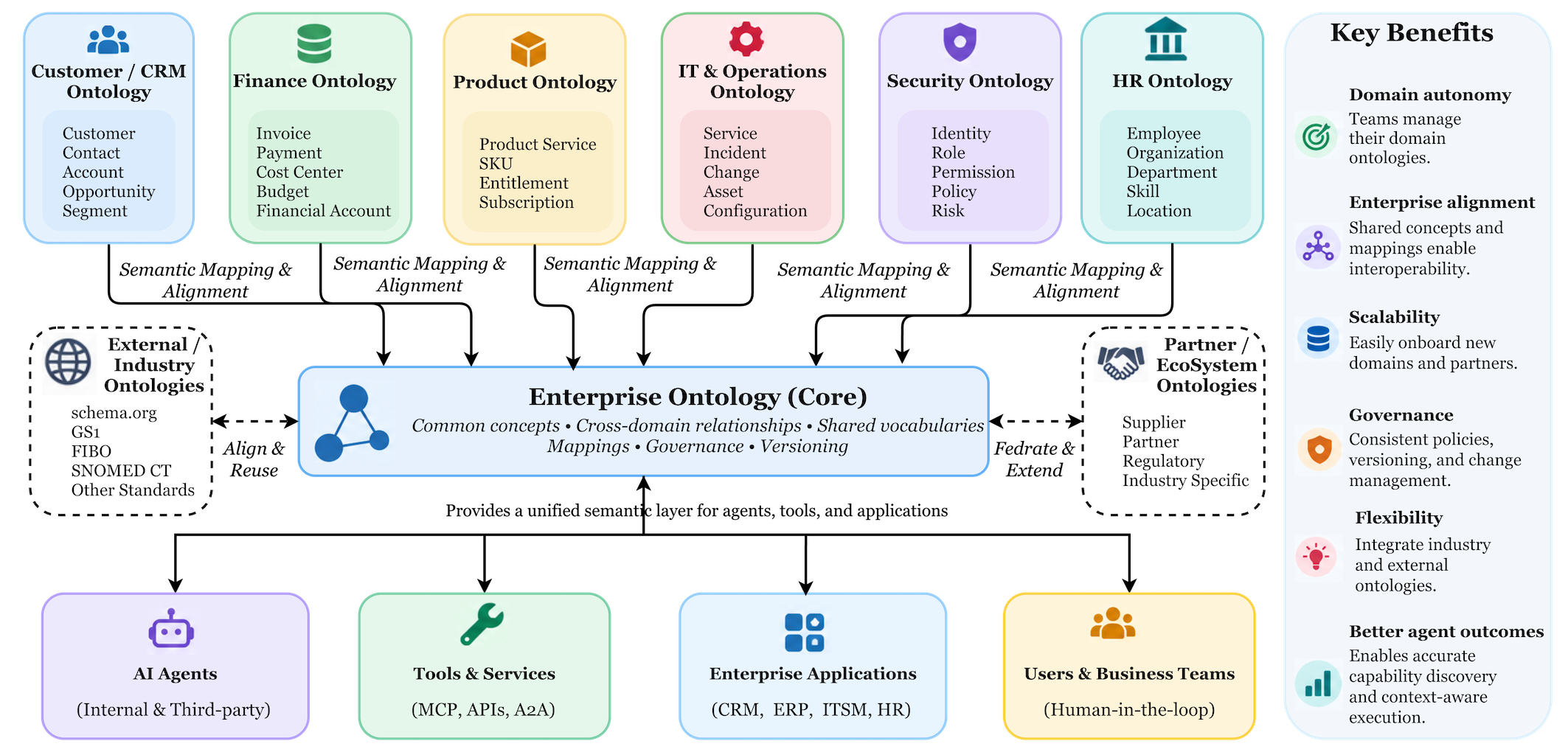
Trying to force all of this into one monolithic ontology isn’t practical. Governance bottleneck; slows down domain teams; model is too abstract to be useful for any specific domain.
The diagram above shows a scalable alternative: federated ontology design. Each domain has its own ontology (Customer/CRM, Finance, Product, IT and Operations, Security and HR) — they have full autonomy over the concepts, relationships, and terminology in that domain. Ontologies for each domain link to an Enterprise Ontology Core shared by all domains via explicit semantic mappings and alignment relationships. The core contains cross-domain concepts, shared vocabularies, and governance and versioning rules that make federation work.
This architecture also extends outward in two directions.
- On one side, the enterprise core aligns with external industry ontologies — schema.org for general web semantics, GS1 for product and supply chain standards, FIBO for financial industry terminology, SNOMED CT for healthcare — allowing the enterprise to adopt established standards rather than reinventing definitions.
- On the other side, partner and ecosystem ontologies for suppliers, regulatory bodies, and industry-specific frameworks can federate with the core through controlled extension points.
The goal is not to eliminate domain-specific meaning. It is to make the relationships between those meanings explicit and machine-readable, so that an agent operating in the Finance domain and an agent operating in the Customer domain can each reason within their own semantic context while still communicating consistently when their work intersects.
Federation also means that new domains can be onboarded incrementally. A new AI agent introduced for HR or procurement does not require a redesign of the entire ontology. It connects through the same alignment and mapping pattern, inheriting cross-domain concepts while adding its own domain vocabulary.
Governance
Because AI agents use ontology definitions to make autonomous operational decisions, semantic changes are no longer just documentation updates — they are configuration changes with real business consequences. Changing the definition of Entitlement may cause a support agent to deny services it should approve. Altering the Policy concept may cause a finance agent to bypass a control it previously enforced. The ontology is live operational infrastructure.
Governance must therefore be treated with the same rigor applied to production software releases. At minimum, it should define:
- Who can propose changes – any domain team can propose additions or modifications within their domain, but cross-domain changes require joint review.
- Who approves semantic changes – changes to core enterprise concepts should require approval from the relevant domain owners and a central semantic governance board.
- How conflicts between domains are resolved – when two domain teams define the same concept differently (for example, both Finance and CRM define Account), there must be a defined arbitration process that results in either a canonical definition or an explicit mapping.
- How provenance is recorded – every concept should carry metadata about who introduced it, when, why, and which version it appeared in, so that an audit trail is always available.
- How policy-related concepts are reviewed – concepts that directly govern agent behavior, such as approval thresholds, permission levels, and compliance rules, should require review by legal, compliance, or risk teams before they are published.
- How changes are tested against existing agent workflows – before a semantic change is released, it should be validated against a test suite of representative agent queries and orchestration flows to confirm that existing behavior is not unintentionally altered.
For high-impact concepts, ontology updates should require the same level of review as a production policy change or a regulated configuration update. The bar is not arbitrary: if an agent can take a financial action, restrict access, or escalate an incident based on an ontology definition, then that definition carries the same operational weight as the code or policy that governs the same action.
Ultimately, the challenge is not just building a shared ontology. It is maintaining a trusted semantic contract across teams, systems, and agents as the enterprise continuously changes. The federated architecture distributes that responsibility appropriately — each domain team owns what they understand, the core team maintains coherence, and governance ensures that changes are deliberate, reversible, and traceable.
“A shared ontology is only valuable if its meaning remains governed, traceable, and trustworthy as the enterprise evolves.”
Conclusion
In the multi-agent enterprise, communication is only the first step. True collaboration requires a shared understanding of business meaning. Protocols connect agents; ontologies align them.
As AI ecosystems grow, semantic interoperability will become as important as technical interoperability. The challenge will no longer be whether agents can communicate, but whether they understand enterprise concepts well enough to collaborate safely, consistently, and effectively.
A practical starting point is simple: model three things, your key business entities, the agents that operate on them, and the policies that govern those interactions. The ontology can evolve incrementally as the agent ecosystem grows.
The future of enterprise AI will depend not only on smarter agents, but on agents that share a common understanding of the enterprise they serve.
Opinions expressed by DZone contributors are their own.
Comments