

AI Agents vs LLMs: Choosing the Right Tool for AI Tasks
Use an LLM for single-step tasks; use an AI agent when the job needs planning + tool/API orchestration across multiple steps.
Join the DZone community and get the full member experience.
Join For Free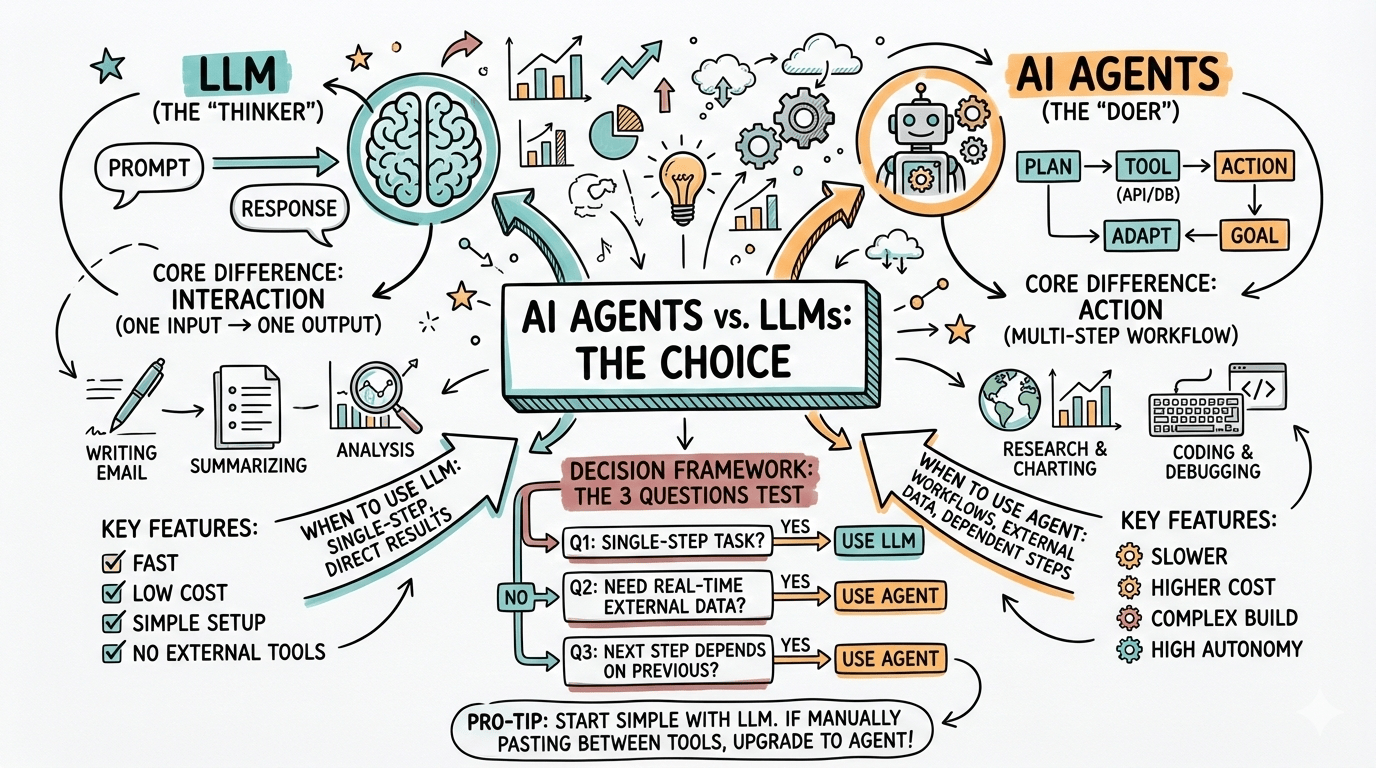
Large language models have changed how software teams think about automation, reasoning, and intelligence. Almost overnight, tasks that once required brittle rules or custom ML pipelines became promptable. But as adoption has grown, so has confusion. Teams now ask a new question that did not exist a few years ago: should we use a large language model directly, or should we build an AI agent around it?
This distinction matters more than it seems. I have seen teams over-engineer agentic systems for problems that only needed a single LLM call. I have also seen teams struggle with fragile prompt chains when what they really needed was planning, memory, and tool orchestration.
Understanding where LLMs end and where agents begin is not academic. It directly impacts cost, latency, reliability, and the long-term maintainability of AI systems.
What an LLM Actually Gives You
At its core, a large language model is a probabilistic system trained to predict the next token given context. That sounds narrow, yet the emergent behavior is powerful. A single model can summarize documents, write code, explain errors, translate text, and generate ideas in one step.
This generality comes from scale and data, not from reasoning in the human sense.
Large language models are trained to minimize prediction error on the next token, not to reason or plan in a symbolic sense.
Source: Bender et al., “On the Dangers of Stochastic Parrots”, ACM FAccT 2021
LLMs shine when the task is:
- Single-step
- Bounded in scope
- Stateless
- Focused on language, code, or interpretation
Examples are everywhere in production systems today: writing emails, summarizing tickets, generating SQL, explaining error messages, or producing first drafts of documentation. These tasks benefit from speed and simplicity. One prompt goes in; one response comes out.
When teams start chaining many LLM calls together to simulate planning, they often rediscover the same limitation: the model has no durable understanding of goals, progress, or consequences beyond the current context window.
What Changes When You Introduce an Agent
An AI agent is not a new model. It is a system design pattern.
Agents typically wrap one or more LLMs with additional capabilities: planning, memory, tool use, and decision-making loops. Instead of answering once, an agent decides what to do next, executes actions, observes results, and adapts.
You can think of an agent as a coordinator rather than a generator.
An agent is anything that can perceive its environment through sensors and act upon that environment through actuators.
Source: Russell and Norvig, “Artificial Intelligence: A Modern Approach
In modern AI systems, the “environment” might be APIs, databases, code repositories, monitoring systems, or even other agents. The agent reasons about which tools to use and in what order.
Agents become useful when tasks are:
- Multi-step
- Tool-driven
- Conditional or branching
- Long-running
- Outcome-oriented rather than response-oriented
Research assistants that search, read, summarize, and cross-check sources are classic examples. So are workflow automations that pull data, run models, generate reports, and notify stakeholders. Incident response systems that detect issues, diagnose causes, apply fixes, and produce postmortems also fall into this category.
The Hidden Cost of Agentic Systems
Agentic AI often sounds more advanced, so teams default to it too quickly. That is a mistake.
Agents introduce real overhead. More moving parts mean more failure modes. Tool calls fail. APIs change. State gets corrupted. Latency increases. Debugging becomes harder because behavior emerges from interactions, not single prompts.
Complex systems fail in complex ways.
Source: Richard Cook, “How Complex Systems Fail”
This is why many agent demos look impressive but collapse under real production constraints. Determinism, observability, and cost control become more difficult as autonomy increases.
A simple rule helps here: if you can clearly describe the task as a single question, you probably do not need an agent.
Practical Decision Points That Actually Matter
Instead of asking, “Should we use an agent or an LLM?”, better teams ask more grounded questions:
- Does the system need to decide what to do next, or is that decision already known?
- Does the task require interacting with multiple external systems?
- Does partial failure matter, or can we retry safely?
- Is latency critical, or can the system take time to think?
- Does the output need to be explainable and auditable?
LLMs are excellent when the path is known and the goal is interpretation or generation. Agents make sense when the path itself is part of the problem.
For example, generating a code snippet for a specific task is an LLM problem. Debugging, testing, fixing, and deploying that code is an agent problem. Asking what an error code means is an LLM task. Detecting an incident, identifying the root cause, resolving it, and notifying teams is an agent workflow.
Why This Distinction Matters for Decision Makers
From a leadership perspective, this is not about technical purity. It is about risk and leverage.
LLMs are cheaper to build, easier to reason about, and faster to ship. They deliver value quickly and fail predictably. Agents promise higher automation but demand stronger engineering discipline.
Organizations that succeed with AI tend to start with LLM-first designs and add agentic behavior only where it clearly pays for itself. They resist the urge to build autonomous systems simply because the tooling exists.
The challenge is not making models more capable, but making systems that reliably harness those capabilities.
Source: OpenAI, “Practices for Governing Agentic AI Systems”, 2024
This mirrors earlier architectural lessons. Microservices were not inherently better than monoliths. Event-driven systems were not automatically superior to request-response architectures. The same is now true for agentic AI.
A Grounded Way to Think About the Future
LLMs today are general, but not that general. Agents are powerful, but not magic. Progress remains incremental, data-driven, and engineering-heavy.
The most effective AI systems in production are pragmatic. They combine simple LLM calls where possible, structured workflows where necessary, and human oversight where it still matters.
If there is one takeaway, it is this: do not ask how intelligent your AI system looks. Ask how reliably it delivers value.
Sometimes, the smartest architecture is the simplest one.
Opinions expressed by DZone contributors are their own.
Comments