

AI Architectures That Drive Real Business ROI
Practical guide to 5 AI architectures that drive business ROI: decision intelligence, personalization, single-agent, multi-agent, and autonomous systems.
 CORE
·
CORE
·
Join the DZone community and get the full member experience.
Join For FreeIn this article, I'll try to give practical insights for choosing the right AI architecture for impact, not just experimentation.
Companies are spending heavily on AI. Many are still struggling to show clear business returns. The most common reason is not the model; it is the architecture. Teams often jump straight to multi-agent systems or "autonomous AI" because those terms sound advanced. In reality, a well-designed decision intelligence system or a focused single-agent architecture often delivers faster, more reliable ROI than a complex multi-agent setup that no one can debug or govern.
This article maps the five AI architectures that are actually driving measurable business value. For each one, you will see:
- What the architecture looks like
- When you should use it
- Why it works from a business perspective
- Practical risks and success factors
The goal is simple: help you choose the right level of architectural complexity for the outcome you need.
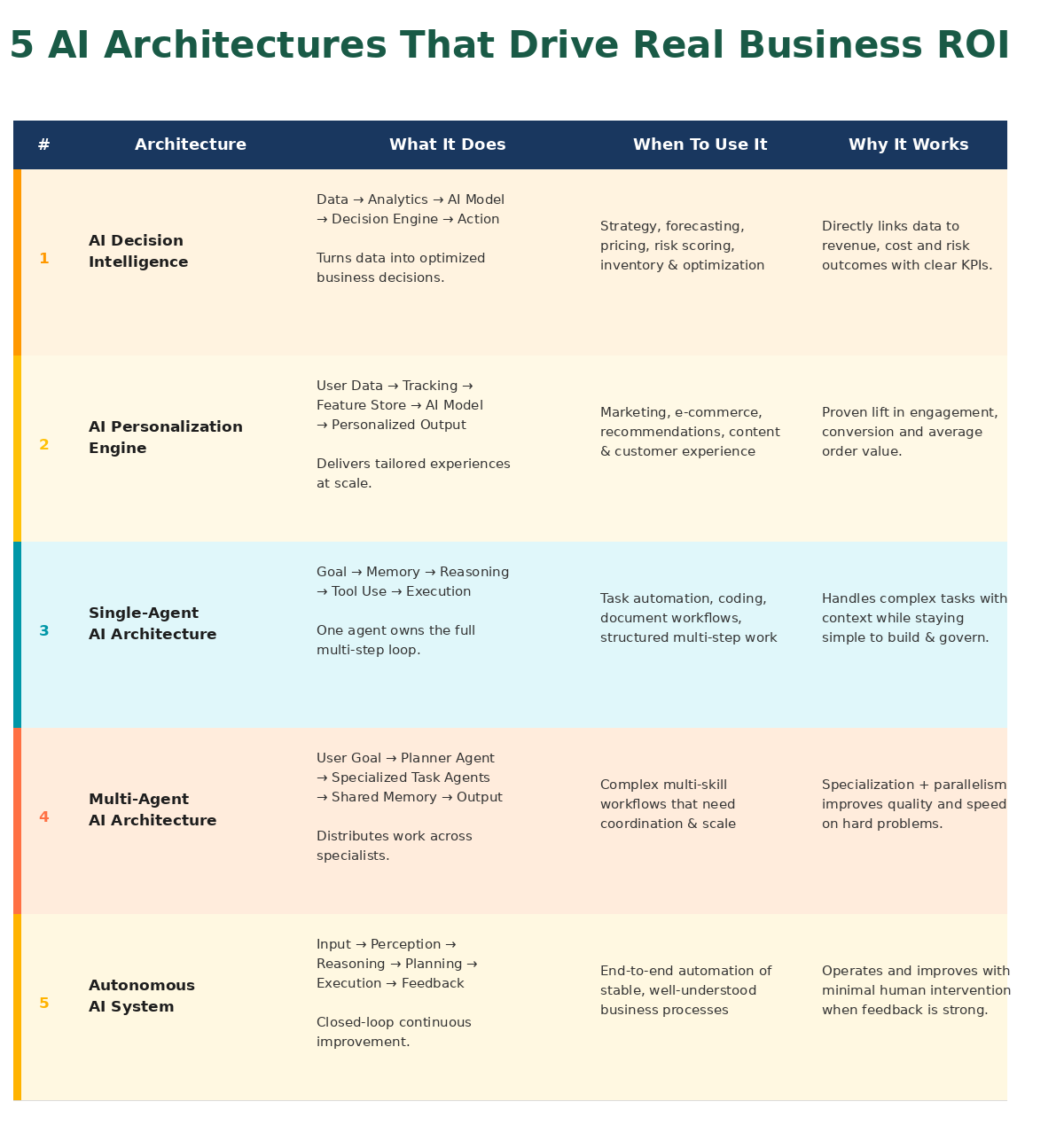
1. AI Decision Intelligence Architecture
What it is:
This is the classic "data -> insight -> decision -> action" loop, now powered by stronger models. Data from operational systems flows into an analytics layer, an AI model produces predictions or scores, a decision engine applies business rules and thresholds, and actions are triggered (often still with human oversight).
When to use it:
Strategy, forecasting, pricing, demand planning, risk scoring, inventory optimization, and any domain where the primary value is better decisions at scale.
Why it works:
It directly connects data to decisions that affect revenue, cost, or risk. The architecture is relatively mature, easier to govern, and usually has clear KPIs (forecast accuracy, reduction in stock-outs, improved conversion, lower credit losses, etc.).
Practical notes:
Success depends more on data quality, feature engineering, and decision policy design than on the latest foundation model. Many organizations already have 70% of this architecture in place and only need to modernize the model and decision layers.
2. AI Personalization Engine Architecture
What it is:
User data and behavioral tracking feed a feature store. An AI model (recommendation, ranking, or generative) produces personalized outputs: product recommendations, content, offers, or next-best-action. The system continuously learns from engagement.
When to use it:
Marketing, e-commerce, media, customer experience, and any product surface where relevance directly drives engagement and revenue.
Why it works:
Personalization has one of the most proven ROI profiles in AI. Even modest lifts in click-through, conversion, or average order value compound quickly at scale. The architecture is well understood and has mature tooling (feature stores, real-time inference, experimentation platforms).
Practical notes:
The biggest failures come from poor cold-start handling, lack of real-time features, or treating personalization as a pure model problem instead of a full-stack system (data-> features -> model -> delivery -> feedback).
3. Single-Agent AI Architecture
What it is:
A single agent receives a goal, maintains memory, reasons about the next step, uses tools, and executes. It operates in a loop until the task is complete. This is the architecture behind many of today’s coding assistants, research helpers, and internal automation agents.
When to use it:
Task automation, structured multi-step workflows, coding, document processing, customer support escalation, and any problem that can be owned by one competent agent with good tools.
Why it works:
It handles multi-step work with context and logic in a way that pure predictive models or simple RPA cannot. It is significantly simpler to build, observe, and govern than multi-agent systems, while still delivering real autonomy on well-scoped tasks.
Practical notes:
Most organizations should master single-agent systems before moving to multi-agent. The limiting factors are usually tool quality, memory design, evaluation harnesses, and clear task boundaries, not the choice of foundation model.
Key insight: A reliable single-agent system with excellent tools and evaluation often outperforms a poorly coordinated multi-agent system in both speed of delivery and actual business results.
4. Multi-Agent AI Architecture
What it is:
A planner (or meta-agent) decomposes a complex user goal into sub-tasks. Specialized task agents execute those sub-tasks, often in parallel, using shared or private memory. Results are aggregated into a final output. This is the architecture used in advanced research systems and complex enterprise workflows.
When to use it:
Complex workflows that genuinely require different skills (research + analysis + writing + coding), long-horizon projects, or situations where parallelism and specialization produce clear gains in quality or speed.
Why it works:
It distributes cognitive load. Different agents can be optimized (or even use different models) for different sub-problems. When designed well, the system scales in capability without making any single agent monolithic.
Practical notes:
Coordination cost is real. Handoff failures, inconsistent memory, and unclear ownership of the final result are common. Multi-agent systems require stronger observability, evaluation, and governance than single-agent systems. Do not adopt this architecture just because it sounds more advanced.
5. Autonomous AI System Architecture
What it is:
A closed-loop system: Input -> Perception-> Reasoning-> Planning-> Execution -> Feedback. The system continuously senses its environment, updates its understanding, plans, acts, and learns from outcomes with minimal human intervention. This is the most ambitious architecture on the spectrum.
When to use it:
End-to-end automation of well-understood business processes, self-optimizing systems, and domains where continuous operation without constant human oversight is both possible and desirable (certain supply-chain, infrastructure, or trading systems, for example).
Why it works:
When the feedback loops are high-quality and the environment is sufficiently stable or well-modeled, the system can improve over time and operate at a scale and speed humans cannot match.
Practical notes:
This is the highest-risk architecture. Failures can be expensive and hard to contain. Most organizations should treat full autonomy as a long-term destination, not a starting point. Strong guardrails, human oversight points, and kill switches are mandatory.
How to Choose the Right Architecture
| Architecture | Complexity | Time to Value | Best For | Main Risk |
|---|---|---|---|---|
| Decision Intelligence | Low–Medium | Fast | Forecasting, optimization, risk | Poor data or unclear decision policies |
| Personalization Engine | Medium | Fast–Medium | Engagement, conversion, CX | Weak feedback loops or cold start |
| Single-Agent | Medium | Medium | Task automation, coding, research | Bad tools or weak evaluation |
| Multi-Agent | High | Slower | Complex multi-skill workflows | Coordination and observability failures |
| Autonomous System | Very High | Slowest | Fully automated closed-loop processes | Uncontrolled behavior and high blast radius |
Simple decision rules:
- If the primary value is better decisions from data, then start with decision intelligence.
- If the primary value is relevance at scale, then build a personalization engine.
- If you need multi-step task completion with tools, then master single-agent first.
- Only move to multi-agent when you have clear specialization and coordination benefits.
- Treat autonomous systems as a maturity goal, not a first project.
Common Mistakes That Destroy ROI
- Jumping to multi-agent or autonomous too early: complexity without corresponding process maturity.
- Treating architecture as a model problem: the model is rarely the bottleneck; tools, data, evaluation, and governance usually are.
- No clear success metrics: if you cannot define what "good" looks like in business terms, you cannot steer the system.
- Ignoring observability: agentic and autonomous systems that cannot be inspected become impossible to improve or trust.
- Building technology in search of a problem: the architecture must serve a real workflow and a real economic outcome.
Closing
The organizations that extract real ROI from AI are not necessarily the ones using the most advanced architecture. They are the ones that match the architecture to the problem, keep the design as simple as the use case allows, and invest heavily in data quality, tools, evaluation, and governance.
Start with the architecture that solves the actual business problem with the least unnecessary complexity. Prove value. Then, and only then, increase architectural sophistication where the returns justify the cost and risk.
Decision intelligence and personalization still deliver some of the clearest and fastest returns. Single-agent systems are currently the highest-leverage step-change for knowledge work and automation. Multi-agent and fully autonomous systems are powerful... but only when the organization is ready to operate them with discipline.
Choose deliberately. Measure ruthlessly. Scale what works.
Opinions expressed by DZone contributors are their own.
Comments