

Designing a Role-Aware Runtime for AI Avatar Systems
Use one shared runtime for AI avatars, with role profiles and adapters managing safety, tools, streaming, and each embodiment.
Join the DZone community and get the full member experience.
Join For FreeAI avatar projects often begin with the most visible question: What should the character look like?
That question matters, but it comes much later in the architecture than many teams expect. A responsive AI avatar is not simply an animated face connected to a large language model. It is a real-time distributed system that must listen, understand, retrieve context, make decisions, authorize tools, generate speech, synchronize animation, support interruptions, and record enough telemetry to explain failures.
When all these responsibilities are placed inside one application or one oversized system prompt, every new character becomes a separate implementation. A cartoon guide, a robotic assistant, an enterprise representative, and an entertainment host may end up with different prompts, APIs, analytics pipelines, safety rules, and release processes.
The visible experiences are different, but the underlying engineering problems are largely the same.
A more maintainable architecture separates the system into three layers:
- A reusable conversational runtime
- A versioned role profile
- An embodiment adapter
The runtime manages the conversation. The role profile defines behavior. The embodiment adapter translates an approved response into speech, facial animation, gestures, screen actions, or physical-device commands.
This separation allows teams to introduce new characters without rebuilding the security, observability, retrieval, and session-management layers each time.
Start With Three Explicit Layers
1. Conversational Runtime
The runtime owns the operational parts of the system:
- Session and turn state
- Automatic Speech Recognition
- Retrieval and grounding
- Model orchestration
- Tool execution
- Text-to-Speech generation
- Streaming and interruption
- Policy enforcement
- Logging, tracing, and metrics
- Human escalation
These capabilities should remain stable regardless of whether the user is interacting with a stylized character, a digital employee, or a physical robot.
2. Role Profile
The role profile defines what makes one avatar different from another.
It can contain:
- Identity and purpose
- Tone and vocabulary
- Permitted knowledge sources
- Restricted topics
- Tool permissions
- Escalation rules
- Gesture limits
- Voice configuration
- Audience suitability
- Response-length preferences
- Language support
A role profile should be stored as versioned configuration rather than buried inside a single prompt.
3. Embodiment Adapter
The embodiment adapter converts a validated response plan into output for a specific interface.
For example, one adapter might generate speech, visemes, and facial expressions for a browser-based character. Another might coordinate an on-screen host with media cues. A robotic adapter might translate approved intentions into a restricted device-command format.
The adapter should not become a second reasoning system. Its job is to translate approved decisions into embodiment-specific output.
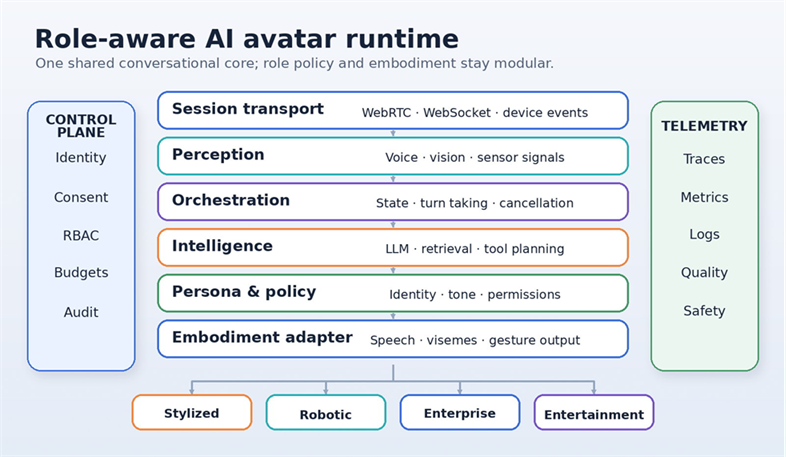
Figure 1: A role-aware AI avatar architecture that separates the conversational runtime, role configuration, control layer, telemetry, and embodiment-specific output.
Use a Stable Event Contract
A reusable runtime needs a stable event model. Passing unstructured strings between services makes cancellation, retries, replay tests, and end-to-end tracing unnecessarily difficult.
Each event should carry at least:
- A session identifier
- A turn identifier
- A sequence number
- An event timestamp
- A typed event name
- The minimum payload required by the next service
A simplified TypeScript contract could look like this:
type AvatarEvent =
   | {
       type: "user.audio.partial";
       sessionId: string;
       turnId: string;
       sequence: number;
       text: string;
       final: false;
       timestamp: number;
     }
   | {
       type: "user.utterance";
       sessionId: string;
       turnId: string;
       sequence: number;
       text: string;
       final: true;
       timestamp: number;
     }
   | {
       type: "response.plan";
       sessionId: string;
       turnId: string;
       text: string;
       toolIntents: ToolIntent[];
       sourceIds: string[];
       timestamp: number;
     }
   | {
       type: "speech.chunk";
       sessionId: string;
       turnId: string;
       audioReference: string;
       animationMarks: AnimationMark[];
       timestamp: number;
     }
   | {
       type: "tool.result";
       sessionId: string;
       turnId: string;
       toolName: string;
       status: "ok" | "error" | "denied";
       timestamp: number;
     }
   | {
       type: "safety.event";
       sessionId: string;
       turnId: string;
       ruleId: string;
       action: "block" | "rewrite" | "handoff";
       timestamp: number;
     };
A shared session and turn identifier should follow the request through speech recognition, retrieval, model inference, tool execution, speech synthesis, and animation.
Without that correlation key, a team may know that an individual service was slow but still be unable to explain why the user waited several seconds before hearing a response.
A typed contract also makes it easier to replace one speech service, model provider, renderer, or transport without changing every downstream integration.
Make Interruption a First-Class Control Path
A conversational avatar must be designed for interruption before the team selects a model or animation system.
In a sequential pipeline, the system performs each operation one after another:
- Wait for the user to stop speaking
- Finalize the transcript
- Retrieve supporting context
- Generate the complete response
- Generate the complete audio
- Start playback
- Start animation
This architecture may work in a controlled demo, but it feels slow during real interaction.
A streaming pipeline begins useful work as soon as enough evidence is available. Partial transcription can begin retrieval. The model can stream response segments. Text-to-Speech can synthesize approved segments incrementally. Animation cues can be produced alongside the audio.
Web Real-Time Communication, commonly known as WebRTC, defines browser APIs for exchanging real-time media and application data between browsers or compatible devices, making it a practical transport option for interactive voice interfaces. [1]
The transport alone does not solve responsiveness. Every stage must share the same cancellation model.
When the user interrupts:
- Current audio playback should stop
- Pending animation cues should be cancelled
- Obsolete model generation should terminate
- Unnecessary retrieval should stop
- Unsafe or stale tool actions should not execute
- The new user turn should become authoritative
One approach is to associate an AbortController with every active turn:
class TurnCoordinator {
private activeTurn?: AbortController;

beginTurn(): AbortSignal {
this.activeTurn?.abort("Superseded by a new user turn");

this.activeTurn = new AbortController();
return this.activeTurn.signal;
}

cancelActiveTurn(reason = "Session cancelled"): void {
this.activeTurn?.abort(reason);
this.activeTurn = undefined;
}
 }
Every asynchronous operation launched during the turn should receive the resulting signal.
A cancellation implementation is incomplete when it stops only the visible audio. The underlying model request, retrieval job, animation queue, and pending tool operation must also respond to cancellation.
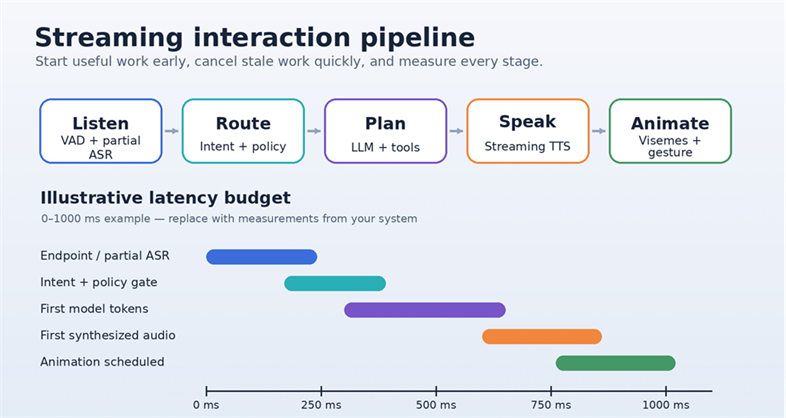
Figure 2: An overlapping streaming pipeline from user audio through transcription, retrieval, generation, speech synthesis, and synchronized avatar output.
Use Role Adapters Instead of Separate Applications
The same runtime can support very different experiences when role-specific requirements are explicit.
Stylized and Cartoon Avatar Characters
For cartoon avatar characters, expression may communicate as much meaning as speech.
A stylized-character adapter might:
- Convert emphasis into larger gestures
- Hold expressions for longer durations
- Use fewer subtle facial movements
- Apply a gesture frequency limit
- Map emotional states to a smaller animation vocabulary
- Enforce audience-appropriate language
- Restrict the character to an approved story or learning corpus
The conversational runtime should not need to know how large a smile should be or how long an eyebrow movement should remain visible. It should emit an abstract expression instruction such as encouraging, surprised, or concerned.
The embodiment adapter then maps that instruction to the available animation system.
Robotic Embodiments
A phrase such as “real avatar robot” usually describes a conversational character connected to a physical robotic body. Architecturally, this introduces a hard safety boundary.
The model should never write directly to:
- Motor controllers
- Navigation systems
- Doors or access controls
- Industrial equipment
- Device firmware
- Unrestricted operating-system commands
Instead, the model should propose a typed intent. A deterministic command broker should validate the intent before it reaches the certified device controller.
For example:
{
"intent": "MOVE_TO_LOCATION",
"arguments": {
"locationId": "reception-zone-a",
"maximumSpeed": 0.4
},
"requestedBy": "session-1842"
 }
- The command broker can then check whether:
- The command is supported
- The requested location is permitted
- The robot is currently available
- A person or obstacle is in the path
- The speed is within the approved limit
- Human approval is required
- An emergency-stop condition exists
The avatar may explain what the robot intends to do, but it should not claim that an action has happened until the control system confirms it.
Enterprise Assistants
The phrase “AI avatar business solutions” covers several possible applications, but the underlying enterprise requirements are more specific:
- Tenant isolation
- Role-based access control
- Approved knowledge sources
- Data-retention policies
- Audit logs
- Human escalation
- Identity verification
- Tool authorization
- Regional deployment controls
- Clear failure handling
Retrieval authorization and tool authorization should be treated as separate decisions.
A user may be allowed to read an internal policy document without being allowed to execute the action described inside it. Access to information is not automatically permission to change a customer record, issue a refund, modify an account, or trigger an external workflow.
The response plan should therefore keep retrieved evidence and proposed actions separate.
Entertainment Hosts
The future of AI in entertainment will depend on more than visually impressive characters. Interactive systems must preserve narrative state while remaining interruptible, safe, and operationally predictable.
An entertainment host may need to:
- Follow a show rundown
- React to live audience input
- Remain inside licensed character boundaries
- Coordinate with lighting, audio, or video cues
- Recover when a media asset fails
- Avoid repeating a segment
- Respect age and content restrictions
- Hand control back to a human operator
This is closer to event-driven orchestration than a conventional chatbot loop.
A show-state service can remain authoritative for what happens next, while the model generates language within the permitted scene and character constraints.
Put a Deterministic Gateway in Front of Tools
Prompt instructions alone are not a sufficient authorization system.
Security guidance for large language model applications identifies risks such as prompt injection, insecure output handling, sensitive-information disclosure, insecure plugin or tool design, and excessive agency. These risks support keeping model output behind deterministic validation and authorization controls. [2]
The model should propose a tool call. It should not decide whether that call is permitted.
A gateway can evaluate the request using normal application-security controls:
async function authorizeToolIntent(
intent: ToolIntent,
context: SessionContext
): Promise<AuthorizationResult> {
assertKnownTool(intent.name);
validateToolSchema(intent.name, intent.arguments);

requireScope(
context.identity,
requiredScopeFor(intent.name)
);

enforceTenantBoundary(
context.tenantId,
intent.arguments
);

enforceRateLimit(
context.sessionId,
intent.name
);

enforceCostBudget(
context.tenantId,
intent.name
);

if (isHighImpactOperation(intent)) {
return {
decision: "approval_required",
reason: "Human approval is required for this operation"
};
}

return {
decision: "allow",
idempotencyKey: createStableIdempotencyKey(
context,
intent
)
};
 }
State-changing tools should support idempotency. Model-driven systems can repeat actions because:
- A user rephrases the same request
- An orchestrator retries after a timeout
- A network response arrives late
- The model proposes the same call twice
- The user interrupts during execution
An idempotency key allows the execution service to return the existing result instead of repeating the operation.
The tool gateway should also record:
- Requested action
- Authenticated identity
- Tenant
- Policy decision
- Approval status
- Final execution result
- Related session and turn
- Duration and error state
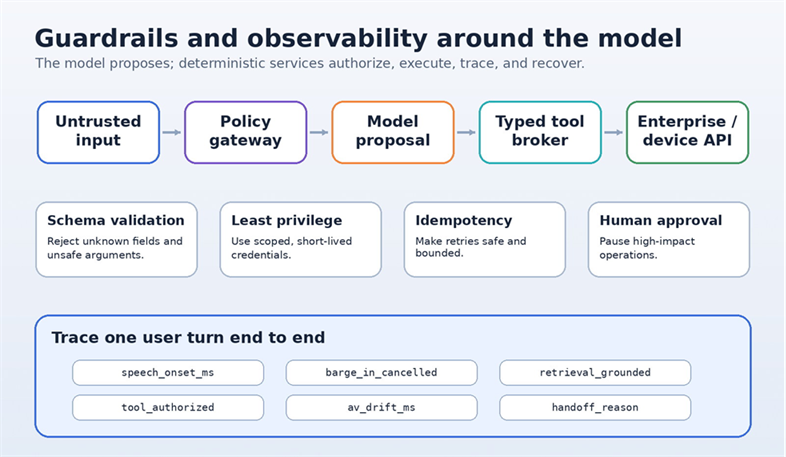
Figure 3: The model operates inside deterministic policy, tool-authorization, safety, execution, and observability boundaries.
Observe the User Turn, Not Only Individual Services
Traditional service metrics are still necessary, but avatar systems also need interaction-specific telemetry.
OpenTelemetry provides a vendor-neutral framework for generating, collecting, and exporting traces, metrics, and logs. Its signal model can be used to correlate activity across the distributed components involved in one conversational turn. [3]
Useful avatar-specific signals include:
Time to First Audio
Measure the time between the end of the user’s utterance and the first audible response.
Break the trace into:
- Stylized and cartoon avatar characters
- Speech endpointing
- Final transcription
- Retrieval
- First model token
- First approved response segment
- First synthesized audio
- Playback start
Barge-In Cancellation
Track whether a user interruption successfully cancelled:
- Audio playback
- Animation
- Model generation
- Retrieval
- Pending tool actions
A visible interruption that leaves an expensive model or tool request running is not a complete cancellation.
Grounding Coverage
Record which response statements were supported by approved sources.
The response plan can attach source identifiers before the speech and animation layers receive the content.
Tool Authorization Outcomes
Record whether each proposed tool action was:
- Allowed
- Denied
- Rewritten
- Sent for approval
- Cancelled
- Executed successfully
- Failed
Audio and Animation Drift
Measure the difference between expected and displayed speech marks, visemes, gestures, and facial movements.
Review median values as well as tail latency. A system can perform well during most interactions while still producing noticeable failures at the 95th or 99th percentile.
Human-Handoff Reasons
Use structured reasons such as:
- User request
- Low confidence
- Missing source
- Policy restriction
- Authentication failure
- Tool failure
- Safety boundary
- Unsupported task
These signals help teams distinguish model-quality problems from infrastructure, retrieval, authorization, or rendering failures.
Test the Persona as Software
Persona quality should be tested as a versioned software behavior rather than evaluated only through manual demonstrations.
A useful test suite should include:
Golden-Turn Tests
Use fixed inputs with expected:
- Policy decisions
- Tool decisions
- Source usage
- Handoff behavior
- Response constraints
- Animation categories
Avoid asserting an exact sentence unless exact wording is a requirement. Instead, assert the properties the response must satisfy.
Property Tests
Examples include:
- The system never retrieves another tenant’s private source
- A tool cannot execute without the required scope
- A robotic command cannot bypass the command broker
- A restricted topic always triggers the defined policy
- A user interruption invalidates the previous turn
- An entertainment role cannot access an unlicensed character profile
Interruption Tests
Trigger interruption during:
- Speech recognition
- Retrieval
- Model generation
- Speech synthesis
- Audio playback
- Animation playback
- Tool authorization
- Tool execution
Verify which operations are cancellable and which must complete safely.
Failure and Chaos Tests
Introduce:
- Slow speech recognition
- Unavailable retrieval
- Duplicate tool results
- Expired authentication
- Delayed media packets
- Renderer disconnects
- Partial model output
- Text-to-Speech failure
- Missing animation marks
The expected result should be a controlled fallback, not a broken or misleading character performance.
Human Review
Automated evaluation should be supplemented with human review for:
- Factual accuracy
- Tone
- Clarity
- Audience suitability
- Escalation quality
- Character consistency
- Gesture appropriateness
- Misleading capability claims
Risk-management frameworks such as the NIST AI Risk Management Framework can provide a broader structure for incorporating trustworthiness considerations into the design, development, deployment, and evaluation of AI systems. F
A Practical Migration Path
Teams with an existing avatar application do not need to replace the entire stack at once.
A gradual migration can follow these steps.
Step 1: Trace the Existing Turn
Record the path from user input to visible and audible output.
Identify:
- Missing correlation identifiers
- Unmeasured latency
- Uncancelled operations
- Direct model-to-tool connections
- Role-specific logic inside shared services
Step 2: Introduce an Event Envelope
Add shared session and turn identifiers across speech, retrieval, model, tool, and rendering services.
This creates the foundation for tracing, replay, and cancellation.
Step 3: Move Tools Behind a Gateway
Introduce:
- Typed schemas
- Identity checks
- Role and tenant scopes
- Approval states
- Idempotency
- Audit events
Start with state-changing or high-impact tools.
Step 4: Extract the Role Profile
Move identity, knowledge boundaries, policy, tool permissions, voice, and embodiment constraints into versioned configuration.
Keep operational security outside the profile.
Step 5: Add a Second Embodiment
Implement one additional character or device through a new adapter.
This is the strongest architecture test. When the core runtime requires role-specific branching throughout the codebase, the separation is incomplete.
Conclusion
A production AI avatar should be treated as a distributed system with a face, not as a face attached to a prompt.
The reusable asset is not one character model. It is the runtime that manages streaming sessions, retrieval, policy, tool authorization, safety, observability, testing, and interruption.
Role profiles can then define identity and behavior, while embodiment adapters translate approved responses into the output required by a stylized character, robotic body, enterprise assistant, or entertainment host.
This architecture does not remove the difficulty of building interactive characters. It puts the difficult parts in explicit boundaries where they can be measured, authorized, tested, and improved.
That is what makes one conversational core capable of supporting multiple embodiments without multiplying the most sensitive and failure-prone parts of the system.
Opinions expressed by DZone contributors are their own.
Comments