

AI for Ensuring Data Integrity and Simplifying Migration in Microservices Ecosystems
AI helps organizations using microservices maintain data integrity during migrations by detecting anomalies, validating data automatically, and reducing manual errors.
Join the DZone community and get the full member experience.
Join For FreeOrganizations implement microservices architectures to create adaptable, scalable applications that function efficiently, but must overcome significant challenges to maintain data accuracy during migration. The data sharing mechanism of microservices architecture enables beneficial advantages but produces complex data accuracy and reliability challenges.
Artificial intelligence functions as a powerful instrument that enables users to manage data integrity and optimize the data migration process. AI delivers efficient solutions for microservices ecosystems to handle data integrity issues and execute data migration operations effectively.
Understanding the Challenges of Data Integrity in Microservices
Distributed Data Management
Each service in a typical microservices system operates autonomously by maintaining its own independent database. The decentralization pattern makes it difficult to establish a single central data authority, which results in problems maintaining data consistency across the entire system.
Concurrent Access Conflicts
Multiple microservices operate simultaneously to access or modify common data points during their execution. The absence of proper synchronization creates data inconsistencies, which produce both transaction failures and race conditions.
Schema Changes
Service data schema modifications create new data usage restrictions for other services that depend on this data. Data integrity demands strict service updates for schema changes to preserve proper data relations.
Version Control Issues
Data integrity becomes harder to maintain because different microservices use different versions of data or APIs.
The Role of AI in Ensuring Data Integrity
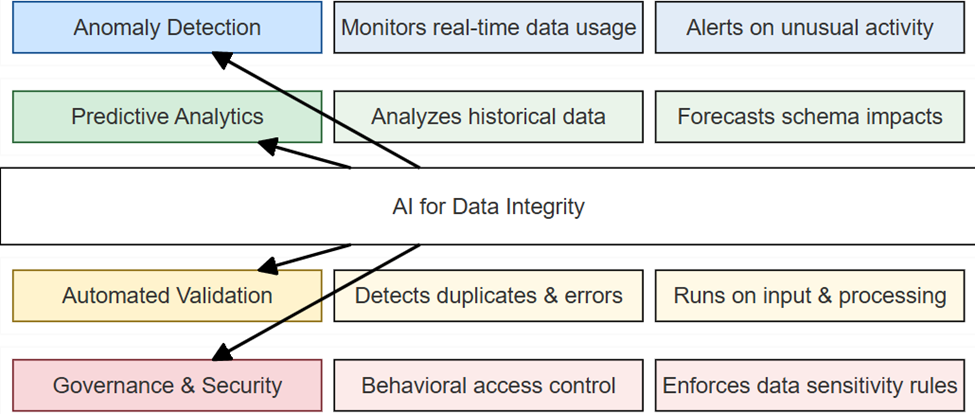
1. Anomaly Detection
Real-time data access pattern monitoring through AI-based systems enables organizations to track how users interact with their data. Through machine learning algorithms, systems can identify typical data usage behaviors to alert administrators about unusual activities that might signal data corruption or unauthorized modification.
2. Predictive Analytics
AI systems use predictive analytics to identify potential data integrity issues as they develop. Algorithmic analysis of historical data usage enables forecasts about schema changes' impact on service access so organizations can perform proactive modifications.
3. Automated Validation Processes
Through AI technology, organizations can automate their data validation operations that detect duplicate records, together with missing information and incorrect formatting. Data quality checks happen immediately during data input, and ongoing data processing helps keep information accurate.
4. Intelligent Governance and Security
Organizations can achieve real-time user access controls through AI-driven dynamic governance, which bases permissions on behavioral patterns and data sensitivity levels. The system restricts all data access to authorized users and services, which strengthens data integrity standards.
The Importance of Data Migration in Microservices
The need for data migration emerges when organizations switch database systems or redesign their database structure or system architecture. The data migration process becomes complex for microservice systems because of their interconnected service structure. Data migration plays a crucial role in microservices architecture because it enables changes to data systems and database structures.
Example: Data integrity with anomaly detection
The program uses the scikit-learn library to create a synthetic dataset and use the Isolation Forest algorithm to detect anomalies, which can help in identifying potential issues in data integrity
Prerequisite
Make sure you have the necessary libraries installed. You can install them by running:
#Bash
pip install numpy pandas matplotlib scikit-learn

import numpy as np
import pandas as pd
import matplotlib.pyplot as plt
from sklearn.ensemble import IsolationForest

# Generate synthetic data
# Normal data points
np.random.seed(42)
data_normal = np.random.normal(loc=0, scale=1, size=(200, 2))  # 200 normal data points

# Anomalous data points
data_anomalies = np.random.uniform(low=-6, high=6, size=(10, 2))  # 10 anomaly points

# Combine normal and anomalous data
data = np.vstack((data_normal, data_anomalies))
df = pd.DataFrame(data, columns=['Feature 1', 'Feature 2'])

# Visualize the data
plt.scatter(df['Feature 1'], df['Feature 2'], color='blue', label='Normal Data')
plt.title('Synthetic Data for Anomaly Detection')
plt.xlabel('Feature 1')
plt.ylabel('Feature 2')
plt.legend()
plt.show()

# Fit the Isolation Forest model
model = IsolationForest(contamination=0.05, random_state=42)  # Assume about 5% of the data are anomalies
model.fit(df)

# Predict anomalies
df['Anomaly'] = model.predict(df)

# Mark anomalies in the dataset (anomalies are marked as -1)
anomalies = df[df['Anomaly'] == -1]

# Visualize the detected anomalies
plt.scatter(df['Feature 1'], df['Feature 2'], color='blue', label='Normal Data')
plt.scatter(anomalies['Feature 1'], anomalies['Feature 2'], color='red', label='Detected Anomalies')
plt.title('Anomaly Detection using Isolation Forest')
plt.xlabel('Feature 1')
plt.ylabel('Feature 2')
plt.legend()
plt.show()

# Output detected anomalies
print("Detected Anomalies:")
print(anomalies)
How AI Facilitates Data Migration
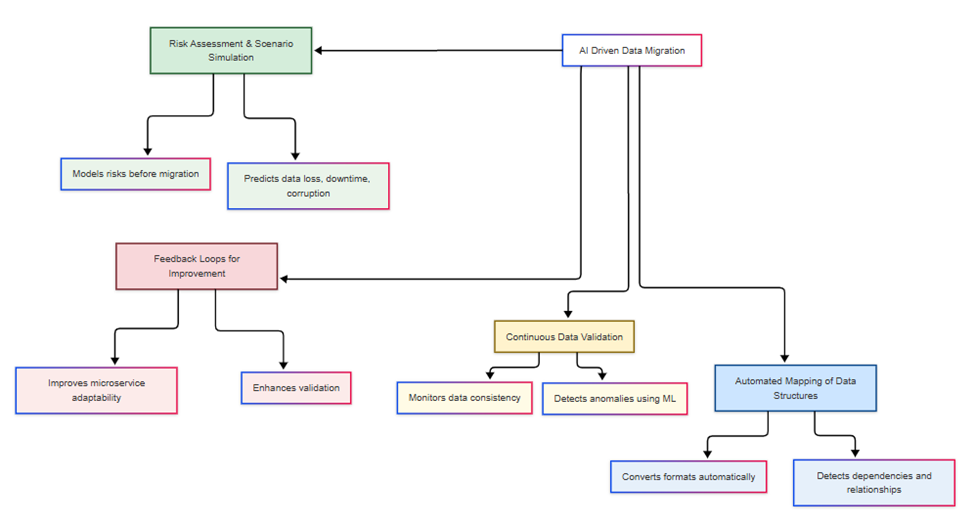
AI tools provide essential support for conducting data migrations by implementing the following strategies.
1. Automated Mapping of Data Structures
Through its algorithms, AI systems enable the quick conversion of existing data structures into new formats while detecting the relationships and dependencies between the data. The system decreases human intervention while decreasing the chance of errors that occur during the migration process.
2. Risk Assessment and Scenario Simulation
AI systems assess migration risks through predictive modeling of different migration protocols before beginning the data transfer process. Organizations can reduce their risks by using this capability to foresee data loss and system downtime, as well as corruption in their data assets, before migration.
3. Continuous Data Validation
AI-powered systems execute post-migration data validation through continuous monitoring to guarantee dataset consistency. Systems utilizing machine learning models can identify normal data patterns to detect anomalies, which helps maintain data integrity after migration.
4. Feedback Loops for Continuous Improvement
AI systems generate feedback mechanisms to improve data validation and integrity through insights collected from data interactions. Microservices gain adaptability through this approach to effectively handle changes in data requirements over time.
Example: Data migration using AI for microservices
Prerequisites
- pandas
- scikit-learn
import pandas as pd
from sklearn.model_selection import train_test_split
from sklearn.tree import DecisionTreeClassifier
from sklearn import metrics

# Sample data representing the old schema from the first microservice
data_old = {
    'user_id': [1, 2, 3, 4, 5],
       'first_name': ['Alice', 'Bob', 'Charlie', 'David', 'Eve'],
    'age': [25, 30, 35, 40, 45],
    'salary': [50000, 60000, 70000, 80000, 90000],
       'department': ['Engineering', 'HR', 'Engineering', 'Management', 'HR']
}

# Sample data for the new schema expected by the second microservice
data_new_format = {
       'employee_id': [1, 2, 3, 4, 5],
       'full_name': ['Alice Johnson', 'Bob Smith', 'Charlie Brown', 'David Wilson', 'Eve Davis'],
       'age_years': [25, 30, 35, 40, 45],
       'annual_income': [50000, 60000, 70000, 80000, 90000],
    'team': ['Dev Team', 'HR Team', 'Dev Team', 'Management', 'HR Team']
}

# Creating DataFrames
df_old = pd.DataFrame(data_old)
df_new_format = pd.DataFrame(data_new_format)

# Simulate Data Migration
def migrate_data(old_df):
    new_df = pd.DataFrame()
       new_df['employee_id'] = old_df['user_id']
       new_df['full_name'] = old_df['first_name'] + ' Johnson'  # Simplified concatenation for example
       new_df['age_years'] = old_df['age']
       new_df['annual_income'] = old_df['salary']

    # Mapping 'department' from old to new team
       new_df['team'] = old_df['department'].replace({'Engineering': 'Dev Team', 'HR': 'HR Team', 'Management': 'Management'})

    return new_df

# Perform data migration
migrated_df = migrate_data(df_old)

# Prepare Data for AI Validation: Simulate a decision tree model to confirm data integrity
# Features we'll use for validation
features = ['employee_id', 'age_years', 'annual_income']
# Expected teams (the target variable)
targets = new_df_format['team']

# Create training data
X = df_new_format[features]
y = targets


# Split the data for training and testing

X_train, X_test, y_train, y_test = train_test_split(X, y, test_size=0.2, random_state=42)


# Train the model

model = DecisionTreeClassifier()

model.fit(X_train, y_train)


# Validate migrated data

migrated_X = migrated_df[features]

predicted_teams = model.predict(migrated_X)


# Add predicted teams to the migrated DataFrame for validation

migrated_df['predicted_team'] = predicted_teams


# Output the migrated DataFrame with predicted values

print("Migrated Data with Predicted Teams:")

print(migrated_df)


# Evaluating model accuracy (for demonstration)

y_pred = model.predict(X_test)

print("Model Accuracy:", metrics.accuracy_score(y_test, y_pred))
Addressing Challenges and Considerations
Organizations must consider several challenges when they implement AI systems for data integrity and migration processes, despite their numerous benefits.
1. Data Privacy and Compliance
The treatment of personal data needs to comply with GDPR and CCPA privacy regulations when AI-driven processes operate. Organizations must achieve regulatory compliance through AI-based data integrity systems.
2. Quality of Training Data
AI models achieve effective training through the utilization of high-quality historical data. When models receive poor-quality training data, they produce wrong predictions, which results in inadequate governance systems.
3. Change Management and Cultural Shifts
AI-driven solution implementation demands organizational cultural transformation, which needs stakeholder approval and possibly staff retraining for acceptance. Organizations need to implement change management practices to adapt their data management approach toward AI-enhanced systems.
The implementation of AI strategies to enhance data integrity and support data migration in microservices ecosystems creates a powerful opportunity for organizational transformation. Businesses that implement machine learning algorithms and predictive analytics together with automation systems can improve their data management capabilities.
Opinions expressed by DZone contributors are their own.
Comments