

Anti-Patterns of Microservices Architecture From Real Production Experience
Microservices don't fix complexity; they shift it to the network. They require strict data, runtime, and business autonomy — not just split codebases.
 ·
·
Join the DZone community and get the full member experience.
Join For FreeMicroservices architecture is frequently presented as the natural evolutionary step for scaling modern systems. In presentations and case studies, it appears almost inevitable. Break the monolith into smaller services, deploy independently, scale selectively, and gain resilience through isolation. In practice, the story is more complex.
Across long-running production environments, I have seen microservices introduce as many risks as they resolve. The challenges rarely stem from incorrect frameworks or insufficient engineering skill. Instead, they arise from architectural decisions that did not fully consider operational reality, organizational structure, or long-term system evolution.
Over the past ten years, working as a Tech Lead in fintech and online gambling, I have observed recurring patterns. These systems processed financial transactions, handled real-time betting flows, and operated under strict regulatory constraints. In such environments, architectural trade-offs are not theoretical. They directly influence revenue, compliance, and customer trust.
The anti patterns described here are not abstract ideas. They are drawn from real systems that require correction under pressure.
Anti-Pattern 1: Distributed Monolith Through Synchronous Coupling
The first and most common issue appears when services are separated at the deployment level but remain tightly coupled at runtime.
At a structural glance, the system looks distributed. Each service has its own repository, its own container, and its own deployment pipeline. However, critical business flows depend on synchronous chains of service calls. A failure in one component propagates across others. Latency accumulates along call paths. Startup sequences introduce hidden dependencies that prevent isolated recovery.
I encountered this problem while leading a platform team at an online gambling company that operated a high-throughput betting system. One service required establishing a streaming connection to another service during startup. If the upstream service was unavailable for any reason, the dependent service could not initialize properly. Architecturally, they were separate. Operationally, they behaved as a single unit.
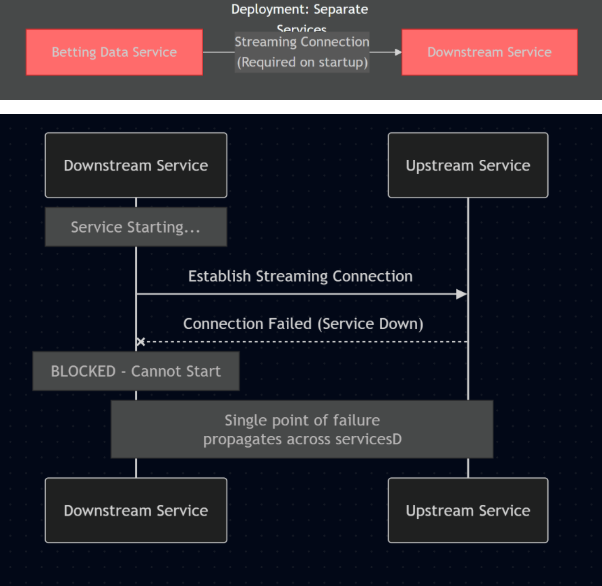
In gambling platforms, downtime is not simply inconvenient. It translates directly into revenue loss and regulatory exposure. The core issue was clear. We had deployment-level separation without runtime isolation.
After analyzing the data flow, we identified that the dependent service was stateless and required high-speed data propagation exceeding one thousand requests per second. What it truly needed was decoupled data transfer rather than a persistent synchronous connection.
I led a team of six engineers to introduce a Redis-based messaging layer. The upstream service published real-time data independently of downstream availability, and the downstream service consumed data according to its own lifecycle. Startup order no longer mattered.
The impact was measurable. Cascading failures disappeared. Recovery time became effectively zero because data persisted in Redis. We implemented Redis Sentinel clustering to avoid introducing a new single point of failure. Throughput requirements remained intact while operational independence improved significantly.
The lesson was straightforward. Without asynchronous boundaries, microservices do not provide meaningful isolation.
Anti-Pattern 2: Infrastructure-Driven Architecture
The second pattern emerges when architecture is shaped primarily by infrastructure convenience rather than domain boundaries.
In the same gambling platform, more than five services consumed a shared distributed configuration source. On paper, this seemed efficient. In reality, it created hidden coupling across teams.
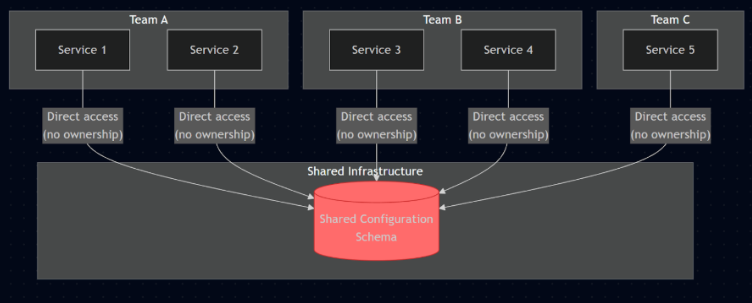
Any configuration change required cross-team coordination. Teams needed awareness of shared schemas outside their own services. Incidents occurred when neighboring teams unintentionally modified configuration parameters that impacted unrelated systems. Infrastructure design dictated team communication patterns.
In complex platforms with dozens of clusters, this configuration coupling introduced significant operational risk.
To restore ownership, I led the development of a centralized Config Manager service. It included a command-line tool capable of managing configurations across clusters with validation and preview capabilities. It also included a back-office interface integrated into our internal tooling, providing audit trails and safe modification workflows.
Most importantly, each service defined and owned its configuration schema. The Config Manager enforced boundaries. Teams could not modify configurations outside their domain. All changes were validated against service-specific rules.
Production incidents related to configuration errors dropped from one or two per quarter to zero. Cross-team coordination overhead decreased substantially. We retained operational convenience without sacrificing autonomy.
Infrastructure should enable architecture, not define it.
Anti-Pattern 3: Data Ownership Dilution
Perhaps the most costly anti-pattern appears when services expose separate APIs but share the same persistence layer.
Earlier in my career, at a fintech company, I inherited a system built around a single shared database that supported more than twenty services across five engineering teams. This so-called god database constrained every architectural decision.
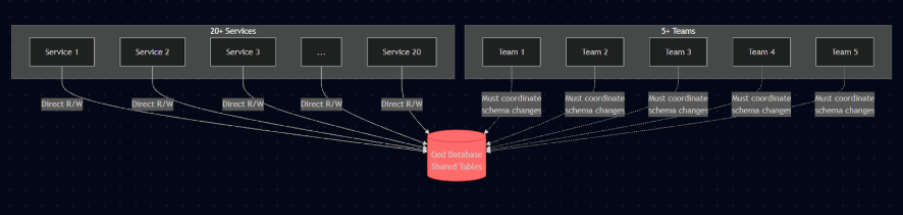
Schema evolution became nearly impossible. Any modification required coordination meetings involving multiple teams. To avoid conflict, teams began creating new tables instead of modifying existing ones. Over time, duplication spread, data fragmentation increased, query complexity grew, and consistency became harder to guarantee.
In fintech, data integrity is mandatory. Regulatory requirements demand precise and auditable records. The shared database gradually transformed into a structural bottleneck.
We initiated a phased migration toward service-owned data. First, we implemented dual writes to both the legacy database and new service-specific databases. We monitored data consistency for an entire quarter and built reconciliation tooling to detect discrepancies.
Next, we introduced an event-driven synchronization layer using Kafka. A transitional service consumed database changes and maintained read-only projections for dependent systems. APIs replaced direct database queries as the official contract.
The migration required eighteen months and coordination across multiple teams with competing priorities. Architectural transitions of this scale demand patience and persistence rather than quick rewrites.
In the end, schema change coordination meetings disappeared. Services gained autonomy. Database issues stopped cascading across unrelated domains. Teams were free to choose storage technologies aligned with their specific needs.
True service autonomy requires data autonomy.
Anti-Pattern 4: Observability as an Afterthought
The final pattern concerns observability.
In a fintech B2B credit application platform integrated with a major retailer, we had comprehensive technical metrics. API latency, error rates, CPU usage, memory consumption- everything appeared healthy.
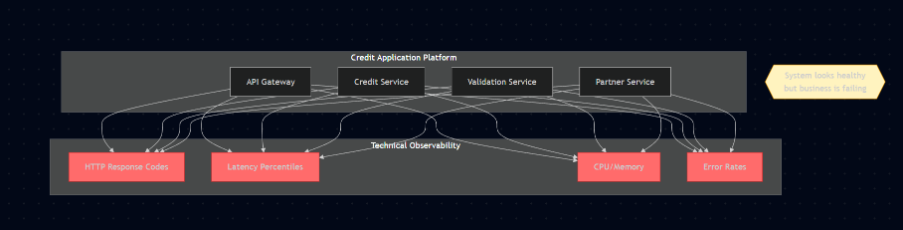
Despite this, credit applications were failing silently. Data was not being populated correctly. Submissions to partner banks were incomplete. The system was technically operational but functionally broken. We were monitoring infrastructure but not the business process.
To address this gap, we implemented business-level observability. We tracked application completion rates, submission success rates to each partner bank, data validation coverage, and funnel conversion metrics across the entire credit application flow.
Alerts were triggered not only by technical anomalies but also by business metric deviations. Developers were required to define business observability alongside technical instrumentation for every new feature. Moreover, incident detection time dropped below five minutes. We gained visibility into real customer impact rather than proxy technical indicators.
Observability must be designed as part of architecture and must reflect business outcomes, not just system metrics.
Conclusion
To sum up, microservices are not inherently flawed. They can provide meaningful isolation, scalability, and team autonomy when applied with architectural discipline.
However, production experience shows that they frequently shift complexity rather than eliminate it. Complexity moves from code to coordination, from logic to operations, from design to organizational structure.
The decision to adopt microservices should be driven by domain needs, team structure, and long-term evolution strategy. Without that clarity, distributed systems can easily behave like monoliths with additional network failure modes.
Opinions expressed by DZone contributors are their own.
Comments