

Architecting Autonomous Network Ecosystems: From Reactive Monitoring to Agentic AI Orchestration
A strategic blueprint for integrating sophisticated multi-agent systems designed to drive proactive, zero-touch network operations.
 CORE
·
CORE
·
Join the DZone community and get the full member experience.
Join For FreeAgentic AI systems represent a paradigm shift in network operations, facilitating the transition from traditional reactive monitoring to fully autonomous management frameworks. For global infrastructure leaders, these specialized AI agents serve as persistent digital engineers, providing round-the-clock expertise across deployment, maintenance, and complex troubleshooting lifecycles.
The following blueprint delineates the strategic application of agentic AI within a global enterprise network operations environment.
Architectural Blueprint: Multi-Agent Network Engine
Rather than deploying a monolithic AI entity, the optimal architecture utilizes a multi-agent system (MAS). In this model, specialized agents collaborate through a centralized Orchestrator to achieve complex operational objectives. Please refer to the System Hierarchy and Flow, as well as the Strategic Vision and Ecosystem diagrams.
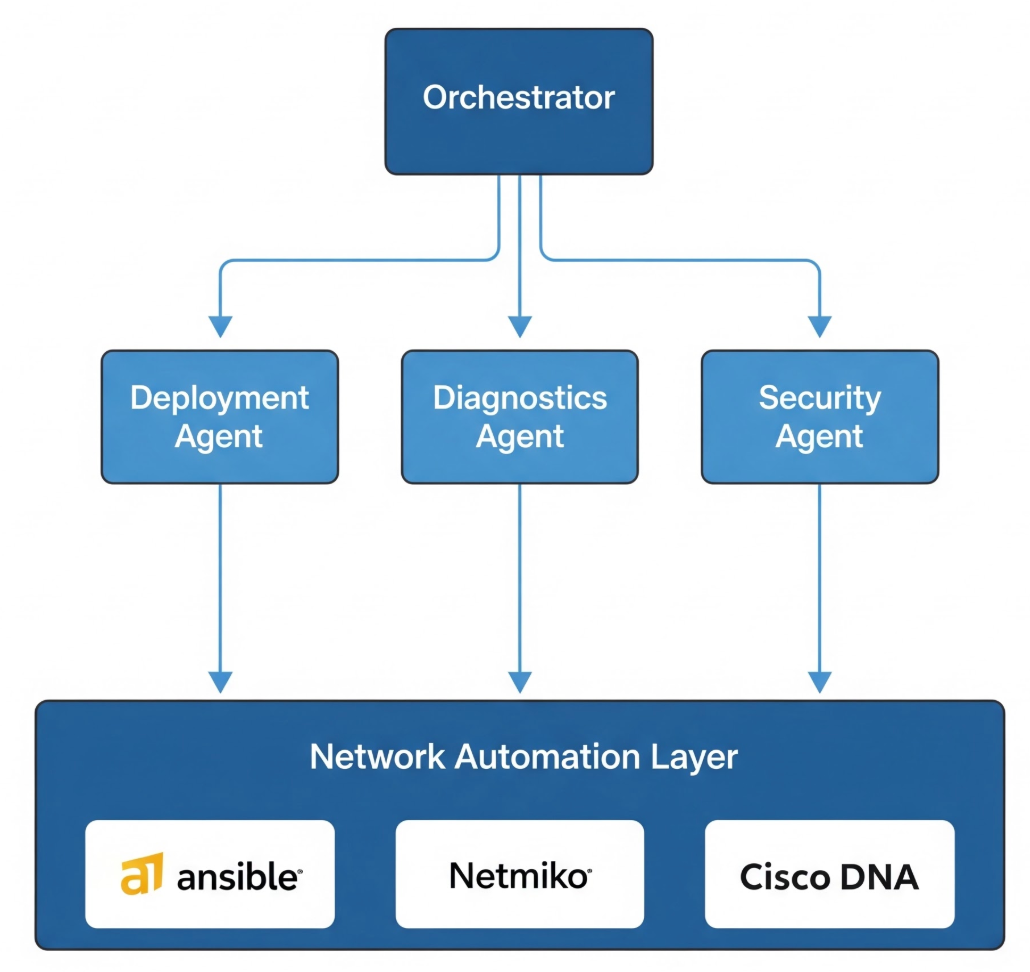
System Hierarchy and Flow
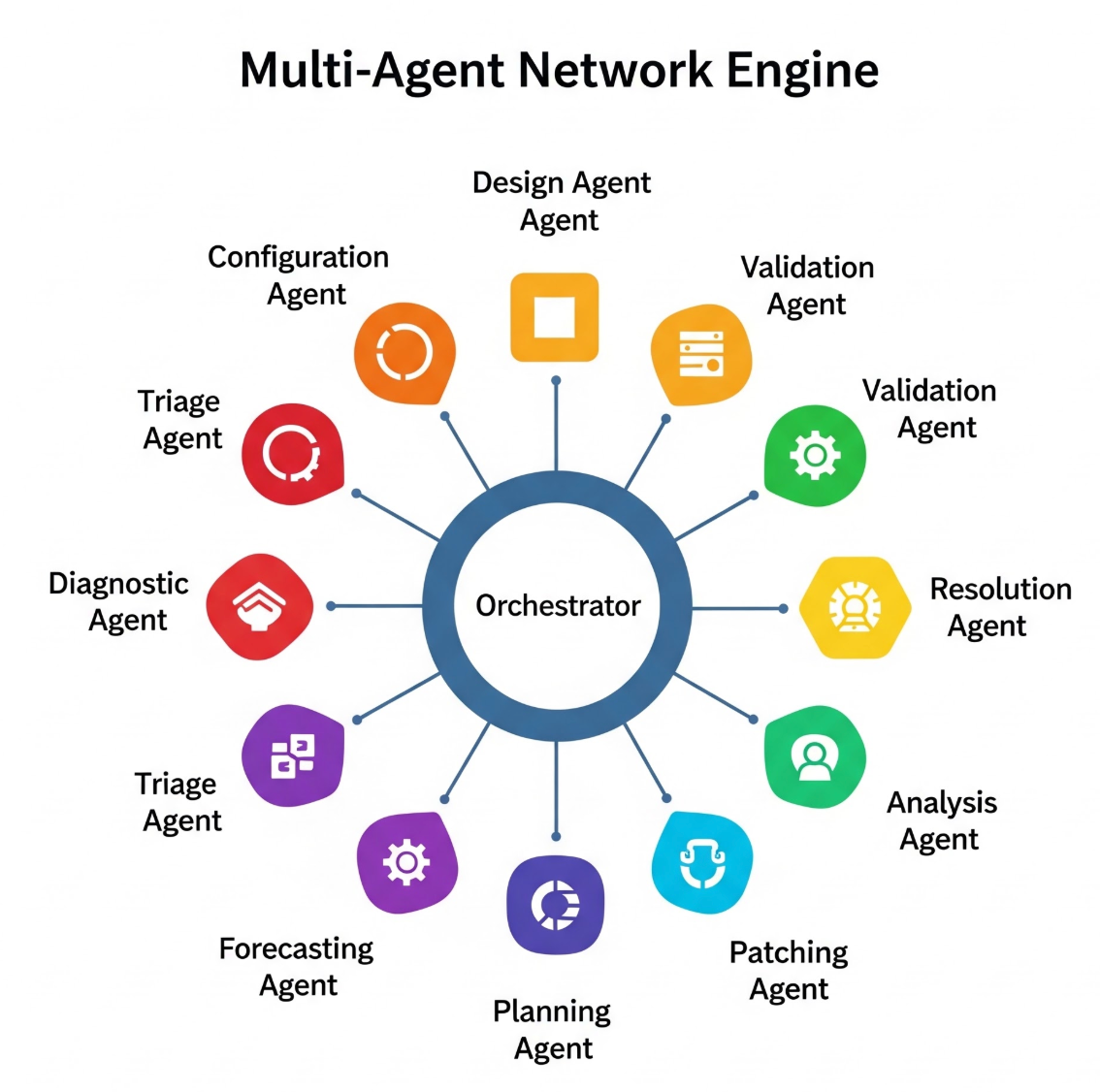
Core Use Cases and Agent Workflows
Autonomous Provisioning and Zero-Touch Deployment
- Functional scope: Serves as an automated configuration and systems engineer.
- Workflow:
- Human inputs a high-level intent (e.g., "Provision a new Cisco core switch for the Seoul R&D campus").
- Design Agent reads existing topology diagrams and ipAM (IP Address Management) databases.
- Configuration Agent generates vendor-specific CLI configs (Cisco IOS/NX-OS).
- Validation Agent runs the config in a virtual sandbox (e.g., Cisco Modeling Labs) to check for routing loops before pushing to production via Ansible.
24/7 Autonomous Incident Triage and Resolution
- Functional scope: Functions as the primary intelligence layer for Network Operations Center (NOC) alerts.
- Workflow:
- A monitoring tool (e.g., Splunk, SolarWinds) triggers a "BGP neighbor down" alert.
- Triage Agent intercepts the alert and instantly queries the device via SSH or telemetry API.
- Diagnostic Agent executes diagnostic scripts (show ip bgp summary, traceroute), analyzes logs, and identifies the root cause (e.g., a flapping fiber link).
- Resolution Agent opens a Jira ticket, attaches all logs, attempts a safe automated fix (like shifting traffic to a backup path), and pages a human only if the physical hardware needs replacement.
Predictive Maintenance and Capacity Optimization
- Functional scope: Operates as a proactive infrastructure strategist and planner.
- Workflow:
- Analysis Agent continuously monitors interface bandwidth, memory usage, and optical transceivers' error rates across global data centers.
- Forecasting Agent identifies trends (e.g., "Link X between Vietnam and Korea factories will hit 95% capacity in 30 days during peak hours").
- Planning Agent drafts a change management proposal recommending a bandwidth upgrade or traffic re-routing plan for human review.
Automated Compliance and Security Patching
- Functional scope: Functions as a continuous vulnerability and configuration compliance auditor.
- Workflow:
- Cisco releases a critical security advisory for an OS vulnerability.
- Auditor Agent scans the entire inventory database to find all vulnerable device models.
- Patching Agent schedules a maintenance window, backs up current configurations, downloads the verified firmware, applies the patch sequentially to avoid downtime, and performs post-flight checks.
Implementation Strategy
To ensure organizational stability while maximizing technological advancement, a phased implementation strategy is recommended:
-
Phase 1: Read-Only Agents (Information Gathering)
- Allow agents to access logs, APIs, and read-only commands.
- Focus on automated documentation, ticket enrichment, and summarizing alerts.
-
Phase 2: Human-in-the-Loop (Co-Pilot)
- Allow agents to generate fixes and configuration scripts.
- Require a senior network engineer to review and click "Approve" before any execution.
-
Phase 3: Guardrailed Autonomy (Full Agentic)
- Give agents autonomous execution rights only for low-risk, repetitive tasks (e.g., port resets, clearing stuck sessions).
- Enforce hard boundaries using API rate limits and strict verification checklists.
To refine the architectural requirements for your specific environment, please provide insights on the following:
- What monitoring tools (e.g., Datadog, ServiceNow) and automation frameworks (e.g., Ansible, Terraform) does your team currently use?
- What is the most repetitive issue your 24/7 NOC team spends time fixing manually?
- Are you looking to build these agents using commercial LLM APIs or host open-source models locally for security reasons?
Building an Enterprise-Grade Agentic System
Constructing an enterprise-grade agentic system for high-security environments requires the integration of a frontier large language model (LLM), a robust production agent framework, and the Model Context Protocol (MCP) to establish secure interoperability with core network infrastructure.
Part 1: Choosing the Right Tool/Solution
Do not rely on a simple chatbot web interface. You need an API-driven architecture that combines a foundational model with an agent framework.
The Foundational Model (The Brain)
-
Top Choice: Anthropic Claude 3.5 Sonnet / Claude 3 Opus
- Why: It currently dominates tool-use (function calling), reasons through complex, multi-step engineering logic flawlessly, and natively supports MCP.
-
On-Premises / Air-Gapped Alternative: Llama 3.1 / 3.3 (70B or 405B) or Qwen 2.5 (72B)
-
Why: For internal Samsung networks with strict data privacy laws, you can host these open-source models locally using vLLM or Ollama. They have excellent coding and structured JSON output capabilities.
-
The Agent Framework (The Backbone)
Use an open-source framework to manage agent memory, states, and collaboration:
- LangGraph (by LangChain): Best for networking. It allows you to build cyclical, graph-based agent workflows with strict state control and mandatory human-in-the-loop approval stages.
- CrewAI: Great for quickly setting up role-based multi-agent teams (e.g., Triage Agent talking to a Scripting Agent).
Part 2: Understanding MCP (Model Context Protocol)
MCP is an open standard created by Anthropic that acts as a secure plug-and-play adapter between LLMs and local/remote data sources, tools, and systems.
Instead of writing custom API integration code for every single Cisco switch, Ansible Tower, or Jira server, you build or use an MCP Server.
- How it works: Your Agent (MCP Client) connects to an MCP Server. The MCP Server exposes specific tools (e.g., run_cisco_command, query_monitoring_alerts) to the agent dynamically.
- Security Benefit: The model never gets direct SSH access to your core switches. The model only talks to the MCP Server, which enforces strict argument validation, sanitization, and logging before executing anything on the network.
Part 3: Writing agents.md
The agents.md file defines the architecture, roles, personas, boundaries, and collaboration patterns of your AI team.
# Network Operations Multi-Agent Architecture
This document defines the specialized AI agents operating within the Network Operations Center (NOC).

## 1. System Orchestrator Agent

- **Role:** Central Dispatch & Intent Router
- **Goal:** Analyze incoming alerts or human engineer requests and delegate tasks to specialized agents.
- **Persona:** A highly organized, senior technical project manager.
- **Boundaries:** Does not execute network commands directly. Must always route tasks and compile final reports.

## 2. Network Diagnostics Agent (NetDiag-Agent)

- **Role:** Incident Triager and Log Analyst
- **Goal:** Investigate network anomalies, verify device status, and pinpoint root causes.
- **Persona:** An analytical Cisco CCIE-certified troubleshooting expert.
- **Tools Allowed:** `ssh_read_only_commands`, `query_splunk_logs`, `ping_traceroute`.
- **Boundaries:** Read-only access to infrastructure. Cannot modify configurations.

## 3. Network Automation Agent (NetAuto-Agent)

- **Role:** Configuration and Deployment Engineer
- **Goal:** Generate valid, syntax-correct network configurations and execute approved automation scripts.
- **Persona:** A precise Network Automation Engineer specializing in Ansible, Python (Netmiko/Nornir), and Cisco IOS/NX-OS.
- **Tools Allowed:** `generate_ansible_playbook`, `validate_config_syntax`, `execute_stage_change`.
- **Boundaries:** Write-access allowed *only* through staging/sandbox tools. Any production push requires an explicit `Human-In-The-Loop` (HITL) approval token.
Part 4: Writing skills.md
The skills.md file maps out the actual capabilities, API tools, and Python execution blocks that the agents can tap into via MCP.
# Network Agent Skills & Tool Definitions

This document details the functional tools exposed to agents via the MCP (Model Context Protocol) layer.

## Category: Network Telemetry & Read Skills

### `query_device_status`

- **Description:** Fetches real-time operational data from a specific network device using Netmiko or Cisco DNA Center API.
- **Arguments:**
- `device_ip` (string, required): The target management IP address.
- `command` (string, required): Allowed values: `show ip interface brief`, `show ip bgp summary`, `show environment`.
- **Safety:** Input string regex validation enforced to prevent CLI injection attacks.

### `fetch_noc_alerts`

- **Description:** Pulls active high-severity network alerts from Splunk/SolarWinds.

- **Arguments:**

  - `severity` (string): Defaults to "CRITICAL".
  - `lookback_minutes` (integer): Time window to check.

## Category: Network Modification Skills (Write)

### `deploy_ansible_playbook`

- **Description:** Triggers an Ansible AWX template to push configuration updates to a device group.
- **Arguments:**
- `template_id` (string, required): Pre-defined template ID in Ansible.
- `extra_vars` (json, required): Key-value pairs for variables (e.g., target VLAN, interface ID).
- **Security Policy:** **CRITICAL_APPROVAL_REQUIRED**. This skill automatically pauses agent execution and sends a webhook to the human supervisor's teams/Slack app for a 2FA confirmation click.
Next Steps for Implementation
To help map out a proof of concept (PoC) for your architecture, tell me:
- Do your network infrastructure components support REST APIs/gRPC, or do the agents need to interface heavily via legacy SSH/CLI parsing?
- Do you plan to build this as an internal web-dashboard/chatbot for engineers, or as a background event-driven system triggered by network monitoring systems?
- What programming language (e.g., Python, TypeScript) is your team's preference for building the MCP servers?
Opinions expressed by DZone contributors are their own.
Comments