

AI-Driven Autonomous CI/CD for Risk-Aware DevOps
AI-driven autonomous CI/CD pipelines enable risk-aware DevOps by predicting failures, reducing downtime, improving reliability, and lowering cognitive load for SREs.
 ·
·
Join the DZone community and get the full member experience.
Join For FreeCurrently, the software development process relies on integrating development and operations (DevOps) to accelerate delivery without compromising quality. When the system becomes very complex, it becomes risky and delays the manual control of the continuous integration or continuous deployment (CI/CD) processes. AI-based autonomous pipelines manage the entire process by automating decisions, optimizing, and eliminating human errors.
Continuous risk-aware DevOps involves monitoring and signaling issues, as well as predicting failures. The self-healing mechanisms handle the whole thing in a way that minimises disruption and improves system stability across different deployments.
Cognitive load management is very important for site reliability engineers (SREs), who are usually involved in multitasking. Intelligent automation reduces cognitive load, enabling SREs to focus on the most important tasks. As a result, the productivity and reliability of the entire process are increased.
To realize these benefits:
- Autonomous CI/CD pipelines: Develop and introduce AI to speed up the building, testing, and releasing processes, thereby overcoming bottlenecks and increasing overall throughput.
- Risk-aware DevOps: Using predictive analytics, monitor continuously, and carry out real-time interventions to address issues so that the downtime is kept to a minimum.
- Cognitive load management: Let automation handle simpler, repetitive tasks, allowing engineers to focus on more critical operations.
The incorporation of AI into the formation of self-healing systems enhances pipeline resilience, thereby making DevOps quicker and more reliable.
Background and Context
The adoption of DevOps has significantly accelerated software delivery. CI/CD pipelines automate testing and deployment; however, as systems grow, their manual management becomes very difficult. The use of AI has made autonomous CI/CD pipelines highly efficient, as they can make decisions instantly, thereby increasing overall output.
Automated pipelines can foresee problems and fix them independently, eliminating the need for human input. AI performs real-time data processing to detect issues and then boosts efficiency by applying improvements. AI-powered automation handles the entire build, test, and deployment process, as well as predicting test failures. A brief demonstration of the use of AI predictions in Jenkins is as follows:
\begin{verbatim}
pipeline {
    agent any
    stages {
        stage('Test') {
            steps {
                script {
                    if (sh('python ai_predict.py').trim() == 'failure') {
                        error("Test failed.")
                    }
                }
            }
        }
        stage('Deploy') {
            steps {
                sh 'deploy.sh'
            }
        }
    }
}
\end{verbatim}
Risk-aware DevOps comprises constant monitoring and predictive maintenance, which are early risk detection and self-healing enablers, respectively. For instance, Kubernetes leverages Prometheus to automatically scale pods when resource constraints are exceeded, as shown below:
apiVersion: apps/v1
kind: Deployment
metadata:
  name: ai-self-healing
spec:
  replicas: 1
  template:
    spec:
      containers:
        - name: ai-container
          image: ai-image
          resources:
            requests: {memory: "256Mi", cpu: "250m"}
            limits: {memory: "512Mi", cpu: "500m"}
With the growing complexity of the system, the mental burden of SREs has also increased. One way to handle this burden is through automation, which allows SREs to focus on the most important tasks.
CI/CD Pipelines in Modern Software Delivery
DevOps relies on the combination of CI/CD to automate workflow, including integration, testing, and delivery stages. The use of such pipelines in software delivery accelerates the entire process, reduces human errors, and increases the deployment frequency:
CI Pipeline Implementation
The continuous integration (CI) procedure starts when a fresh piece of code is committed to the repository. Once the pipeline automatically runs the tests and the preceding step is successful, the code is deployed to a staging environment. The following is a basic example of using Jenkins to implement the CI pipeline:
pipeline {
    agent any
    stages {
        stage('Test') {
            steps {
                sh 'mvn clean test'  % Run unit tests with Maven
            }
        }
        stage('Deploy') {
            steps {
                sh 'deploy.sh'  % Deploy to staging after tests pass
            }
        }
    }
}
In the Jenkins pipeline, MVN clean test runs the unit tests. deploy.sh is triggered to deploy the code to a staging environment once the tests pass.
CD Pipeline Implementation
The CD pipeline ensures that after the code is committed, tested, and validated, it moves through stages such as code review, staging, and finally deployment to production. The following example shows how Jenkins automates this process:
pipeline {
    agent any
    stages {
        stage('Review') {
            steps {
                input 'Approve Deployment?'  % Manual approval before deploying to production
            }
        }
        stage('Deploy to Production') {
            steps {
                sh 'deploy-prod.sh'  % Deploy the code to production
            }
        }
    }
}
The pipeline has an approval stage before the code is deployed to the production environment:
- The input step processes the request for the team's manual approval before granting an endorsement for the entire deployment procedure.
- Upon getting the consent, the code is transferred to the production area via deploy-prod.sh.
CI/CD Pipeline Flow
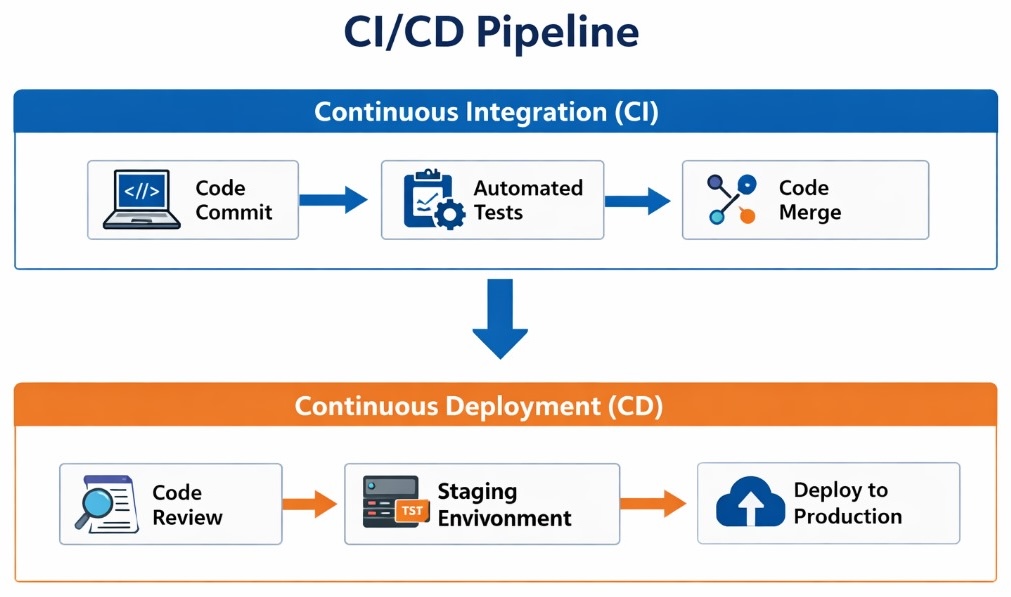
The CI/CD pipeline allows smooth integration and deployment. Here is a brief outline of the stages involved in the collaborative CI/CD process:
- CI flow: Code is committed, automated tests run, and if the tests pass, the code is merged into the main repository.
- CD flow: Subsequently to the CI pipeline, the code shifts to the review, staging, and production deployments.
Risk Awareness in DevOps
Risk-aware DevOps recognizes and reduces risks throughout the software delivery pipeline. The primary techniques are as follows:
- Continuous monitoring: Instantaneous monitoring of system health.
- Predictive maintenance: Foretelling trouble before it happens.
- Self-healing: Troubleshooting automatically without human participation.
Continuous Monitoring
Continuing surveillance is fundamental to monitoring the system's performance. For example, with Jenkins and Prometheus, we can set alerts that trigger when the system's health declines. The procedure for implementing a basic monitoring test is as follows:
pipeline {
    agent any
    stages {
        stage('Review') {
            steps {
                input 'Approve Deployment?'  % Manual approval before deploying to production
            }
        }
        stage('Deploy to Production') {
            steps {
                sh 'deploy-prod.sh'  % Deploy the code to production
            }
        }
    }
}
Using curl, this program monitors the system's condition and terminates the pipeline when an unhealthy state is detected.
Predictive Maintenance
The notion behind predictive maintenance is to utilize data to forecast system breakages. Deploying AI models into CI/CD pipelines can help identify future problems beforehand. An instance of this could be an AI model that predicts problems with deployment as follows:
pipeline {
    agent any
    stages {
        stage('Monitor') {
            steps {
                script {
                    def health = sh(script: 'curl -s http://prometheus-server/health', returnStdout: true).trim()
                    if (health != 'healthy') {
                        error("Health check failed.")
                    }
                }
            }
        }
The AI algorithm was tasked with generating potential failure scenarios. When these are predicted, the deployment process is put on hold.
Self-Healing With Kubernetes
Kubernetes facilitates self-healing by managing containers and enabling automatic resource scaling when needed. There is a way to set it so that it can recover from failures on its own. Let us explore the procedure for obtaining the self-healing feature by setting the resource requests and limits:
pipeline {
    agent any
    stages {
        stage('Predict Failure') {
            steps {
                script {
                    def aiPrediction = sh(script: 'python predict_failure.py', returnStdout: true).trim()
                    if (aiPrediction == 'failure') {
                        error("Prediction: Failure detected.")
                    }
                }
            }
        }
    }
}
This configuration ensures that the automatic scaling and failover recovery mechanisms in Kubernetes adjust all related resources accordingly.
Risk-Aware DevOps Pipeline Flow
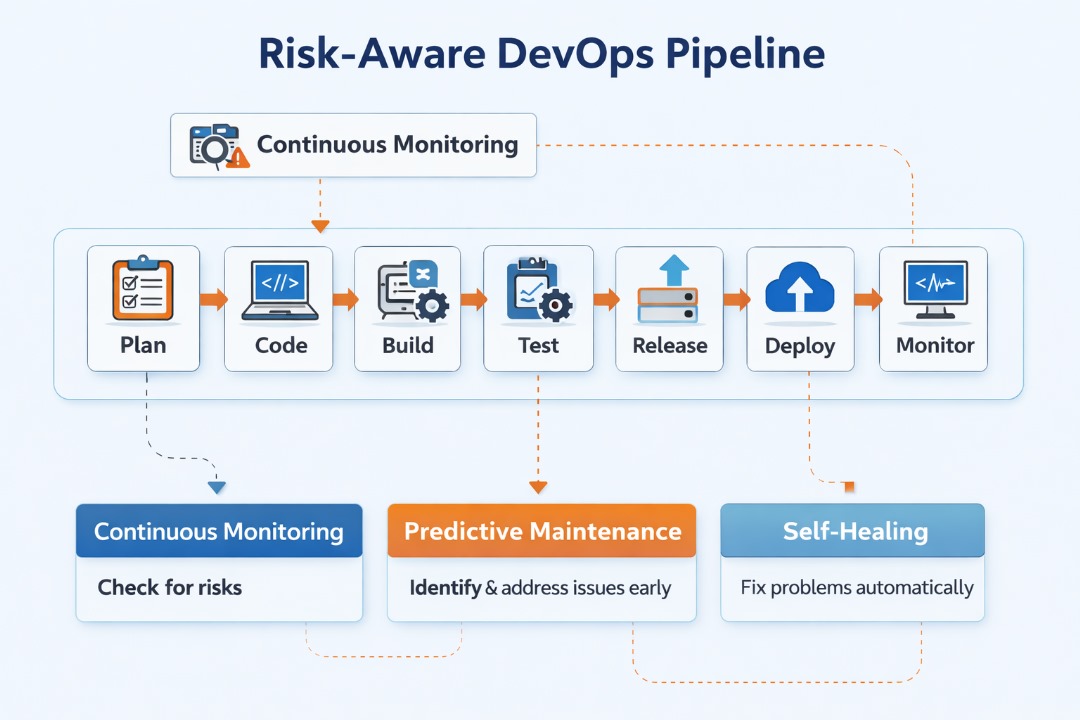
The subsequent Fig. 2 shows the incorporation of risk-aware measures into the DevOps pipeline:
- Continuous monitoring: It covers the whole pipeline and provides real-time monitoring of the health status.
- Predictive maintenance: A technique applied before deployments to prevent outages.
- Self-healing: It is a process enabled by Kubernetes that automatically controls and recovers from failures.
Cognitive Load in Site Reliability Engineering
Cognitive load in site reliability engineering (SRE) refers to the mental effort required to manage complex systems, including monitoring, incident response, and maintaining service uptime.
High cognitive load can hamper otherwise good decisions and reduce productivity, leading to errors and delays in performing critical tasks.
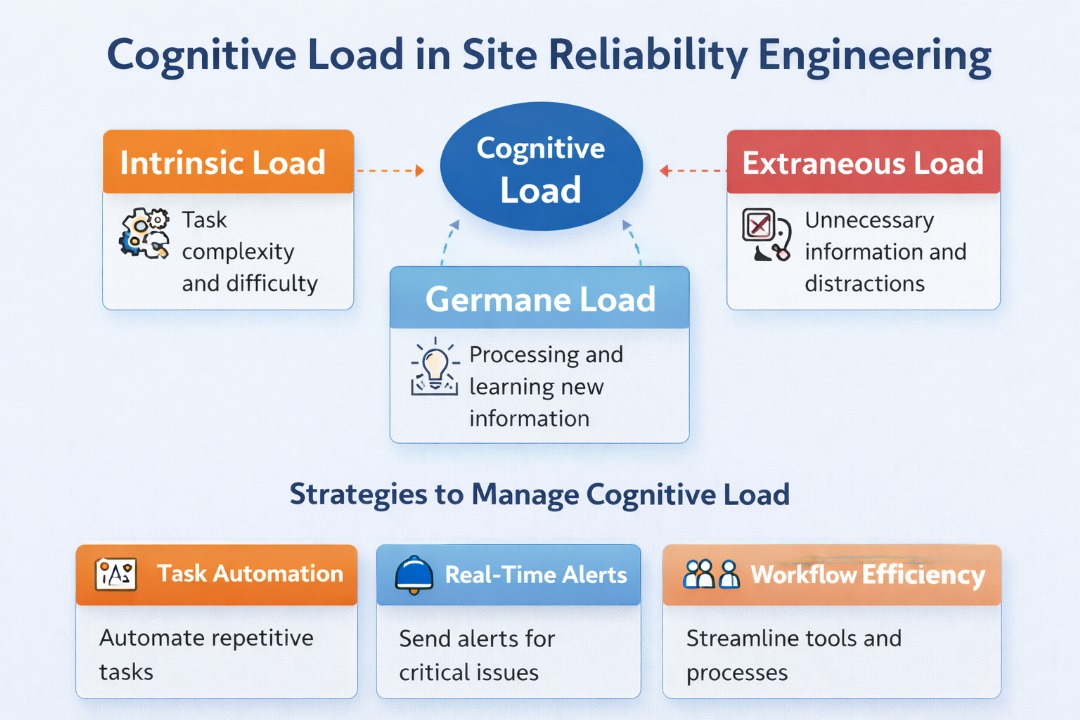
Types of Cognitive Load
- Intrinsic load: The task complexity, like troubleshooting system failures.
- Extraneous load: Distractions or unnecessary information, such as redundant alerts.
- Germane load: The mental effort to process and organize new information.
Managing Cognitive Load in SRE
To lessen cognitive load, the following strategies are suggested:
- Task automation: Implementing task automation can save time and energy by automating health checks and log parsing.
- Real-time alerts: Set up to automatically notify engineers of critical issues, eliminating the need for manual monitoring.
- Streamlined workflows: Dashboards can be implemented to minimize context switching and help engineers focus on problem-solving.
Task Automation Example
The use of monitoring systems such as Prometheus for health-check automation can considerably lighten the mental load by guaranteeing continuous monitoring of the system's health. Here is how Prometheus can be set up to conduct health checks without manual intervention:
apiVersion: apps/v1
kind: Deployment
metadata:
  name: self-healing
spec:
  replicas: 1
  template:
    spec:
      containers:
        - name: app
          image: app-image
          resources:
            requests:
              memory: "256Mi"
              cpu: "250m"
            limits:
              memory: "512Mi"
              cpu: "500m"
Cognitive Load Model
When properly managed, types of cognitive load can enhance concentration and productivity in SRE tasks. The model presented here depicts the partitioning of cognitive load into three types.
- Intrinsic load: The intrinsic difficulty of a task.
- Extraneous load: Unnecessary distractions or redundant information.
- Germane load: The energy required for assimilating and comprehending new information.
Design Principles for Autonomous, Risk-Aware Pipelines
This section explains the automated nature of CI/CD pipelines, where risk management is performed without manual intervention.
To start with, autonomous pipelines rely on AI and ML to foresee potential problems and resolve them, ensuring flawless operation.
In the end, all these pipelines work to deliver faster, safer, and more reliable outputs by handling tasks automatically and with performance that continues to improve.
Architecture Overview
An autonomous CI/CD pipeline that accounts for potential risks can deliver software efficiently while minimizing manual effort and managing risks simultaneously. This structure comprises various components.
- Data collection: Consistently collects logs and metrics to assess system performance and spot problems as they happen.
- AI and machine learning: Data is analyzed to predict failures and optimize pipelines proactively.
- Risk detection: Monitors system health, identifies risks such as failed builds or security issues, and notifies the relevant parties.
- Self-healing: The system automatically takes measures to fix the problem by rolling back, scaling up, or restarting the failed stages, for example.
- Feedback loop: The system gains experience from every deployment, making subsequent iterations quicker and less resource-intensive.
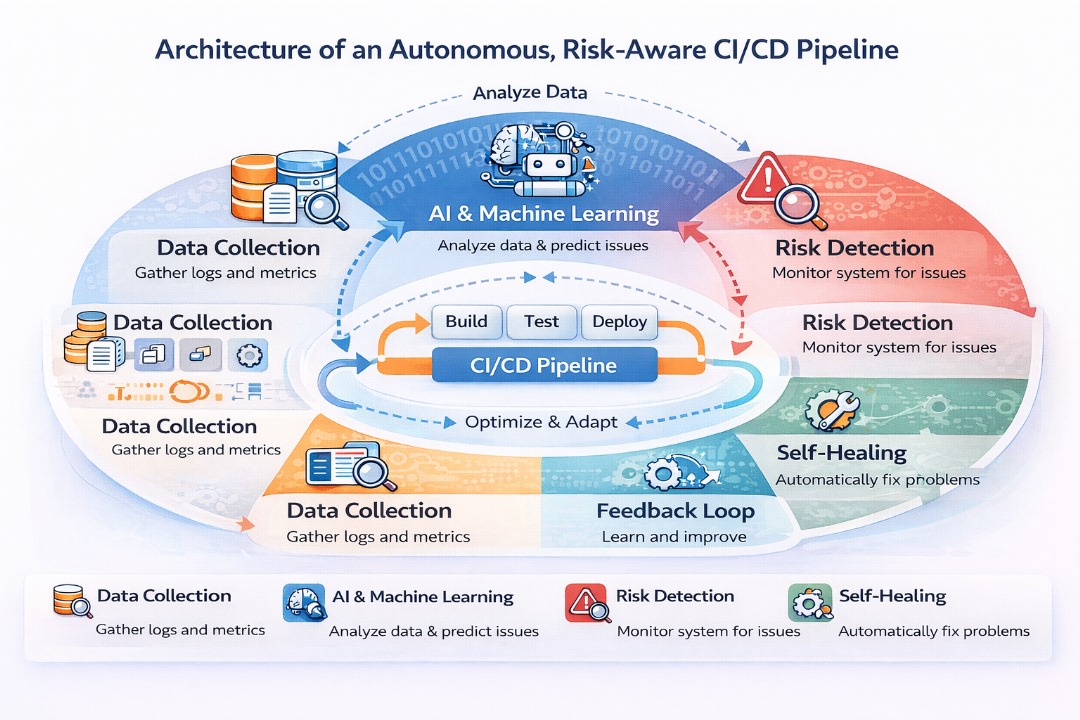
Fig 4: Architecture of an autonomous, risk-aware CI/CD pipeline.
In an endless loop, all these elements work together, allowing the pipeline to independently incorporate modifications, fix issues, and enhance its performance over time. Automated deployment, AI integration, and performance optimization are performed autonomously, as shown in Fig. 4.
Integrating Cognitive Load Awareness into DevOps Practices
Cognitive load management in DevOps is a crucial factor positively influencing decision-making and productivity. It does this by monitoring mental effort at every stage of the pipeline, thereby reducing mistakes and increasing the concentration of the people involved.
The automation of the cognitive load reduction process includes automated testing, CI/CD pipelines, and monitoring tools, which are among the main technologies that take engineers away from uninteresting tasks and let them focus on the essential ones. As a result, system reliability is enhanced, errors are reduced, and delivery is accelerated.
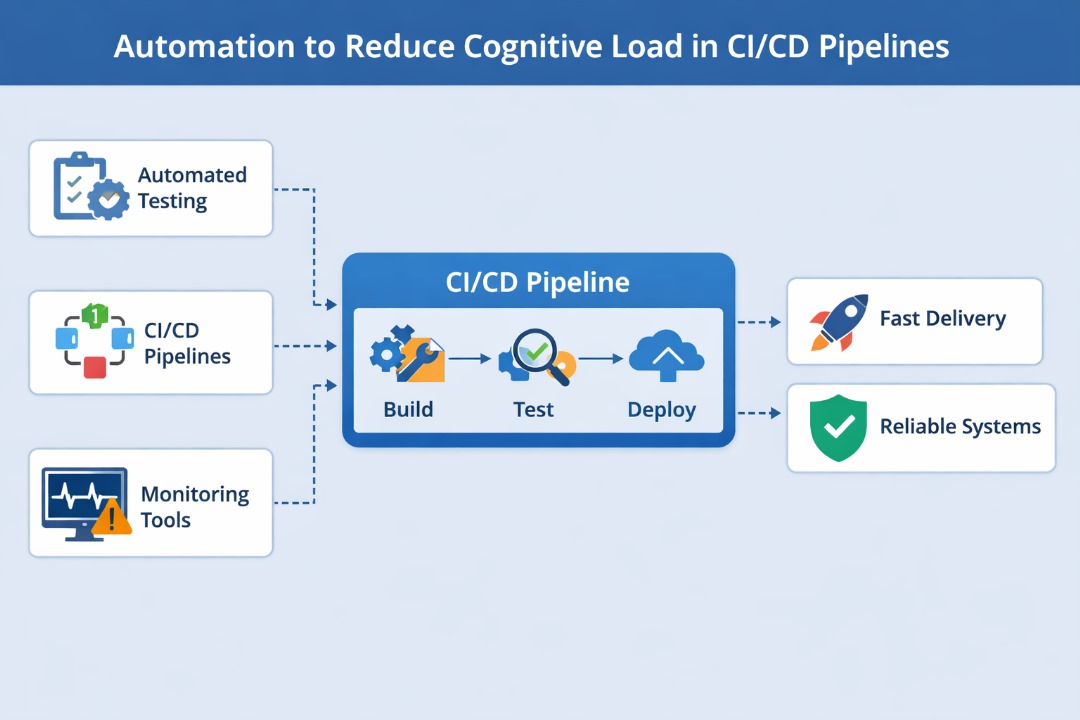
Fig 5: Automation and tooling to reduce cognitive load in CI/CD pipelines.
Case Studies/Practical Example
The adoption of DevOps relies on automation and cognitive load management to increase productivity and minimize human error. One example of such use is an e-commerce platform where Jenkins has been implemented to carry out unit and integration testing.
A microservices-based system uses Prometheus for monitoring and automatically creates alerts whenever service failures or performance degradation occur, enabling immediate issue resolution and reducing downtime.
Discussion and Conclusion
Automated continuous integration or continuous deployment (CI/CD) pipelines do away with manual intervention altogether and, along with that, set up a faster, more dependable quality assurance system using testing and monitoring tools. The ability to manage cognitive load helps to concentrate more, make fewer errors, and increase one's output.
On the other hand, the adoption of automation and AI technologies opens up a whole new world of possibilities, even if it comes with some difficulties. Combining automation with cognitive load management, DevOps teams not only improve efficiency but also work on the most critical issues, thereby scaling their performance, quality, and, eventually, quantity.
Opinions expressed by DZone contributors are their own.
Comments