

Best Practices for Handling Bad Data in Stream Processing Platforms
Learn best practices for handling bad data in stream processing, from schema validation and duplicate detection to dead-letter queues, monitoring, and data lineage.
 CORE
·
CORE
·
Join the DZone community and get the full member experience.
Join For FreeToday, stream processing platforms facilitate the real-time analysis of data flowing continuously from Internet of Things (IOT) devices, financial transactions, web applications and servers at banks, manufacturing equipment, logistical systems in warehouses and ships, as well as customer activities with conversational agents on web portals. Streaming frameworks like Apache Kafka, Apache Flink, Apache Spark Structured Streaming, and stream databases are empowering business folks to process millions of events in real time.
But what your streaming platform is worth depends exclusively on the quality of data fed into it. An event that is malformed, a duplicate message, any missing field, or an invalid timestamp can lead to incorrect analytics generation, false alert triggers, bursts of alerts, and even application crashes. Batch processing allows for data to be cleaned before execution, but stream-processing requires that validation and corrections occur while the data is flowing. Thus, establishing a strong data quality strategy is a core necessity of any event-driven architecture.
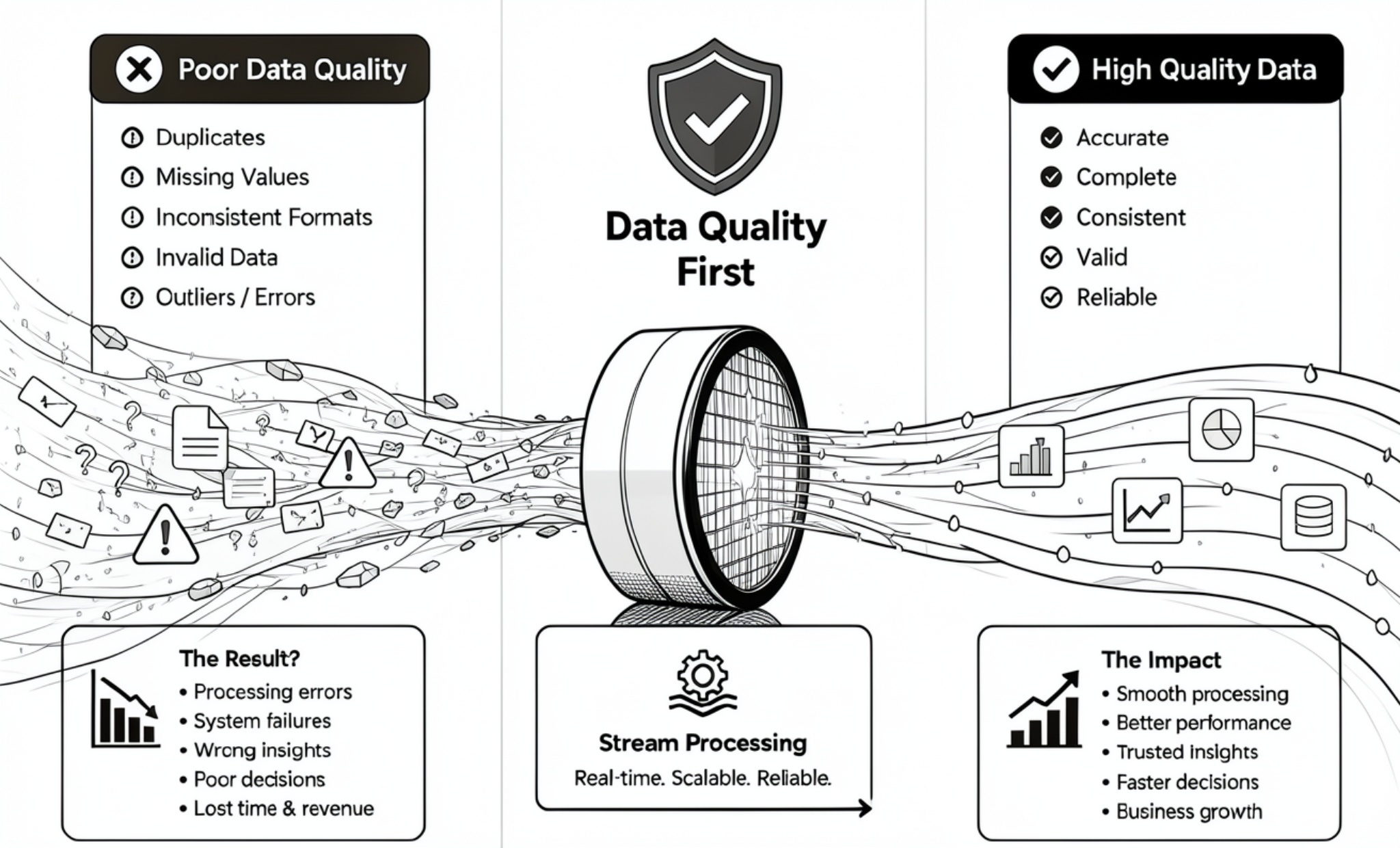
What Is Bad Data?
Bad data refers to any event that fails to satisfy the quality rules required by downstream applications.
Examples include:
- Missing mandatory fields
- Invalid data types
- Corrupted JSON or Avro messages
- Duplicate events
- Incorrect timestamps
- Schema incompatibility
- Out-of-range sensor values
- Future-dated events
- Null primary keys
- Invalid GPS coordinates
- Negative financial values
- Incomplete business transactions
Processing these events without validation can lead to unreliable business intelligence and poor operational decisions.
Best Practices for Handling Bad Data
1. Validate Data at the Ingestion Layer
The first validation should be right after data enters the platform. For event streaming data validation, validate data at the ingestion layer so that only high-quality, well-formed, and schema-compliant events reach our data lake. If we catch errors early in the pipeline, then the event flow passing through the rest of the stream processing components will be cleaner and more reliable, and it reduces the probability of processing invalid data later on. In simple words, rejecting invalid events early significantly reduces downstream complexity.
2. Enforce Schema Validation
Enforce a schema to guarantee that every streaming event adheres to a data structure defined by us before it is operated on. It ensures data consistency, schema evolution with backward compatibility, and protects downstream consumers from non-well-formed or incompatible messages by validating field names, types, and required attributes against a schema. Along with a Schema Registry, it ensures producers and consumers agree on the event structure.
3. Detect Duplicate Events
In a streaming platform, the ability to detect and eliminate duplicate events is critical — simply because our event could be sent multiple times due to retries, network outages, or producer errors. This includes avoiding duplicates and ensuring consistency across downstream systems that consume this data. And making sure there are no incorrect aggregations and duplicate transactions by creating reliable event processors. Processing duplicates could exaggerate revenue figures, inventory tallies, or analyses.
4. Validate Event Time
One of the key features that modern stream processing should support is event-time processing. In streaming platforms, validating the event time is a key measure as it ensures that your events will be processed in the correct chronological order irrespective of whether they arrive late or out of sequence. Event timestamps are a prerequisite for accurate windowed aggregations to avoid duplicate or stale data affecting analytics (windowing needs distinct event timestamps), solidify data quality, and guarantee consistency in producing real-time insights and downstream processing.
Using watermarks and event-time windows helps manage late-arriving events while preserving analytical accuracy.
5. Apply Business Validation Rules
Technical validation makes sure that the ingested events have proper structures, completeness, and semantic validity – but it does not prove any business meaning. By applying business validation rules, we ensure that our events adhere to domain-level requirements (valid relationships, range of values, and business constraints) in order to keep dirty data from propagating downstream through systems and analytics.
For example, some business rules like:
- Temperature between acceptable operating limits in temperature-measuring sensors.
- Customer ID exists, Product inventory is available, Order amount greater than zero in E-Commerce applications
- Device status is active in IoT applications
- Transaction currency is supported in financial applications
Business validation protects applications from logically incorrect data.
6. Route Bad Data to a Dead-Letter Queue (DLQ)
If we are using Apache Kafka as a data/event ingestion tool for the stream processing platform, then the dead-letter queue (DLQ) of Kafka will play a very important role in segregating bad data or events from the flow of continuous data streams. Instead of processing bad data, we can route it to a dedicated DLQ. The following are the benefits:
- Investigation
- Root-cause analysis
- Reprocessing the events after correction to minimize the maximum data loss
- Producer feedback
- Audit trail
A DLQ keeps production pipelines running while preserving problematic records for later analysis.
7. Separate Critical and Non-Critical Errors
However, in stream processing, we should not react to every bad data with the same severity. Critical errors like invalid transactions, an empty key field, or a corrupted schema should be isolated or routed to a dead-letter queue (DLQ), so that they do not impact downstream processing. Non-critical errors, for example, a low-priority warning like a change in formatting or some kind of optional fields, can be logged, fixed, or handled with default values and positive acceptance of the stream processing. With the above approach, we can improve the production pipeline resilience.
8. Monitor Data Quality Continuously
Data quality should be treated as an operational metric so that the following can be monitored to avoid bad data processing:
- Invalid event rate
- Duplicate percentage
- Schema failures
- Parsing failures
- Late events
- DLQ growth
- Producer error rates
Real-time dashboards from the above statistics would help engineering teams identify problems before they affect business users for decision-making.
9. Maintain Data Lineage
To handle bad data in a stream processing platform, the first and essential step is to preserve data lineage. What does preserving data lineage mean? Put simply, it means recording the complete activity trajectory for every piece of data that flows through the platform. With it, one can trace the origin and circulation path of the data, as well as every modification it undergoes throughout the entire processing workflow, without missing any detail of changes related to the data.
By recording the data's trajectory clearly, enterprises can quickly identify at which node the damaged, incomplete, or invalid data entered the data stream, and also calculate which downstream systems, or results generated relying on this data, will be affected. This avoids the situation where people only realize there is a problem long after the bad data has caused a large number of issues, and more importantly, it prevents them from being unable to pinpoint the source of the problem, only to fumble around with a pile of erroneous results.
10. Automate Data Quality Rules
Avoid hardcoding validation logic inside application code whenever possible.
Instead:
- Maintain reusable validation rules.
- Version business rules.
- Centralize governance.
- Allow configuration without code changes.
Automation reduces maintenance effort and increases consistency across streaming applications.
11. Build Observability into the Pipeline
Building observability into the pipeline is very important for detecting and handling bad data in stream processing platforms. Here are a couple of steps involved, such as continuously monitoring data quality, processing errors, latency, throughput, and unusual patterns in real time. With the help of metrics, logs, alerts, and dashboards, we can identify malformed, missing, or inconsistent data as soon as it occurs. Using the above, the teams can quickly investigate the source of the problem and subsequently take corrective action so that the entire pipeline can maintain reliable and accurate data for stream processing.
Final Thoughts
Building a stream processing platform is not only about high throughput or low latency. It is about having all decisions made based on accurate, trustworthy, and well-governed data.
With ingestion-time data validation, schema enforcement, business rule application, duplicate detection, and late event handling mechanisms such as dead-letter queues (DLQs), steady monitoring for data quality issues, and designing for scale, builders can create a streaming architecture that withstands the test of time by providing you with the right insights in real time.
Published at DZone with permission of Gautam Goswami. See the original article here.
Opinions expressed by DZone contributors are their own.
Comments