

Context Graphs: From Outcomes to Decisions
Enterprise systems store outcomes, not reasoning. Context graphs capture decision context, enabling AI agents and turning systems of record into systems of reasoning.
 ·
·
Join the DZone community and get the full member experience.
Join For FreeMost enterprise systems are very good at answering one question: “What happened?”
They are surprisingly bad at answering a more important one: “Why did it happen?”
As AI agents move from demos into real business workflows, this gap is becoming the biggest blocker to real autonomy.
This article explains:
- Why existing systems fail AI agents
- What context graphs actually are (and what they are not)
- How they turn enterprises from systems of record into systems of reasoning
The World We Built: Systems That Remember Outcomes
Over the last two decades, enterprise software has enabled the creation of trillion-dollar companies by becoming systems of record.
- CRM systems store customers
- HR systems store employees
- ERP systems store transactions
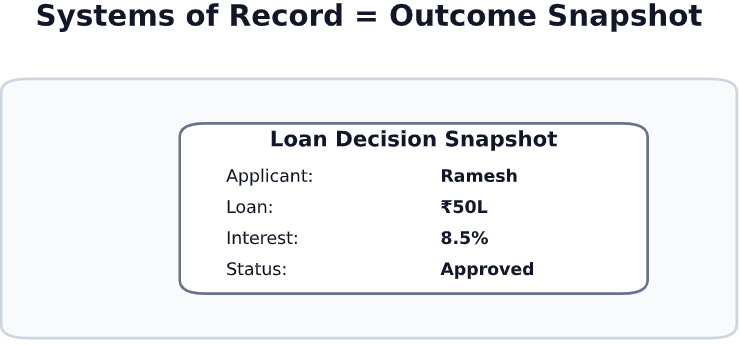
They own the final state of the business. For example, a bank’s system might tell you:
- Applicant: Ramesh
- Loan amount: ₹50 lakhs
- Interest rate: 8.5%
- Status: Approved
This is useful — but incomplete.
What Actually Drives Decisions (and Gets Lost)
In reality, decisions are rarely made by rules alone. Behind that loan approval, a human likely considered:
- Ramesh works in IT → stable income
- Credit score is slightly below the cutoff
- A similar case was approved last year
- Branch manager approved an exception over WhatsApp
This reasoning lives in:
- People’s heads
- Slack or WhatsApp messages
- Informal conversations
- Organizational memory
Once the decision is made, all of this context disappears. Only the final number survives.
Why This Is a Problem for AI Agents
AI agents are now being asked to operate in exception-heavy workflows:
- Loan approvals
- Deal desks
- Compliance reviews
- Support escalations
These are not deterministic processes. Humans handle them by using Precedent, Judgment, Cross-system context, and memory. But none of the judgments are stored as data in enterprise systems. So agents hit a wall — not because data is missing, but because decision memory is missing.
Enter Context Graphs
A context graph is a system that records not just outcomes, but decision traces.
When an AI agent sits directly in the workflow, it can capture:
- The rules that applied
- The exceptions that were triggered
- The signals considered across systems
- Who approved the deviation
- Why was the final decision allowed
In our loan example, the system would store:
- Rule: Minimum credit score = 750
- Exception: IT employee allowed ±20 points
- Precedent: Similar approval in March 2024
- Approval: Branch manager
- Outcome: 8.5% interest
Now the system can answer: “Why did we approve this loan at this rate?”
Important Clarification: What Context Graphs Are NOT
Before going further, let’s clear up a common confusion.
Context graphs are NOT graph databases.
- They are NOT Neo4j.
- They are NOT knowledge graphs or vector graphs.
The word graph often misleads people. A context graph is an architectural pattern, not a storage technology. It combines two ideas:
- Context engineering – giving an agent exactly the context it needs at decision time
- Decision graphs – recording why each decision was made as the agent executes steps
The “graph” emerges naturally from connected decisions over time — not from modeling nodes upfront.
The Core Insight: Decisions Are Data Too
Rules tell an agent what should happen in general.
Decision traces capture what happened in this specific case:
- Which rule applied
- Which exception was used
- Who approved it
- What precedent justified it
Agents don’t just need rules. They need decision lineage.
Why This Changes Everything
Once decisions are stored as data:
- Audits become explainable
- Similar cases can be auto-approved
- Agents can safely gain autonomy
- Organizations stop relearning the same exceptions
Over time, these decision traces connect across people, policies, and events — forming a context graph. This graph becomes a system of record for decisions, not just objects.
Example 1: Loan Approval With a Context Graph
Let’s revisit the bank example — this time with a context graph.
Instead of storing just the outcome, the system records:
- Rule: Minimum credit score = 750
- Exception: IT employee allowed ±20 points
- Precedent: Similar case approved in March 2024
- Approval: Branch manager
- Outcome: 8.5% interest
Now the system can answer: “Why did we approve this loan at this rate?”
Even better:
- Similar future cases can be auto-approved
- Auditors can trace the logic
- Agents can safely act with autonomy
Example 2 (Rewritten): Why CRMs Fail — and How Context Graphs Fix It
To understand why context graphs matter, we need to first understand how CRMs actually work today — and why that model breaks down for AI agents.
How a Traditional CRM Works Today
A CRM is designed to answer questions like:
- What stage is this deal in?
- What is the expected deal size?
- Is the deal open, won, or lost?
To do this, CRMs store:
- Fields (text, dates, dropdowns)
- Current state of the opportunity
- Occasional free-text notes
For example, a sales leader might add a field called “Success Criteria” and ask reps to keep it updated.
At any moment, the CRM shows: “This is what we currently believe matters.”
This model assumes:
- The latest update is the most accurate
- Older reasoning is no longer relevant
- Context does not need to be preserved
That assumption is exactly where the problem starts.
The Real Sales Scenario (Setting the Stage)
Imagine a company selling enterprise software. They are running a Proof of Concept (POC) with a customer called Dunder Mifflin. Two meetings happen.
Meeting 1: The End User (Jim)
Jim is a sales rep at the customer company. In the first meeting, Jim says:
- “I spend 5 hours a week prospecting and I hate it.”
- “Updating the CRM takes too much time.”
What the CRM Captures
The CRM (or an AI assistant connected to it) updates the Success Criteria field to something like: “Customer wants better prospecting and faster CRM updates.”
So far, this looks reasonable.
Meeting 2: The Decision Maker (Michael)
In the second meeting, we talked to Michael, Jim’s manager and he says:
- “We are planning to IPO in two years.”
- “I spend every Friday forecasting.”
- “Our forecast accuracy is only 73%.”
- “We need 90%+ accuracy to go public.”
What the CRM Does Next
The CRM (or AI) updates the same Success Criteria field again: “Customer wants better prospecting, faster CRM updates, and improved forecasting.”
The CRM now contains a summary, but something critical has been lost.
What Went Wrong in the CRM Model
From the CRM’s point of view:
- All inputs are treated equally
- There is no distinction between:
- End user vs decision maker
- Tactical pain vs strategic goal
- Opinion vs organizational mandate
The CRM stores:
- The final text
- But not why each input mattered
- Not who said it
- Not which goal dominated
If the VP of Sales later asks: “What defines success for this deal?” The CRM answers with a bag of keywords, not a reasoned explanation.
This is the state overwrite problem:
- Each update replaces the previous understanding
- Decision logic is destroyed over time
How a Context Graph Solves This
Now let’s look at the same scenario with a context graph. Instead of updating fields, the agent builds decision context over time.
Step 1: Establish Grounding Truth
Before any meetings, the system already knows:
- Our product capabilities (e.g., Forecasting, Pipeline Visibility)
- What we do well and what we don’t do
This becomes the root context.
Step 2: Capture the First Meeting (Jim)
The context graph records:
- Speaker: Jim
- Role: End user
- Pain points:
- Prospecting
- CRM updates
It then evaluates these against product capabilities:
- Prospecting → Not supported (flagged)
- CRM updates → Supported (weak match)
Nothing is discarded — but nothing is prioritized yet.
Step 3: Capture the Second Meeting (Michael)
Now the system records:
- Speaker: Michael
- Role: Decision maker
- Goal: IPO in two years
- Pain point: Forecast accuracy (73% → 90%)
The context graph now does something CRMs cannot:
- It weights the input by role
- It links the pain point to an organizational goal
- It matches it to a core product capability
The graph creates:
- A Success Metric node: “Increase forecast accuracy to 90%”
- A Justification: IPO readiness
- A Priority decision: Forecasting > CRM updates > Prospecting
The Result: A Reasoned Answer, Not a Summary
Now, when someone asks: “What defines success for this deal?”
The system can answer:
“Success is improving forecasting accuracy to enable an IPO.
This priority was set by the decision maker and aligns with our strongest product capability.”
This is not better summarization. This is decision intelligence.
Why This Matters
CRMs are optimized to store:
- Entities
- Fields
- Current state
Context graphs are optimized to store:
- Decisions
- Intent
- Precedence
- Organizational logic
CRMs are systems of record. Context graphs are systems of reasoning.
The Bridge Back to the Core Thesis
This is why AI agents struggle when plugged directly into CRMs. They don’t fail because:
- The model is weak
- The data is missing
They fail because:
- Enterprises overwrite reasoning
- Decisions are never treated as data
Context graphs fix this by capturing why decisions were made, at the moment they were made.
Why Existing Platforms Struggle Here
Traditional systems struggle because:
- CRMs focus on the current state, not the decision time
- Warehouses receive data after decisions, via ETL
- Neither sits in the execution path
By the time data lands in Snowflake or Databricks, the decision context is already gone .To capture decisions, a system must be present at the moment a decision is made. That’s why agent orchestration layers have a structural advantage.
From Systems of Record to Systems of Reasoning
Context graphs change the nature of enterprise software.
- CRMs are passive systems of record
- Context graphs are active systems of reasoning
They don’t just digitize entities.
They digitize how the business thinks.
Over time:
- Exceptions become precedent
- Precedent becomes automation
- Automation becomes autonomy
AI doesn’t fail because it lacks intelligence. It fails because enterprises forget why decisions were made. That is the real trillion-dollar opportunity.
Opinions expressed by DZone contributors are their own.
Comments