

Building AI-Driven Service Operations: Integrating CRM, Inventory, and Field Service
Effective AI-driven CRM implementations depend on integration with field service, inventory, ERP, and logistics so predictive insights can be executed successfully.
Join the DZone community and get the full member experience.
Join For FreeArtificial intelligence has transformed customer relationship management from a record-keeping function into a data-driven decision support system. Across utilities, high-tech manufacturing, industrial equipment, telecommunications, and infrastructure services, AI capabilities are increasingly being incorporated into CRM platforms to improve service planning, maintenance scheduling, and customer support workflows.
Modern CRM platforms commonly support capabilities such as identifying customers at risk of churn, predicting equipment failures, recommending preventive maintenance actions, and generating service insights from vast volumes of operational data. Many organizations are adopting AI capabilities within CRM platforms to automate service workflows and improve maintenance planning.
Yet despite these advances, many enterprises continue to struggle with service delays, missed service-level agreements, and inconsistent customer experiences.
In many implementations, predictive insights are not fully translated into operational execution.
An AI-powered CRM platform may accurately predict that a high-value asset is likely to fail within the next ten days. It can automatically create a work order, notify stakeholders, and schedule a technician visit. However, if the required spare part is unavailable, sitting in the wrong warehouse, delayed in transit, or inaccessible to the technician, the prediction creates little practical value.
From the customer's perspective, the result is the same, with ongoing downtime, disrupted production, and service levels that fail to meet expectations.
The implementation gap highlights the importance of integrating predictive systems with operational processes. Inventory management and logistics directly influence whether predictive maintenance recommendations can be executed successfully.
Operational coordination plays an important role in translating predictive insights into effective service delivery. They are the ones building integrated operational processes where customer intelligence, inventory visibility, field service operations, and logistics execution operate as a single coordinated framework.
Why Operational Readiness Matters as Much as AI
For many years, CRM platforms focused primarily on managing customer interactions. Their purpose was to capture customer information, track sales opportunities, and maintain service histories. Success was measured through relationship visibility and customer engagement.
The emergence of AI has significantly expanded the role of CRM. Modern CRM systems can:
- Predict service demand before customers raise support requests, allowing organizations to intervene proactively rather than reactively.
- Analyze customer behavior and asset performance trends, helping service teams identify risks before they become operational disruptions.
- Recommend preventive maintenance actions, reducing the likelihood of costly failures and unplanned downtime.
- Automate service scheduling and case prioritization, improving responsiveness across large service networks.
- Support outcome-based service models, where providers are increasingly measured by performance and uptime rather than service activity alone.
These capabilities expand CRM beyond traditional customer relationship management. However, many organizations still struggle to convert customer intelligence into operational execution. As customer expectations rise, the ability to act on predictive insights is becoming just as important as the ability to generate them.
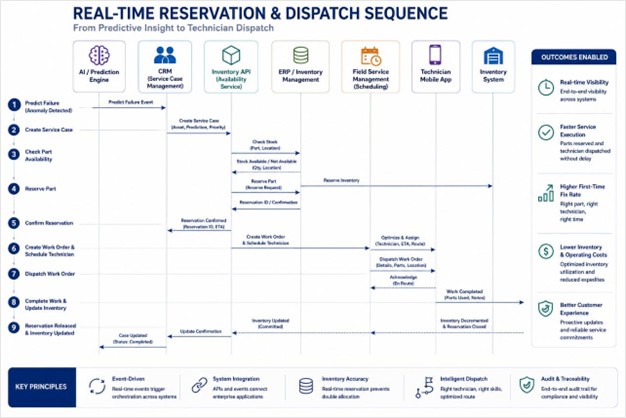

Figure 1: Real-time reservation and dispatch sequence illustrating how predictive events trigger inventory reservation, technician scheduling, and work execution across enterprise systems.
Why Predictive Insights Often Fall Short
A common implementation challenge of digital transformation is that AI often exposes operational weaknesses rather than solving them.
Consider a utility company using AI-powered monitoring to predict transformer or substation failures before they occur. The technology works as intended, providing early warnings and actionable insights. However, if replacement inventory is unavailable or service teams cannot access the required components in time, outages and disruptions still happen.
The same challenge exists in manufacturing. Predictive analytics may identify a component nearing failure, allowing maintenance teams to plan interventions in advance. Yet if the necessary spare part is out of stock or procurement lead times are too long, production delays remain unavoidable.
Organizations may not realize expected operational improvements when inventory and logistics processes remain disconnected. The limitation is rarely the predictive model itself; more often, it lies in operational constraints such as:
- Inaccurate inventory records, which create uncertainty around actual stock availability.
- Fragmented warehouse operations, making it difficult to locate and allocate inventory efficiently.
- Limited visibility across service networks, preventing organizations from understanding where high-priority spare parts are located.
- Inefficient replenishment processes, resulting in avoidable shortages and delays.
- Disconnected service and logistics teams, reducing the organization's ability to respond quickly when intervention is required.
Organizations increasingly discover that AI can identify service needs faster than operational systems can fulfill them. This is why operational readiness has become an important implementation consideration in determining the success of AI-powered service strategies.
Inventory Visibility and Customer Experience
Historically, inventory management was measured by operational metrics such as stock levels, carrying costs, and warehouse efficiency. Today, it plays a far more strategic role by directly influencing customer experience.
Business customers expect real-time visibility into parts availability, repair timelines, and service status. To meet these expectations, service organizations need visibility across:
- Central warehouses for high-value and high-priority spare parts
- Regional distribution centers supporting local service operations
- Forward stocking locations positioned near demand hotspots
- Technician vehicle inventories for immediate field service needs
- Supplier and third-party logistics networks for added flexibility
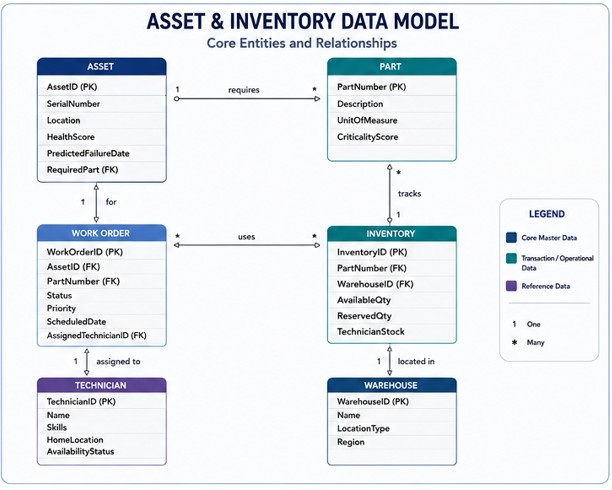

Figure 2: Logical data model illustrating the core entities supporting predictive maintenance, inventory reservation and field service execution.
Without end-to-end visibility, organizations struggle to deploy inventory efficiently, directly impacting service responsiveness and customer satisfaction.
Accurate inventory visibility enables reservation, allocation, and dispatch decisions before technician scheduling occurs.
Why Inventory Matters for First-Time Fix Rates
Among all service performance indicators, First-Time Fix Rate (FTFR) remains one of the most important measures of service effectiveness.
The metric evaluates an organization's ability to resolve issues during the initial technician visit. Inventory intelligence is often one of the strongest drivers of first-time fix performance. Higher first-time fix rates are commonly associated with accurate parts allocation, technician skill matching, and inventory availability and typically benefit from:
- Higher customer satisfaction, because issues are resolved without requiring repeat visits.
- Lower operational costs, as additional technician dispatches become less frequent.
- Improved workforce productivity, allowing service teams to handle more work orders effectively.
- Stronger contract performance, particularly within uptime-driven service agreements.
- Reduced asset downtime, helping customers maintain operational continuity.
Even the most skilled technician cannot complete a repair without access to the required parts. This is why many enterprises are integrating inventory intelligence directly into field service workflows. By aligning inventory planning with service demand, businesses can ensure technicians arrive prepared with the parts required to complete repairs successfully.
A single visit that resolves the issue creates confidence in the service provider. Multiple visits often create frustration regardless of how modern the underlying technology may be.
Improving Spare Parts Forecasting With AI
Forecasting spare parts demand has always been challenging due to irregular usage patterns influenced by asset age, operating conditions, maintenance cycles, and equipment reliability. Traditional forecasting models relied heavily on historical consumption data, often limiting their ability to adapt to changing conditions.
AI supports a more dynamic approach by analyzing multiple demand drivers, including:
- Service history: Identifies recurring maintenance and repair patterns across asset populations.
- Asset health data: Uses IoT insights to detect performance trends and anticipate failures.
- Demand trends: Forecasts regional and operational service requirements more accurately.
- Supplier risks: Factors in lead times and procurement constraints to improve planning.
- Operating conditions: Considers environmental and usage factors that influence failure rates.
This approach can improve inventory planning, increase service responsiveness, and lower inventory costs.
AI is also being used to improve replenishment decisions. Instead of relying on static reorder points, AI continuously evaluates inventory consumption, service schedules, lead times, and asset conditions to trigger replenishment actions automatically. This helps reduce stockout risks, avoid overstocking, and improve replenishment accuracy while reducing excess inventory.
The Role of Service Logistics in Better Service Delivery
Inventory availability is only part of the equation. Organizations must also ensure that parts move efficiently through the service network to reach the right location at the right time. Service logistics has evolved from a support function into a core component of service delivery, directly influencing repair timelines, asset uptime, and customer satisfaction.
Modern service logistics includes:
- Transportation planning, ensuring inventory reaches service locations efficiently.
- Technician replenishment programs, keeping field teams equipped with frequently used components.
- Emergency parts fulfillment, enabling rapid responses to critical failures.
- Route optimization capabilities, reducing travel times and improving service responsiveness.
- Reverse logistics processes, helping organizations recover and manage returned components effectively.
AI Models can prioritize replenishment recommendations using inventory consumption, lead times, and predicted demand. As customer expectations continue to rise, logistics performance is becoming an increasingly important operational capability rather than a back-office activity.
Balancing Service Levels and Inventory Costs
One of the most complex challenges facing service leaders is balancing inventory investment with customer expectations. Excess inventory increases costs, while insufficient inventory leads to delayed repairs and missed service commitments.
AI can help organizations strike a more sustainable balance. By analyzing demand patterns, asset performance trends, service histories, and supplier lead times, inventory optimization models that use AI can determine where inventory should be positioned and in what quantities. Rather than maximizing stock levels, organizations can focus on maximizing inventory effectiveness, ensuring that high-priority spare parts are available where they are most likely to be required.
This shift is particularly important for organizations operating large service networks. Utility providers, industrial equipment manufacturers, and infrastructure operators must maintain service readiness without tying up excessive capital in inventory. AI enables a more precise approach, helping organizations improve responsiveness while maintaining financial discipline.
Operational Priorities for Service Organizations
As AI adoption accelerates, service leaders must focus on strengthening the operational foundations that enable service outcomes.
Key priorities include:
- Establishing real-time inventory visibility across the service network, enabling faster and more informed decision-making.
- Deploying AI-driven forecasting capabilities, improving spare parts planning and reducing stock-related service disruptions.
- Improving integration between customer, operational, and inventory systems, creating a unified operational environment.
- Strengthening logistics agility, particularly around emergency fulfillment and field service support.
- Expanding predictive maintenance programs, allowing organizations to address issues before customers experience disruptions.
Many manufacturers increasingly view service performance and asset uptime as important operational priorities.
AI is also enhancing workforce planning within field service operations. By combining predicted service demand, technician skill profiles, geographic location, parts availability, and customer priority levels, organizations can schedule resources more effectively. This ensures technicians are dispatched with both the expertise and inventory required to resolve issues during the first visit, improving workforce productivity and customer satisfaction simultaneously.
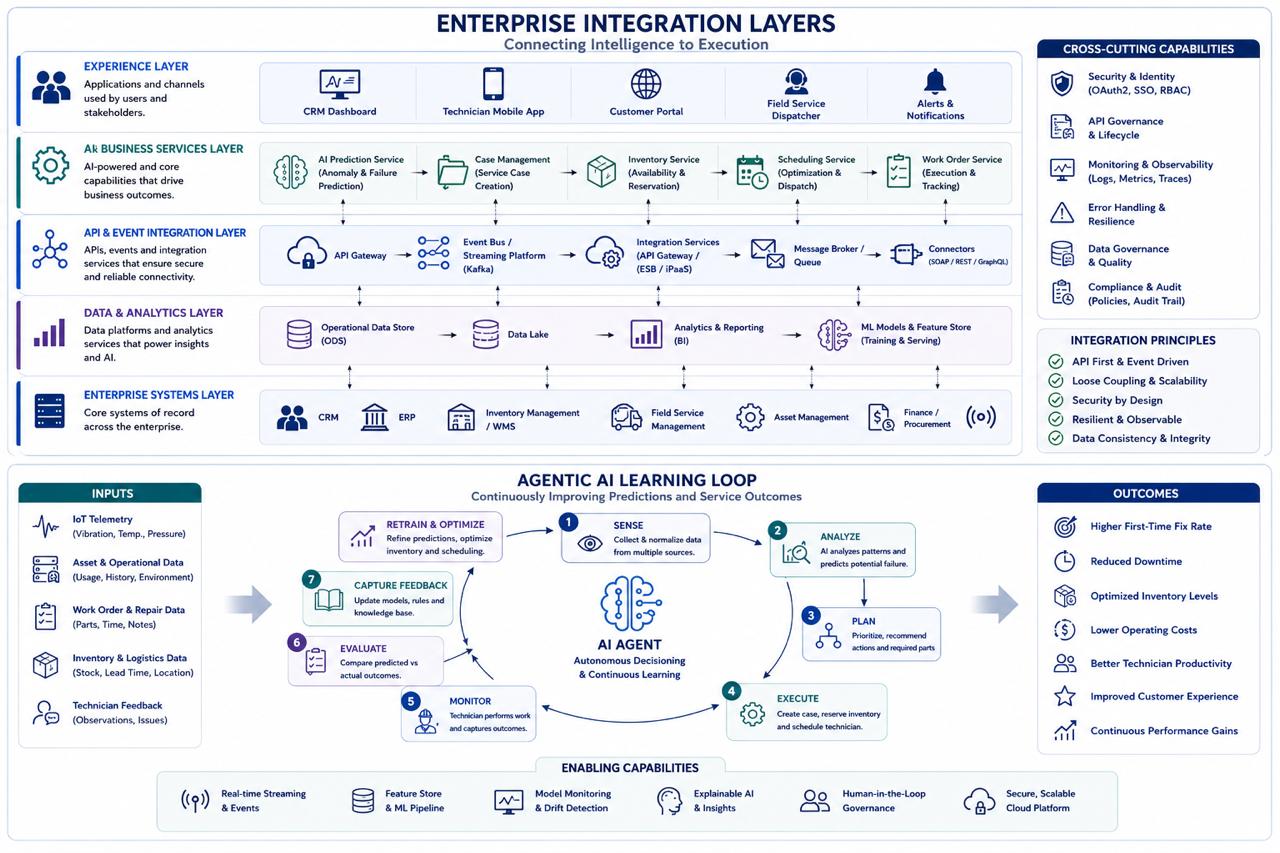

Figure 3: Enterprise integration architecture and agentic AI learning loop enabling continuous optimization across predictive maintenance, inventory management, and field service operations.
Turning Predictive Insights into Action
As AI-enabled CRM systems become more sophisticated, the real differentiator is no longer the ability to predict service needs but the ability to act on those insights. Predictive intelligence delivers value only when supported by inventory availability, service readiness, and logistics agility.
Organizations that strengthen operational coordination are those connecting customer insights with operational capabilities across the entire service ecosystem. In this environment, operational performance will not be determined solely by smarter algorithms, but by ensuring the right part reaches the right technician at the right time.
AI predictions produce measurable operational benefits only when Inventory availability, logistics, and technician scheduling are integrated with CRM workflows.
Opinions expressed by DZone contributors are their own.
Comments