

Database Deadlocks: Reasons and Resolution
Learn about database deadlocks, how they occur, and how to avoid them.

Join the DZone community and get the full member experience.
Join For FreeUnderstanding Deadlocks in Databases
In the context of databases, deadlocks are situations where two or more transactions are unable to proceed because each is waiting for the other to release a resource. This can be likened to a circular chain of transactions, where each transaction is waiting for the next in the chain to release a resource.
Here’s a visual representation of a deadlock scenario:
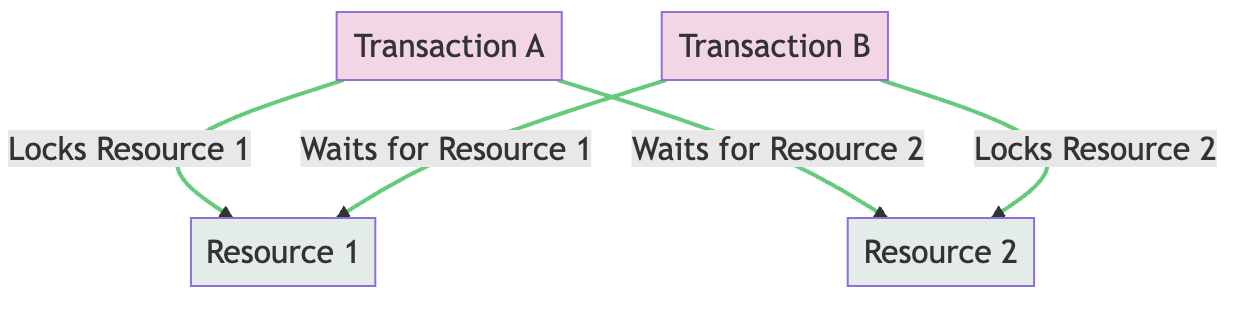
In this diagram, Transaction A has locked Resource 1 and is waiting for Resource 2, which is locked by Transaction B. Similarly, Transaction B has locked Resource 2 and is waiting for Resource 1, which is locked by Transaction A. This circular wait creates a deadlock.
SQL Example of a Potential Deadlock
Here’s a simplified SQL example that could potentially lead to a deadlock:
-- Transaction A
BEGIN;
UPDATE Orders SET Quantity = Quantity - 1 WHERE OrderID = 1;
-- Now Transaction A needs to update Customers
UPDATE Customers SET TotalOrders = TotalOrders + 1 WHERE CustomerID = 1;
COMMIT;

-- Transaction B
BEGIN;
UPDATE Customers SET TotalOrders = TotalOrders - 1 WHERE CustomerID = 1;
-- Now Transaction B needs to update Orders
UPDATE Orders SET Quantity = Quantity + 1 WHERE OrderID = 1;
COMMIT;
In this example, if Transaction A and Transaction B are executed concurrently and the timing is such that Transaction A locks the Orders table and Transaction B locks the Customers table before either has a chance to commit, a deadlock will occur.
Strategies to Prevent and Resolve Deadlocks
Deadlock Avoidance
This involves careful resource scheduling, where the database system checks ahead of time to detect potential deadlock situations and prevent them from happening. However, this requires knowledge of future process requests, which is generally not possible.
Deadlock Prevention
This strategy involves designing a system in such a way that the conditions for a deadlock cannot hold. This can be achieved by preventing at least one of the four Coffman conditions for deadlock, which are: mutual exclusion, hold and wait, no preemption, and circular wait.
Coffman Conditions for Deadlocks
The Coffman conditions, named after Edward G. Coffman, Jr., who first articulated them, are a set of four conditions that must all hold true for a deadlock to occur:
- Mutual Exclusion: Only one process uses a resource at a time.
- Hold and Wait: A process holds one or more resources and waits to acquire additional resources that other processes currently hold.
- No Preemption: The process holding a resource is the only one that can release it voluntarily.
- Circular Wait: Each process in a set of processes waits for a resource that another process in the set holds.
Preventing any one of these conditions from holding can prevent deadlocks. For example, to prevent Hold and Wait, you could require processes to request all the resources they will need before starting up (or before embarking on a particular set of operations). This is often impractical as a process won't know all the resources it will need in advance.
Deadlock Detection and Recovery
In this strategy, the system periodically tests the database for deadlocks. If the system detects a deadlock, it must recover from the deadlock, typically by aborting one of the transactions and rolling back its changes. Most modern DBMS like MySQL and PostgreSQL have automatic deadlock detection mechanisms built-in. They use a cycle detection algorithm that checks for the existence of wait-for cycles (deadlocks) within the lock manager's data structures.
However, the most effective way to handle deadlocks is through good application design and transaction management. This includes keeping transactions as short as possible, accessing objects in a consistent order across different transactions, and using lower isolation levels when possible.
Configurations for Deadlock Management
In PostgreSQL, there's a configuration parameter called deadlock_timeout that sets the time to wait on a lock before checking for a deadlock. If the system detects a deadlock, it rolls back one of the transactions and returns an error.
In MySQL, the system automatically detects deadlocks in InnoDB (the default storage engine) and resolves them by rolling back a transaction. The details of the deadlock can be found in the error log if the innodb_print_all_deadlocks configuration is set to ON.
Published at DZone with permission of Faheem Sohail. See the original article here.
Opinions expressed by DZone contributors are their own.
Comments