

Versioning Lies: A Date Contract Is a Promise That Never Breaks
Modify URI-based API versioning to use date-based versions, easing operations, ensuring immutability, and also separating core logic from API responses.
 ·
·
Join the DZone community and get the full member experience.
Join For FreeURI versioning, such as /v1/foo, is one of the most used methods for versioning APIs. Clients can easily comprehend it, but as your API develops, it may become challenging to manage. However, a date versioned header-based API versioning can be a little more opaque for clients, but when done properly, it provides flexibility and maintainability.
Let’s get a gist of both approaches.
Uri-Based Versioning
With URI versioning, the version of your API is included in the URL. Whenever a breaking change is introduced, developers create the next version and clients update their requests accordingly:
GET http://www.endpoint.com/v1/user

GET http://www.endpoint.com/v2/userAdvantages:
- Simple to comprehend for consumers and developers
- Easy to keep track of and log
- CDNs and caching operate simply.
Disadvantages:
- Pollution of URLs with numerous versions
- As versions increase, it becomes more difficult to maintain
- Tight coupling between the client and the server
Header-Based Versioning
Header-based versioning keeps the URL the same and passes the version in request headers:
GET http://www.endpoint.com/user
Accept: application/vnd.endpoint.v1+gson
Or via a custom header:
GET http://www.endpoint.com/user
API-version: v1Advantages:
- Cleaner endpoints and no URL modifications
- Versatile versioning system (semantic versioning, dates, etc.)
- Long-term upkeep is easier
- Reduced pollution from URLs
Disadvantages:
- More difficult to track version number in logs
- A little less user-friendly for new users
The Core Proposed Concept
One of the top payment platforms uses dates as version IDs in header-based versioning. This is how it operates:
- Clients use the version indicated in the header to call the endpoint.
- Developers are always working on the most recent version of the API on the server side.
- The hard lifting is done by transformers, which translate data from the most recent API format to the version that the client requests sequentially from the current version to the previous, and so on.
Example request:
GET http://www.endpoint.com/v1/payment
Header: API-version: 2020-01-01
The server always works with the latest API version (say, 2025-12-01). The response object generated internally looks like this:
{
  "id": 123,
  "name": "John Doe",
  "email": "[email protected]",
  "payment": {
   	"id": "987someId",
    "amount": 900,
    "currency": "USD",
    "time": 1766959292
  }
}
But since the client requested the 2020-01-01 version, the server transforms the response using a transformer matching the requested version:
{
  "id": 123,
  "name": "John Doe",
  "paymentId": "987someId",
  "amount": "USD 900",
  "time": "2025-12-28T22:01:32Z"
}
Notice that:
- Only the primary payment processing functionality is touched by developers.
- From 2025-12-01 → 2024-01-01 → 2020-01-01, the hard work of changing the response is done in a progressive manner by the transformer.
This ensures backward compatibility without cluttering the main codebase.
Getting the Best of Both Worlds: Hybrid Versioning
The proposed system uses a date-based URI:
GET http://www.endpoint.com/2020-01-01/fooThis approach:
- Keeps URL visibility for easier logging, caching, and monitoring.
- Allows date-based versioning, similar to header-based approaches, enabling backward compatibility without cluttering the main codebase.
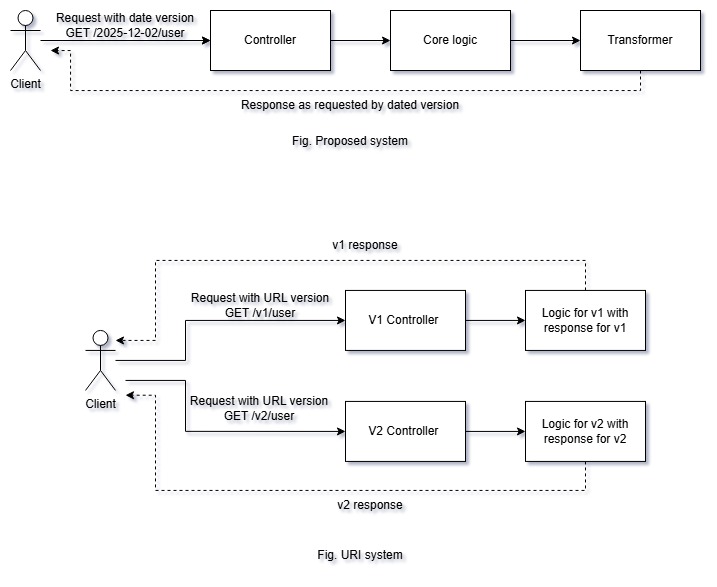
Example: Spring Boot Controller
Here’s how you could handle this in Java Spring Boot:
@RestController

public class FooController {

    private final FooService fooService;

    @PostMapping("/{versionDate}/foo")

    public String getFoo(@PathVariable String versionDate, @RequestBody FooRequest request) {

        return fooService.processFoo(versionDate, request);

    }
}
Service Layer
@Service
public class FooService {
    private final TransformerService transformerService;

    public String processFoo(String versionDate, FooRequest request) {
        // Main processing logic
        CurrentResponseObject response = callSomeDatabase(request);
        // Transform response to requested version
        return transformerService.transform(versionDate, response);
    }
}
Transformer Service
@Service
public class TransformerService {
    public String transform(String versionDate, CurrentResponseObject data) {
        // Transform from current version to requested version
        // e.g., 2025-12-01 -> 2024-06-01 -> 2020-01-01
        return transformed_data;
    }
}
Note:
- The controller stays simple, just passing the version and request to the service.
- The service only focuses on main business logic.
- Transformers handle backward compatibility, allowing support for old versions without modifying core logic.
Recommended Practices and Benefits of Hybrid Versioning
When implementing this hybrid versioning approach, a few key rules are essential:
- Transformers should be backward compatible
- Use a default version implicitly
Here’s why this technique is so effective:
The hybrid date-based URL versioning offers operational clarity and predictable API contracts.
1. Improves Developer Experience
The existing processing logic is all that developers need to concentrate on. In order to minimize errors and reduce cognitive stress, the transformer takes care of the labor-intensive task of modifying replies for previous versions.
2. Meaningful Version Number
Clients can quickly determine which version they are calling due to a date in the URL. This helps developers in debugging as well because they may predict the answer type simply by looking at the request. In contrast to /v1 or /v2, a date conveys:
- How dangerous it might be
- When it was first introduced
3. Immutable Endpoints
With transformers, the response for a given version never changes. This avoids mistakes like altering /v1 responses, which could break clients if endpoints were mutable.
4. Better Visibility
Logs and monitoring are instantly visible in URL-based versions. CDNs can function more effectively, caching performs consistently, and debugging becomes simpler. Compared to versioning that is only header-based, this is a significant advantage.
5. Backward Compatibility
All versions continue to be backward compatible as long as the transformer service is properly built. As the server develops, this enables clients to securely keep utilizing older versions.
6. Compatible With Proxies and API Gateways
When it comes to proxies and API gateways, path-based versioning is more dependable than header-based methods. This makes routing easier and safer while lowering the possibility of misconfigurations.
Criticisms and Tradeoffs
1. Version Explosion
Date-based versioning results in several versions — one for each date and transformer. Strong governance is necessary:
- Keep your versioning policy obvious.
- Prevent the unchecked spread of versions.
2. Less Expressive Than v1.0.1
Date-based versions might feel less descriptive than v1.0.1 or v2.3.0. But every change is breaking, a date signals an immutable contract.
3. Having Too Many URL Breaks Clients
Yes, clients need to update URLs, rebuild SDKs, etc. On the other hand, a silent change is harder to detect, rollback, and break clients. There will be explicit migrations necessary to upgrade to the versions.
4. Confusion for Clients on Different Versions to Use
It will be a documentation problem and not a design problem. Clear documentation would always make it easier to use such versions.
5. Increased Test Cases
Date-based versioning increases the number of handlers and test cases:
- More versions mean more coverage is needed.
- Testing becomes more honest and aligns with actual code.
6. Why Not Just Use Header Versioning?
Date-based URLs are less elegant in some ways, but they provide operational clarity, traceability, and immutability. Header versioning comes with tradeoffs:
- Header versions can be invisible in logs.
- Debugging manually is harder.
- Caching may fail or behave inconsistently.
7. Is This Just /v1 Repackaged?
/v1 means new change, breaking changes may sneak in, and v0 degraded eventually. On the other hand, /2025-01-01 means immutable behavior and predictable migrations.
Conclusion
Trading URL stability for operational clarity is a deliberate design choice. This approach needs to be strictly evaluated for the use case and the team; it is not for everyone. While date-based versioning introduces more versions, explicit migrations, and increased testing, it prevents silent breakages, improves predictability, and gives clients confidence. Clear documentation and governance make this approach practical and reliable for long-term API maintenance.
Opinions expressed by DZone contributors are their own.
Comments