

Demystifying Service-Oriented Architecture
This guide for building agile and scalable software systems explains SOA in plain English for beginners and offers valuable insights for seasoned professionals.
Join the DZone community and get the full member experience.
Join For FreeIn the ever-changing world of software, one term that keeps popping up is Service-Oriented Architecture (SOA). It might sound complex, but fear not! This article aims to be your friendly guide, explaining SOA in plain English for beginners and offering valuable insights for seasoned professionals.
Understanding Service-Oriented Architecture
At its core, SOA is a method of designing and building software by breaking it into smaller, independent parts. We call these parts "services." Each service does a specific job and talks to others through a well-defined language.
Think of it like Lego blocks. Imagine building a massive structure with Lego blocks. Each Lego piece is like a service — small, specific, and able to connect with other Legos. You can rearrange or add new Legos without the whole structure falling apart. That's the beauty of SOA.
Key Components of SOA
1. Services
Think of services as mini-programs, each handling a specific task like sending an email or processing payments. For example, in an e-commerce system, you might have a service for handling user accounts and another for managing product information.
2. Interfaces
Interfaces are like the language services use to talk to each other. They can be simple, like saying "hello" and "goodbye" (REST), or more formal, like writing a letter (SOAP). Imagine a service that fetches weather data. Other services can talk to it by asking, "What's the weather like today?" and getting a clear response.
3. Loose Coupling
Loose coupling means the Legos (services) are connected, but not glued together. If you want to replace a red Lego with a blue one, it won't mess up the whole structure. So, if you decide to upgrade the payment service in your e-commerce system, it won't disrupt the rest of the website.
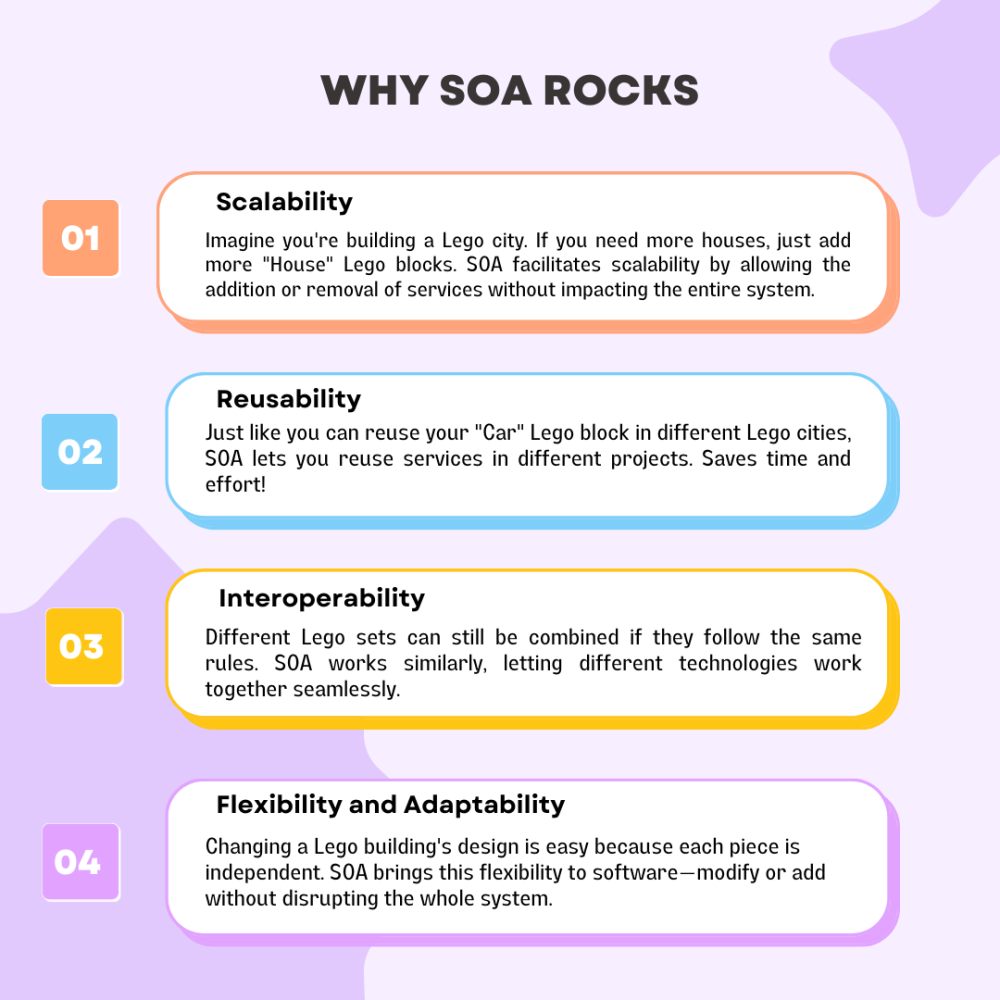
How To Use SOA: Practical Tips
- Service design: Design services to do specific jobs, like a "User Authentication Service." Make them like Lego blocks — simple and focused.
- Standard interfaces: Imagine every Lego block having the same connection points. That's what standard interfaces in SOA are about — everyone speaks the same language.
- Service discovery: Imagine having a catalog telling you where each Lego block is. A service registry in SOA helps components find and talk to each other.
- Security first: Like locking away your favorite Lego pieces, SOA needs security. Protect information by adding security measures like passwords and encryption.
- Keep an eye on performance: Just as you'd check if your Lego city is stable, monitor your services. Use tools to track their performance and health.
- Versioning: Think of different Lego versions. In SOA, plan for changes without breaking things. It's like upgrading your Lego city without wrecking the existing structures.
SOA in the .NET Ecosystem
The .NET framework provides a robust foundation for building and implementing SOA-based architectures. Here are some key aspects to consider:
- WCF (Windows Communication Foundation): WCF is a powerful framework in the .NET ecosystem for building distributed services. It supports a variety of communication protocols and provides a flexible programming model for designing service contracts.
- ASP.NET Web API: ASP.NET Web API is well-suited for building RESTful services, a popular choice for implementing services in SOA. It simplifies the creation of HTTP services and supports content negotiation for seamless communication.
- Azure Service Fabric: For those venturing into microservices architecture within SOA, Azure Service Fabric provides a platform for building, deploying, and managing microservices at scale. It integrates seamlessly with the .NET stack.
Challenges and Things To Keep In Mind
While SOA is a superhero, even superheroes have challenges. Sometimes it can get complex, and you need to manage it carefully. Think of it like driving a car — easy when you know how, but you need to watch out for traffic and road signs.
Conclusion
Service-Oriented Architecture isn't just a term for tech experts. It's like having a superpower that lets you build flexible, scalable, and adaptable software. As technology keeps zooming forward, SOA remains a trusty guide for creating robust digital experiences. So, whether you're a coding newbie or a seasoned pro, hop on the SOA train and explore the exciting possibilities in the world of software.
Published at DZone with permission of ABUFAIZUR RAHMAN R ALI. See the original article here.
Opinions expressed by DZone contributors are their own.
Comments