

Deployable Architecture: The Cornerstone of Scalable Platform Engineering
Deployable architecture turns platform strategy into scalable execution — standardizing delivery with speed, security, and control.
 CORE
·
CORE
·
CORE
·
CORE
·
Join the DZone community and get the full member experience.
Join For FreeAs architects, you’ve likely seen the same story unfold across growing organizations: teams move fast, each solving problems in their own way — building pipelines, wiring infrastructure, and embedding security into their services from scratch. Initially, it works. But as the organization scales, the cracks begin to show.
Environments drift. Deployments become brittle. Governance becomes reactive. And suddenly, the well-intentioned architecture you’ve crafted becomes challenging to replicate, secure, or evolve consistently across teams.
This is where platform engineering earns its place — not as a buzzword, but as a strategic discipline that delivers consistency, control, and speed in software delivery. And at the heart of every successful platform initiative lies a foundational element: deployable architecture.
Deployable architecture is more than prewritten code or templates — it’s a systematic approach to designing, packaging, and delivering infrastructure and services in a way that is scalable, repeatable, and secure. It allows architects to encode best practices into blueprints that teams can consume confidently — knowing they’re inheriting compliance, observability, performance, and guardrails by design.
In this blog, we’ll explore how deployable architecture acts as the cornerstone of scalable platform engineering — empowering architects to go beyond designing systems to enabling organizations to deploy them at scale, with consistency and control.
What Is Deployable Architecture?
Deployable Architecture can be understood as a set of pre-designed, reusable blueprints for both infrastructure and application deployment. Unlike ad-hoc scripts or one-off configurations, deployable architecture packages battle-tested best practices into production-ready templates.
These blueprints are not just about convenience — they provide consistency, reliability, and scalability across teams and environments. By embedding security, compliance, monitoring, and resilience standards, they ensure every deployment inherits the same quality and safeguards, no matter who executes it or where it runs.
Key attributes include:
- Reusability: Standard designs that work across multiple teams and environments.
- Consistency: Every deployment follows the same high-quality, compliant structure.
- Automation: Rapid provisioning using Infrastructure as Code (IaC).
- Governance: Security, compliance, and policy enforcement built in by design.
By offering these advantages, deployable architecture transforms platform engineering from a reactive activity into a proactive, scalable discipline.
Why It’s the Cornerstone of Scalability
Scalability in platform engineering isn’t just about handling more users or bigger workloads—it’s about scaling practices, knowledge, and operations. Deployable Architecture makes this possible:
- Standardization across teams – Without reusable blueprints, each team reinvents infrastructure and workflows. Deployable Architecture ensures uniformity, reducing fragmentation and operational overhead.
- Reduced cognitive load – Developers and operators don’t need to worry about setting up security groups, monitoring dashboards, or network policies every time. These elements are already baked into the architecture.
- Faster time to value – Deployments that once took weeks can be completed in hours, accelerating innovation cycles.
- Compliance at scale – By embedding organizational policies into reusable templates, every environment deployed is compliant by default — reducing risks and audit headaches.
The Link to Platform Engineering
Platform engineering thrives on self-service, automation, and consistency. Deployable Architecture is what enables these principles:
- For developers, it provides the guardrails and golden paths to build applications without second-guessing infrastructure.
- For operations teams, it ensures predictable, compliant deployments.
- For the business, it ensures faster delivery while maintaining governance and reliability.
Without a deployable architecture, platform engineering risks devolving into siloed practices, with each team solving the same problems repeatedly.
Benefits for the Organization
Deployable architecture converts institutional best practices into repeatable, auditable, and self-service capabilities — improving speed, safety, and cost simultaneously, with clear KPIs to prove it.
- Strategic and Speed (Faster time-to-market): Reusable blueprints cut provisioning and setup from weeks to hours.
- Measure: DORA Lead Time for Change, Deployment Frequency, Time-to-First-Deploy.
- Reliability and risk (Higher service reliability): Opinionated defaults and tested patterns reduce misconfigurations and change failures.
- Measure: Change Failure Rate, Incident Rate, MTTR.
- Security and compliance (Compliance by default): Policy-as-code, immutable baselines, and standardized secrets/KMS make every environment audit-ready.
- Measure: Policy pass rate, audit findings closed, vulnerability remediation SLA, % signed artifacts/SBOM coverage.
- Cost and FinOps (Lower TCO via standardization): Reuse > rebuild; enforced tagging, right-sizing, and auto-shutdown reduce waste.
- Measure: % tagged spend, idle/over-provisioned resources, and unit cost per deploy/service.
- Governance and Control (Consistent guardrails at scale): Versioned blueprints provide traceability, change history, and easy rollbacks.
- Measure: Drift incidents, variance across environments, and rollback mean time.
- Scalability and reuse (Scale practices, not just workloads): One blueprint serves many teams, regions, and clouds with minimal variation.
- Measure: Blueprint adoption rate, forks vs. deviations, number of teams onboarded.
Comparison of Deployable Architecture Terminologies Across Cloud Providers
| Cloud Provider | Terminology used | focus area |
|---|---|---|
|
IBM Cloud |
Deployable Architectures, Secure Landing Zones |
Compliance-first, automation, industry workloads |
|
AWS |
Solutions Library, Reference Architectures, Landing Zones |
Enterprise multi-account setup, automation, and governance. |
|
Microsoft Azure |
Azure Verified Modules, CAF (Cloud Adoption Framework) Landing Zones, Deployment Stacks |
Standardized deployments, policy enforcement, scalability |
|
Google Cloud (GCP) |
Enterprise foundations blueprint, Solutions, Landing Zones |
IaC-driven deployments, secure foundations, compliance |
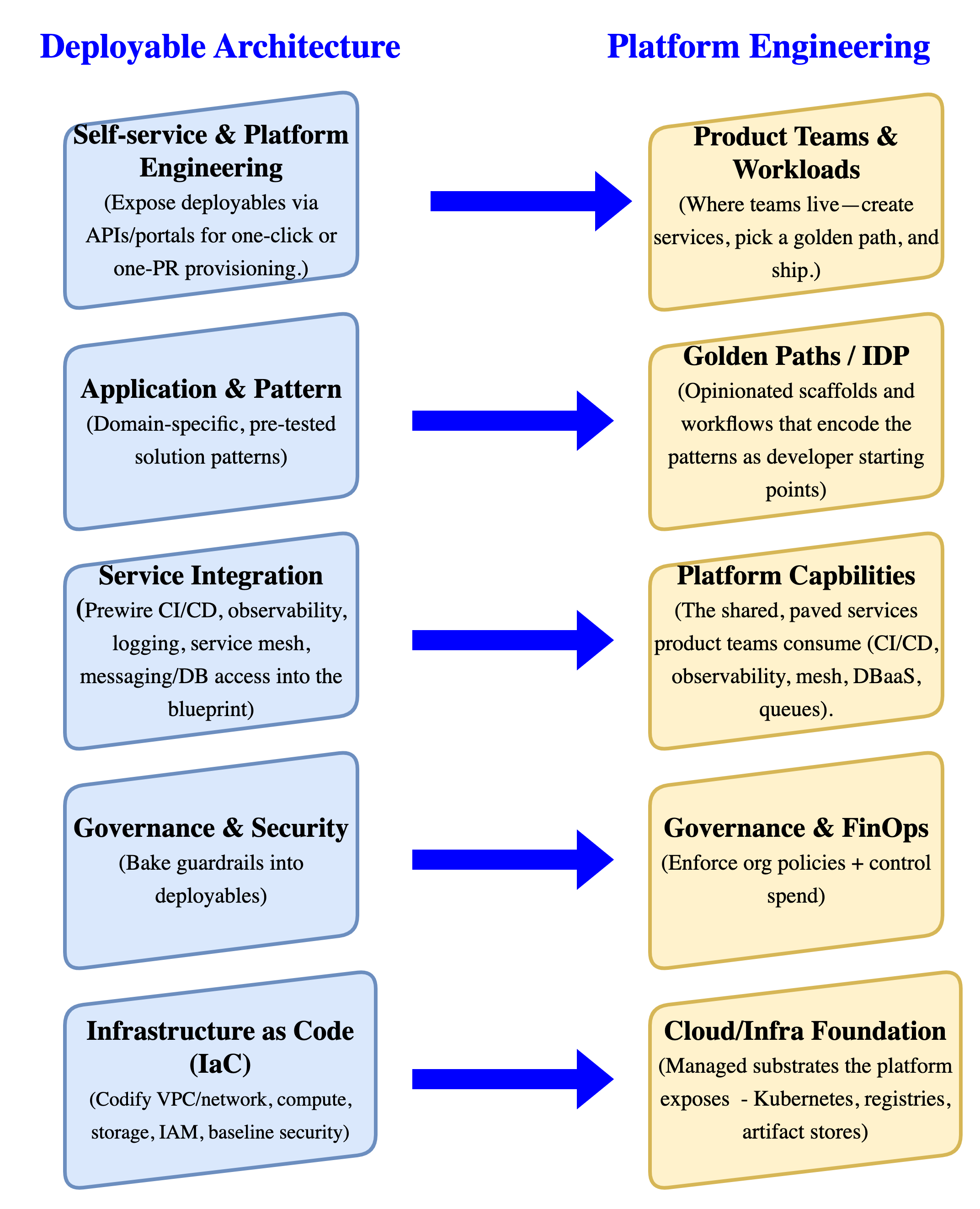
From Blueprints to Capabilities
The diagram below outlines the correspondence between layers, from IaC foundations and governance to service integration and golden paths to self-service.
Boosting Developer Velocity Through Deployable Architecture
Developer velocity increases when cognitive load, hand-offs, and “reinventing the wheel” are eliminated. Deployable architecture makes this possible by transforming infrastructure, security, and runtime conventions into reusable, production-ready blueprints. With these blueprints, teams can spin up environments in minutes — freeing them to focus on building features instead of rebuilding foundations.
How It Accelerates Teams
- One-click environments: Pre-tested IaC modules (networking, IAM, secrets, observability) spin up a compliant stack on demand—no ticket queues.
- Golden path templates: Opinionated repos/starters wire in CI/CD, test scaffolds, Helm/Kustomize, GitOps rules, SLIs/SLOs, and alerts from day one.
- Policy-as-code by default: Security and compliance are embedded (OPA/Azure Policy/IBM SCC), eliminating late-stage rework.
- Batteries-included observability: Dashboards, tracing, logs, and SLO burn-rates ship with the template — issues surface early.
- Standard contracts: Platform APIs for data, messaging, identity, and storage reduce glue code and integration drift.
Enablement Patterns
- Developer portal integration: Surface blueprints as catalog items with guardrails, docs, and “provision” buttons (Backstage/Port/IBM Cloud Projects).
- Versioned baselines: Semantic-version your deployables; publish release notes and migration guides.
- Default ≠ locked-in: Provide safe “escape hatches” with reviewable, policy-checked deviations.
Design Principles and Anti-Patterns
Building a robust and scalable deployable architecture isn’t just about tools and templates — it’s about following sound engineering principles while actively avoiding design pitfalls. This section outlines the core design principles that underpin effective deployable architectures, along with the anti-patterns that often sabotage them.
Key Design Principles
- Declarative over imperative – Declarative definitions (e.g., Terraform, Helm) describe what the desired state is, not how to achieve it.
- Composability and modularity – Modular architecture allows reusable components (infra modules, service templates, and CI/CD steps) to be composed for different use cases.
- Secure-by-default – Security should not be optional or bolted on after deployment.
- Environment parity – Environments (dev, staging, and prod) should be as similar as possible to reduce "it worked on my machine" issues.
- Git as the source of truth – Git provides version control, auditability, and rollback capability.
- Observability built in – Logs, metrics, and traces are critical for debugging and performance.
Common Anti-Patterns to Avoid
- Hardcoding configuration – Use parameterized templates, secret managers, and external config maps.
- Over-engineering or over-abstraction – Keep it simple. Favor transparency and ease of use over abstract perfection.
- Mixing runtime logic with deployment logic – Keep deployment logic declarative and parameterized. Separate concerns.
- Lack of version control for blueprints – Treat blueprints and architecture templates as code with semantic versioning and Git governance.
- No feedback loop from consumers – Maintain active feedback channels. Iterate on blueprints based on usage data and team input.
Conclusion
Deployable architecture is no longer a “nice to have” — it is the essential foundation that enables modern platform engineering to deliver at scale, with speed, security, and consistency. From codified blueprints and reusable modules to secure-by-default environments and developer self-service, deployable architectures act as the connective tissue between infrastructure, application, and platform teams.
As organizations move toward building platforms as products, deployable architecture becomes the product’s backbone — one that enables innovation at speed without compromising reliability or control.
In platform engineering, the true measure of success isn’t just uptime — it’s how quickly and safely your teams can deliver value. Deployable architecture makes that possible.
Opinions expressed by DZone contributors are their own.
Comments