

Detecting and Reducing Fake Contact Data
Apple ecosystem signals like iMessage, FaceTime, and WhatsApp help cut fake leads and appointments, boosting efficiency and conversion rates.
Join the DZone community and get the full member experience.
Join For FreeWhy Lead Data Quality Fails So Often
In a perfect tech world, every phone number or email that flows into your product would belong to a real, reachable person. In practice, sales and marketing teams know the story is very different.
Recently, two of our clients — unrelated and in different industries — came to us with a strikingly similar issue: their lead pipelines were full of contacts that looked valid but went nowhere.
At first glance, their intake process seemed solid. They gathered information from Facebook and Google Ads forms and from their own landing pages. Basic checks were in place: regex email validation, MX/SPF lookups to confirm a domain could accept mail, and carrier-prefix checks for phone numbers. All these filters caught typos and obviously fake addresses, but the downstream CRM was still drowning in “dead” leads.
When we audited their data, the problem became clear. Between 10 and 40 percent of contacts were either unreachable or inactive within a year of collection, an annual decay rate of roughly 30 percent. Salesforce estimates that poor data quality can drain up to 30 percent of revenue. Validity.com’s 2022 report pegs the annual cost of bad data at $9.7 million to $15 million for mid- to large-size organizations.
The manual fix — periodically calling or emailing every contact — is brutally expensive. One client estimated it took 15–20 staff hours every week to verify a single batch of 1,000 leads, often for a negligible payoff.
Why Traditional Validation Doesn’t Go Far Enough
Conventional verification pipelines focus on syntax, not signal. They ask questions such as:
- Does the email conform to a valid pattern?
- Does the domain have an MX record?
- Is the phone number formatted and prefixed correctly?
Some tech companies go further by sending one-time passwords (OTPs) via email or SMS. Unfortunately, none of these steps ensures that the contact is either genuine or active:
- Disposable email services accept incoming messages and can forward or display OTPs. A user can create a temporary inbox, receive the code, and never check it again.
- Temporary phone number providers can receive SMS verifications instantly and are often free or very cheap.
- Apple’s iCloud+ service allows customers to generate an unlimited number of “Hide My Email” aliases that forward to a real account the user may never read.
As a result, traditional methods filter out obvious typos but do little to confirm the living, breathing person on the other side.
Asking a Better Question
The real question isn’t “Is this string correctly formatted?” but rather “Is this person active and reachable right now?”
To answer it, we explored whether Apple’s iMessage, FaceTime, and WhatsApp registrations could serve as a live validation signal.
Here’s the logic:
- Every iPhone automatically registers its active SIM phone number and associated Apple ID with iMessage and FaceTime.
- Deregistration happens only if the SIM is removed, the Apple ID is signed out, the user deliberately disables iMessage/FaceTime (something fewer than 1 percent of users do), or the device sits inactive for several days.
- If the phone number registered in WhatsApp, it also means that it still valid and verified. Because WhatsApp periodically checks the session in the app, and if it is invalid, the number will be deregistered.
If a phone number or email is confirmed as active within Apple’s messaging ecosystem, it is extremely likely that the contact is both legitimate and currently reachable. The same thing related to the phone number registered in WhatsApp.
Building a Solution for Lookup
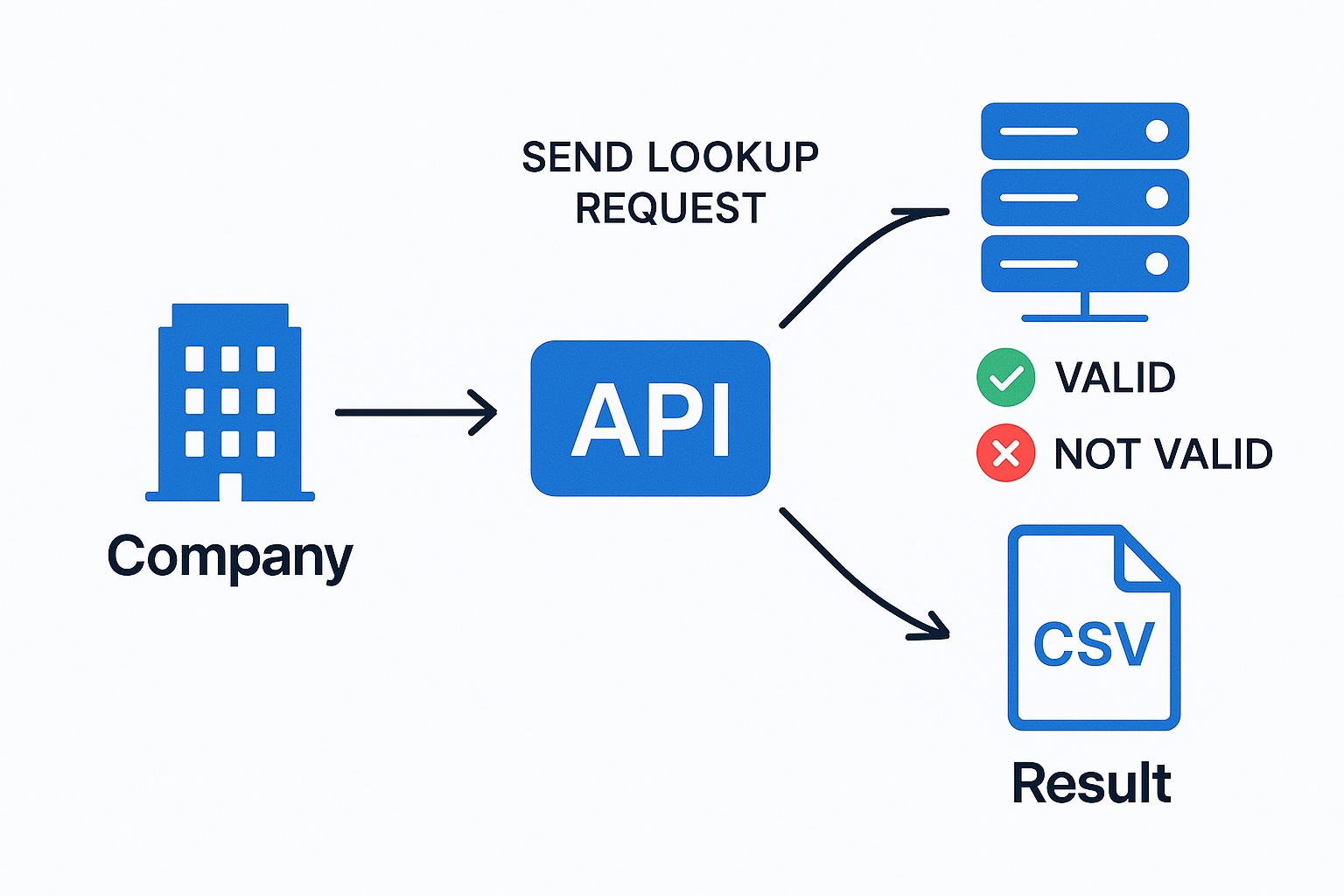
We transformed this idea into a production service called LoopLookup, spun out of our original Loop Message platform. The service is delivered as a microservice that integrates directly with a CRM or marketing automation tool through a simple API or CSV upload.
LoopLookup performs three core steps:
- Query Apple’s registration status for each phone number or email address.
- Flag contacts as active (registered) or inactive (unregistered) for iMessage and FaceTime.
- Return the results via downloadable CSV or a webhook callback for automated workflows.
Because the check runs server-side, it adds only milliseconds to the ingestion pipeline and requires no additional user interaction.
Deployment in Real Environments
Two early-adopter customers integrated lookup services into their existing lead-scoring workflows:
- Step 1 – Data intake: Leads continue to flow in from ads and web forms.
- Step 2 – Automated validation: Each new phone number or email is silently checked against iMessage/FaceTime registration. In some cases, they begin to use other services to check WhatsApp registration.
- Step 3 – Lead scoring: Contacts confirmed as WA or Apple-registered receive a high score, automatically moving them to priority queues for sales outreach.
The Apple/WhatsApp signal also reveals the best communication channel. A validated contact can be reached instantly via iMessage, WhatsApp, or FaceTime calls, bypassing carrier fees and international SMS restrictions.
Quantifiable Results
After several months, the impact was clear:
| metric | before (manual checks) | after (apple-based validation) |
|---|---|---|
|
Outdated contacts detected |
~5 % |
~22 % |
|
Weekly manual verification time |
15–20 hours |
<1 hour |
|
Lead response rate |
8–10 % |
22–28 %* |
|
International outreach |
Limited |
High (iMessage/FaceTime) |
*Actual rates vary by segment but consistently outperform the previous baseline.
For both clients, the shift meant not only fewer wasted calls but also a measurable uptick in successful conversations and closed deals.
A Recent Case Study: Stopping Fake Real Estate Appointments
Just last month, we worked with a company that develops software for real estate brokers who work with international customers. Their platform helps agents schedule property viewings with potential buyers and renters. But they faced a growing and costly problem: fake appointments for estate visits.
People were filling out booking forms with names that looked real, but at the same time, invalid or fake phone numbers, or disposable emails, to secure slots. Sometimes these were prank bookings, and other times, competitors were attempting to waste broker resources. Either way, the outcome was the same — agents driving across town to show a property, only to discover that not all people who scheduled a time slot showed up.
The company had already tried standard safeguards: email syntax checks, expensive SMS-based OTP confirmations, and occasional manual verification calls. Unfortunately, disposable phone numbers and temporary email services still slipped through. Staff wasted countless hours chasing unresponsive contacts, while genuine buyers missed out on available viewing times.
They integrated a phone number lookup service directly into their booking system. Every new appointment request was automatically checked for iMessage, FaceTime, or WhatsApp registration. If the phone number or email wasn’t active on at least one of these platforms, the system flagged a contact in the booking as suspicious.
Within weeks, the impact was dramatic:
- Fake property visits dropped by over 40%.
- Brokers no longer had to manually confirm every suspicious booking.
- Agents regained valuable time and focused on serious buyers, increasing close rates.
This case shows how messaging ecosystem presence checks can extend beyond marketing and sales. Industries like real estate, automotive dealerships, and service providers that rely on scheduled appointments can benefit from filtering out ghost bookings before they waste time and resources.
Related Researches
While studying the last customer use case, we noticed some academic investigations, like:
- Data Validation Techniques for Ensuring Data Quality (Eben Charles, 2024) – categorized and evaluated core validation strategies (range checks, uniqueness, consistency, code validation), arguing that layered, multi-level validation and continuous monitoring are vital as datasets scale.
- Detecting Quality Problems in Research Data: A Model-Driven Approach (Kesper, Wenz & Taentzer, 2020) – proposed a model-driven approach to detect quality defects in research data by identifying anti-patterns and abstracting across database technologies, enabling domain experts to plug in validation patterns.
These works underscore that while many theoretical and algorithmic approaches exist for validating and maintaining data quality, few have adopted real-time presence signals — such as messaging registration indicators — as active gating criteria in operational contact pipelines.
Strategic Advantages
Using WhatsApp and Apple ecosystem signals for validation offers several key benefits:
- Higher detection of fraudulent or disposable numbers than OTP or carrier checks.
- Early identification of unreachable emails (including iCloud+ aliases that forward but remain inactive).
- Significant reduction in manual labor, freeing sales and marketing teams for higher-value tasks.
- Improved lead-to-customer conversion rates by focusing effort on contacts who are provably active.
- Cost-effective international outreach, thanks to internet-based delivery through iMessage, WhatsApp, and FaceTime.
Given Apple’s estimated 55–60 percent market share in the U.S. and Canada — and executive adoption rates that exceed 80 percent in many B2B contexts — the impact of this method is particularly strong for enterprise lead generation. The same thing in WhatsApp, according to some public statistics, there are more than 3 billion monthly active users in 2025 around the world.
Practical Considerations and Ethics
This approach is designed for B2B lead qualification and should never be used to spam or harass consumers. The goal is to improve data quality and reduce wasted effort, not to intrude on personal privacy. LoopLookup merely checks whether an identifier is registered; it does not access message content or user activity.
Organizations implementing this strategy should also maintain traditional hygiene practices—deduplication, permission-based marketing, and compliance with regulations such as GDPR and CCPA—to preserve trust and avoid legal pitfalls.
Conclusion
Bad data is more than an inconvenience — it’s a revenue drain. Traditional validation methods stop at syntax, leaving sales teams chasing leads that were never real. By incorporating Apple ecosystem registration signals into the validation pipeline, companies can:
- Cut manual verification from hours to minutes
- Detect a far higher percentage of fake or dormant contacts
- Focus outreach on prospects who are demonstrably active and reachable
The result is a leaner, more responsive sales operation and a healthier bottom line. For any organization struggling with lead quality, WhatsApp and Apple-based validation is a proven way to keep your data—and your growth pipeline—alive and accurate.
Opinions expressed by DZone contributors are their own.
Comments