

The Anatomy of an AI Agent and How to Build One With Docker Cagent
AI Agents perceive, reason, plan, and act autonomously using LLMs. This article breaks down the core components that power every agent and shows you how to build one.
 CORE
·
CORE
·
Join the DZone community and get the full member experience.
Join For FreeArtificial intelligence (AI) agents are systems that understand their environment, reason, plan, and take actions using large language models (LLMs) with minimal human interaction. Today, we have agents that read your calendar, inbox, and event write and execute code. As part of this tutorial, we will explore the different constructs that make up an AI agent and learn how to build one using the Docker cagent.
Unlike traditional software, which executes predefined logic, an AI agent can autonomously drive toward a goal with minimal human interaction. And at a very high level, every AI agent consists of seven core components.
Components
- Perception and input handling
- Planning and task decomposition
- Memory
- Reasoning and decision-making
- Action and tool calling
- Communication
- Learning and adaptation
Let's talk about each of them.
To make this easier to understand, consider a scenario where a user wants to identify which months in 2026 are suitable for kayaking and potentially reserve a trip. This is the goal for an agentic AI system.
1. Perception and Input Handling
For the current example, we can consider the input as plain text. However, in the real world, input can be in various forms, such as images, videos, documents, etc. Therefore, the perception module must be capable not only of reading from multiple formats but also of cleaning and structuring the data.
2. Planning and Task Decomposition
The next step in the process is to plan and lay out the series of actions that need to be executed to achieve the goal. In the case of kayaking, examples of steps are:
- Get the current location.
- Determine on what days the weather is suitable for kayaking.
- Find the nearest kayak rentals.
- Reserve the rental for a particular day.
3. Memory
Using memory, agentic systems can reuse information between steps. There are mainly two types of memory. Short-term, responsible for keeping coherence and long-term memory, either from knowledge bases or vector embeddings, mainly for historical references.
A memory could store:
- User preferred travel radius
- Any past kayaking trips
- User's budget constraints
4. Reasoning and Decision-Making
The most critical step in the process. This is where the agent evaluates different options from the previous steps to make an informed decision. The evaluation is necessary to come up with an optimal sequence to achieve the goal.
Examples can be:
- Comparing the weather in different months and eliminating unsafe months.
- Deciding which days are best from an experience and a price standpoint.
5. Action and Tool Calling
This is what makes the agent interact with the real world. Without these tools, agent knowledge is limited to its static training data and text generation capabilities. You can think of it like a brain without a body.
In this scenario, actions may include, but are not limited to:
- Calling a weather API to fetch forecast data
- Querying location data to fetch the nearest kayak locations
- Interacting with the kayak rental properties for reservations
- Making a reservation on behalf of the user
6. Communication
This is how agents interact with the users throughout the process. It includes things like asking clarifying questions and presenting different options to the user.
Options can include:
- Asking if the user prefers open waters
- Presenting different months to the users and asking if they have a choice
- Checking the rental rates are ok for the user
7. Learning and Adaptation
There is always a scope of improvement, and the way to provide these improvements is through the feedback mechanism. Different feedback mechanisms like Reinforcement learning and human in the loop are used here.
While there are multiple frameworks to write agents, today we will talk about Docker cagent.
Docker Cagent
Docker cagent is an open-source framework for building AI agents. It allows you to define multiple specialized agents that can collaborate to solve a problem. With cagent, agent behavior and coordination are declared using a YAML configuration file (for example, cagent.yaml), which is then executed via the command line.
Step 1: Install the Docker cagent.
winget install Docker.Cagent

Successfully verified installer hash
Starting package install...
Path environment variable modified; restart your shell to use the new value.
Command line alias added: "cagent"
Successfully installed
Step 2: Create a cagent yaml config file.
# web_search_agent.yaml
agents:
  root:
    model: openai/gpt-4o-mini
    description: A helpful AI assistant with web search capabilities
    instruction: |
      You are a knowledgeable assistant that helps users with various tasks.
      Use web search to find up-to-date information when needed.
      Be helpful, accurate, and concise in your responses.
    toolsets:
      - type: mcp
        ref: docker:duckduckgo
Step 3: Run the YAML file, but before that, make sure you have the OPENAI_API_KEY environment variable set.
cagent run ./cagent.yaml[root]
Hello! I'm here and ready to assist you. How can I help you today?
┃
┃ Can you search the web for Docker cagent
┃
┃
┃ ✓ search
┃ query:
┃ Docker cagent
┃
┃ -> output (truncated):
┃ Found 10 search results:
┃
┃ 1. cagent | Docker Docs
┃ URL: https://docs.docker.com/ai/cagent/
┃ Summary: cagentlets you build, orchestrate, and share AI agents that work together as a team.
┃
┃ 2. Agent Builder and Runtime by Docker Engineering - GitHub
┃ URL: https://github.com/docker/cagent
┃ Summary: Dockercagent A powerful, easy-to-use, customizable multi-agent runtime that orchestrates AI agents with specialized capabilitie
┃ s and tools, and the interactions between agents.
┃ ...
┃
[root]
I found some information about Docker's cagent, which is a framework designed for creating and managing AI agents. Here are some key resources:
After running the command, you will see a GUI that lets you run a bunch of commands, something like the one below.
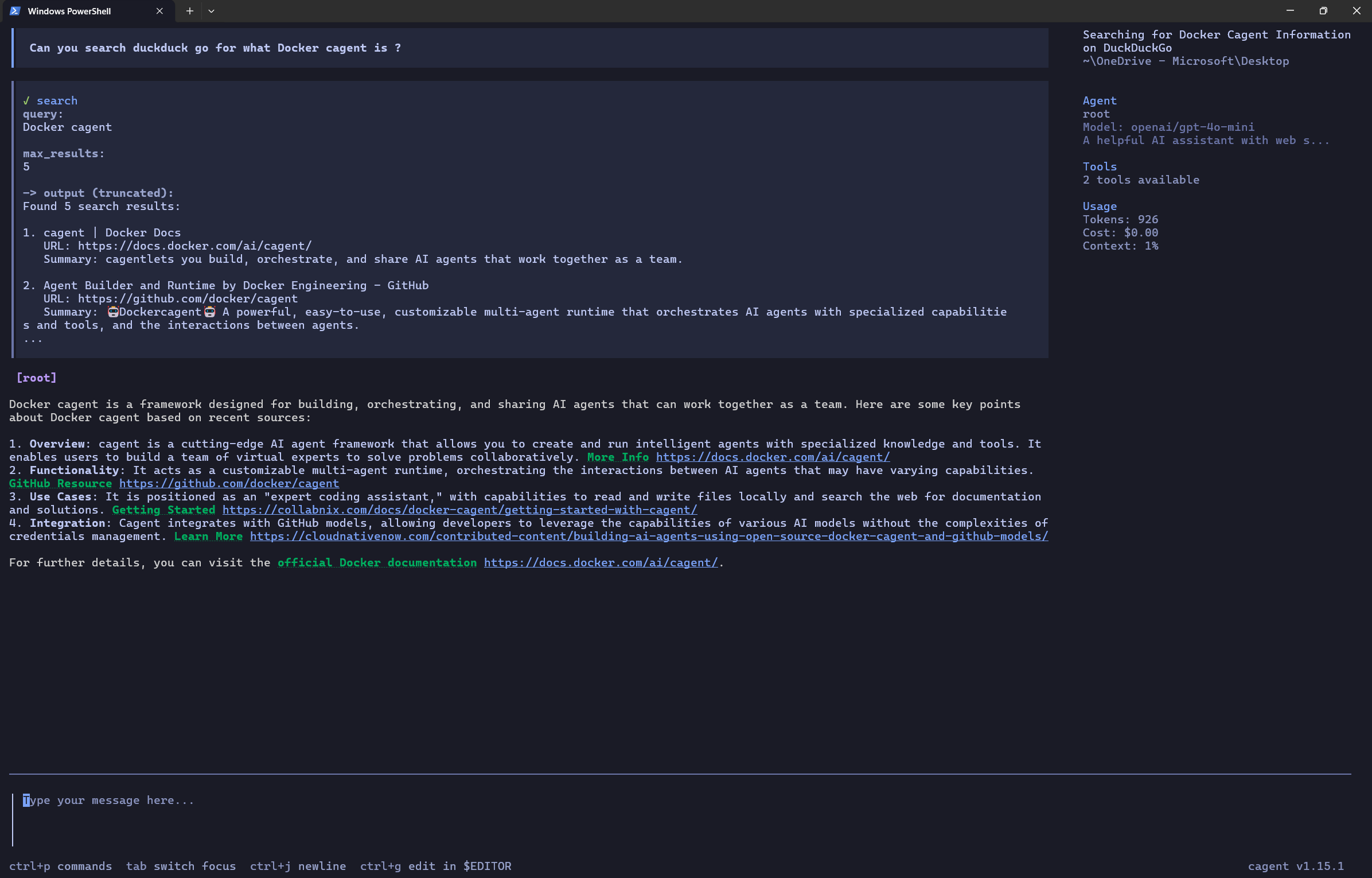
What we have discussed till now is configuring a simple agent using the Docker cagent. In the next article, we will discuss how we can build more complex agentic workflows, like having nested agents.
Conclusion
AI Agents are no longer a futuristic concept. They are reshaping how we interact with software as we speak. By combining the capabilities we discussed previously, the ability to take real-world actions with tool calling, agents are able to bridge the gap between human intent and automated execution.
Opinions expressed by DZone contributors are their own.
Comments