

Why Domain-Driven Design Is Still Essential in Modern Software Development
Software keeps growing in complexity while losing touch with business goals. Domain-driven design brings clarity, making systems scalable, meaningful, and built to last.
 CORE
·
CORE
·
Join the DZone community and get the full member experience.
Join For FreeThere’s no doubt that software has become the invisible infrastructure of our modern world. Over a decade ago, Forbes published a prophetic article titled “Now Every Company Is a Software Company.” At the time, that sounded bold — today, it feels like common sense. Whether in banking, healthcare, logistics, or agriculture, software has moved from the background to the core of business strategy.
This means that every company, regardless of industry, is now a software-driven organization. Success no longer depends only on market reach or physical infrastructure but also on how effectively a business translates its goals into code. In other words, the quality of your software often determines the quality of your company’s decisions, processes, and customer experience.
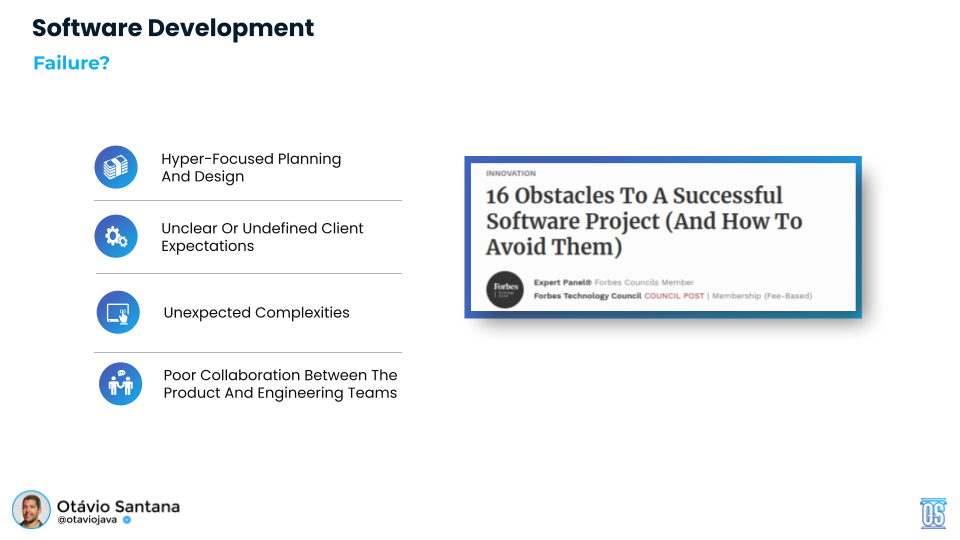
And yet, despite decades of innovation, we continue to struggle with the same issues that have haunted the software world for years. Agile, DevOps, microservices, and cloud-native paradigms have made us faster — but not necessarily better. As Forbes pointed out in its list of 16 obstacles to a successful software project and how to avoid them, the same mistakes keep repeating:
- Endless meetings that create noise instead of clarity.
- Delivering what the client said rather than what they meant.
- A growing web of complexity across systems and tools.
- There is weak collaboration between technical and business teams.
It’s like ordering a pizza that takes four hours to arrive because the kitchen had “alignment meetings,” only to end up with a Caesar salad for $500. You get something expensive, late, and irrelevant. That’s what happens when software development loses sight of its true purpose.
The Rising Tide of Complexity
The issue runs deeper than process or tooling. As InfoWorld warned years ago in its article “Complexity Is Killing Software Developers,” complexity has become the silent killer of creativity and productivity.
Modern teams operate under constant pressure to adopt new frameworks, languages, and architectural styles. Ironically, each promises simplicity — yet together, they make our systems more complicated to understand. We’ve built layers of abstraction so thick that developers now spend more time configuring than creating.
It’s the paradox of choice in action. Just like scrolling through six streaming platforms without deciding what to watch, developers often drown in decisions before writing a single line of meaningful code. We confuse motion for progress, complexity for sophistication, and tools for outcomes.
But if technology keeps changing faster than our ability to reason about it, how can we ensure that our software still serves the business? The answer lies not in the next framework or methodology — but in going back to the foundations. And that’s where domain-driven design (DDD) becomes not just relevant, but essential.
Returning to the Core: What DDD Really Means
Domain-driven design is where business understanding and software craftsmanship finally meet. It’s not a framework or a pattern; it’s a philosophy that teaches us how to align our systems with the real-world problems they’re meant to solve.
Unfortunately, DDD has been widely misunderstood. Let’s clear that up:
- DDD is not a language or framework.
- DDD is not Java, an @Entity annotation, or a repository suffix.
- DDD is not microservices.
These are tools or artifacts that may appear in a DDD system, but they are not the essence. The essence of DDD lies in building software that mirrors business logic. It’s about capturing the company’s knowledge — the domain — and making it explicit in code.
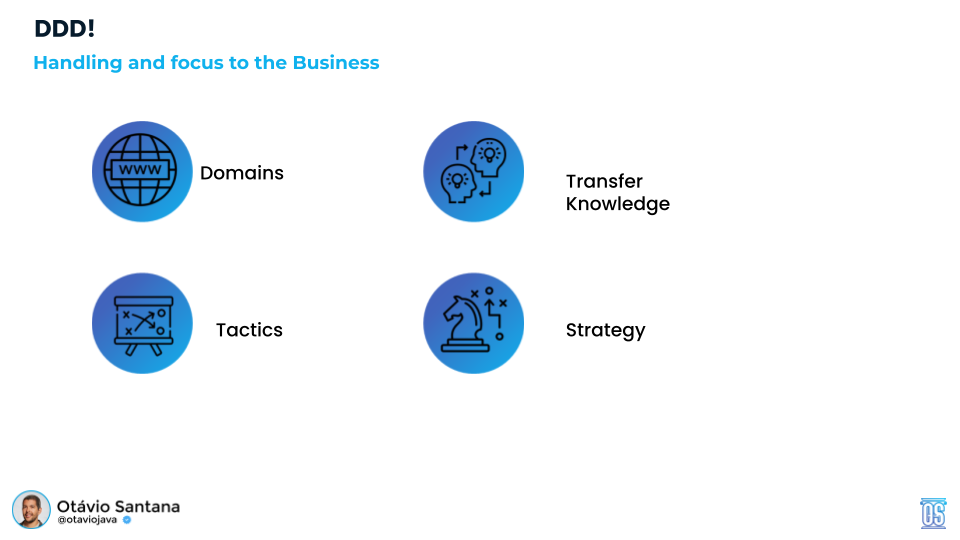
When a team embraces DDD, code stops being just instructions for a computer and starts becoming a shared language or a fluent communication between developers and domain experts. That’s where accurate communication happens, and software begins to reflect human reasoning rather than technical convenience.
But to get there, DDD offers two complementary perspectives: strategic and tactical design. Each has a purpose, and together they form a complete picture of how to build meaningful systems.
Strategy Before Code: Understanding the Business
The strategic side of DDD is where everything begins. It’s the most critical step — and ironically, the one most teams skip.
Before writing a single line of code, we must understand how the business operates, how teams communicate, and where responsibilities start and end. This is where concepts such as ubiquitous language, bounded context, and context mapping come into play.
A Ubiquitous Language ensures that everyone — from engineers to business analysts — uses the same terms to describe the same things. A Bounded Context defines where one meaning ends and another begins, preventing the typical chaos where “customer,” “user,” and “client” mean three different things. I love the sample of Ajax, which can refer to a soccer team, technology, or a clean product, depending on the context. And a Context Map shows how those boundaries interact, revealing dependencies, collaborations, and potential friction points.
Strategic DDD is not just about drawing boxes; it goes beyond that! It’s about creating shared understanding. It’s where alignment happens before implementation begins.
Once that understanding is solid, we can finally move to the next stage: expressing that knowledge in code.
From Understanding to Implementation: Tactical DDD
If the strategic layer defines what we are building and why, the tactical layer defines how. This is the part most developers recognize: entities, value objects, aggregates, repositories, and domain events.
These constructs ensure that the business logic isn’t lost inside technical plumbing. They help maintain boundaries, consistency, and meaning within the codebase. But without the strategic foundation, they become empty shells — patterns applied without purpose.
Too often, teams rush into tactical DDD because it feels more tangible. They implement aggregates and repositories, but forget to model the business language first. It’s like constructing a beautiful building on unstable soil — it may look solid, but it won’t last long.
When both layers — strategic and tactical — work together, DDD turns software into a living model of the organization. Every piece of software, including classes, methods, and events, becomes a representation of the real-world behavior. And that’s when development finally starts serving its true purpose again: delivering business value through clarity.
Why DDD Still Matters in 2025
Two decades after Eric Evans introduced it, DDD remains one of the few methodologies that age gracefully. In a world obsessed with speed and tools, DDD invites us to slow down — just enough to think clearly.
With the time the software increases, became more complex and more requirement to don't lost the focus, DDD gives teams a vocabulary and structure to navigate this complexity. It ensures that as your software evolves, it continues to express the company’s intent rather than drift into entropy.
Modern technologies like event-driven architectures, CQRS, and microservices have roots that trace back to DDD thinking. Each tries, in its own way, to keep the business domain at the center of the system. The difference is that DDD does this not through technology, but through conversation, collaboration, and modeling.
In a landscape where tools change every year, principles like these become timeless.
The Journey Ahead
That’s the main reason, despite the noise of new frameworks and buzzwords, domain-driven design still stands as a guiding light for software engineers, architects, and business leaders alike, because, in the end, we still need to achieve results. It teaches us to focus on the essence of the system — the domain — before diving into the accidents of implementation.
This article marks the beginning of a series celebrating my newest book, Domain-Driven Design with Java: Building Scalable and Maintainable Java Applications with DDD Principles. In this book, I explore these ideas in depth and translate them into real, modern Java applications.
At the end of the day, software is not about frameworks — it’s about people, language, and purpose. And DDD reminds us of that every single time we open a code editor.
Opinions expressed by DZone contributors are their own.
Comments