

Strategic Domain-Driven Design: The Forgotten Foundation of Great Software
Most teams skip strategic DDD and focus only on code. Learn how domains, contexts, and patterns align software with business reality.
 CORE
·
CORE
·
Join the DZone community and get the full member experience.
Join For FreeWhen teams talk about domain-driven design (DDD), the conversation often jumps straight to code — entities, value objects, and aggregates. Yet, this is where most projects begin to lose direction. The essence of DDD is not in the tactical implementation, but in its strategic foundation — the part that defines why and where we apply the patterns in the first place.
The strategic aspect of DDD is often overlooked because many people do not recognize its importance. This is a significant mistake when applying DDD. Strategic design provides context for the model, establishes clear boundaries, and fosters a shared understanding between business and technology. Without this foundation, developers may focus on modeling data rather than behavior, create isolated microservices that do not represent the domain accurately, or implement design patterns without a clear purpose.
As with software architecture, where we need to understand what we need to do, the why or motivation is indeed more crucial than how to do it. The strategic DDD guides on this journey to deliver better software.
Despite more than two decades since Eric Evans introduced DDD, many teams still make the same mistake: they treat it as a technical recipe rather than a way of thinking. Strategic DDD is what transforms DDD from a set of patterns into a language for collaboration. It's what connects software design to business vision — and without it, even the most elegant code cannot deliver real value.
The Four Pillars of Strategic DDD
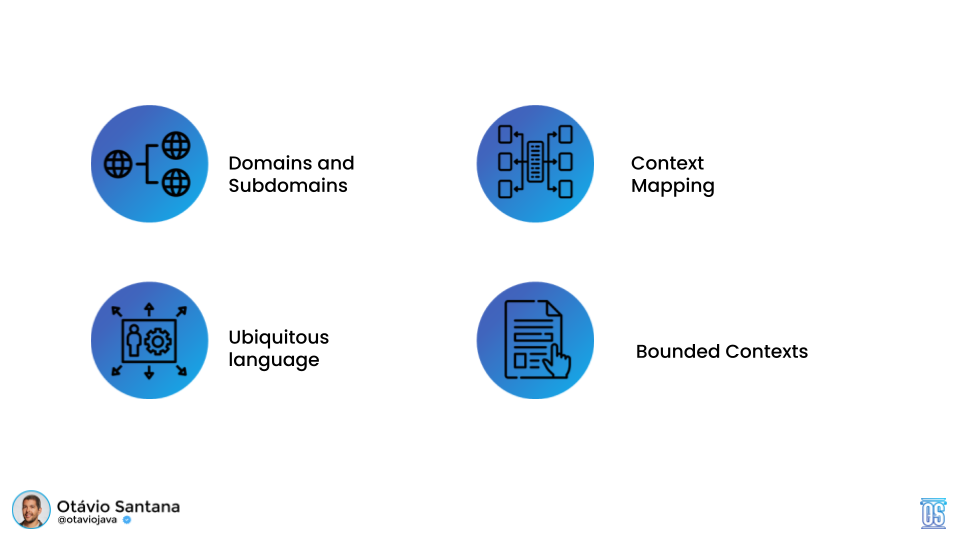
Strategic domain-driven design can be understood through four fundamental parts: domain and subdomains definition, ubiquitous language, bounded contexts, and context mapping. These elements form the foundation for aligning business understanding with software design, transforming complex organizations into manageable, meaningful models.
1. Domain and Subdomains Definition
The first step in strategic modeling is to define your domain, which refers to the scope of knowledge and activities that your software intends to address. Next, we apply the age-old strategy of "divide and conquer," a principle used by the Romans that remains relevant in modern software development. We break down the larger domain into smaller, focused areas known as subdomains.
Each subdomain has its own nature and strategic importance:
- Core subdomain – Unique to the company, defining its identity and competitive advantage.
- Supporting subdomain – Supports the core business activities but does not directly create differentiation.
- Generic subdomain – Common across organizations, representing standardized or commodity processes.
These classifications are not universal; they depend entirely on the business context. For instance, in an e-commerce platform, payments are typically a supporting subdomain, often integrated via a third-party API. But for a payment provider like Stripe, payments represent the core subdomain — the company's essence.
Recognizing which subdomains drive your organization's unique value helps prioritize where to invest your best engineering efforts. The core subdomain deserves focus, innovation, and the most capable team.
2. Ubiquitous Language
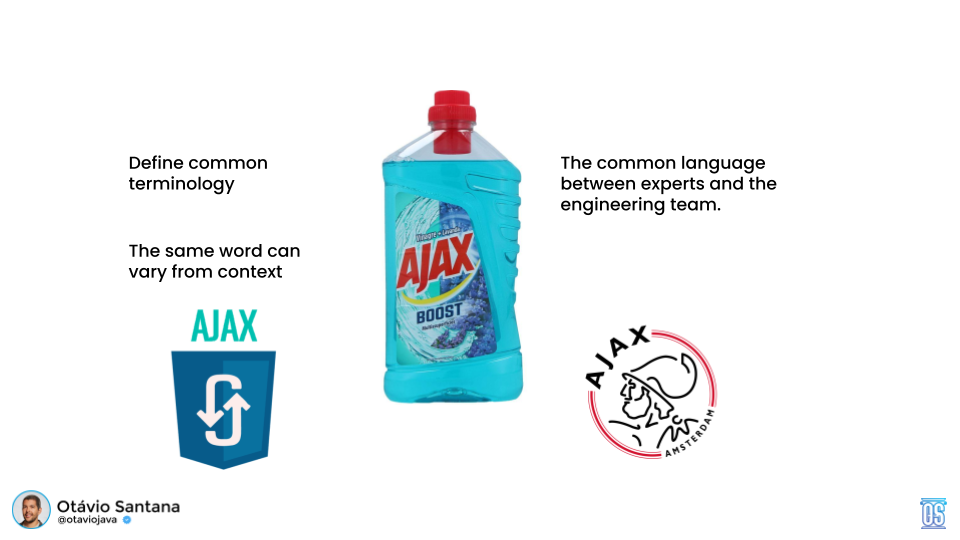
Once subdomains are clear, the next challenge is communication. DDD emphasizes shared understanding — a language that unites developers and domain experts.
Words matter, and meanings often differ depending on the speaker's background. Take Ajax as an example: it could refer to a cleaning product, a soccer club, or the once-famous web technology. The same word can lead to three different conversations.
Building a ubiquitous language means aligning terminology so that every concept has one meaning — precise and consistent within its subdomain. This shared vocabulary becomes the foundation for clear discussions, accurate models, and meaningful software.
3. Bounded Contexts
Once the language is aligned, the next step is to define bounded contexts. These are explicit boundaries that indicate where a particular model and language apply. Each bounded context encapsulates a subset of the ubiquitous language and establishes clear borders around meaning and responsibilities.
Although the term is often used in discussions about microservices, it actually predates that movement. Bounded contexts help clarify the meanings of terms used in your code, such as "Order," "Customer," or "Payment," especially during communication between engineers and the product team.
4. Context Mapping
After defining each bounded context, the final step is to understand how they interact. That's where context mapping comes into play. It visualizes the relationships between contexts — who depends on whom, how data flows, and where translation between models is needed.
Context mapping helps teams identify integration points, communication styles, and ownership responsibilities. It's a crucial step to prevent misalignment, duplication, and endless coordination problems between teams.
Strategic DDD Patterns
The strategy provides a set of seven patterns to guide collaboration between bounded contexts. These patterns define how teams, systems, and models interact across organizational boundaries.
With this path clear, these patterns help you choose the right relationship for each context — balancing autonomy, trust, and shared responsibility.
1. Shared Kernel – A Common Ground
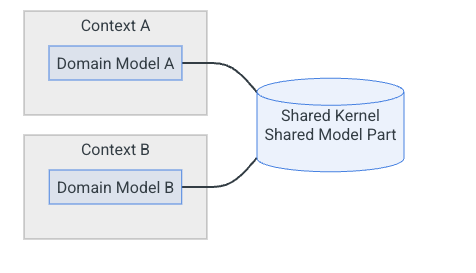
Sometimes, two teams must work so closely that they share a small part of their model. This shared kernel represents the portion of the domain that both rely on, demanding strong communication and mutual trust.
Example: In a financial system, the Compliance and Transaction contexts might share the definition of a CustomerIdentity object that includes verified user information. Any modification requires coordination among those teams; you can think of it as a library shared between domains.
2. Customer–Supplier
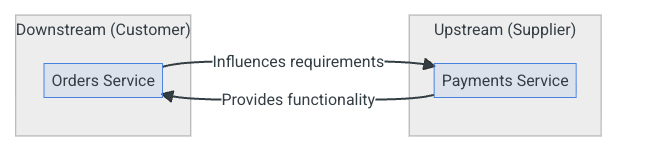
In this relationship, the downstream (customer) depends on the upstream (supplier). The downstream can influence priorities or request changes, but the upstream retains control over its model.
Example: In an e-commerce platform, the Order Management context (customer) depends on the Inventory context (supplier) to confirm product availability. If inventory changes frequently, the order team can request new API features — such as batch stock validation — influencing the supplier’s roadmap while maintaining separate models.
3. Conformist
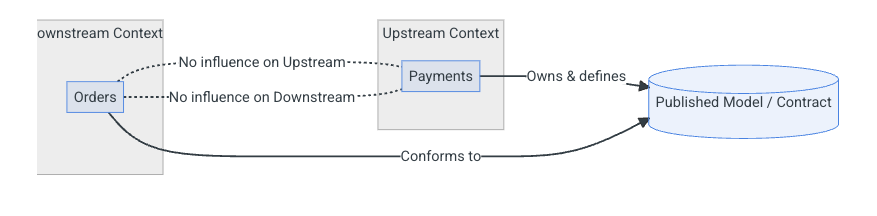
The conformist pattern occurs when the downstream does not control or influence the upstream model, but it happens often. The downstream must fully adapt to the upstream’s design, accepting its structure as-is and sometimes combining with other patterns, such as the Anticorruption layer, that we will cover soon.
Example: An online marketplace integrating with a payment gateway (like Stripe or PayPal) typically acts as a conformist. The e-commerce platform must conform to the payment provider’s API and cannot dictate changes in its design or terminology.
4. Anticorruption Layer (ACL)
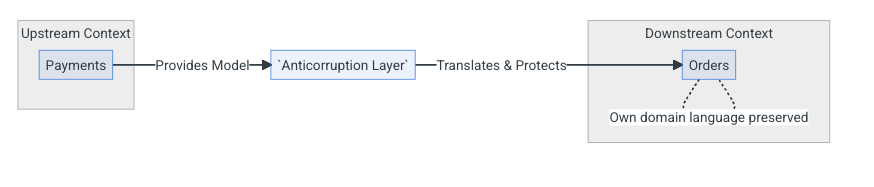
To avoid polluting its model with foreign concepts, a downstream context can use an anticorruption layer to translate between external models and its own. This layer protects the integrity of the internal domain language. You can view this as a wrapper or adapter layer to protect your business from external services or parties.
Example: A card management integration must handle several Card flags; instead of incorporating the terminology of each API into the system, it translates these into the domain.
5. Published Language
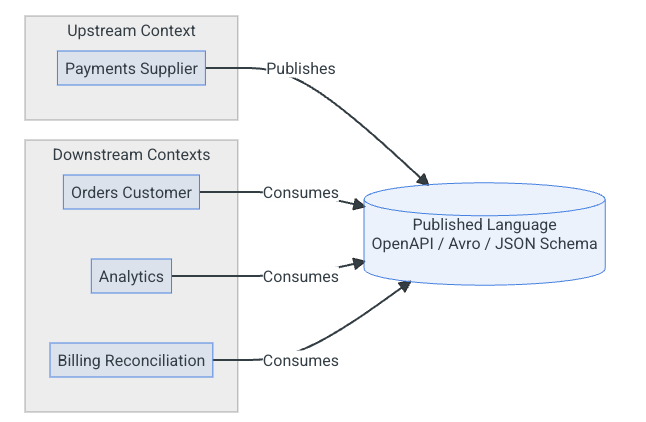
When multiple teams need to integrate, they can agree on a published language — a formal, shared contract or schema that defines how data is exchanged. It’s similar to an API specification or message schema that both sides commit to. You can view this as a specification, but within an organization, for example, it relates to how money is handled.
Example: In an e-commerce ecosystem, Order Management and Shipping teams might agree on a shared JSON schema called OrderDispatchedEvent. Both systems integrate using the same data structure.
6. Separate Ways
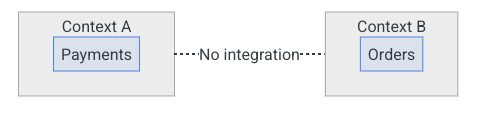
For some areas, it does not make sense to have an integration. In that case, contexts can evolve separately, without any integration, each focusing on its own goals without direct coordination.
Example: Some e-commerce might have the core far from the marketing and social media integration.
7. Open Host Service
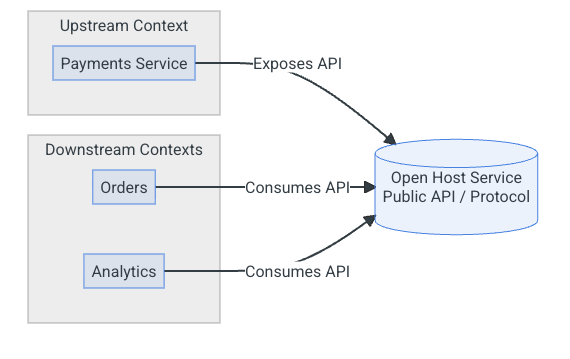
An open host service allows an upstream context to expose a straightforward and extensible API or protocol that many downstream systems can consume without tight coupling. It’s a well-defined entry point for collaboration.
Example: A Payment Service in a fintech ecosystem provides an Open Host API that allows partners to initiate payments, check transaction status, and handle refunds. Each downstream system (like invoicing, reporting, or merchant dashboards) can consume the same API without requiring one-on-one coordination.
Strategic patterns go beyond simple communication and integration. Choosing the correct pattern determines how contexts depend on each other — whether they share responsibility, coordinate loosely, or evolve independently. Mastering these relationships is what keeps software ecosystems healthy as they grow. It is super valid from an architectural perspective as well.
Conclusion
When we talk about domain-driven design, we often go to the code, generating a huge mistake, because we forget to go to the crucial part: the Strategic domain-driven design is not just an architectural exercise — it’s about shaping collaboration, defining boundaries, and ensuring that software reflects the business, not the database. Yet, it remains the most neglected side of DDD. Many teams jump straight into code, skipping the conversations, maps, and models that give meaning to every line they write.
Of course, in an article like this, it’s impossible to explore every nuance of strategic DDD — from context mapping decisions to how communication patterns evolve within growing organizations. That’s why I decided to go deeper into this topic in my new book, Domain-Driven Design with Java.
In the book, I explore in detail how strategic and tactical design connect, how to identify subdomains, define clear bounded contexts, and model relationships across complex systems — all with practical Java examples. If this article gave you a glimpse of why strategic DDD matters, the book will take you on the complete journey.
Opinions expressed by DZone contributors are their own.
Comments