

Governing Identity Under Uncertainty: Experimentation and Incrementality in Modern Programmatic Advertising
In a modeled-identity world, reach metrics are no longer sufficient. Identity decisions must be validated with incrementality and governed as production infrastructure.
Join the DZone community and get the full member experience.
Join For Free(Series: How Audiences Become Addressable in Programmatic Advertising)
Identity is not something you “set.” It is a set of design choices that determine who is eligible, what the system can learn, and which performance claims are even interpretable. The only reliable way to validate identity decisions is to treat them as changes to treatment assignment and evaluate them with incrementality-first experimentation, wrapped in an operating model that prevents silent drift.
This is Part 3 of a series on how audiences become addressable in programmatic advertising. Part 1 built an end-to-end systems model of addressability and identity resolution. Part 2 showed why match rate is mostly recall and why identity expansion introduces precision error that performance dashboards often hide. Part 3 closes the loop: how to test identity choices causally, how to quantify incremental value under identity uncertainty, and how to govern identity systems so improvements are real, durable, and explainable.
The Core Principle: Identity Changes Are Treatment Assignment Changes
A common mistake is to evaluate identity solutions as if they are data plumbing: “We improved match rate; therefore we improved performance potential.”
In reality, most identity work changes at least one of these:
- The eligible set (who can be targeted)
- The mapping between impressions and entities (who is considered the same)
- The measurement join (who can be attributed, deduped, or modeled)
That means identity changes are not “inputs” to the various points in activation workflow, they are interventions. Interventions must be validated with causal designs, not overlap metrics such as match rates. 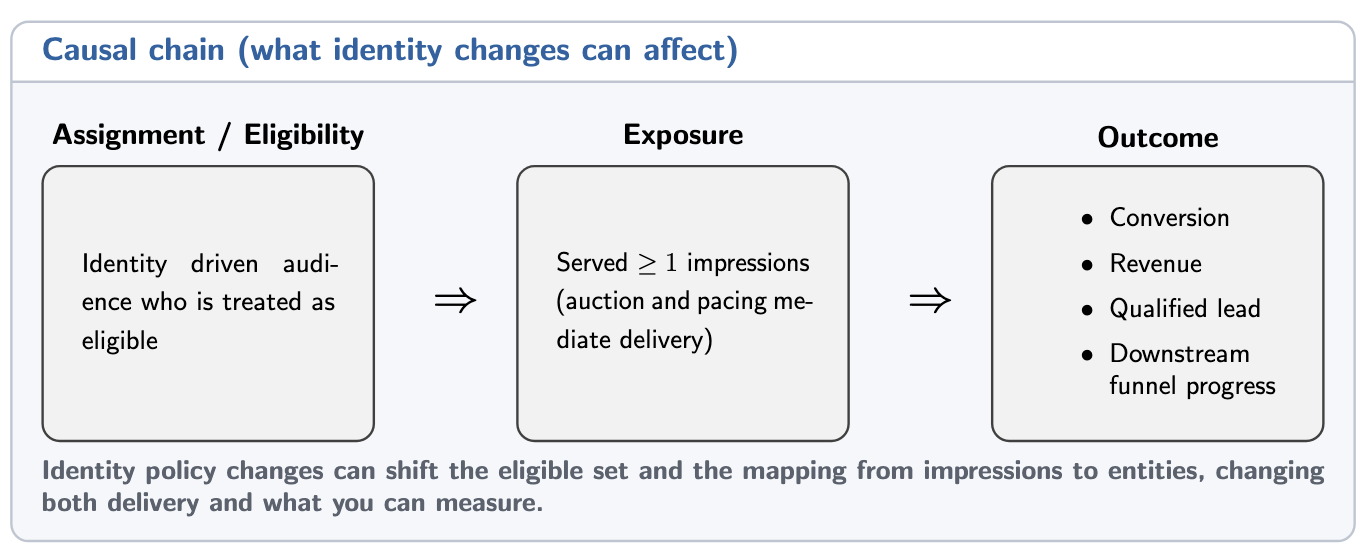
A pragmatic framing: If an identity change can alter who receives ads (or who gets credited), it must be evaluated like a product change in a high-stakes decision system.
What You Are Actually Trying to Estimate: ITT vs. TOT Under Identity Uncertainty
Incrementality conversations get messy because “treatment” is ambiguous in ad systems. There are (at least) three layers:
- Assignment: the system considers an entity eligible for treatment (in audience)
- Exposure: an eligible entity is actually served one or more impressions
- Outcome: conversion, revenue, downstream funnel progression, etc
Under identity error, assignment and exposure are not cleanly observed — and they can drift differently across environments. This is why it helps to be explicit about estimands:
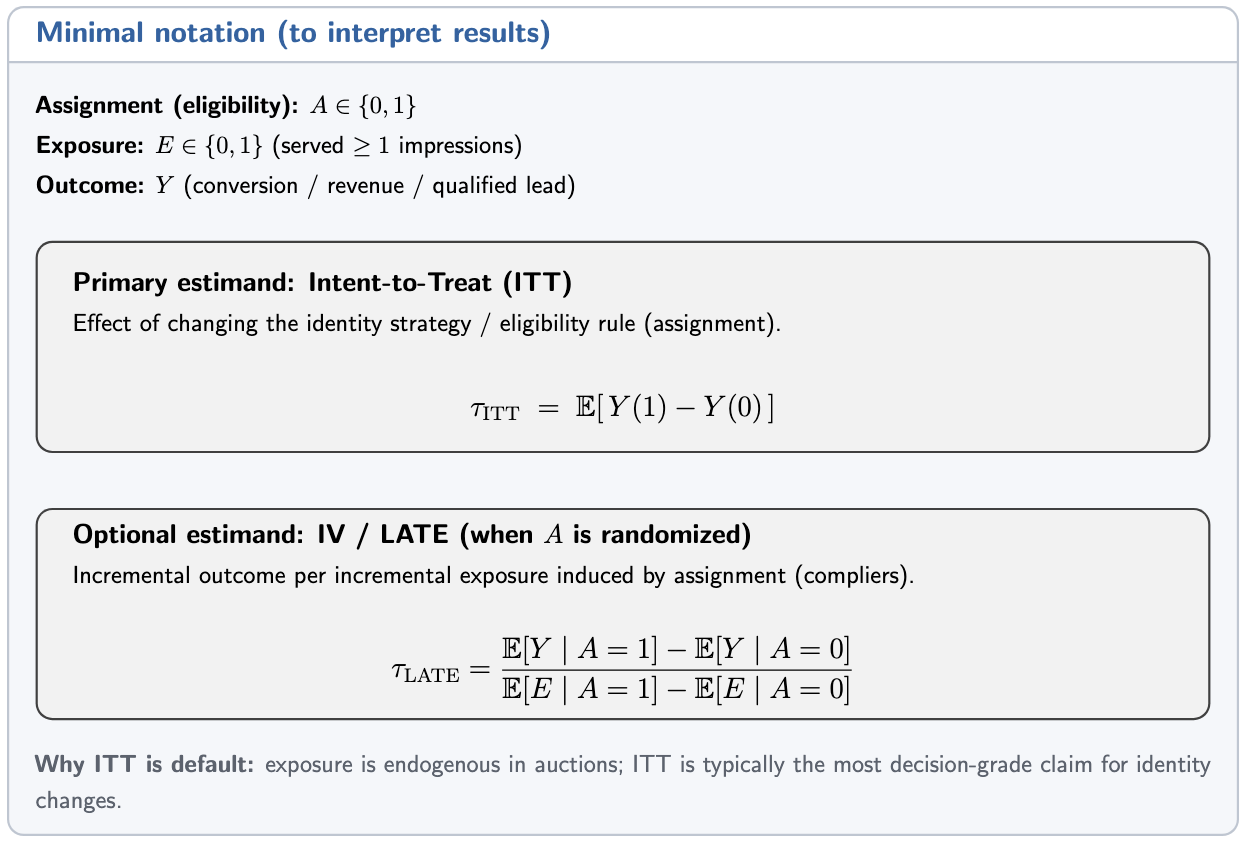
- Intent-to-treat (ITT): effect of being assigned to an eligible audience strategy, regardless of actual exposure.
- Treatment-on-the-treated (TOT): effect among those who were actually exposed (often requires strong assumptions or instrumental variables).
In programmatic identity evaluation, ITT is usually the right anchor because:
- Assignment is what you control (via audience definitions and identity rules),
- Exposure is mediated by auction dynamics,
- And identity uncertainty makes “who was exposed” noisier than “who was assigned.”
If you try to jump straight to TOT without a clean instrument, you end up “explaining away” identity error with modeling.
Choosing the Right Experimental Design for Identity Questions
Because identity decisions affect eligibility, competition, and measurement simultaneously, experimental design must tolerate interference and imperfect observability.
- User-level randomized experiments work best in environments with stable, deterministic identifiers and minimal cross-device spillover. Even there, frequency controls, budgets, and auctions can introduce interference.
- Geo-level experiments are often preferred when identity is unstable, household-level, or cross-device, because they tolerate interference and measurement noise that break user-level designs.
- Time-based switchbacks can be operationally useful for monitoring identity changes, but require careful control for seasonality and demand shifts.
There is no universally “correct” design. The correct design is the one whose assumptions are least violated by the identity regime in which it is deployed.
A Practical Identity Experiment You Can Defend: Person-Level Audiences and CTV Household Expansion
Consider a common identity question in CTV activation: should a person-level first-party audience be expanded to households to increase reach?
A naïve evaluation compares match rate, reachable audience size, or in-platform CPA before and after expansion. These metrics confound changes in eligibility, exposure, and attribution, making them unsuitable for evaluating identity policy changes.
A defensible approach treats household expansion as a change in treatment assignment and evaluates it causally.
Define two strategies:
- Strategy A (Conservative): deterministic person-level matching only.
- Strategy B (Expanded): deterministic matching plus household expansion.
Randomize geographies into A or B, using matched pairs or pre-period checks to ensure baseline comparability. Hold all other variables constant: creative, budgets or pacing rules, frequency caps, and measurement windows.
Evaluate using a primary incremental business outcome, not platform attribution — such as site conversions, revenue, qualified leads, or downstream funnel events measured consistently across geos. Use secondary diagnostics to interpret results: incremental reach and frequency, down-funnel quality (e.g., MQL→SQL, close rate, returns), and stability over time.
Interpretation is straightforward. If expansion increases incremental outcomes at acceptable marginal ROI without degrading downstream quality, it is justified for this use case. If reach increases without incremental outcomes, the result is precision dilution. If top-of-funnel metrics improve while downstream quality degrades, the targeting entity mismatch is material (household ≠ person).
This design yields conclusions that hold up under scrutiny because it estimates the causal impact of the identity policy change on business outcomes — rather than relying on proxy metrics that obscure identity error.
Making Identity Experiments Feasible in Practice
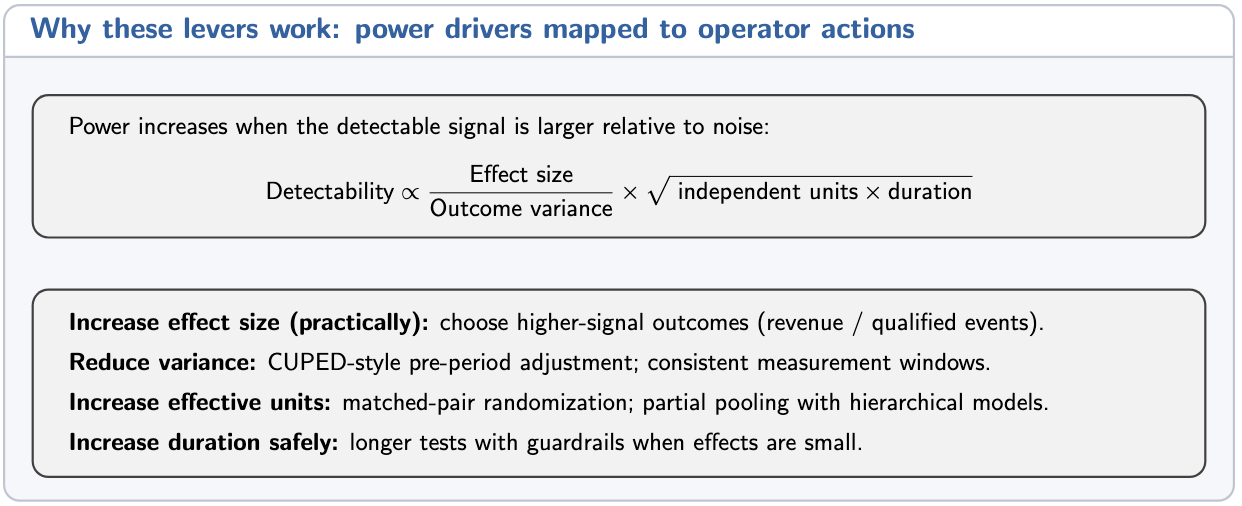
Identity experiments often suffer from limited power: incremental effects can be modest, identity regimes vary across channels, and usable geographies are scarce. These constraints are structural, but they do not make rigorous evaluation impractical.
Feasibility comes from variance reduction and design discipline rather than larger samples. Pre-period adjustment reduces noise using baseline outcomes. Matched-pair geo randomization improves balance when units are limited. Hierarchical models allow partial pooling when appropriate. When effects are small, longer test durations — paired with guardrails — are often the most cost-effective lever. Outcome choice matters as well: revenue or qualified downstream events typically outperform raw conversions in precision-sensitive identity tests.
The objective is not academic perfection. It is credible, decision-grade inference.
Incrementality is Necessary, but Not Sufficient
Even well-designed experiments can mislead if measurement is not aligned to the targeting entity. Identity-related lift often appears real in aggregate while being confined to a subset of environments or driven by a measurement artifact.
A practical monitoring layer should separate three questions: whether the eligible population changed as intended, how delivery was composed across deterministic and expanded paths, and whether downstream outcomes are consistent with the targeted entity.
Many teams fail here. They observe lift, generalize it, and deploy expansion everywhere — without realizing the effect was environment-specific or dependent on a particular identity path. Operator practice should reflect this reality: always segment results by identity path and environment, even if the final decision is unified.
Governing Identity as Production Infrastructure
Experimentation tells you whether an identity strategy works at a point in time. Governance ensures it continues to work as platforms, models, and policies evolve.
Effective identity governance requires explicit contracts defining the targeting entity, allowed resolution methods, and where expansion is permitted. Identity policies must be versioned and change-controlled, just like models. If you cannot answer what changed, when it changed, and which experiment validated it, performance shifts are impossible to diagnose.
Operational guardrails — such as limits on expansion share, minimum deterministic coverage thresholds, or acceptable volatility across refreshes — are not vanity metrics. They are risk controls. Auditability matters as well: teams must be able to prove consent enforcement, define approval authority for expansion rules, and document joins and transformations.
Governance tools constrain behavior; they do not improve identity quality. The improvement comes from disciplined choices and evidence.
When to Expand Identity — and When Not To
There is no universally correct identity strategy, but a simple rubric holds across most systems.
Deterministic-first approaches are appropriate when outcomes are high-value and sparse, false positives are expensive, or the targeting entity must remain person-level. Expansion can be justified when reach is required, incremental value can be validated causally, and results can be segmented by identity path. Platform-native modeling is viable when reduced explainability is acceptable, incrementality can be measured independently, and it is treated as an explicit strategy rather than a hidden default.
The point is not to avoid expansion. It is to expand with an explicit precision budget, validated by causal outcomes.
Conclusion
Programmatic advertising is a distributed decision system operating under constraint, and identity determines what the system can see and act on. Optimizing addressability metrics alone increases recall while hiding precision loss, degrading performance and learning. The solution is to treat identity as a governed intervention — validated with incrementality-first experimentation and operationalized as versioned infrastructure with contracts, guardrails, and auditability.
The goal of identity is not maximum reach. It is controlled, explainable precision at scale — proven incremental and resilient to platform drift.
Opinions expressed by DZone contributors are their own.
Comments