

How AI and ML Technologies Drive Transformation in DevOps
From code quality to DevSecOps, AI and ML revolutionize DevOps. Dive into the impact of these technologies and their implementation challenges.
 ·
·
Join the DZone community and get the full member experience.
Join For FreeEnterprise DevOps has brought radical changes in conventional workflows. Both AI and ML technologies play a vital role in enabling DevOps to change the corporate world and streamline processes. A Gartner report has revealed that 40% of DevOps teams will use infrastructure apps that have integrated AI for IT operations platforms by the year 2023.
Today, we will discuss the role of AI and ML in DevOps, along with some implementation challenges. Before moving ahead, let’s understand the concepts of AI, ML, and DevOps and their synchronization in various processes.
AI, ML, and DevOps: How They Work Together
Simply put, artificial intelligence (AI) is an umbrella term for software that mimics human cognition to perform complex tasks. Machine Learning, or ML, is a branch of AI that uses data-based algorithms to produce adaptable models. In other words, ML is about learning the way of performing complex and interrelated tasks like the way humans do.
DevOps, on the other hand, is a set of practices that integrates the process of software development and IT. It helps developers build, test, and deploy the software more quickly. DevOps involves continuous feedback on the process while filling the gap between the Development and Operations. DevOps can generate a massive amount of data, and here, AI and ML come into play.
AI and ML in DevOps can completely change the way companies build, operate, and release customized software. Both these technologies bring advanced automation and intelligent monitoring with analytics to take DevOps to the next level. AI and ML can also improve collaboration and data security. AI-based predictive analytics can assist developers in detecting issues in advance.
Let’s dig deep into the impact of AI and ML on DevOps.
Importance of AI and ML in DevOps Transformation
Globally, data-driven organizations embrace AI and ML to achieve their goals. The integration of AI and ML into DevOps drives a transformative shift in its evolution. It enables DevOps to play its role in the organization's digital transformation journey. AI facilitates the scanning of massive data volumes at high speeds, thereby identifying critical issues and reducing manual workloads.
AI and ML also streamline manual configuration and automation of security aspects, minimizing the risk of mistakes and administration misconfigurations. They enhance downtime reduction and potential breach mitigation by proactively identifying exploitable vulnerabilities. AI and ML-powered computing enables data-backed, efficient analysis and decision-making in DevOps solutions.
Here is the description of the role of AI and ML in DevOps.
- Efficient Processes: AI integration with tools like Git provides visibility into code volume irregularities, extended build times, improper resource handling, and process slowdowns, enabling timely resolution.
- Quality Assurance: ML facilitates effective quality checking by building comprehensive test patterns based on learnings from each release, leading to enhanced application quality delivery.
- DevSecOps: ML integration promotes secure application delivery by identifying behavioral patterns. Both AI and ML can prevent anomalies in system provisioning, automation routines, and deployment activities.
- Enhanced Analysis: ML plays a crucial role in analyzing resource utilization and patterns to identify memory leaks and other issues. It leads to improved management of production issues and decision-making.
- Early Detection: AI and ML empower enterprise DevOps teams to detect issues early, ensuring immediate mitigation responses and uninterrupted business continuity. Actionable insights can help them make real-time decisions.
- Business Assessment: While DevOps focuses on understanding code releases to achieve business goals, ML tools analyze user metrics and alert concerned business teams and developers in case of any issues.
AI and ML can bring major changes in DevOps by driving efficiency, quality, security, and continuous business value. By embracing these transformative technologies, organizations can achieve their strategic objectives and gain multiple benefits.
Key Benefits of AI and ML for DevOps
Here is a list of top benefits you can get with the synergy of AI, ML, and DevOps:
- Automated Issue Detection: AI-powered analytics quickly identify operational issues, allowing DevOps teams to resolve them faster and reducing the Mean Time to Recovery (MTTR).
- Improved Code Quality: AI-based tools continuously monitor code to identify bugs and critical issues. ML-driven insights assist in resolving these issues to improve the code quality.
- Optimized Performance: Developers can address performance issues such as logging, CPU, or memory problems by leveraging visualizations and ML-powered recommendations.
- DevSecOps Implementation: ML integration offers secure application delivery by identifying behavioral patterns to prevent anomalies in system provisioning, automation routines, etc.
- Higher Efficiency: AI tools provide visibility into code volume, resource handling, and process slowdowns, enabling developers to address irregularities more effectively.
- Enhanced Quality Checking: Machine learning creates comprehensive test patterns on the basis of learning from previous releases, resulting in improved application quality.
- Intelligent Automation: AI automates repetitive tasks and frees up DevOps teams to focus on strategic and more complex tasks and challenging technical issues.
- Reduced Costs: AI promotes automation and streamlines workflows to reduce manual intervention and optimize resource utilization. It finally leads to cost savings.
You can consult a reputed DevOps solutions provider to get these benefits for your company.
Step-by-Step Guide for AI/ML-Driven DevOps Environment
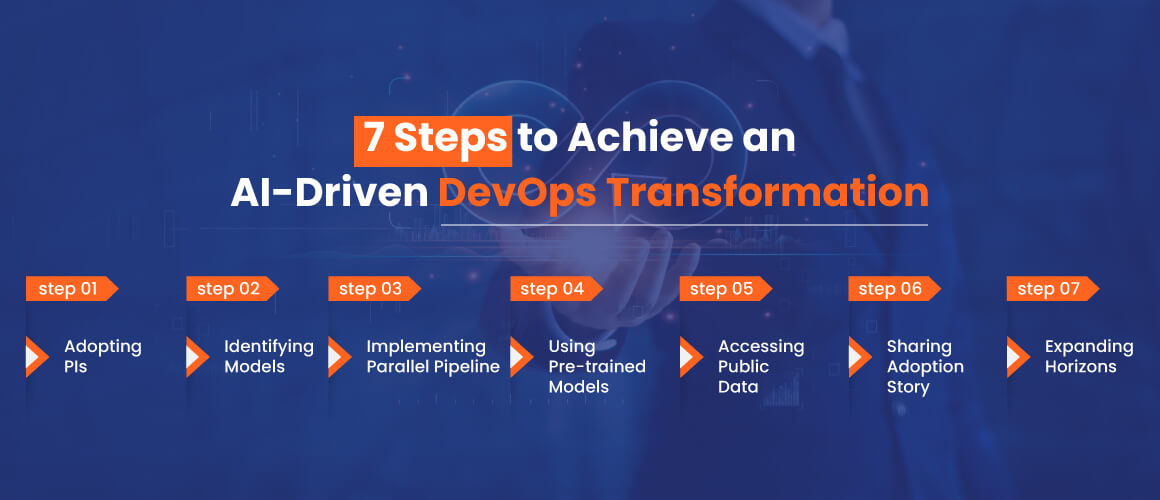
Though these advanced concepts can offer many business benefits to modern enterprises, it is essential to follow the proven implementation process. Here, we mention seven steps for implementing AI and ML in DevOps.
Step 1. Adopting APIs
Development teams need to utilize advanced APIs like Azure, AWS, and GCP to integrate AI and ML capabilities seamlessly into the customized software.
Step 2. Identifying Models
Identifying similar AI/ML APIs is the next step. Development teams can streamline their efforts and collaborate after AI or ML model deployment.
Step 3. Implementing Parallel Pipeline
Implementation of parallel pipelines is crucial to mitigate the impact of potential failures or disruptions of AI or ML models in the future.
Step 4. Using Pre-trained Models
Utilizing a well-documented, pre-trained model can significantly reduce the difficulties in adopting ML and AI capabilities.
Step 5. Accessing Public Data
While adopting AI/ML, public data sets offer a valuable solution to the challenge of getting initial training data.
Step 6. Sharing Adoption Story
Enterprises should identify and share successful AI/ML adoption stories to inform and encourage other teams. It fosters knowledge sharing.
Step 7. Expanding Horizons
Developers should continuously seek opportunities to learn and stay updated on emerging AI/ML use cases. Organizations can support this goal.
It is always beneficial to get assistance from DevOps consulting services to address the implementation-related challenges.
Implementation Challenges for AI and ML in DevOps
Implementing AI and ML in DevOps brings significant challenges due to the sheer complexity of modern DevOps environments. The vast amount of data is generated in today's distributed application ecosystem. Such huge volumes of data overwhelm traditional human capabilities for analysis and decision-making. Moreover, manual processing and analysis are not only time-consuming but also prone to errors and inefficiencies.
This is where AI and ML emerge as a powerful tool to automate and optimize DevOps processes. This integration enables organizations to effectively handle the increasing volume and complexity of data.
Concluding Remarks
AI/ML has emerged as a transformative force, bridging the gap between humans and the vast volumes of corporate data in DevOps solutions. AI/ML tools offer consolidated solutions without disrupting entire software environments. Integration of AI and ML into DevOps software can increase operational efficiency, improve code quality, and optimize performance to save costs.
Published at DZone with permission of Vipul Makwana. See the original article here.
Opinions expressed by DZone contributors are their own.
Comments