

How Generative AI Can Transform Cloud Support Operations: A Practical Framework
A practical framework for using generative AI to improve speed, quality, and customer experience in cloud support operations.
 ·
·
Join the DZone community and get the full member experience.
Join For FreeAbstract
Cloud support is no longer a staffing problem — it’s a cognition and scalability problem. As cloud platforms grow in complexity, support engineers are spending more time searching, routing, and rewriting than actually solving issues.
This article introduces a three-layer framework showing how generative AI can improve resolution speed, reduce escalations, and enhance communication quality in modern cloud support teams, using a vendor-neutral, implementation-focused approach.
Who Is This For?
Support Engineering Managers, SRE and DevOps Leads, Operations Architects, and AI-curious engineering leaders designing scalable support workflows.
The New Reality of Cloud Support
Cloud support teams are operating in a world of increasing complexity: multi-service environments, distributed engineers, rapidly evolving tech stacks, and customer expectations shaped by real-time Software as a Service (SaaS) experiences. Traditional approaches like knowledge bases, audits, manual triage, and classroom-style training struggle to keep pace with this scale and speed.
Generative AI is not a magic replacement for human expertise, but it can become a powerful augmentation layer: accelerating knowledge retrieval, surfacing hidden patterns, predicting risk, and improving communication quality. When applied intentionally, AI becomes a support engineer’s thinking partner, not a ticket-reply bot.
This article introduces a three-layer framework for integrating AI into cloud support operations in a structured, safe, and measurable way.
Where AI Actually Helps (And Where It Doesn’t)
| Area | Problem Today | AI Superpower |
|---|---|---|
| Knowledge | Engineers dig through docs, internal wikis, case history | Retrieval-augmented reasoning with context |
| Operations | Manual routing, backlog firefighting, SLA risks | Predictive + skills-based assignment |
| Communication | Tone errors, long replies, inconsistent clarity | AI-assisted message drafting + empathy scoring |
Where AI does not help:
- Fully automated customer replies
- Replacing human judgment in escalations
- Running unsupervised on production data without governance
The goal is not to replace engineers — it is to reduce cognitive load so they can solve harder problems.
A Three-Layer AI-Enhanced Support Framework
Figure 1. Framework Overview
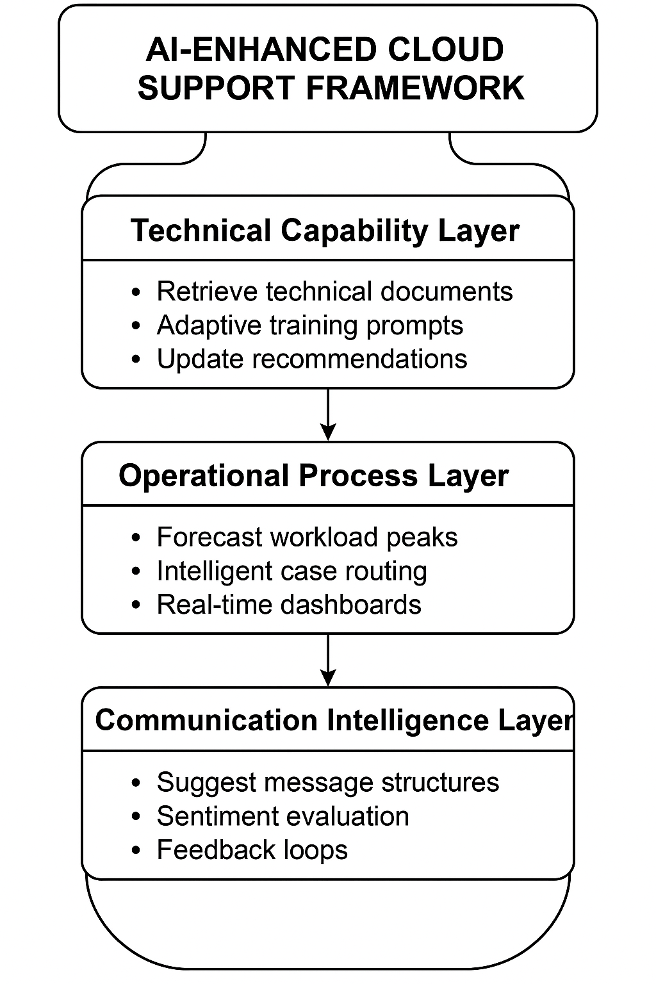
Layer 1 — Technical Capability (Knowledge Reasoning)
- AI retrieves relevant past cases, docs, and diagnostic steps
- Results are tied to case context, not generic search
- Output: Step-by-step recommendations, not hallucinated answers
- Engineers stay in control: AI surfaces insights, humans choose actions
Layer 2 — Operational Optimization (Forecasting + Routing)
- AI forecasts workload peaks using historical ticket data
- Tickets are routed based on expertise, current load, and SLA priority
- Dashboards auto-update with backlog heatmaps and SLA risk alerts
- Managers shift from reactive to predictive decision-making
Layer 3 — Communication Intelligence (Tone + Clarity)
- AI drafts concise, empathetic customer responses
- Sentiment and clarity are scored before sending
- Engineers review + edit, building a feedback loop to improve the model
- Consistency improves even across globally distributed teams
Simulated Impact (Illustrative Only)
All metrics shown below are illustrative and do not reference any real support organization, company, or production dataset.
| Metric | Before AI | After AI Assist | Improvement |
|---|---|---|---|
| Avg. Case Resolution Time | 14.2 hrs | 11.5 hrs | 15-20% faster |
| Escalation Frequency | 1 in 8 cases | 1 in 10 cases | 10-12% reduction |
| Customer Sentiment (CSAT proxy) | +3.9 | +4.4 | +5 points |
These simulated results show the directional impact typically seen when AI is used to reduce cognitive load, standardize responses, and improve routing logic.
Risks & Safeguards
| Risk | Mitigation |
|---|---|
| AI hallucination | Retrieval grounding + human-in-loop review |
| Model drift | Scheduled retraining on recent tickets |
| Privacy concerns | PII redaction + role-based access control |
| Over-automation | AI suggests, humans approve |
| Adoption resistance | Roll out as opt-in assist, not forced workflow |
The safest rollout is phased: shadow mode → partial assist → optional auto-drafts → full augmentation.
How to Get Started (Vendor-Neutral)
- Start with retrieval, not full automation — use AI to surface relevant knowledge, not solve tickets
- Use anonymized or synthetic data for initial testing
- Create metrics before adoption (baseline → compare post-AI)
- Deploy in assistive mode first
- Design governance early: audit logs, model versioning, override paths
- Train engineers on prompt hygiene + validation discipline
The Takeaway
AI won't eliminate cloud support — but it will redefine it.
The teams that win will be the ones who treat AI as:
- A second brain for engineers
- A pattern-recognition engine for operations
- A writing coach for customer empathy
- A continuous feedback loop for learning and quality
Not a replacement. An amplifier.
Opinions expressed by DZone contributors are their own.
Comments