
DZone
Thanks for visiting DZone today,
Edit Profile
  • Manage Email Subscriptions
  • How to Post to DZone
  • Article Submission Guidelines
Sign Out View Profile
  • Post an Article
  • Manage My Drafts
Newsletter
Log In / Join
Refcards Trend Reports
Events Video Library
Refcards
Trend Reports

Events

View Events Video Library

Related

  • How to Build Permission-Aware Retrieval That Doesn't Leak Across Teams
  • Effortless Credential Management in Azure: The Power of Managed Identities
  • From Novice to Expert: Building Robust Security With Kubernetes RBAC
  • Best Practices To Secure Stateless REST Applications

Trending

  • To Switch, or Not to Switch the AI Model
  • Fix the Target, Precompute Once: A Backend-Free Word-Ladder Solver With a BFS Distance Field
  • OpenCode: Setting Up an Open-Source AI Coding Assistant
  • AI Agents and Frontier Models: Insights From The Neuron

Draft This article hasn't been published, so readers can't see it.

In moderation This article is waiting for review, so readers can't see it yet.

Deleted This article has been deleted, so readers can't see it.

  1. DZone
  2. Software Design and Architecture
  3. Integration
  4. Fundamentals of an Enterprise Role-Based Access Control (RBAC) System

Fundamentals of an Enterprise Role-Based Access Control (RBAC) System

Learn how to use RBAC to restrict access to your enterprise systems, and keep your corporate data safe from cyberattacks.

By 
Justin Baker
·
Jun. 10, 17 · Tutorial
Post on X (opens in a new tab) Share on LinkedIn (opens in a new tab)
7.0K Views

Join the DZone community Save articles, join the discussion, and download Refcards and Trend Reports with a free account.

Join for free Already a member? Log in

Role-Based Access Control (RBAC) is an approach to restricting system access to users based on defined roles. Many companies have built internal systems like these, but usually in a very archaic and haphazard way.

There are a few primary semantics to a role and a set of attributes, operators, and actions that define a role. 
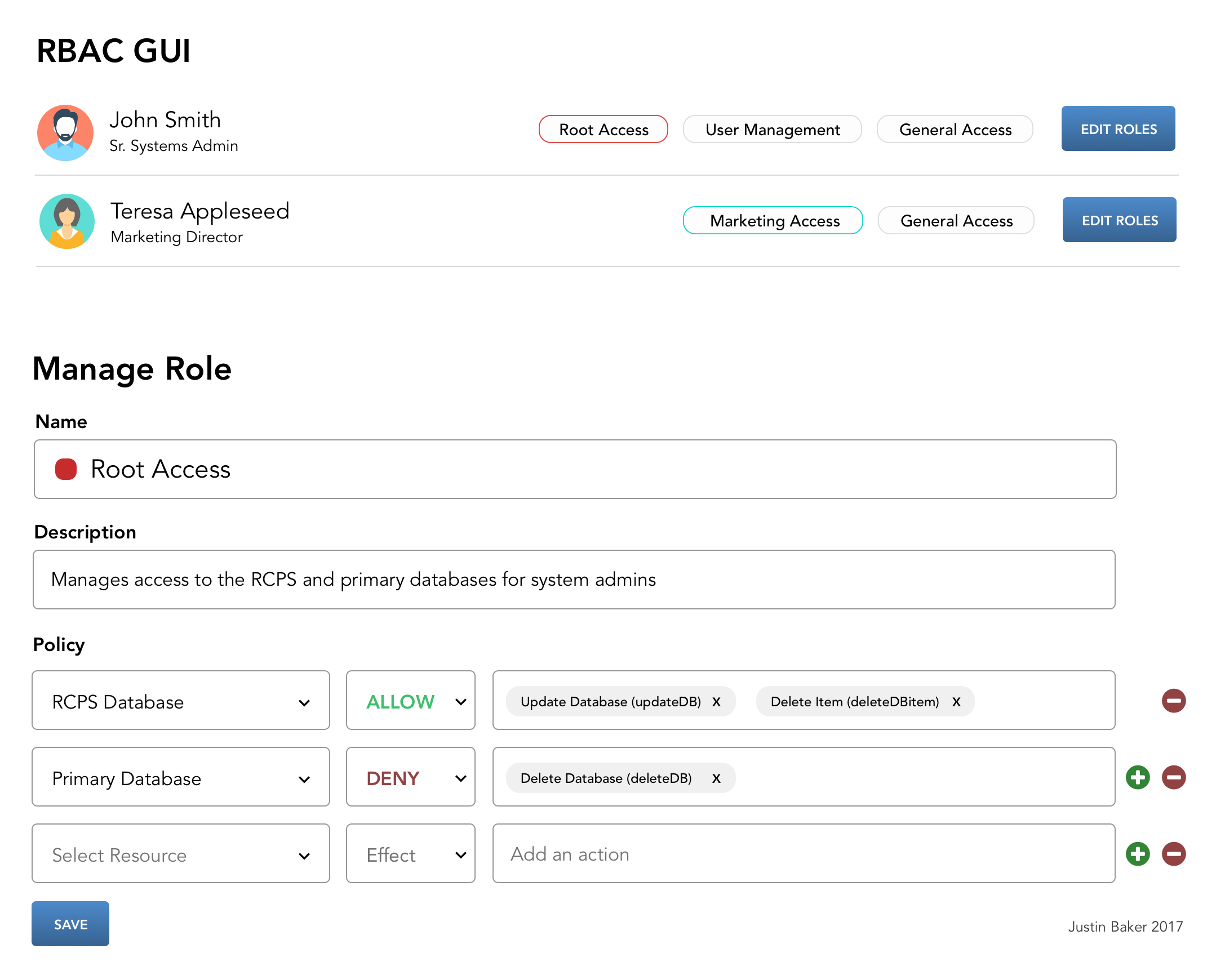
Image title

Defining a Role

A role should have five semantic components:

  • Name - a human readable and business-friendly way to identify a role.

  • Description - the role's purpose, clearly defined.

  • Tags - important for managing multiple roles and creating roles to manage to roles.

  • Assignments - assigning roles to individuals or groups of individuals.

  • Policies - specific rules and permission sets assigned to a role.

Defining a Policy

A policy has one primary component:

  • Array of Statements - a policy can have many statements. You should be able to save policies and re-use them across multiple roles. In other words, a policy is a collection of specific permission rules.

Defining a Statement

A statement has three components:

  • Resource - the targetted feature, environment, or operation.

  • Effect - typically "Allow" or "Deny".

  • Action - a resource can have many actions, like deleteUser, addUser, modifyUser.  These actions should have human-readable names, like "Delete a User" for "deleteUser." This is essential when you get into more complex actions, like "Modify Image Upload" for "imgUploadMod."

  {
    "effect": "deny",
    "resources": [
      "prod/primaryDB/*"
    ],
    "actions": [
      "deleteDB"
    ]
  }


Mapping Roles

You should be able to assign multiple roles to an individual user. Ideally, you would have a clear user interface that allows you to build these roles and attach them to individual users or groups of users.

Avoiding Technical Debt

It is very common amongst large companies to accrue hundreds or thousands of roles over time. Having an intuitive GUI lets you manage this debt, keep your roles up-to-date, and keep your system secure.

Role-based access control

Published at DZone with permission of Justin Baker. See the original article here.

Opinions expressed by DZone contributors are their own.

Related

  • How to Build Permission-Aware Retrieval That Doesn't Leak Across Teams
  • Effortless Credential Management in Azure: The Power of Managed Identities
  • From Novice to Expert: Building Robust Security With Kubernetes RBAC
  • Best Practices To Secure Stateless REST Applications

Partner Resources

×

Comments

Loading comments

The comments didn't load

Please try again in a moment.

Likes

Loading

The next likes didn't load. Please try again.

The likes didn't load

Please try again in a moment.

See who liked this

Log in or join DZone for free to see who liked this article.

Log in Join for free
  • RSS
  • X
  • Facebook

ABOUT US

  • About DZone
  • Support and feedback
  • Community research

ADVERTISE

  • Advertise with DZone

CONTRIBUTE ON DZONE

  • Article Submission Guidelines
  • Become a Contributor
  • Core Program
  • Visit the Writers' Zone

LEGAL

  • Terms of Service
  • Privacy Policy

CONTACT US

  • 3343 Perimeter Hill Drive
  • Suite 215
  • Nashville, TN 37211
  • [email protected]

Let's be friends:

  • RSS
  • X
  • Facebook