

How to Evaluate and Maximize Cloud Migration ROI?
Cloud migration cost vs. benefit analysis: how to evaluate and maximize cloud migration ROI? Discover how to avoid hidden migration costs.
Join the DZone community and get the full member experience.
Join For FreeCloud migration is no longer a forward-looking initiative, but a growth necessity for modern enterprises. As the “early adopter” era comes to an end, with more than 50% of workloads running in the public cloud, organizations are discovering that migrating to the cloud and profiting from it are two very different challenges.
Realizing true cloud cost savings requires moving away from a lift-and-shift mindset and toward a TCO (total cost of ownership)-driven ROI calculation strategy. Leaders must look beyond the monthly bill and understand how to calculate the ROI of cloud migration using a compounding lens and across agility, scalability, and mobility. This guide explores the frameworks, hidden costs, and strategic shifts necessary to transform your migration into a high-yield investment.
Why Do Companies Migrate to the Cloud?
The cloud market is nearing the $1 trillion milestone and near-universal adoption, with over 95% of enterprises now using cloud services (at least in some capacity). Most migrations stem from one or more of the following business drivers:
1. Cost
Capital expenditures have risen exponentially, driven by a surge in AI workloads and digital transformation projects. Moreover, CapEx refresh cycles cost billions of dollars every 4-5 years. Organizations are replacing this with usage-based spend and clearer unit economics by migrating to the cloud.
2. Release Speed
Cloud migration enables organizations to provision environments in minutes, not days. These environments offer standardized, pre-set templates for networking, access, and security, automating builds and deployments through CI/CD pipelines.
3. Scalability
Using cloud services makes it easier to scale up (or down) as per seasonal demand without permanently altering your building capacity. Organizations pay for what they use and when they need it.
4. Mobility
Cloud-hosted apps and managed data services provide consistent, secure access to distributed teams and external partners, from anywhere. This centralized identity and access management eliminates the need for organizations to route everything through office networks or rely on third-party VPN servers.
But, to truly gain from the above benefits of cloud migration, you must have a sound migration plan and an ROI calculation. This due diligence will help you with the cloud migration cost vs. benefit analysis.
Understanding Cloud Migration: What is it and How Can You do it?
What is Cloud Migration?
It is the process of moving your applications, data, and/or supporting infrastructure from on-premises (or a legacy hosting solution) to a cloud environment (on AWS, GCP, Azure, etc.).
How to Migrate to the Cloud?
There are several ways to migrate to the cloud. Here are the 7Rs of cloud migration to help you decide a suitable approach:
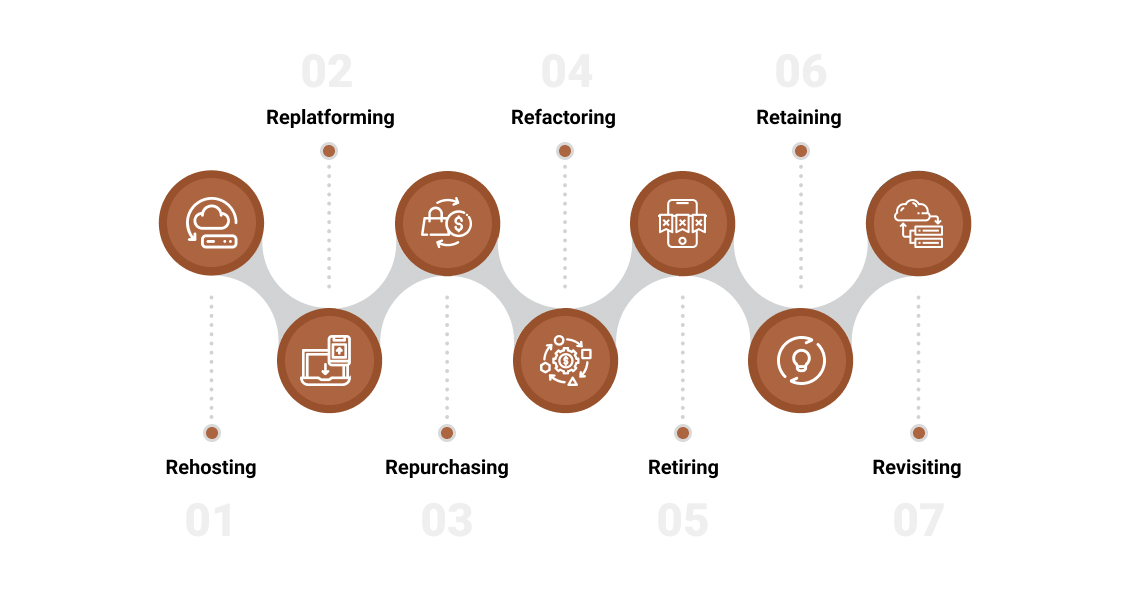
- Rehosting: Move as-is (lift and shift) with minimal changes.
- Replatforming: Make small optimizations (e.g., managed database) without rewriting the app.
- Repurchasing: Replace with a SaaS product instead of running your own software.
- Refactoring (Re-architect): Redesign parts of the app to use cloud-native patterns for scale and resilience.
- Retiring: Decommission what is unused or redundant to reduce complexity and cost.
- Retaining: Keep it where it is for now due to constraints like latency, cost, or compliance.
- Revisiting: Reassess the cloud migration strategy later because prerequisites are missing (architecture, data, contracts, skills, compliance)
How to Calculate the ROI of Cloud Migration?
At the surface level, cloud migration ROI calculation can be done using the following formula:
Cost of Investment or TCO = One-Time Cloud Migration Cost + Total Cloud Run Cost (over a 3-5 year horizon)
Here,
- One-Time Cloud Migration Cost = Planning + Build + Migration execution + Testing + Training + Parallel Run
- Total Cloud Run Cost = Cloud services + Security/Monitoring + Support + Data transfer + Licenses.
Gain from Investment or Total Benefits = Baseline TCO (expected) + Any Quantified Business Uplift
[brief section elaborating the formula]
Here is a quick example.
- Time period: 3-year horizon
- Baseline TCO: $1,200,000 per year
- Cloud run cost: $900,000 per year
- Business uplift from faster releases: $100,000 per year
- One-time migration cost: $600,000
Net Benefits (per year): 1,200,000 + 100,000 − 900,000 = $400,000
3-year benefits = 400,000 × 3 = $1,200,000
Cloud Migration ROI Calculation = (1,200,000 − 600,000) / 600,000 × 100 = 100%
Digging Deeper into Your Cloud Bill: Key Costs
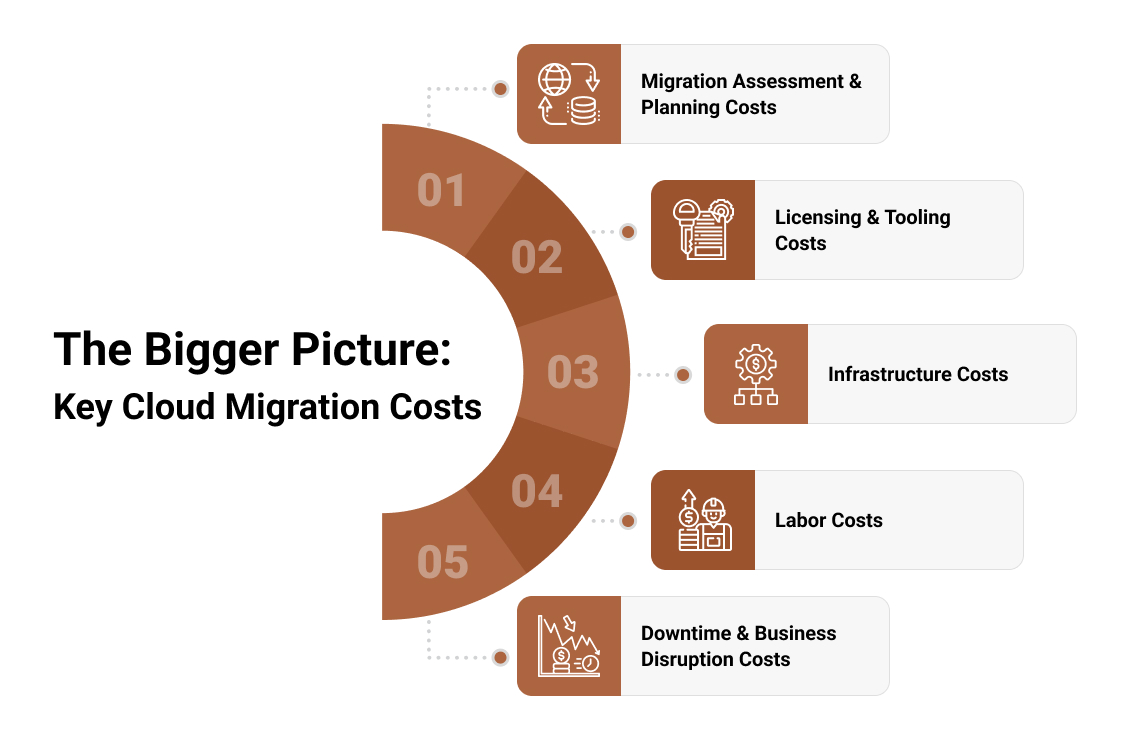
Digging Deeper into Cloud Migration Costs
Cloud ROI calculation fails when your reference point is the monthly cloud bill. The full picture of cloud migration costs includes pre-migration planning, licensing changes, employee effort, and operational risk during cutover.
Migration Assessment and Planning Costs
This is a part of initial cloud computing costs and accounts for the upfront effort that goes into planning the move to avoid surprises later. It covers:
- Workload sizing and application discovery
- Data and compliance review
- Migration strategy selection using the 7Rs
- Cutover plan, DR (data recovery) approach, and rollback strategy
What this cloud migration cost looks like: Cloud consulting, tooling for discovery and mapping, and a migration assessment.
Licensing and Tooling Costs
Migrating to the cloud does not automatically reduce licensing or tooling costs. In fact, if cloud computing costs are not optimized, licensing becomes a key driver of your run rate. These costs include:
- OS and database licensing changes
- Enterprise agreements that continue even after partial migrations
- Monitoring, vulnerability scanning, and configuration management tools
- CI/CD, artifact repositories, and Infrastructure-as-Code (IaC) tools
- FinOps tools to manage cloud computing costs
What this cloud migration cost looks like: Overlapping licensing costs, once for the migration and once for the steady state when you have migrated. Initial overlap is common.
Infrastructure Costs
This is what most teams think of first, but it needs to be modeled as a system, not as a single metric. Infrastructure costs include:
- Compute: VMs, containers, serverless execution
- Storage: block, object, archival, snapshots, backups
- Managed databases and caches
- Networking: load balancers, VPNs, private links, gateways
- Data transfer and egress, inter-region traffic
What this cloud migration cost looks like: over-provisioned instances and always-on resources.
Labor Costs
Labor costs change when you move to the cloud, but they do not disappear. The costs shift from infrastructure maintenance to engineering and governance. After migrating, you pay for:
- Cloud architects and platform engineers
- DevOps engineers
- QA and testing specialists
- Ops people
What this cloud migration cost looks like: Training and productivity, one-time migration labor, and ongoing cloud operations and governance labor.
Downtime and Business Disruption Costs
Even well-planned cloud migrations carry risks that are often overlooked until they manifest as real outcomes.
- Planned downtime during cutovers
- Unplanned outages or performance regression post migration
- Revenue loss from failed checkouts or SLA penalties
- Productivity loss for internal users
- Remediation costs if rollback is required
What this cloud migration cost looks like: Downtime hours × average revenue per hour (or productivity cost per hour).
The Flip Side: Benefits of Cloud Migration
Long-term cost savings, operational efficiency and speed, easier innovation, scalability, and better mobility.
How Exponential Value is Created in the Long-Term?
Migrating to the cloud offers several benefits: improved operational efficiency, faster speed, greater scalability, greater mobility, and cost savings. But the true ROI of cloud migration is realized through the exponential value it creates over the long term.
Look at the graph presented below: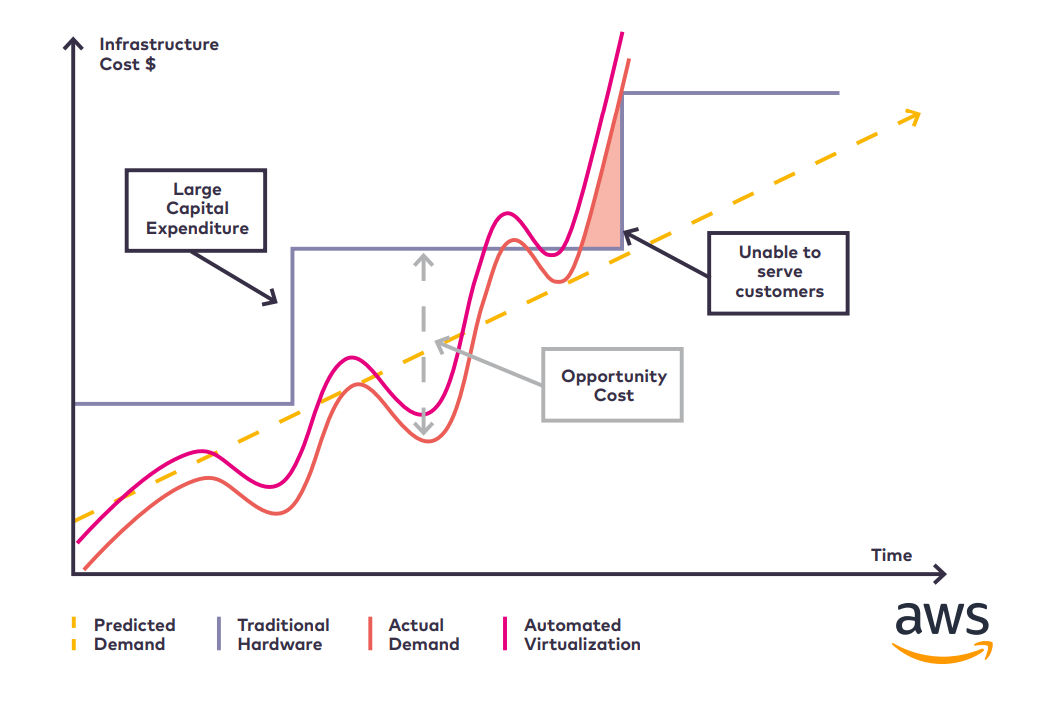
Here, long-term value is generated (and accelerated) in the following manner:
- Large CapEx is needed every few years to sustain growth. As a result, the most seasoned resources spend 70% of their time on server patching, hardware management, and infrastructure provisioning. The vertical, grey bars depict the same. Note the difference between the predicted demand and the grey threshold — it increases after each refresh cycle, even if the seasonal demand slumps.
- Cloud migration automates this by scaling cloud services on demand and flexibly adjusting resources as needed. This bridges the gap between predicted demand and automated provisioning.
How to Evaluate the True ROI of Cloud Migration?
Phase 1: Define the Baseline
Before assessing cloud migration ROI, determine the cost of your current on-premises environment.
Direct Costs: Hardware lease/purchase, power consumption, cooling, and physical data center real estate.
Operational Costs: Man-hours spent on server maintenance, patching, and emergency troubleshooting.
The "Shadow" Costs: The cost of downtime and the "opportunity cost" of projects delayed due to a lack of infrastructure.
Phase 2: Project the After State
Model your target cloud environment, accounting for both the migration period and ongoing operations.
- Migration Investment: Include refactoring costs (rewriting code for the cloud), data transfer fees, and staff training.
- Cloud Consumption: Estimate monthly spend based on reserved instances vs. on-demand usage.
- Efficiency Gains: Project the reduction in "maintenance toil" and the increase in deployment frequency.
Phase 3: Crunch the Numbers and Analyze
Compare the financial metrics.
- TCO (Total Cost of Ownership): Model 3-5-year cost of the baseline vs. the cloud.
- Payback: Forecast how long until the operational savings outweigh the initial cloud migration costs.
- Value Addition: Calculate the projected revenue growth made possible by faster time-to-market.
Phase 4: Build a Business Case for Cloud Migration Cost vs. Benefit
If the after state outperforms the baseline, synthesize the cloud migration cost-benefit data into a stakeholder narrative. Show how shifting from CapEx (heavy upfront investment on on-premises infrastructure) to OpEx (pay-as-you-go on the cloud) reduces expenditure. Take it a step further by emphasizing that migration isn’t limited to cloud cost savings; it’s about long-term growth.
Common Mistakes in Cloud ROI Evaluation and How to Avoid Them?
Despite proper planning, many cloud migration strategies fail to deliver the projected ROI because they treat migration as a hardware swap. But, cloud spend can also skyrocket, even with increased efficiency, if not optimized.
|
Common Cloud Migration ROI Calculation Mistakes |
Why is This a Mistake? |
Solutions |
|---|---|---|
|
Direct Hardware-to-Cloud Price Comparison |
Comparing the monthly cloud invoice solely to the purchase price of a server misses the TCO, which also includes electricity, cooling, floor space, physical security, and hardware insurance. |
Account for the hidden 20-30% of IT overhead that goes into maintaining physical hardware. |
|
Excluding Parallel Run Costs |
Assuming costs switch from on-premise to cloud overnight traps organizations in the ‘migration bubble,’ a setup where they run both environments for about 6-12 months of testing and cutover. |
Budget for a temporary increase in total IT spend during the transition phase. |
|
Omitting Data Egress and API Fees |
Focusing only on compute and storage costs while assuming data movement is free, when the reality is different. Even cloud services charge data egress and API fees, with high-traffic apps accounting for 10-15% of the total monthly bill. |
Map out data traffic patterns and third-party integrations to estimate monthly transfer volumes. |
|
Ignoring Developer Velocity and Downtime Costs |
Measuring only "cost out" rather than "revenue in" underscores the impact. Benefits of reduced deployment cycles from weeks to hours or a $500K worth of hourly downtime costs > savings on hardware. |
Quantify the dollar value of Time-to-Market and Service Availability as part of the total ROI. |
The Takeaway
As cloud computing reaches universal adoption, the conversation has moved from “why migrate” to “how to optimize.” Even with global adoption, most organizations still fail in their cloud migration projects. They treat migrations as the end goal when they should be seen as the starting line for future-proof operations and continuous business growth.
Realizing true ROI requires them to move beyond simply matching surface-level cloud migration cost vs. benefits and embracing its compounding potential. The greatest cloud investment return isn’t found in a lower server bill, but in the ability to pivot at the speed of the market.
Frequently Asked Questions
What is the formula for ROI in cloud migration cost vs. benefit analysis?
Cloud migration ROI is calculated using the following formula over 3-5 years.
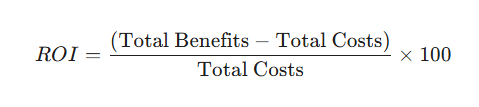
Where:
- Total Benefits: The sum of infrastructure savings, avoided capital expenses (CapEx), and revenue gains from faster feature releases.
- Total Costs: The sum of migration execution, cloud consumption fees, and staff training.
How to calculate cloud migration costs?
Start by categorizing expenses into three categories: preparation and planning, migration, and ongoing execution.
- Preparation and Planning Costs: Readiness assessment, architecture design, PoC, security audits, and cloud consulting fees.
- Migration: Modernization or refactoring, data egress, tooling, parallel run, and testing and QA costs.
- Ongoing Execution: Cloud resources, managed support, FinOps and governance tools, security ops, and continuous training.
Why is it usually hard to calculate the benefits in cloud ROI calculation?
It is difficult to quantify cloud ROI benefits, as they are often intangible compared to explicit cost line items.
- Agility: How would you put a dollar value on a developer deploying a feature in 2 hours instead of 2 weeks?
- Avoided Risk: How would you calculate the "profit" of a system crash that didn't happen because of cloud redundancy?
With cloud migration, much of the savings come from shorter timelines, greater speed, and reduced hassle — all of which are absorbed into other tasks rather than appearing as cloud cost savings.
Opinions expressed by DZone contributors are their own.
Comments