

The Human Bottleneck in DevOps Automating Knowledge with AIOps and SECI
DevOps pipelines are often automated, yet operations side remains surprisingly manual. Here’s a framework to reduce toil using AIOps and the SECI model.
 ·
·
Join the DZone community and get the full member experience.
Join For FreeIn modern IT operations (ITOps), we face a paradox: our infrastructure is dynamic, scalable, and cloud-native, but our operational processes are often static, manual, and dependent on a few hero engineers.
When an incident occurs, the mean time to recovery (MTTR) often depends less on the technology stack and more on who is on call. If the expert is unavailable, the system stays down. This is the knowledge bottleneck.
Based on recent research into efficiency management, this article proposes a dual-layer solution: AIOps to automate the known knowns and the SECI model to democratize the known unknowns.
The Problem: The “Hero” Dependency
Analyzing typical operational failures reveals a recurring pattern:
- Alert fatigue: Thousands of alerts flood the dashboard.
- Manual triage: Operators manually log in to inspect logs.
- Knowledge silos: The fix requires “tribal knowledge” held by senior engineers.
This results in high operational costs and slow recovery times. To address this, we must treat knowledge as code and operations as data.
Layer 1: AIOps for Automation
AIOps (Artificial Intelligence for IT Operations) is not just a buzzword; it is a practical mechanism for applying machine learning to massive streams of operational data.
Research indicates that AIOps delivers the highest ROI in three key areas:
- Intelligent alerting: Instead of 100 separate alerts for “CPU High,” “Latency High,” and “Pod Crash,” AIOps correlates them into a single incident linked to a root cause (e.g., “Database Lock”).
Impact: Reduces triage noise by up to 90%. - Root cause analysis (RCA): Automatically identifying the “patient zero” service.
- Auto-remediation: Executing scripts for known issues (e.g., restarting a stuck service).
Implementation Strategy
Do not attempt to automate everything at once. Start with the low-hanging fruit.
- Phase 1: Log aggregation – Centralize logs (ELK, Splunk) to feed the AI.
- Phase 2: Alert correlation – Use clustering algorithms to group related events.
- Phase 3: Remediation – Connect the AIOps engine to Ansible or Kubernetes Operators to trigger fixes.
Layer 2: The SECI Model for Human Knowledge
Automation cannot solve every problem. Complex, novel incidents still require human intuition. The challenge is that this intuition is often locked in a senior engineer’s head as tacit knowledge.
The SECI model (Socialization, Externalization, Combination, Internalization) provides a structured way to convert this tacit knowledge into explicit, shareable assets.
The SECI Cycle in DevOps
Socialization (Tacit → Tacit)
Old way: Shadowing a senior engineer.
New way: Weekly “war room” reviews. Instead of a formal meeting, hold a brainstorming session where junior and senior engineers discuss difficult tickets from the past week. Record these sessions.
Externalization (Tacit → Explicit)
The hack: Don’t ask engineers to write documentation. Ask them to record a five-minute video explaining how they fixed an issue.
Use speech-to-text to index these videos. This converts “gut feeling” into searchable knowledge.
Combination (Explicit → Explicit)
Combine these artifacts into a knowledge graph or structured runbooks (e.g., in Confluence or a Git repository). Group incidents by service or error type.
Internalization (Explicit → Tacit)
Junior engineers review runbooks and videos before going on call. They simulate fixes in a sandbox environment, building their own intuition over time
The Combined Architecture
By integrating AIOps and SECI, we create a self-reinforcing loop:
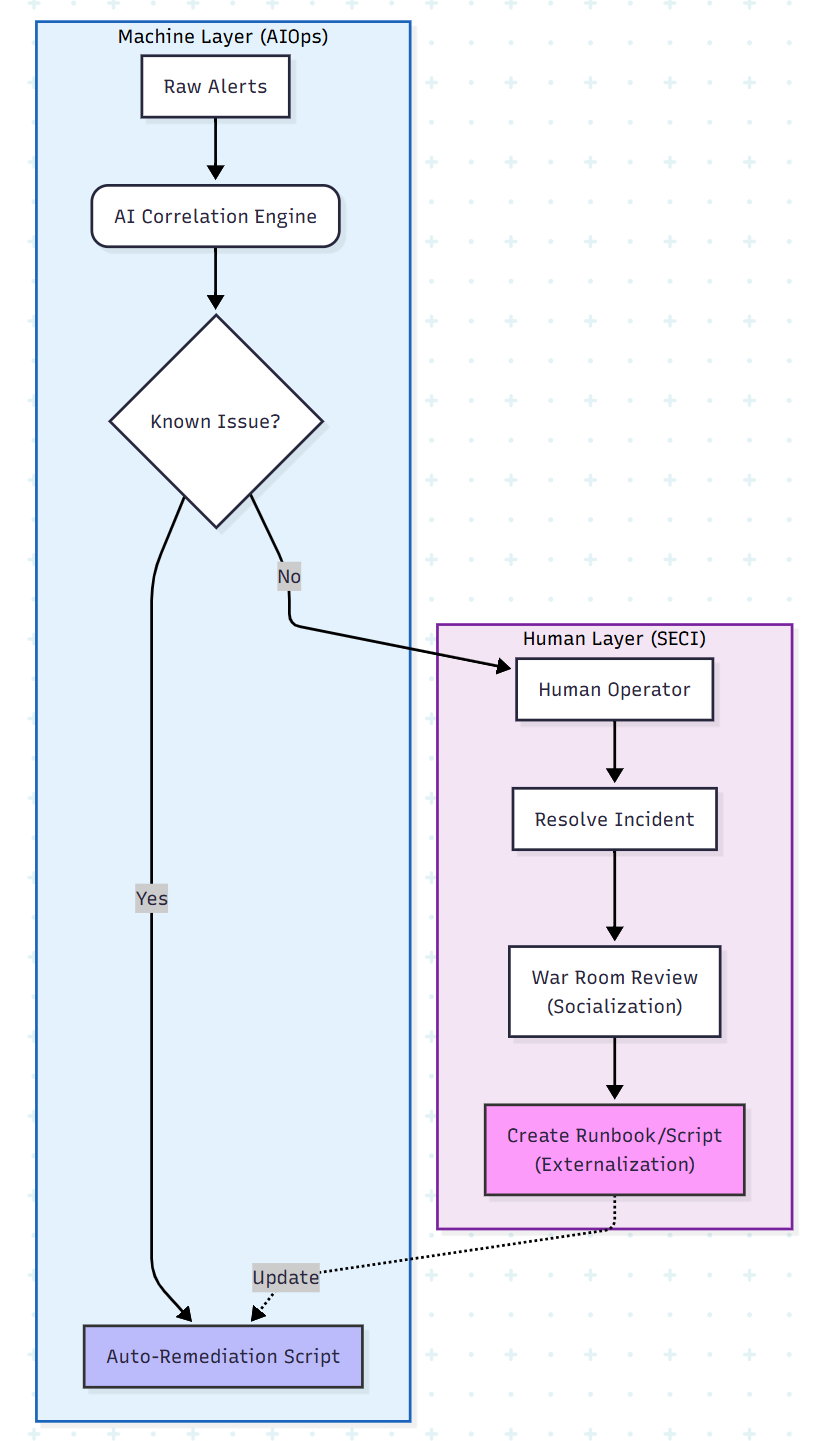
- AIOps handles repetitive noise.
- Humans handle novel issues.
- SECI ensures that once a novel issue is solved, it is documented and eventually converted into an auto-remediation script — feeding improvements back into the machine layer.
Results: Efficiency Metrics
Implementing this dual approach yields measurable improvements:
- 90% reduction in triage time: AIOps filters noise, allowing engineers to focus on real incidents.
- Knowledge redundancy: By systematically externalizing knowledge, the organization is no longer dependent on a single “hero.”
- Cost optimization: Junior engineers resolve complex incidents using shared knowledge, while senior engineers focus on architecture and innovation.
Conclusion
Operational efficiency is not just about better tools — it is about better knowledge management. By using AIOps to manage data and the SECI model to manage human expertise, organizations can build resilient, self-healing IT operations that grow smarter with every incident.
Published at DZone with permission of Soiure Coure. See the original article here.
Opinions expressed by DZone contributors are their own.
Comments